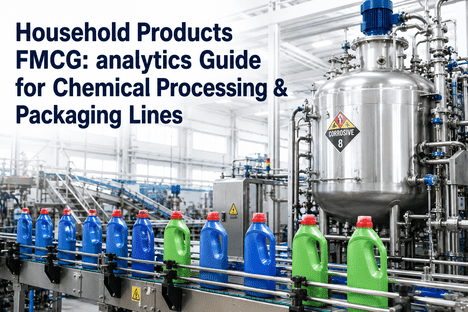
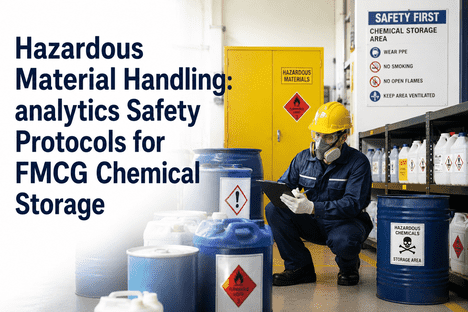
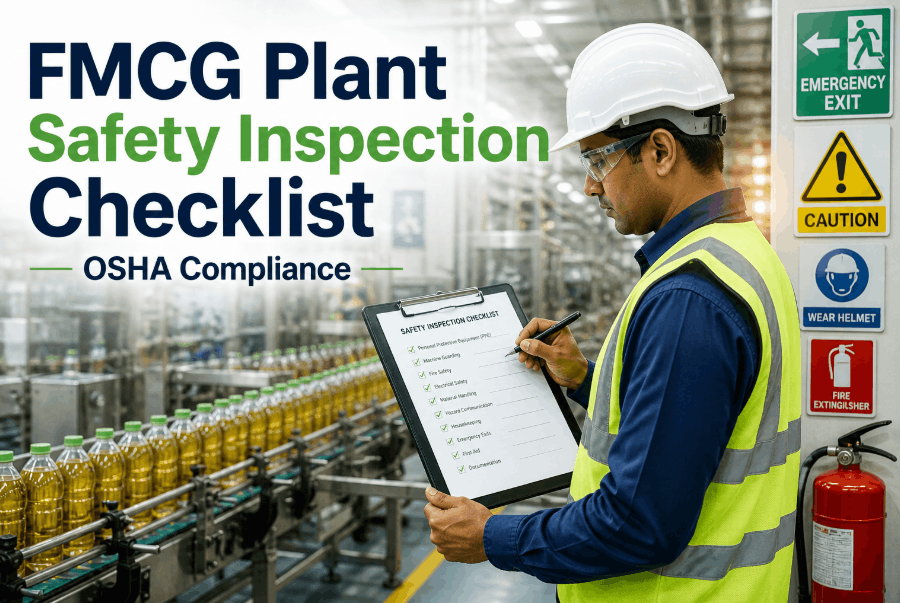
In FMCG manufacturing facilities, cleaning agents, sanitizers, and process chemicals are used daily across production lines, CIP systems, and sanitation stations. Workers handling concentrated acids, caustic soda, chlorine-based sanitizers, quaternary ammonium compounds, peroxides, and solvent-based adhesives face real risks of chemical splash to eyes and skin, inhalation of vapors and mists, and skin contact during mixing, dilution, transfer, and application. Traditional HazCom programs rely on Safety Data Sheets, container labeling, and periodic training but without continuous monitoring, a cross-contamination event between an acid and a hypochlorite in a drain line, a vapor release from an overheated cleaning solution, or an unauthorized chemical mixture in a spray bottle can go undetected until a worker is injured. iFactory AI provides continuous chemical exposure monitoring via AI vision for container and label compliance, IoT sensor networks for vapor and spill detection, and Shift Logbook integration for HazCom audit trails, SDS access, and incident documentation across the entire chemical handling lifecycle. Book a Demo to see how iFactory addresses chemical handling safety compliance in FMCG manufacturing environments.
Chemical Handling · HazCom · GHS · AI Exposure Monitoring
Your Workers Handle Hazardous Chemicals Every Shift. Your HazCom Program Relies on Paper SDS Binders and Annual Training. That Gap Creates Real Exposure Risk.
AI-powered chemical handling safety for FMCG facilities continuous vapor monitoring, AI vision container compliance, GHS/HazCom audit automation, and real-time exposure alerting that closes the gap between periodic training and real-time chemical hazard conditions.
38%
Of all recordable illnesses in FMCG manufacturing involve chemical exposure — skin contact, inhalation, or chemical burns from cleaning agents and process chemicals
#2
Hazard communication violations rank as the second most frequently cited OSHA standard across food manufacturing facilities nationwide
60%
Of chemical exposure incidents in FMCG involve cleaning and sanitizing agents — the most frequently handled hazardous chemicals on the production floor
$15,625
Maximum OSHA penalty per serious violation — HazCom and chemical safety citations routinely reach this threshold for inadequate labeling or SDS access
The Four Key Chemical Exposure Risks in FMCG Manufacturing
Every FMCG facility uses a distinct chemical portfolio shaped by its product types, cleaning protocols, water chemistry, and packaging requirements. The hazards fall into four categories that collectively determine the scope of HazCom program requirements under 29 CFR 1910.1200 and GHS Revision 7 classification standards. Each presents a distinct monitoring challenge that traditional SDS binders and annual training cannot address in real time.
The Four Chemical Exposure Categories — What Every FMCG EHS Manager Must Monitor and Why Traditional Methods Miss the Critical Moments
Category 01
Cleaning & Sanitizing Agents CIP Chemicals, Foam Cleaners, and Sanitizers
The Exposure Reality
CIP systems use concentrated acids (nitric, phosphoric), caustic soda (sodium hydroxide), and oxidizing sanitizers (peracetic acid, chlorine dioxide) at elevated temperatures. Workers at chemical mixing stations face splash risks during drum transfers, hose connections, and concentrate refills. Foam cleaning operators risk inhalation of alkaline mists and aerosolized sanitizers. The interval between a chemical transfer line failure and worker exposure is measured in seconds — significantly faster than the response time of any paper-based HazCom program.
How AI Changes This
AI vision cameras at chemical mixing stations monitor PPE compliance — are operators wearing acid-resistant gloves, face shields, and chemical aprons during concentrate handling? IoT vapor sensors detect airborne acid or caustic concentrations above PEL and trigger immediate evacuation and ventilation alerts. Electronic flow and pressure monitoring on CIP chemical feed lines detects leaks or over-pressurization within seconds, shutting down the chemical feed before a line rupture exposes workers.
FMCG facilities using AI chemical monitoring reduce cleaning-agent related exposure incidents by 55–70% within the first six months, according to industry safety program data from food and beverage manufacturing sites.
Category 02
Process Chemicals pH Adjusters, Preservatives, and Adhesives
The Exposure Reality
Beverage plants handle phosphoric acid for pH adjustment, preservative dosing systems for sodium benzoate and potassium sorbate, and CO2 for carbonation. Food processing facilities use solvent-based adhesives for packaging, release agents for baking lines, and brine solutions for cheese and meat processing. Each presents distinct exposure pathways — acid splash during tank top-ups, solvent vapor inhalation near adhesive application stations, and skin contact during manual preservative batching.
How AI Changes This
Continuous vapor monitoring arrays at process chemical dosing stations detect solvent VOCs and acid mists at concentrations below OSHA PEL, providing early warning before airborne concentrations reach hazardous levels. AI vision systems verify that chemical containers are properly labeled with GHS pictograms and that secondary containers used for daily dispensing carry correct product identification and hazard warnings.
Category 03
Incompatible Chemical Mixtures Reactive Hazard Prevention
The Exposure Reality
FMCG facilities store and use multiple chemical families in proximity — acids and oxidizers, caustics and chlorine-based sanitizers, solvents and peroxides. An acid accidentally mixed with sodium hypochlorite in a drain line or waste container generates chlorine gas. A peroxide contaminated with organic material can ignite. These reactive hazards are addressed in SDS Section 10 (Stability and Reactivity), but on a busy production floor, incompatible chemicals frequently end up in the same waste stream or secondary container.
How AI Changes This
AI vision systems read container labels and GHS pictograms at waste collection points and chemical storage areas. When a container with an oxidizer pictogram is placed in a waste bin containing organic materials, or an acid container is detected near a hypochlorite storage area, the system generates an immediate alert with location, container identity, and the specific incompatibility risk. The Shift Logbook captures the event for EHS review and corrective action tracking.
Category 04
Vapor & Inhalation Exposure Chronic Health Risk Monitoring
The Exposure Reality
Chronic low-level exposure to chemical vapors — solvent VOCs from adhesive stations, acid mists from CIP systems, ammonia from refrigeration systems — presents a health risk that accumulates over months and years rather than causing acute symptoms. OSHA PELs and ACGIH TLVs define permissible exposure limits, but without continuous personal or area monitoring, employers cannot verify that workers in chemical handling zones remain below these thresholds throughout their shift.
How AI Changes This
iFactory deploys area vapor monitoring sensors that continuously measure VOC, acid gas, and ammonia concentrations in chemical handling zones. Data is logged every 60 seconds and compared against OSHA PEL and STEL thresholds. When cumulative exposure trends indicate a potential PEL exceedance over an 8-hour work shift, the system alerts the EHS manager and recommends additional engineering controls — increased ventilation, respiratory protection requirements, or process changes to reduce vapor generation.
The True Cost of Chemical Safety Gaps Why Inadequate Monitoring Costs More Than the Solution
The cost of chemical handling noncompliance extends far beyond the OSHA fine. A single chemical splash injury requiring emergency room treatment triggers an OSHA recordable, a workers' compensation claim averaging $22,000 for chemical burn cases, a potential OSHA inspection that reviews the entire HazCom program, and the indirect cost of production interruption while the incident is investigated. For facilities with multiple chemical exposure incidents, workers' compensation premiums can increase by 15–25% annually. The gap between paper-based HazCom compliance and real-time chemical safety monitoring is measured in worker injury risk, regulatory exposure, and operational continuity.
Paper-Based HazCom Cost Profile
Annual HazCom training (all shifts)
$12,000 / year
SDS binder maintenance & updates
$3,600 / year
Chemical exposure incident avg cost
$22,000 - 47,000 / event
OSHA HazCom citation (avg penalty)
$8,400 - 15,625 / citation
AI Chemical Safety Monitoring Cost Profile
AI vapor & container monitoring (20+ zones)
$9,600 / year
Digital HazCom & GHS audit automation
$1,800 / year
Exposure incident cost with early detection
$0 with AI prevention
OSHA citation cost avoided
$0 with continuous compliance
Net annual savings: $24,000+ for a typical FMCG facility
How iFactory's AI Chemical Safety Platform Protects FMCG Workers
The transition from paper-based HazCom compliance to continuous AI-driven chemical safety monitoring does not require replacing your existing SDS system, chemical inventory platform, or training program. iFactory overlays an AI safety intelligence layer on the chemical handling infrastructure already in place — reading container labels via existing security cameras, deploying targeted vapor sensors in high-risk zones, and generating the predictive alerts and compliance documentation that transform chemical safety management from reactive to proactive.
Capability 01
AI Vision Container & Label Compliance — Real-Time GHS/HazCom Verification
Automated GHS Compliance
iFactory AI vision models analyze camera feeds at chemical storage areas, mixing stations, and waste collection points to verify that every chemical container carries the correct GHS label with required pictograms, signal words, hazard statements, and precautionary statements. When an unlabeled secondary container is detected, a container with faded or missing pictograms is identified, or a container is stored in an incompatible location, the system generates an immediate alert and captures photographic evidence for the HazCom audit trail. The Shift Logbook records each label compliance event — container identity, location, detected deficiency, corrective action taken — creating a continuous compliance record that demonstrates the facility's HazCom program is actively enforced between annual audits. Book a Demo to see iFactory's AI container label compliance monitoring for FMCG chemical handling areas.
Real-time GHS pictogram detection
Unlabeled container identification
Continuous HazCom audit trail
Capability 02
Continuous Vapor & Airborne Chemical Monitoring — PEL and STEL Compliance
Exposure Limit Monitoring
iFactory deploys area monitoring sensors for VOC, acid gas, chlorine, ammonia, and hydrogen peroxide at chemical mixing stations, CIP chemical storage, adhesive application lines, and sanitation chemical preparation areas. Sensors log airborne concentrations at 60-second intervals and compare readings against OSHA PEL, STEL, and ACGIH TLV thresholds. When any reading exceeds 50% of the PEL, the system generates a precautionary alert. At 80% of PEL, the system escalates to a warning with recommendation for ventilation verification and respiratory protection review. At PEL exceedance, the system triggers an immediate evacuation alert for the affected zone and documents the event for OSHA recordkeeping. Cumulative exposure tracking over 8-hour and 40-hour work periods identifies chronic exposure trends that would be invisible to grab-sample or badge-based monitoring methods.
60-second VOC monitoring intervals
Three-tier PEL alert escalation
8-hr cumulative exposure tracking
Capability 03
Chemical Spill & Leak Detection Instant Alerting & Containment Verification
Spill Prevention Intelligence
Chemical spills during drum transfers, dripping hose connections, and leaking pump seals are the most common source of chemical exposure incidents in FMCG facilities. iFactory integrates with chemical-compatible liquid sensors deployed in secondary containment areas, drip trays, and chemical pump skids. When a sensor detects liquid in a containment area, the system identifies the chemical based on the sensor location and stored product identity, assesses the spill volume from sensor activation duration, and generates a tiered alert: Level 1 (small spill contained in secondary containment — EHS notification only), Level 2 (spread beyond containment — evacuation of adjacent zone and spill team dispatch), Level 3 (potential drain or environmental release — regulatory notification requirement). The Shift Logbook captures the full spill event timeline for EPA or state environmental agency reporting.
Instant liquid detection in containment
Three-tier severity escalation
Automated regulatory documentation
Capability 04
Digital HazCom Program Management SDS Access, Training Records & Audit Documentation
HazCom Program Automation
The OSHA Hazard Communication Standard requires employers to maintain a written HazCom program, a current inventory of hazardous chemicals, accessible SDS for every chemical, and documented training for all exposed workers. iFactory's digital HazCom module centralizes these requirements into a single compliance dashboard with QR-code SDS access at every chemical handling location, automated training tracking linked to chemical inventory changes, electronic HazCom program documentation with version control, and audit-ready compliance reports that demonstrate each element of 29 CFR 1910.1200 is actively maintained. When a new chemical is added to inventory or an SDS is updated, the system automatically notifies affected workers and schedules required training updates — eliminating the gap between chemical change and worker notification that paper-based systems routinely miss.
QR-code SDS access at each station
Automated training tracking & alerts
Audit-ready HazCom documentation
Your Chemical Handling Areas Generate Continuous Exposure Risk. Your HazCom Program Still Relies on Annual Audits. iFactory Closes the Gap.
AI vision container compliance, continuous vapor monitoring, instant spill detection, and digital HazCom program management — built from the cameras and sensors your facility already has, without replacing your chemical inventory or SDS system.
How the Platform Adapts to Different FMCG Chemical Profiles
Every FMCG facility has a distinct chemical handling profile shaped by its product type, cleaning protocols, packaging materials, and regulatory framework. A dairy processing plant using nitric acid and peracetic acid for CIP sanitation faces different exposure risks than a snack food facility using solvent-based adhesives and release agents. iFactory's AI models and sensor configurations are adapted to each facility's specific chemical inventory — the platform does not apply generic algorithms but learns the unique chemical exposure patterns of the production environment it monitors.
FMCG Sub-Sector — Chemical Handling Risk Profile and iFactory Configuration
Sub-Sector
Highest Chemical Exposure Risks
iFactory AI Configuration
Beverage & Bottling
CIP acid/caustic exposure, CO2 asphyxiation risk, caustic soda splash during tank cleaning, phosphoric acid handling for pH adjustment
CIP chemical zone vapor monitoring, AI vision PPE compliance at mixing stations, CO2 area monitoring in filling halls, acid splash sensor arrays
Dairy & Ice Cream
Nitric acid CIP burns, peracetic acid vapor inhalation, ammonia refrigeration exposure, caustic soda handling for wash cycles
Acid mist monitoring in CIP rooms, ammonia detection in refrigeration areas, AI container label checks at chemical storage, digital HazCom SDS access at each station
Snack & Bakery
Solvent-based adhesive VOC exposure, release agent inhalation, sanitizer quat handling, oven cleaning caustic exposure
VOC monitoring at adhesive application stations, release agent mist detection, continuous quat sanitizer area monitoring, PPE compliance vision verification
Meat, Poultry & Seafood
Chlorine-based sanitizer gas release, peracetic acid mist, ammonia refrigeration, quat sanitizer skin exposure during hand-dipping stations
Chlorine gas detection in processing rooms, peracetic acid vapor monitoring, ammonia area sensors, quat concentration verification at dip stations
We operate a beverage bottling plant with 12 CIP circuits, three chemical mixing stations, and a CO2 filling hall. For eight years our HazCom strategy was paper binders at each station and annual training sessions. We had two chemical splash incidents in 2024 — one required surgery for corneal damage from caustic soda. The OSHA inspection that followed cited us for inadequate HazCom training documentation and missing SDS at two mixing stations. With iFactory's AI container monitoring and vapor detection, we now verify label compliance in real time across all chemical zones. Our vapor sensors detected a peracetic acid line pinhole leak at 7:00 AM — before the first shift started — and we repaired it with zero worker exposure. The platform paid for itself in that single prevented incident.
— EHS Manager, Regional Beverage Bottling — 3 Plants, 14 Years FMCG Experience
PPE Compliance Monitoring AI Vision Verification for Chemical Handling Zones
PPE requirements for chemical handling are specified in each SDS Section 8 (Exposure Controls/Personal Protection) and enforced through facility-specific PPE matrices. But verifying that every worker entering a chemical handling zone is wearing the correct PPE — chemical splash goggles, acid-resistant gloves, face shield for concentrate handling, chemical apron — is impractical with manual observation. iFactory AI vision models analyze camera feeds at chemical zone entry points and workstations to detect PPE compliance in real time. When a worker enters a caustic mixing area without a face shield, or approaches a sanitizer dilution station without chemical gloves, the system generates a real-time alert with worker image and location. The Shift Logbook records each PPE deviation for trend analysis by shift, zone, and individual worker, enabling targeted retraining and progressive corrective action without requiring full-time safety observers at every chemical station.
Conclusion
The gap between annual HazCom training and real-time chemical exposure risk is not a training problem. It is a monitoring problem. Every shift that passes without continuous vapor monitoring, every chemical station with unverified container labels, every PPE deviation that goes undetected, and every incompatible chemical storage arrangement that escapes the annual audit represents an exposure window during which a chemical splash, vapor release, or reactive hazard event can injure a worker and trigger regulatory consequences that far exceed the cost of continuous monitoring.
AI-powered chemical handling safety does not replace HazCom training or SDS access. It transforms the facility's relationship with chemical risk from periodic compliance verification to continuous exposure prevention. When every chemical container label is verified by AI vision between shifts, every vapor concentration is tracked against PEL thresholds in real time, every spill is detected at the instant of release, and every PPE deviation is captured and corrected before exposure occurs, the EHS manager's relationship with chemical safety changes. The annual HazCom audit stops defining the safety program. The continuous monitoring data starts driving the safety strategy.
iFactory's AI chemical safety platform gives FMCG EHS managers the continuous container label compliance, vapor exposure monitoring, spill detection, and digital HazCom program management that closes the gap between periodic training and real-time chemical handling conditions. Book a demo to see how iFactory maps to your facility's chemical handling zones and chemical inventory, or talk to an expert about your current HazCom program and the fastest path to continuous AI-driven chemical safety compliance.
Frequently Asked Questions
Your Chemical Handling Zones Generate Continuous Risk. Your HazCom Program Still Operates on an Annual Audit Cycle. iFactory Closes That Gap.
AI vision container label compliance, continuous vapor and PEL monitoring, instant spill detection, and digital HazCom program management — working with the cameras and infrastructure you already have, deployed without replacing your existing chemical inventory management system.