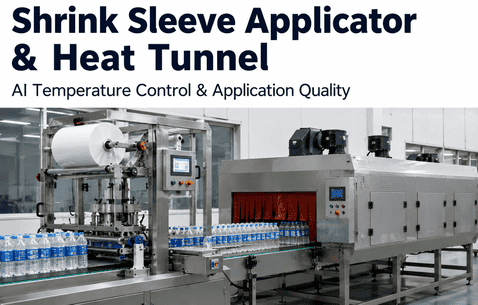
Shrink Sleeve Applicator & Heat Tunnel AI Temperature Control & Application Quality
By Seren on June 22, 2026
A high-speed packaging line running shrink sleeves at 400 bottles per minute generates more than 576,000 individual sleeve applications every shift. Each one depends on a precise sequence of mechanical positioning, steam or hot air temperature profiling, and film contraction dynamics that must complete within a two-second window inside the heat tunnel. When the applicator timing drifts by three milliseconds, the sleeve shifts 1.2 millimetres off register. When a steam nozzle accumulates mineral deposits, the temperature gradient across the container surface shifts by six degrees Celsius, and the sleeve develops a wrinkle that triggers a reject. When the IR emitter array in an electric tunnel loses two elements out of forty-eight, the energy density drops below the shrinkage threshold on one face of the container, and the sleeve leaves the tunnel partially shrunk. For the Maintenance Manager accountable for OEE, material waste, and line throughput, the shrink sleeve applicator and heat tunnel represent a convergence of mechanical, thermal, and material variables that generate more than thirty percent of all packaging-line quality deviations. iFactory brings AI-driven temperature profiling, real-time application quality monitoring, and predictive maintenance to this critical zone — turning the heat tunnel from a black box into a managed thermal process.
Shrink Sleeve Quality · Heat Tunnel AI · Temperature Profiling · Predictive Maintenance
576,000 Sleeves per Shift. 30% of Quality Deviations Trace Back to the Heat Tunnel. iFactory Brings Thermal Process Control to Packaging.
iFactory's Packaging Line AI platform gives Maintenance Managers the tools to monitor shrink sleeve applicator performance, heat tunnel temperature profiles, and application quality in real time — with automated alerts, predictive maintenance triggers, and decision-ready dashboards that connect sleeve quality data directly to maintenance action.
The Shrink Sleeve Application Process — Where Quality Is Made and Where It Is Lost
Every shrink sleeve application depends on a four-stage process. When each stage performs correctly, the line produces sleeves that are register-accurate, wrinkle-free, and fully shrunk at the rated line speed. When any stage degrades, the entire output becomes unpredictable. The Maintenance Manager who understands this process controls the quality of every sleeve leaving the tunnel.
Stage 1
Sleeve Application
The mandrel places the rolled sleeve onto the container at the correct vertical position. Mechanical rollers and vacuum hold the sleeve in place during transfer.
Failure risk: Misregistration >1.5mm
iFactory: Real-time placement accuracy tracking
Stage 2
Pre-Heat Zone
Containers enter the tunnel and pass through the pre-heat section. Steam or IR emitters raise the sleeve temperature to the glass transition point of the film material.
Failure risk: Zone temperature drift >5°C
iFactory: Per-zone temperature profiling
Stage 3
Shrink Tunnel
The sleeve passes through the main shrink zone where controlled heat causes the film to contract uniformly around the container profile.
Failure risk: Wrinkling & incomplete shrink
iFactory: AI defect detection per container
Stage 4
Cooling & Inspection
Containers exit the tunnel and pass through a cooling section. Vision inspection systems verify sleeve position, shrinkage quality, and surface defects.
Failure risk: Post-shrink relaxation defects
iFactory: Quality KPI dashboards & alerts
30%
Of packaging-line quality deviations originate at the shrink sleeve applicator or heat tunnel — the single largest defect source in container decoration
6°C
Temperature gradient shift caused by steam nozzle fouling — enough to produce visible wrinkling on PET-G and PVC sleeve materials at line speed
3ms
Timing drift in the applicator mandrel that causes 1.2mm of sleeve misregistration — enough to push a registered graphic outside the acceptable tolerance window
400
Bottles per minute on a high-speed line — each with a two-second shrink window. A thermal deviation of 3 seconds means 10 rejected containers before the operator reacts.
The Three Failure Modes That Undermine Sleeve Quality — and How AI Closes Each One
The gap between a properly tuned shrink sleeve line and a line producing rejects is not a single problem. It is three distinct failure modes — each with its own root cause, quality impact, and solution. The Maintenance Manager who addresses all three builds a shrink sleeve operation that delivers consistent, audit-ready quality at rated line speed.
The Three Sleeve Quality Failure Modes and How iFactory Closes Them
Failure Mode
What Causes It
Quality Impact
iFactory Solution
Misregistration
Applicator mandrel timing drift, worn vacuum ports, container grip misalignment, and film tension variation cause the sleeve to be placed at the wrong vertical or angular position.
Graphics are shifted off the container profile. Brand elements, barcodes, and nutritional panels are misaligned. The container fails retail quality standards and must be rejected or stripped.
Real-time applicator timing monitoring with high-speed camera feedback loop. Automated wear tracking on mandrel rollers and vacuum components. Alerts fire when registration drifts beyond 0.5mm tolerance.
Wrinkling
Uneven temperature distribution across the tunnel cross-section, excessive airflow velocity, steam condensation, or insufficient dwell time in the shrink zone cause non-uniform film contraction.
Visible wrinkles on the sleeve surface degrade shelf appearance. In severe cases, wrinkles create channels that allow the sleeve to lift from the container. The package fails aesthetic and functional quality checks.
Multi-zone temperature monitoring with IR sensor array across the tunnel. AI pattern detection correlates temperature gradients with wrinkle occurrence. Predictive alerts for nozzle fouling and emitter degradation.
Poor Shrinkage
Insufficient energy delivery to the sleeve, line speed exceeding thermal capacity, or film material mismatch with the tunnel temperature profile cause incomplete or non-uniform film contraction.
Sleeves that are loose, baggy, or incompletely shrunk at the shoulders or base. The container fails drop-testing and leak testing. Retailers reject loose-sleeved containers on arrival.
Energy density monitoring per tunnel zone with real-time power consumption tracking. Line speed versus thermal capacity dashboard. Material-specific temperature profile recommendations from the AI model library.
The Waste Reduction That Was Hiding in the Heat Tunnel Temperature Data
A North American beverage contract packer operating five high-speed shrink sleeve lines deployed iFactory's temperature profiling dashboard on three steam tunnels. Within the first 14 days, the platform detected that one tunnel's pre-heat zone was running an average of 8°C below setpoint due to a partially blocked steam valve that had not been identified during routine PM checks. The temperature deviation had been present for an estimated six weeks, during which the line produced 3.2 million sleeves with measurable wrinkling on the trailing edge. The customer had accepted the output with a 4.7 percent price concession. Restoring the setpoint and replacing the valve cost $260. The annualised waste reduction from that single intervention totalled $38,000 in avoided price concessions and reduced material scrappage. The Maintenance Manager deployed the platform across all five lines within the next 30 days.
The Maintenance Manager's Decision Framework — Which Shrink Sleeve AI Capabilities to Deploy and in What Order
Not all shrink sleeve AI capabilities deliver equal value at all stages of line maturity. The Maintenance Manager who sequences deployment correctly builds momentum, confidence, and measurable results at each phase. The manager who attempts to deploy everything at once typically sees none of it adopted. The following framework shows the recommended sequence, the KPI that validates each phase, and the operational decision each phase enables.
Phase 1 · Weeks 1-2
Temperature Profiling First
Deploy multi-zone temperature monitoring across the heat tunnel. Every zone that has deviated more than 3°C from setpoint for more than 15 minutes is flagged automatically. The goal is zone temperature stability within ±2°C across all zones within the first 14 days.
Validation KPI: Zone temp stability ±2°C
Phase 2 · Weeks 3-4
Application Quality Monitoring
Integrate vision inspection data with temperature profiles. Correlate sleeve defects — misregistration, wrinkling, incomplete shrink — with thermal conditions at the time of production. Build the baseline defect-to-temperature relationship.
Validation KPI: Defect-to-temp correlation >85%
Phase 3 · Weeks 5-6
Predictive Maintenance Triggers
Configure risk-based thresholds on applicator wear components, steam nozzle pressure, IR emitter current draw, and conveyor chain tension. Generate work orders automatically when degradation exceeds defined levels.
Validation KPI: Predictive alert accuracy >80%
Phase 4 · Weeks 7-8
Automated Quality Optimization
Enable AI-driven temperature profile adjustment based on sleeve material, container geometry, and line speed. Deploy closed-loop control that maintains optimal shrink quality without operator intervention.
Validation KPI: First-pass yield >99.2%
From Reactive Tunnel Maintenance to Predictive Thermal Management — What Changes for the Maintenance Manager
The packaging industry is transitioning from reactive tunnel maintenance, where the heat tunnel is serviced after a quality failure is detected, to predictive thermal management, where AI monitors every zone and component continuously and generates maintenance triggers before the defect occurs. For the Maintenance Manager, this transition changes what is expected of the shrink sleeve line and what the organisation can demand from its packaging operation.
Reactive Tunnel Maintenance
Operator inspects sleeve quality at the reject station and flags defects
Maintenance is called after a quality threshold is breached
Tunnel temperature checked weekly with handheld thermocouple
Steam nozzles cleaned on a fixed calendar schedule
IR emitter replacement after failure or annual PM
Operational cost: Scrap, rework, price concessions, lost throughput
Predictive Thermal Management
AI detects temperature drift and generates an alert 48 hours before a defect occurs
Maintenance is triggered by predictive models, not quality failures
Continuous multi-zone IR temperature profiling with real-time dashboard
Nozzle condition monitored via pressure drop and flow rate — cleaned on condition
IR emitter current draw monitored — replacement scheduled before failure
Reactive Maintenance Reacts to Rejects. Predictive Thermal Management Prevents Them. iFactory Powers the Shift.
From waiting for quality failures to preventing them — iFactory gives Maintenance Managers the analytics infrastructure to monitor every zone, detect every drift, and act before the sleeve leaves the tunnel. Real-time temperature profiling, AI defect correlation, and predictive maintenance triggers that turn the heat tunnel into a managed thermal process.
The shrink sleeve applicator and heat tunnel represent the most quality-sensitive zone on any container decoration line. With more than 30 percent of packaging defects tracing back to this zone and line speeds pushing past 400 containers per minute, the Maintenance Manager who treats the heat tunnel as a black box is accepting scrap rates, price concessions, and lost throughput that are entirely preventable. The gap between a properly tuned line and one producing rejects is not a technology gap. It is a visibility gap — and it closes when managers deploy the right sequence of capabilities: temperature profiling first, application quality monitoring second, predictive maintenance triggers third, and automated quality optimization fourth. Each phase builds on the one before. Each phase delivers measurable results that fund the next.
iFactory's Packaging Line AI platform gives Maintenance Managers the complete toolkit for this sequence — real-time heat tunnel temperature profiling, application quality monitoring with AI defect detection, predictive maintenance triggers on applicator and tunnel components, and automated quality optimization that maintains first-pass yield at rated line speed. Book a Demo to see how the platform maps to your shrink sleeve line configuration and production targets, or Talk to an Expert to discuss your packaging operation's thermal management maturity pathway.
Frequently Asked Questions
iFactory integrates through standard industrial protocol connectors including OPC-UA, Modbus TCP, and Profinet, supporting the most common tunnel controller platforms from Krones, Sidel, KHS, and AETNA as well as applicator systems from PDC, Trine, B&H, and Fuji Seal. The platform reads temperature zone data, line speed, applicator timing signals, steam pressure, and IR emitter current draw without requiring changes to existing PLC logic or tunnel controller configuration. For lines with vision inspection systems from Cognex, Keyence, or Teledyne Dalsa, iFactory ingests defect data directly to correlate quality outcomes with thermal conditions. Talk to an Expert to discuss your specific applicator and tunnel integration requirements.
The platform monitors temperature at every zone within the tunnel — typically six to twelve zones depending on tunnel length and configuration. For steam tunnels, monitoring points include pre-heat zone temperature, main shrink zone temperature profile across the tunnel cross-section, steam pressure at each nozzle manifold, condensate return temperature, and exhaust air temperature. For IR tunnels, the platform tracks individual emitter zone temperature, emitter current draw per element, and tunnel air temperature profile. For hot-air tunnels, monitoring includes air velocity, heating element temperature, and recirculation air temperature. Each zone is tracked against its setpoint, and the platform generates alerts when any zone deviates beyond the configured tolerance band. Talk to an expert to see the temperature profiling dashboard configured for your specific tunnel type and zone layout.
Yes. iFactory maintains a material profile library that stores the optimal temperature profile for each sleeve material type — PET-G, PVC, OPS, PLA, and MDO-PE. When the line changes over from one material to another, the platform automatically loads the correct temperature profile and monitors each zone against material-specific setpoints. The AI model tracks how well the actual temperature profile matches the material requirement and flags deviations that would produce material-specific defects, such as PET-G whitening from overtemperature or PVC incomplete shrink from undertemperature. The profile library can store multiple profiles per material for different container geometries, line speeds, and ambient conditions. Talk to an Expert to discuss material profile configuration for your specific sleeve film types.
For a multi-line packaging operation with three to ten shrink sleeve lines, the standard four-phase sequence completes within eight weeks. Phase one — temperature profiling — is operational within the first week after tunnel controller connection, with the first zone temperature data visible within hours of pipeline validation. Phase two application quality monitoring activates in weeks three to four after vision inspection data is correlated with temperature profiles. Phase three predictive maintenance triggers begin generating alerts in weeks five to six after sufficient degradation pattern data has accumulated. Phase four automated quality optimization is configured and operational by weeks seven to eight. The first maintenance manager KPI dashboard is typically available for operational review within the first 14 days. Deployment timelines for operations with multiple tunnel types — steam, IR, and hot air — may extend by one to two weeks for additional integration validation. Talk to an expert to build a deployment timeline specific to your line count, tunnel types, and material mix.
576,000 Sleeves per Shift. 30% of Defects Are Preventable. iFactory Exists to Close the Visibility Gap.
The only shrink sleeve analytics platform built for Maintenance Managers — real-time temperature profiling, AI quality monitoring, predictive maintenance triggers, and automated thermal optimization. The intelligence between your heat tunnel and the sleeve quality that protects your brand.