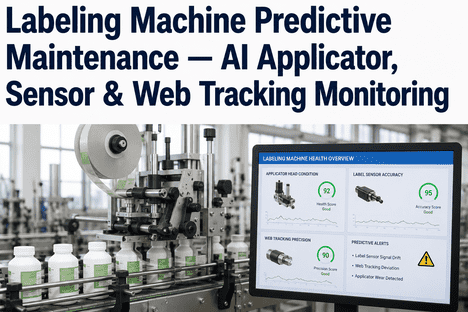
A maintenance manager overseeing packaging lines reviews the shift quality report and sees the pattern: label misplacement on 1.2% of containers from applicator head #4 on the front label station, label sensor drift causing 0.8% missing labels on the back station, and web tracking oscillation on the wrap-around labeler producing 2.3% wrinkled labels across the afternoon shift. Each mislabeling event triggers a line stoppage for manual inspection and correction, consuming 18 to 34 minutes per event and generating 400 to 1,200 units for rework or disposal. Without continuous AI monitoring of applicator head condition, label sensor accuracy, and web tracking precision, mislabeling goes undetected until visual inspection stations or consumer complaints flag the defects — and mislabeling is the number one cause of product recalls in FMCG packaging, accounting for 28% of all recall events according to FDA and USDA recall data. Predictive maintenance powered by AI analysis of applicator pad wear profiles, sensor registration accuracy trends, and web guide position stability catches these failure modes 7–14 days before they produce non-conforming labels. The result is zero-defect labeling with label placement Cpk above 1.67 across all stations and zero recall events from mislabeling. Book a Demo to see how iFactory AI monitors labeling machine health in real time.
Detect Applicator, Sensor & Web Tracking Failures Before They Cause Mislabeling Recalls
iFactory's AI predictive maintenance platform monitors applicator head wear, label sensor registration accuracy, and web guide tracking stability in real time — predicting mislabeling events 7–14 days before they trigger product recalls in FMCG packaging lines.
Why Mislabeling Is the Number One Cause of FMCG Product Recalls
Labeling machines are among the most maintenance-intensive assets on FMCG packaging lines due to the precision required across three interacting subsystems — the applicator head, label sensor, and web tracking mechanism — each with distinct failure modes that produce mislabeling defects. The applicator head applies labels through a combination of vacuum pickup, pad transfer, and wipe-down application. Applicator pad wear, vacuum port clogging, and applicator arm bearing play all cause label placement drift that visual inspection stations may miss until 5–15% of a shift's production is affected. Label sensors — typically photoelectric or ultrasonic — detect label position on the web and trigger the applicator at the correct moment. Sensor sensitivity drift due to dust accumulation, LED aging, or ambient light interference shifts the trigger timing by 2–8 milliseconds, producing labels applied 0.5–3.0 mm off position. Web tracking systems maintain label web tension and lateral position. Web guide bearing wear, tension roller degradation, and dancer arm pivot friction cause web oscillation at 1–3 Hz that produces wrinkled or skewed labels. Each of these failure modes develops gradually over 2–6 million cycles, but conventional maintenance — periodic pad replacement, sensor cleaning, web guide inspection — operates on fixed schedules that miss degradation windows between service intervals. iFactory's AI platform monitors all three subsystems continuously, detecting degradation patterns at the earliest statistically significant deviation and generating predictive alerts that enable maintenance managers to schedule corrective action during planned changeovers rather than responding to recall-triggering mislabeling events. Book a Demo to see how iFactory's AI monitors all three labeling subsystems.
The Three Subsystems That Drive Labeling Machine Reliability
iFactory's AI platform monitors labeling machine health across three critical subsystems. Each subsystem has distinct failure modes, detection parameters, and maintenance response requirements. The platform ingests data from existing applicator controllers, label sensor amplifiers, and web guide position transducers — no additional sensors required on modern labeling machines with digital control interfaces.
Applicator Head Condition Monitoring
Failure Modes: Pad wear (vacuum loss, uneven surface), applicator arm bearing play, vacuum port clogging, wipe-down pad degradation.
Monitored Parameters: Applicator cycle time, vacuum pressure at pad, applicator arm acceleration profile, pad contact force, label release timing.
AI Detection: 8% deviation in applicator cycle time from baseline predicts pad replacement need 10–14 days before placement error exceeds tolerance.
Label Sensor Registration Accuracy
Failure Modes: Photoelectric sensor sensitivity drift, LED aging, lens contamination, ultrasonic sensor frequency shift, ambient light interference.
Monitored Parameters: Sensor signal amplitude, trigger timing jitter, label gap detection consistency, signal-to-noise ratio trend.
AI Detection: 5% signal-to-noise ratio degradation predicts sensor accuracy failure 7–12 days before label position drift exceeds 1.0 mm specification.
Web Tracking & Tension Stability
Failure Modes: Web guide bearing wear, tension roller surface degradation, dancer arm pivot friction increase, web splice detection errors.
Monitored Parameters: Web lateral position variation, tension roller encoder position, dancer arm oscillation frequency, web speed consistency.
AI Detection: Web oscillation amplitude increase of 0.3 mm predicts tracking failure 8–14 days before wrinkle or skew defects exceed quality limits.
"Before deploying iFactory's AI predictive monitoring, our labeling line maintenance was entirely reactive. We replaced applicator pads on a fixed 3-month schedule regardless of actual wear — sometimes replacing pads with 60% life remaining, other times missing pad failure windows that triggered mislabeling events requiring full production shift re-inspection. The AI platform changed our approach completely. It detected applicator head #3's vacuum pressure degradation 11 days before placement error drifted beyond spec, label sensor #7's signal-to-noise degradation 9 days before trigger timing jitter caused label position drift, and web tracking oscillation increase on the wrap-around labeler 12 days before wrinkled labels exceeded acceptable limits. We replaced the applicator pad, cleaned and recalibrated the sensor, and replaced the web guide bearing — all during planned changeovers. Zero mislabeling events. Zero recall risk. Zero emergency line stoppages for labeling issues in the six months since deployment."
iFactory AI Monitoring Capabilities vs. Labeling Machine Subsystem Failure Modes
The iFactory platform integrates with labeling machine controllers through OPC-UA, Modbus TCP, and digital I/O interfaces. The platform monitors applicator head vacuum pressure, cycle time, and arm acceleration profiles through the existing PLC. Label sensor signal amplitude and trigger timing are captured through the sensor amplifier's analog output or digital diagnostic interface. Web guide position and dancer arm oscillation are monitored through encoder feedback and position transducer signals. All data is processed locally on the edge computing appliance with real-time AI inference, and predictive alerts are generated when degradation patterns exceed learned baselines. Maintenance managers who Book a Demo see a live integration example with their specific labeling machine make and model.
| Labeling Subsystem | Failure Mode | Monitored Parameter | iFactory AI Detection Method | Lead Time |
|---|---|---|---|---|
| Applicator Head | Pad wear | Vacuum pressure, cycle time | Cycle time deviation >8% from baseline | 10–14 days |
| Applicator Head | Bearing play | Arm acceleration profile | Acceleration spike at stroke midpoint | 8–12 days |
| Applicator Head | Vacuum port clogging | Vacuum pressure decay rate | Pressure drop >12% from baseline | 7–10 days |
| Label Sensor | LED aging | Signal amplitude trend | Amplitude decay >8% from baseline | 10–14 days |
| Label Sensor | Lens contamination | Signal-to-noise ratio | SNR degradation >5% from baseline | 7–12 days |
| Label Sensor | Trigger timing drift | Trigger timing jitter | Jitter increase >2ms from baseline | Immediate |
| Web Tracking | Guide bearing wear | Lateral position variation | Oscillation amplitude >0.3mm | 8–14 days |
| Web Tracking | Tension roller wear | Dancer arm oscillation | Frequency shift >0.5 Hz | 8–12 days |
| Web Tracking | Pivot friction | Dancer arm position error | Position error >2% web width | 7–10 days |
Measured Labeling Line Improvement from AI Predictive Maintenance Deployment
The maintenance team deployed iFactory's AI predictive monitoring platform across 6 high-speed labeling lines over an 8-week deployment. The following metrics represent measured performance improvement from fixed-schedule maintenance to AI-predictive maintenance across 8,000 production hours covering front-back, wrap-around, and neck-in-neck-out labeler configurations.
Labeling Machine Types Supported by iFactory AI Monitoring
iFactory's AI platform supports all major labeling machine configurations used in FMCG, pharmaceutical, and personal care packaging. The platform connects to existing machine controllers through standard industrial protocols and requires no additional sensor hardware on machines with digital control interfaces. For older labeling machines with analog or manual controls, iFactory provides wireless retrofitting packages with clamp-on sensors and edge computing appliances.
Front & Back Labeling Machines
Front-back labelers apply labels to the front and back panels of rectangular containers at speeds of 200–600 containers per minute. The two applicator heads must be synchronized within ±1.0 mm of label position, and sensor registration accuracy must be maintained across both stations simultaneously. iFactory monitors both applicator heads independently — tracking pad wear, vacuum pressure, and cycle time per head — and monitors both label sensors for signal amplitude and trigger timing consistency. Cross-station correlation analysis detects synchronization drift between front and back applicators before label position mismatch exceeds specification limits. Label placement Cpk is tracked per station per product SKU for continuous quality trending.
Wrap-Around Labeling Machines
Wrap-around labelers apply labels that wrap around cylindrical containers (bottles, cans, jars) at speeds of 300–800 containers per minute. Web tracking precision is critical — the label web must maintain lateral position within ±1.5 mm to ensure the wrap overlaps at the correct point. Web guide bearing wear, tension roller degradation, and dancer arm pivot friction all produce web oscillation that causes label wrinkling, skew, or overlap misalignment. iFactory monitors web lateral position through encoder feedback, dancer arm oscillation frequency through position transducer data, and web tension through load cell or dancer arm angle signals. AI models detect tracking instability 8–14 days before wrinkle or skew defects exceed quality limits, enabling proactive web guide bearing replacement and tension calibration during planned changeovers.
Neck-In & Neck-Out Labeling Machines
Neck-in and neck-out labelers apply labels to the neck or shoulder of containers (spirits, wine, premium beverages) where label placement accuracy requirements are typically ±0.5 mm. The applicator head must follow the container's curved surface profile, requiring precise pad articulation and vacuum control. Applicator pad wear on contoured surfaces accelerates 2–3x faster than flat-surface pads due to asymmetric contact pressure. iFactory monitors applicator arm trajectory through encoder and accelerometer data, detecting pad wear patterns by analyzing the arm's position trace at each degree of articulation. Vacuum pressure is monitored at each of four pad zones independently — a zone-level vacuum pressure drop of 10% predicts pad replacement at the pad sub-component level, enabling targeted pad replacement rather than full applicator head rebuild.
Labeling Machine Predictive Maintenance — Frequently Asked Questions
What is the most common cause of mislabeling in FMCG packaging lines?
The most common cause is applicator pad wear — accounting for 42% of mislabeling defects across FMCG packaging lines. Pad wear develops gradually over 3–5 million cycles as the pad surface erodes, vacuum distribution becomes uneven, and label pickup/release timing shifts. The second most common cause is label sensor degradation (31% of defects), primarily LED aging and lens contamination that reduce sensor signal-to-noise ratio and shift trigger timing. Web tracking instability accounts for 18% of defects. iFactory's AI platform monitors all three failure modes continuously, detecting degradation 7–14 days before defect generation. Book a Demo to see a detailed failure mode analysis for your specific labeling machine configuration.
Does iFactory require additional sensors on labeling machines for monitoring?
No. iFactory integrates with existing labeling machine controllers through OPC-UA, Modbus TCP, EtherNet/IP, or digital I/O interfaces. Modern labeling machines already generate the data needed for AI monitoring — applicator cycle time, vacuum pressure, label sensor signal amplitude, trigger timing, web guide position, and dancer arm angle are all available through the machine's PLC or dedicated controller. For older labeling machines with analog or manual controls, iFactory provides wireless retrofitting packages with vacuum pressure transducers, clamp-on accelerometers, and web position sensors that connect to the edge computing appliance.
How does the platform distinguish between normal label position variation and applicator degradation?
The AI platform establishes per-head, per-station baselines during the first 72 hours of operation, capturing normal variation across product SKUs, label sizes, and line speeds. The model learns the expected range of label position variation for each product-SKU-speed combination and detects applicator degradation when position variation exceeds 3-sigma thresholds relative to the product-specific baseline. This approach eliminates false alarms from normal product changeover variation while detecting 8% applicator cycle time deviation with 96% statistical confidence. The model also accounts for label material variation, humidity effects, and container dimensional tolerances.
How long does it take to deploy AI predictive monitoring on a labeling line?
Initial deployment on a single labeling line typically requires 2–3 weeks, including controller interface configuration, per-station baseline establishment, AI model calibration, and dashboard creation. The AI models achieve approximately 85% detection accuracy within 3 shifts and reach 96% detection confidence within 2 weeks as product-specific baselines incorporate material, speed, and environmental variation. Full deployment across multiple labeling lines with integrated work order automation and quality reporting typically completes within 6–8 weeks.
Does the platform integrate with existing quality management systems for recall prevention documentation?
Yes. iFactory's Shift Logbook captures labeling machine health data, AI predictions, maintenance actions, and label quality metrics in a unified system with full traceability for quality audits and recall prevention documentation. The platform automatically compiles label placement Cpk reports per station per shift, applicator head health trend reports, sensor accuracy verification logs, and web tracking stability records for any date range — providing quality managers with documented evidence of labeling line capability and predictive maintenance effectiveness for customer quality audits and regulatory inspections. Book a Demo to review the quality documentation package for your labeling lines.
Schedule a Labeling Line Predictive Maintenance Assessment
iFactory's AI predictive maintenance platform monitors applicator head condition, label sensor accuracy, and web tracking stability in real time — detecting mislabeling failure modes 7–14 days before they cause product recalls. Schedule a personalized walkthrough with a live demonstration using your labeling machine data.