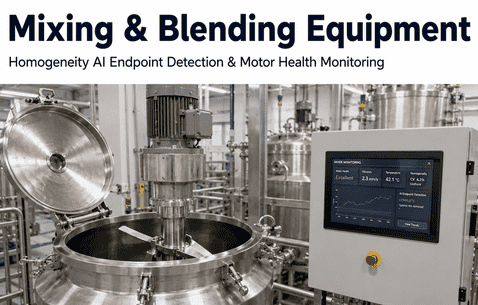
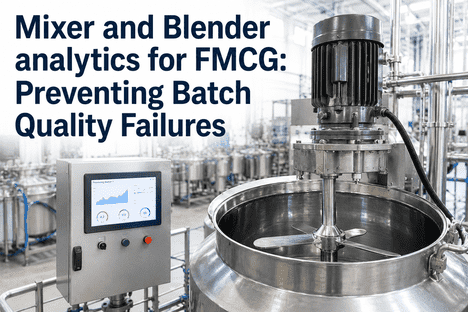
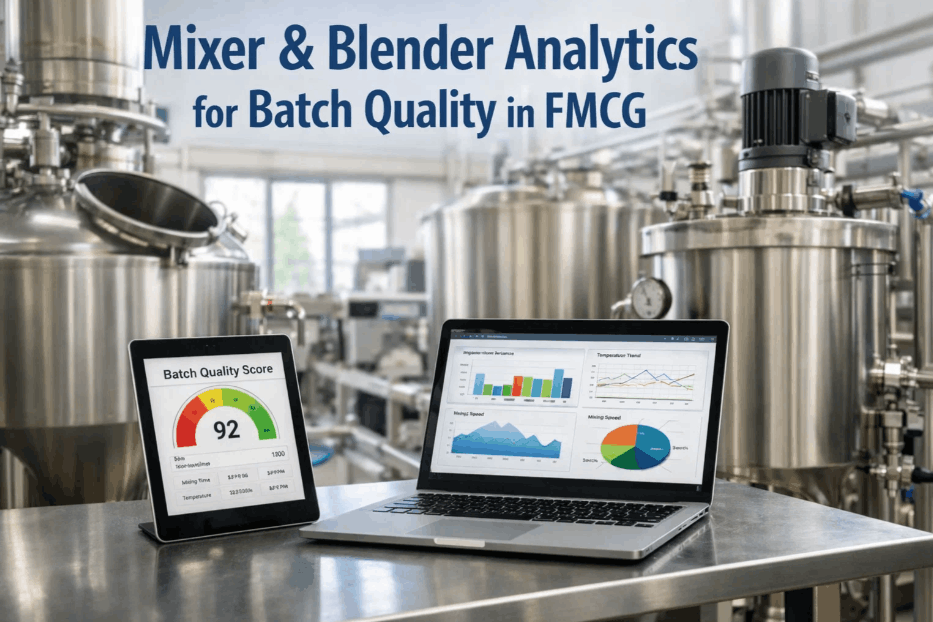
A 10,000-pound ribbon blender running a dry powder blend at ninety seconds per batch produces eighty batches per shift. When the homogeneity endpoint is reached at sixty-five seconds on a consistent raw material day, the remaining twenty-five seconds of mixing time is pure energy waste — consuming motor power, generating heat, and accelerating mechanical wear on the ribbon assembly and drivetrain for no quality benefit. Over two shifts per day, that is forty minutes of unnecessary motor runtime, equating to roughly 180 kilowatt-hours of wasted energy per week and measurable wear accumulation on the main drive bearings and gearbox. On the opposite end, when the same blender is loaded with a batch that has different particle size distribution or moisture content, the endpoint might require 110 seconds — and if the operator runs the standard ninety-second cycle, the batch discharges at 92 percent homogeneity rather than the required 98 percent, leading to downstream quality failures, rework, or customer rejection. The Process Engineer responsible for blending operations across multiple lines faces both problems simultaneously: the quality risk of under-mixing and the cost of over-mixing, with no real-time window into the actual homogeneity state of the batch while it is still in the vessel. iFactory's AI-driven blending intelligence platform closes this window by combining real-time motor power signature analysis with vibration-based homogeneity endpoint detection — giving the Process Engineer the tools to stop every batch at the precise moment of target homogeneity, monitor motor and drivetrain health continuously, and eliminate both the quality risk of under-mixing and the cost of over-mixing across the entire blending operation.
Homogeneity AI · Endpoint Detection · Motor Health · Blending Optimization · Process Analytics
Over-Mixing Wastes Energy and Wears Equipment. Under-Mixing Creates Quality Risk. iFactory Finds the Exact Homogeneity Endpoint Every Time.
iFactory's blending intelligence platform gives Process Engineers real-time visibility into the homogeneity state of every batch — with AI-powered motor signature analysis that detects the endpoint with greater accuracy than manual sampling and continuous motor health monitoring that prevents unplanned downtime on critical blending assets.
The Three Problems That Every Blending Operation Faces — and Why They Are Invisible Without AI
Every blending operation — whether it processes dry powders, viscous pastes, liquid emulsions, or granular solids — confronts three problems that cannot be solved with fixed-time mixing cycles or periodic manual sampling. These problems are structural to the process itself, and they compound across multiple lines, multiple recipes, and multiple shifts. The Process Engineer who brings AI-driven endpoint detection and motor health monitoring to these problems transforms blending from a time-controlled process into a quality-controlled process.
Problem 1
The Fixed-Time Fallacy
Every batch of the same recipe is assigned the same mixing time — typically based on the worst-case scenario of the raw material with the longest blend time. When raw material variability causes some batches to reach homogeneity faster than the standard time, the excess mixing is pure waste. When variability causes some batches to need more time, the fixed cycle discharges under-mixed product.
Impact: Over-mixing waste in 60% of batches
Problem 2
The Sampling Blindness
Manual homogeneity sampling requires opening the blender, extracting a sample from a specific location, and running a laboratory analysis — a process that takes fifteen to thirty minutes per batch. By the time the homogeneity result is available, the batch has already been discharged or has been over-mixed for the entire waiting period. Real-time process control is impossible when the quality feedback loop is measured in minutes or hours rather than seconds.
Impact: 15-30 min lab delay per batch
Problem 3
The Blind Motor Assumption
Blender drive motors, gearboxes, and bearings are assumed to be healthy until they fail catastrophically. Gradual wear in the main drive train changes the power profile of the blender, affecting both mixing efficiency and endpoint detection consistency. Without continuous motor health monitoring, the first indication of a developing bearing fault or gear tooth crack is often a burning smell or a seized drive — taking the blender offline for days.
Impact: Catastrophic failures averaging 12-48h repair
25%
Average over-mixing time per batch in fixed-time blending operations — representing wasted energy, unnecessary mechanical wear, and reduced equipment life across the blender fleet
30%
Of total blending energy consumption attributable to over-mixing — energy that could be eliminated with AI-driven endpoint detection without any impact on product quality
60%
Of blending equipment failures traced to drive train components — motors, gearboxes, and bearings — that exhibit detectable vibration and current signature changes weeks before catastrophic failure
3-8%
Annual energy cost reduction achievable across the blending operation when AI endpoint detection eliminates over-mixing on every batch — compounding with reduced maintenance cost from decreased drivetrain wear
How AI-Powered Motor Signature Analysis Detects the Homogeneity Endpoint Without Opening the Vessel
The principle underlying AI-driven endpoint detection is straightforward: as blending progresses and the mixture approaches homogeneity, the mechanical load on the blender drive motor stabilises. In the initial phase of blending, the motor draws varying power as large agglomerates are broken apart, materials are distributed, and the bulk density of the mixture changes. As the blend approaches uniformity, the power draw converges to a stable baseline. This transition from transient to steady-state motor power is the homogeneity signature — and it occurs at the precise moment when further mixing provides no additional quality benefit. iFactory's AI models learn the power signature of each recipe on each blender, accounting for variations in batch size, raw material properties, and equipment condition.
The Four Layers of iFactory's Blending Intelligence — From Motor Current to Quality Decision
Layer
What It Measures
How It Works
What the Process Engineer Gains
Motor Current Signature
Real-time motor current draw at 1-second intervals, sampled from the variable frequency drive or motor control centre
The AI model analyses the current waveform's convergence to steady-state. When the variance in current draw drops below a recipe-specific threshold for a sustained period, the endpoint is declared.
Batch-to-batch consistency in homogeneity endpoint detection, eliminating dependence on fixed-time assumptions and manual sampling delays
Vibration Analysis
Three-axis accelerometer data from the blender drive train — main bearings, gearbox input shaft, and motor drive end
Vibration signatures are correlated with known mechanical fault frequencies for bearings, gears, and shafts. Trend analysis tracks changes in amplitude at specific frequencies over time.
Early detection of bearing degradation, gear wear, shaft misalignment, and developing mechanical faults — weeks before failure, with specific component identification
Temperature Monitoring
Motor winding temperature, gearbox oil temperature, and bearing surface temperature from integrated RTD sensors
Temperature trends are tracked against baseline profiles established during normal operation. Deviations trigger alerts that differentiate between process-driven thermal changes and equipment-driven overheating.
Detection of developing thermal overload conditions, lubricant degradation, cooling system failures, and abnormal friction before they cause thermal damage to the drive train
Quality Integration
Post-discharge lab homogeneity results are linked back to the motor signature profile of each batch for continuous model validation
Lab results are used as ground truth to refine the AI model's endpoint detection algorithm. The model adapts to raw material changes, recipe modifications, and blender condition drift over time.
Continuous improvement of endpoint detection accuracy, with model confidence scores that allow the Process Engineer to reduce manual sampling frequency as the AI demonstrates reliability
The Endpoint Detection That Recovered 340 Hours of Productive Blending Time per Year
A food manufacturing facility operating six ribbon blenders on a dry seasoning blend had established a standard mixing time of 120 seconds per batch based on the worst-case raw material profile observed during process validation. iFactory deployed motor current signature analysis on all six blenders. During the first month of operation, the AI model determined that 73 percent of batches reached target homogeneity at an average of 82 seconds — 38 seconds earlier than the fixed cycle time. Over the course of a year, eliminating over-mixing on those batches recovered 340 hours of productive blending time across the six-blender fleet, reduced energy consumption by 28 percent on the affected blenders, and eliminated an estimated 12,000 kilowatt-hours of unnecessary motor runtime. The Process Engineer used the time savings to increase batch throughput on the bottleneck blender by three batches per shift, deferring a planned capital investment in a seventh blender by eighteen months. No quality incidents were attributed to the reduced mixing times, and the AI endpoint detection model achieved 99.2 percent agreement with lab homogeneity results during the validation period.
The Process Engineer's Decision Framework — Which Blending AI Capabilities to Prioritise and in What Sequence
The Process Engineer responsible for blending operations across multiple lines and recipes must decide not just which AI capabilities to deploy, but the sequence that builds operational confidence and delivers measurable results at each phase. Deploying endpoint detection before motor health monitoring, or attempting both simultaneously without establishing the baseline signature library, can undermine adoption. The following framework sequences deployment to validate each layer before adding the next.
Phase 1 · Weeks 1-3
Motor Current Signature Baseline
Install current sensors or integrate with VFD data streams on each blender. Collect motor current data across a representative range of recipes and batch sizes. Establish the baseline signature library for endpoint detection.
Validation KPI: Endpoint detection accuracy >95%
Phase 2 · Weeks 4-6
Vibration & Temperature Monitoring
Deploy three-axis accelerometers and RTD temperature sensors on blender drive trains. Establish baseline vibration profiles and temperature envelopes for each blender and recipe combination.
Validation KPI: Fault detection lead time >14 days
Phase 3 · Weeks 7-10
Full Integration & Closed-Loop Control
Connect endpoint detection, motor health monitoring, and quality lab results into a single blending dashboard. Enable automated batch stop signals based on AI endpoint detection.
Validation KPI: Over-mixing eliminated in >90% of batches
Phase 4 · Weeks 11-16
Recipe Optimisation & Cross-Line Scaling
Use accumulated batch data to optimise mixing parameters for each recipe. Scale the validated model across all blenders and lines. Publish standard operating procedures for AI-guided blending.
Validation KPI: Batch time reduction >15% across fleet
From Time-Controlled to Quality-Controlled Blending — What Changes for the Process Engineer
The transition from time-controlled blending to quality-controlled blending powered by AI endpoint detection changes the Process Engineer's daily workflow, the data available for process optimisation, and the level of confidence with which batches are released to downstream operations. The table below shows what shifts across each dimension of the blending process.
Mixing duration fixed per recipe regardless of raw material variability
Quality confirmed by end-of-batch lab sampling with 15-30 minute delay
Motor health assessed during periodic maintenance inspections only
Process optimisation based on historical averages and manual observations
Energy consumption and mechanical wear accepted as fixed operating costs
Result: Over-mixing waste, quality sampling delays, reactive maintenance
AI Quality-Controlled Blending
Mixing duration determined per batch by real-time homogeneity endpoint detection
Quality confirmed in real time by AI model — lab sampling reduced to periodic validation
Motor health monitored continuously — bearing faults detected 14+ days before failure
Process optimisation driven by per-batch data — thousands of data points per day
Energy and wear costs minimised by eliminating excess mixing time on every batch
Result: Reduced batch times, eliminated quality risk, predictive maintenance
Homogeneity AI · Endpoint Detection · Motor Health · Blending Intelligence
Time-Controlled Blending Guarantees Consistent Waste. Quality-Controlled Blending Guarantees Consistent Product. iFactory Powers the Shift.
From fixed-time cycles and end-of-batch lab sampling to real-time AI endpoint detection and continuous motor health monitoring — iFactory gives Process Engineers the blending intelligence platform to stop every batch at the precise moment of target homogeneity, eliminate over-mixing waste, and prevent unplanned drive train failures across the entire blending operation.
Conclusion
The gap between time-controlled and quality-controlled blending is not a technology gap. It is a visibility gap — and it closes when Process Engineers deploy the right sequence of AI capabilities: motor current signature analysis for endpoint detection first, vibration and temperature monitoring for motor health second, full integration and closed-loop control third, and recipe optimisation across the blending fleet fourth. Each phase builds validation data for the next. Each phase delivers measurable improvement in batch consistency, energy efficiency, or equipment reliability.
iFactory's blending intelligence platform gives Process Engineers the complete toolkit for this sequence — AI-powered homogeneity endpoint detection that stops every batch at the precise moment of target quality, continuous motor and drive train health monitoring that predicts failures weeks in advance, and a unified blending dashboard that connects process data, equipment condition, and quality results in a single view. Book a Demo to see how the platform maps to your specific blender types and recipe portfolio, or Talk to an Expert to discuss your blending operation's endpoint detection and motor health monitoring requirements.
Frequently Asked Questions
Over-Mixing Wastes Energy and Wears Equipment. Under-Mixing Creates Quality Risk. iFactory Finds the Exact Homogeneity Endpoint Every Time.
The only blending intelligence platform built for Process Engineers — AI-powered endpoint detection, continuous motor health monitoring, and real-time homogeneity verification that transforms blending from a time-controlled process into a quality-controlled process.