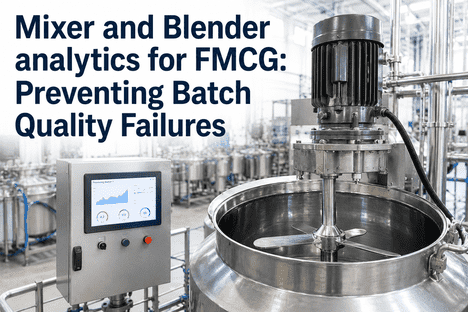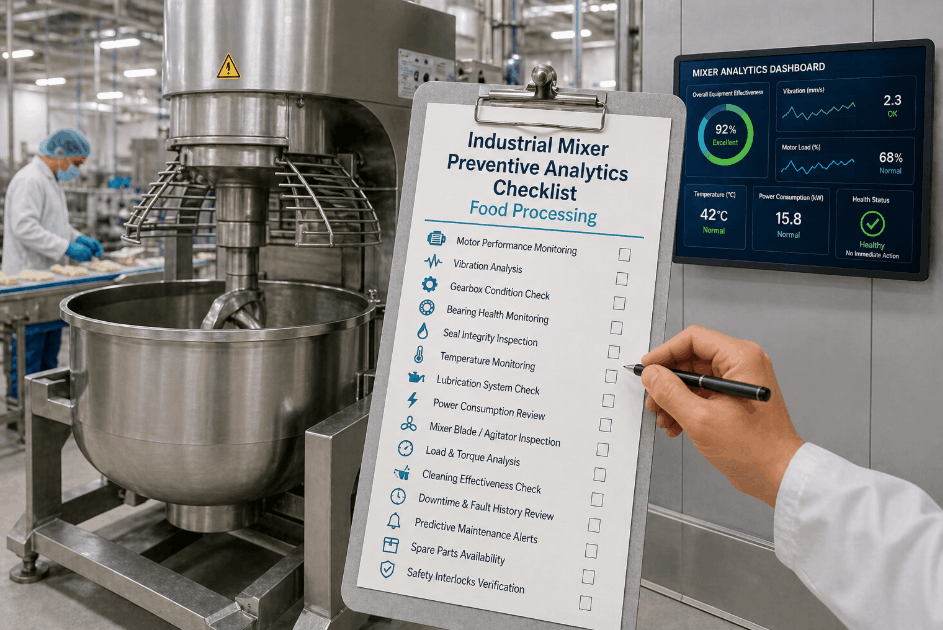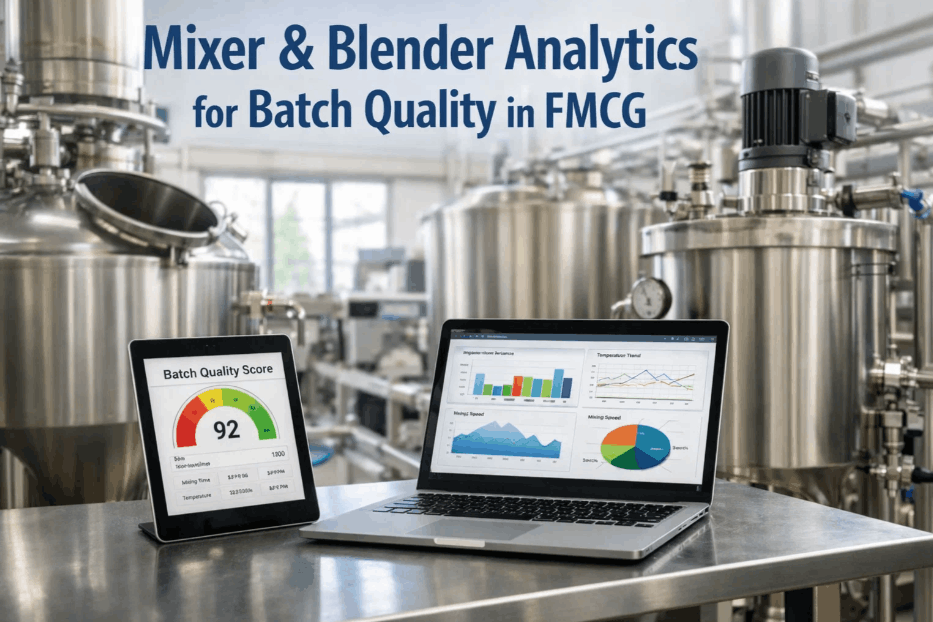
FMCG batch production relies entirely on the mechanical reliability of primary mixing and blending equipment. When an industrial dough mixer, ribbon blender, or high-shear homogenizer degrades silently, it doesn't just stop the line — it ruins the batch. A failing shaft seal introduces foreign contaminants into a 5,000-liter food batch; worn agitator blades increase blending times and cause inconsistent product texture; and sudden gearbox failure leaves perishable ingredients stranded inside the vessel. Traditional time-based maintenance requires opening sanitary vessels, disrupting production schedules, and creating unnecessary contamination risks. iFactory's AI-driven mixer Analytics FMCG platform monitors blade wear, seal integrity, and motor torque externally in real time — securing batch quality FMCG targets and eliminating catastrophic mixer failure without ever breaching the sterile boundary. Book a demo to schedule a mapping session.
Mixer & Blender Analytics for Batch Quality in FMCG
Maintain perfect batch consistency. Prevent bad batches with continuous blade wear monitoring, acoustic seal integrity alerts, and predictive motor vibration analysis for food blenders.
Predictive AI vs Time-Based PMs — Protecting FMCG Batch Quality
Relying on scheduled vessel entry to inspect blender blades or hoping operators catch weeping seals before contamination occurs is a massive risk to FMCG food safety. Schedule an equipment mapping session to transition your critical mixers from reactive visual checks to real-time predictive analytics.
Non-Invasive Sensor Tiers — How We Monitor FMCG Mixers
Food safety and CIP sanitary standards dictate that vessel boundaries cannot be easily breached. The iFactory architecture relies entirely on external, high-fidelity sensors that read internal conditions through the drive shaft and motor casing. Speak with our hardware team about outfitting your high-shear homogenizers or massive ribbon blenders.
Six Blender Failure Modes Our AI Catches Instantly
FMCG mixing equipment Analytics focuses primarily on these six catastrophic failure scenarios that commonly lead to scrapped batches, prolonged cleaning validation, or severe mechanical downtime.
As mixer blades wear down, mixing efficiency drops, leading to unblended ingredients or over-processed textures. AI tracks micro-changes in motor torque resistance to score blade health externally.
Worn lip seals and packing glands allow oil into food batches or raw material to leak out. Acoustic emission sensors catch seal friction spikes weeks before the physical seal ruptures and fails.
Heavy doughs and high-shear mixtures place immense radial load on bearings. FFT vibration analysis detects cage wear and lack of lubrication early, preventing mid-batch mechanical seizure. Book a demo to see the dashboard.
Continual start/stop cycles in batch processing destroy gearbox teeth. AI isolates specific gear mesh frequencies, allowing maintenance to replace the drive assembly during scheduled washdown.
Bent shafts caused by heavy ingredient dumping cause severe wobble, accelerating wear on every connected component. Baseline phase angle monitoring flags shaft deviation instantly.
AI verifies that Clean-in-Place (CIP) spray ball motors and agitator speeds are functioning correctly during the wash cycle, guaranteeing sanitary compliance without breaking open vessels.
Zero-Downtime Deployment — Covering Your FMCG Mixers
You do not need to pause production or open sanitary vessels to implement mixer Analytics. Our sensors are mounted entirely externally on drive components. From kickoff to predictive work order takes roughly 6 weeks.
Engineers evaluate gearbox layouts, motor accessibility, and seal locations across your blenders to design a non-invasive, IP69K-washdown compatible sensor mapping plan.
Sensors are mounted to external casings. Acoustic tags are placed near seals, and electrical nodes monitor current phases. Data begins streaming to the iFactory platform securely.
The AI observes multiple mixing cycles—learning the normal torque and vibration profiles for different SKUs and viscosities, establishing dynamic health thresholds automatically. Book a demo to explore anomaly detection.
Pre-failure alerts trigger SAP/CMMS work orders for seal replacements or motor greasing to be performed naturally during next weekend's sanitation downtime.
What a Plant Director Said
Last year, a catastrophic trunnion seal failure on our primary ribbon blender contaminated 15,000 lbs of ready-to-mix powder with bearing grease. The scrap cost was enormous. By installing iFactory's acoustic seal monitoring, the AI gave us a 16-day early warning of seal degradation last month. We changed it gracefully during Saturday washdown. Not a single pound of product was lost. The ROI on that one catch paid for the entire SaaS platform for three years.
Mixer Analytics for FMCG: Frequently Asked Questions
Does this work on high-viscosity dough or industrial baking mixers?
Yes. The AI dynamic baselines automatically adjust for different SKU viscosities. Heavy dough places immense torque on gearboxes, making predictive vibration and electrical current monitoring incredibly effective for early fault detection.
How do you monitor sanitary seals without breaching food safety protocol?
We strictly utilize non-invasive external Acoustic Emission (AE) sensors clamped near the seal assembly. They listen for high-frequency scratching or friction that precedes seal failure, requiring absolutely zero disruption to the sterile boundary.
Can it detect agitator blade wear without entering the vessel?
Yes. By tracking minute, gradual drops in motor torque over thousands of cycles while processing the exact same SKU, the AI correlates the loss of resistance to physical blade profile wear, triggering a replacement alert.
Does the sensor array integrate with Clean-in-Place (CIP) washdowns?
All primary sensors utilized for mixer Analytics FMCG are IP69K rated, meaning they withstand aggressive high-pressure, high-temperature chemical foam washdowns natively with no shielding required.
Stop Inspecting Mixers. Start Predicting Failures.
Protect batch quality, prevent seal leaks, and run your blending lines confidently.