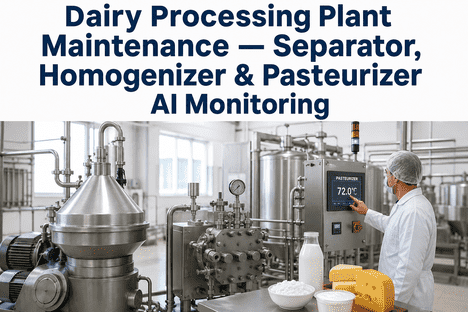
A plate heat exchanger in a dairy pasteurization line processing 30,000 litres per hour begins a production run with a heat transfer coefficient of 4,500 W/m²K. Within four hours of continuous operation, milk protein and mineral fouling deposits reduce that coefficient by 35 percent — to approximately 2,900 W/m²K. The pasteurizer control system responds by increasing the heating medium temperature to maintain the required 72°C for 15 seconds at the holding tube. This temperature increase raises the surface temperature of the plates, accelerating further fouling deposition in a self-reinforcing cycle. By hour six, the heat transfer coefficient has dropped another 12 percent, steam consumption has increased by nearly 50 percent compared to the start of the run, and the pressure drop across the heat exchanger has risen from 0.8 bar to 1.6 bar — signalling that the plate gaps are partially obstructed by fouling deposits. The Maintenance Manager overseeing a multi-line pasteurization operation must decide when to terminate production and initiate a clean-in-place cycle. Stop too early and production time is lost to unnecessary cleaning. Stop too late and the run ends with compromised thermal processing margin, elevated energy consumption, accelerated plate degradation from localized overheating, and a CIP cycle that requires more chemicals and longer duration because the fouling has aged and hardened. iFactory's AI-driven heat exchanger intelligence platform solves this dilemma by tracking fouling rate in real time through continuous analysis of thermal performance, hydraulic behaviour, and energy efficiency — giving the Maintenance Manager the data to optimize every production run-to-CIP transition across the entire pasteurizer fleet.
Fouling Rate AI · CIP Effectiveness · HTST UHT Monitoring · Thermal Processing · Heat Exchanger Analytics
Every Hour Past the Fouling Breakpoint Costs Energy, Capacity, and Plate Life. iFactory Tells You Exactly When to CIP.
iFactory's heat exchanger intelligence platform gives Maintenance Managers real-time visibility into fouling progression across every plate heat exchanger, pasteurizer, and UHT system — with AI-powered fouling rate analysis that optimizes production run length, validates CIP completeness, and eliminates the guesswork from thermal processing maintenance decisions.
The Four Costs of Fouling — and Why Calendar-Based CIP Scheduling Addresses None of Them
Fouling in heat exchangers and pasteurizers imposes four distinct categories of cost on the processing operation. Calendar-based CIP scheduling — where every heat exchanger is cleaned after a fixed number of hours regardless of actual fouling state — is the industry default because it is administratively simple and provides a predictable cleaning schedule. But it fails to address any of these costs optimally, because fouling does not progress on a calendar schedule. It progresses according to raw material quality, product type, flow rate, temperature profile, and the condition of the heat transfer surfaces — all of which vary from run to run and from season to season.
Cost 1 · Energy
Excess Steam and Hot Water Consumption
As fouling reduces heat transfer efficiency, the control system increases the heating medium temperature to maintain product outlet temperature. A 30 percent reduction in heat transfer coefficient typically requires a 12 to 18 percent increase in steam consumption. On a pasteurizer processing 25,000 litres per hour for sixteen hours, this translates to approximately 1,200 to 1,800 additional kilograms of steam per run — or roughly $60 to $90 in excess energy cost for every hour the heat exchanger operates beyond the optimal CIP point.
Impact: 12-18% steam increase per run
Cost 2 · Capacity
Throughput Reduction and Extended Run Time
When heat exchanger fouling reaches the point where the control system cannot maintain product outlet temperature within the required tolerance, the operator must reduce the product flow rate to increase residence time and achieve the required thermal treatment. A flow reduction of 10 to 15 percent is typical in the late stages of a fouling cycle. On a line that runs at 30,000 litres per hour, this means a loss of 3,000 to 4,500 litres of throughput per hour — directly reducing the production capacity of the entire processing line.
Impact: 10-15% capacity loss at end of run
Cost 3 · Asset Life
Accelerated Plate and Seal Degradation
Localized overheating caused by fouling deposits creates hot spots on the plate surface that can exceed the design temperature rating of gasket materials and plate alloys. Each fouling cycle that runs beyond the optimal CIP point reduces the effective service life of the plate pack. Repeated over-CIP cycling — cleaning the heat exchanger when it does not yet need it — also accelerates wear on plates and gaskets through unnecessary exposure to cleaning chemicals and thermal cycling. Both over-running and over-cleaning reduce the interval between plate replacements.
Impact: 15-25% reduction in plate pack life
Cost 4 · Chemical
Ineffective CIP and Excess Chemical Usage
When a heat exchanger is CIP'd after the fouling has aged and hardened — particularly protein-based fouling in dairy applications — the standard CIP cycle may not remove all deposits. This necessitates a second cleaning cycle with higher chemical concentrations or extended recirculation times, increasing chemical consumption, effluent treatment load, and cleaning time. Alternatively, residual fouling carries into the next production run, seeding accelerated fouling from the start and progressively shortening the effective production window between CIP events.
Impact: 20-40% excess chemical consumption
35-50%
Typical reduction in heat transfer coefficient over a pasteurizer production run due to protein and mineral fouling deposition on plate surfaces
20-40%
Excess CIP chemical consumption in operations that run calendar-based cleaning schedules — cleaning too early wastes chemicals, cleaning too late requires extended cycles with higher concentrations
2-4%
Annual energy cost reduction achievable across a multi-line pasteurizer fleet when AI fouling rate optimization eliminates extended runs with degraded heat transfer efficiency
15-25%
Extension in plate pack replacement interval reported by operators using AI-optimized CIP scheduling — fewer unnecessary cleaning cycles and reduced thermal stress on plates and gaskets
How AI Fouling Rate Monitoring Transforms CIP Decision-Making
The Maintenance Manager responsible for heat exchanger and pasteurizer performance across multiple production lines has historically received fouling information in one of two forms: after-the-fact reports from production teams saying the pasteurizer was "running hot" or that the pressure drop was "getting high," or periodic CIP logs showing that every heat exchanger was cleaned on schedule regardless of actual need. Both information sources are inadequate for optimizing the run-to-CIP transition. The first is subjective and arrives too late. The second is administratively convenient but economically suboptimal for every metric that matters. iFactory fills this information gap by providing continuous, quantitative, per-unit fouling data that tells the Maintenance Manager exactly how much fouling is present on every heat transfer surface at every moment — and exactly when the optimal CIP trigger point will be reached.
The Three Layers of iFactory's Heat Exchanger Fouling Intelligence — From Process Data to CIP Decision
Layer
What It Monitors
How It Works
What the Maintenance Manager Gains
Thermal Fouling Rate
Product inlet/outlet temperatures, heating medium temperature and flow rate, product flow rate — at 1-minute intervals from process sensors
The AI model calculates the overall heat transfer coefficient in real time and tracks its decay curve. When the coefficient drops below a configurable threshold — or when the rate of decay accelerates beyond the normal fouling profile — the platform alerts the maintenance team.
Real-time visibility into fouling progression per heat exchanger. Early warning of accelerated fouling events. Data-driven CIP trigger timing instead of fixed-interval cleaning.
Hydraulic Fouling Detection
Pressure drop across the heat exchanger, product flow rate, and fluid viscosity data — compared against the clean-surface baseline for each unit
The platform tracks the pressure drop-to-flow ratio. An increase in this ratio indicates partial blockage of plate gaps by fouling deposits. The AI model distinguishes fouling-driven pressure rise from flow-driven pressure variation.
Secondary confirmation of fouling state. Early detection of uneven fouling distribution across the plate pack. Identification of flow distribution problems that may indicate mechanical issues.
CIP Effectiveness Verification
Return-to-baseline data — heat transfer coefficient, pressure drop, and outlet temperature response compared before and after each CIP cycle
After each CIP cycle, the platform compares the post-CIP thermal and hydraulic performance against the clean-surface baseline for that specific heat exchanger. If the performance does not return to within an acceptable tolerance of the baseline, the CIP cycle is flagged as incomplete.
Direct verification that every CIP cycle restored the heat exchanger to clean condition. Early detection of incomplete cleaning before it carries into the next production run. Elimination of the "cleaning that did not clean" problem.
The CIP Optimization That Recovered Two Extra Hours of Production per Week per Pasteurizer
A dairy processing plant operating five HTST pasteurizers on a 2x8-hour shift pattern had standardized on a 12-hour fixed CIP interval across all units — meaning each pasteurizer was cleaned twice per day regardless of the actual fouling state. The Maintenance Manager deployed iFactory's fouling monitoring platform on all five units. During the first month of operation, the AI model identified that two of the pasteurizers — processing a standard whole milk product with consistent raw material quality — reached the fouling limit at an average of 14.5 hours, meaning the fixed 12-hour CIP cycle was over-cleaning those units by 2.5 hours per run. The remaining three pasteurizers — processing a protein-fortified product with variable raw material composition — reached the same fouling limit at an average of 9.8 hours, meaning the fixed cycle was under-cleaning those units by over 2 hours per run, with CIP verification showing incomplete fouling removal on 40 percent of cycles. By switching to AI-optimized CIP triggers, the plant eliminated the incomplete cleaning cycles on the protein-fortified lines, extended the whole milk pasteurizer runs by an average of 2 hours per cycle, and recovered a net gain of 10 hours of production time per week across the five-unit fleet. Annualized chemical savings from eliminating unnecessary CIP cycles and incomplete cleaning rework totalled $47,000.
The Maintenance Manager's Deployment Sequence — Which Heat Exchanger AI Capabilities to Activate and in What Order
For the Maintenance Manager responsible for heat exchanger performance across multiple production lines, the deployment sequence matters more than the technology itself. Deploying all capabilities simultaneously risks overwhelming the operations team with data before the baseline fouling profiles are established. The following sequence builds operational confidence and delivers measurable results at each phase.
Phase 1 · Weeks 1-2
Thermal Baseline & Real-Time Fouling Rate
Connect process temperature and flow sensors to the platform. Establish clean-surface heat transfer coefficient baselines for each heat exchanger and product type. Begin real-time fouling rate tracking.
Validation KPI: Fouling rate accuracy >90%
Phase 2 · Weeks 3-4
Hydraulic Monitoring & Multi-Variable Validation
Add pressure drop monitoring and flow correlation. Validate fouling state through dual thermal-hydraulic analysis. Calibrate CIP trigger thresholds for each heat exchanger and product.
Validation KPI: CIP trigger accuracy >95%
Phase 3 · Weeks 5-6
CIP Effectiveness Verification
Activate post-CIP return-to-baseline verification. Track incomplete CIP events. Correlate CIP chemical usage with cleaning effectiveness. Optimize CIP cycle parameters.
Validation KPI: CIP verification rate >98%
Phase 4 · Weeks 7-10
Cross-Line Optimization & Plate Life Management
Aggregate fouling data across all heat exchangers and lines. Optimize run-to-CIP transitions per product and unit. Track plate pack degradation trends and forecast replacement intervals.
Validation KPI: Run time extension >15% across fleet
From Calendar-Based CIP to Condition-Based CIP — What Changes for the Maintenance Manager
The transition from calendar-based cleaning schedules to condition-based CIP optimization changes the Maintenance Manager's relationship with the heat exchanger fleet. Instead of managing a cleaning calendar and reacting to production disruptions from fouling-related issues, the Maintenance Manager gains a real-time data stream that shows exactly when each heat exchanger needs attention and whether the cleaning cycle was effective. The table below shows what shifts across key maintenance dimensions.
Calendar-Based CIP Management
CIP schedule determined by fixed hours of operation irrespective of actual fouling state
Fouling state inferred from operator reports of "running hot" or high pressure drop
CIP effectiveness assumed if the cycle completed — no quantitative verification
Energy consumption accepted as a fixed cost per production run
Plate replacement intervals based on manufacturer recommendations rather than actual condition
Result: Over-cleaning or under-cleaning, excess energy costs, unplanned fouling events
AI Condition-Based CIP Optimization
CIP triggered by real-time fouling rate analysis — each run length optimized per heat exchanger
Fouling state measured quantitatively by heat transfer coefficient and pressure drop trends
CIP effectiveness verified by post-cleaning return-to-baseline analysis
Energy consumption minimized by terminating each run at the optimal fouling threshold
Plate replacement timing driven by accumulated thermal and chemical stress data per unit
Result: Optimized run times, reduced energy costs, validated CIP cycles, extended plate life
Fouling Rate AI · CIP Effectiveness · HTST UHT Analytics · Heat Exchanger Intelligence
Calendar-Based CIP Guarantees Suboptimal Everything. Condition-Based CIP Guarantees Optimal Run Time, Energy, and Plate Life. iFactory Powers the Shift.
From fixed-interval cleaning schedules and subjective operator reports to real-time AI fouling rate monitoring and verified CIP effectiveness — iFactory gives Maintenance Managers the heat exchanger intelligence platform to optimize every production run-to-CIP transition, reduce energy consumption, extend plate pack life, and validate cleaning quality across the entire pasteurizer fleet.
Conclusion
The gap between calendar-based CIP management and condition-based CIP optimization is not a technology gap. It is a visibility gap — and it closes when Maintenance Managers deploy the right sequence of AI capabilities: real-time thermal fouling rate monitoring first, hydraulic validation second, CIP effectiveness verification third, and cross-line optimization fourth. Each phase builds the baseline data for the next. Each phase delivers measurable improvement in run time utilization, energy consumption, chemical usage, or plate pack service life.
iFactory's heat exchanger intelligence platform gives Maintenance Managers the complete toolkit for this sequence — AI-powered fouling rate tracking that identifies the optimal CIP trigger point for every heat exchanger and product combination, hydraulic fouling detection that provides multi-variable confirmation of fouling state, CIP effectiveness verification that validates every cleaning cycle, and cross-line optimization that maximizes production uptime across the entire pasteurizer fleet. Book a Demo to see how the platform maps to your specific heat exchanger types and pasteurizer configurations, or Talk to an Expert to discuss your operation's fouling monitoring and CIP optimization requirements.
Frequently Asked Questions
You Are Either Over-Cleaning or Under-Cleaning Every Heat Exchanger. iFactory Is the Only Way to Know Which.
The only heat exchanger intelligence platform built for Maintenance Managers — AI-powered fouling rate tracking, real-time CIP effectiveness verification, and cross-line optimization that transforms pasteurizer maintenance from a calendar-based guessing game into a condition-based precision operation.