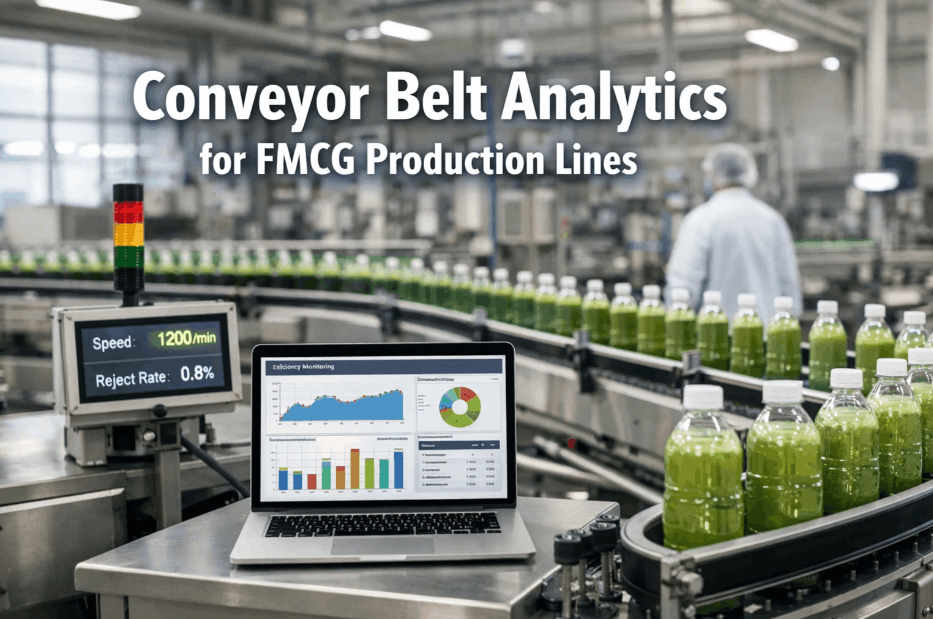
A beverage bottling plant in the Midwest ran three high-speed packaging lines with 23 conveyors — belt conveyors for PET bottles, tabletop chain conveyors for aluminum cans, and modular belt accumulation tables feeding two palletizers. Overall line OEE was reported at 84 percent, and the maintenance team was responding to an average of four conveyor-related jams per shift. Then a detailed failure analysis revealed the hidden pattern: belt edge wear on the main bottle conveyor had been progressing for six weeks, chain tension on the can line was 11 percent below specification, and the accumulation table was experiencing micro-stalls that caused container tipping every 90 minutes. The maintenance manager was winning the reactive battle while losing the reliability war. Six weeks after deploying iFactory AI conveyor health monitoring, the team identified three critical wear trajectories, scheduled replacements during planned downtime, and reduced conveyor-related jams by 94 percent. Line OEE climbed from 84 percent to 93 percent. That is the difference AI-powered conveyor monitoring makes. Not more maintenance. Smarter, earlier, data-driven intervention.
94%
Conveyor-related jam reduction when AI wear monitoring replaces time-based inspections with condition-based alerts per conveyor zone
8-12
Days of advance warning on belt edge wear and chain elongation before failure impacts production — enabling planned replacement during scheduled downtime
67%
Reduction in unplanned conveyor downtime when predictive alerts catch accumulation table micro-stalls, belt tracking drift, and motor overload patterns
$28,600
Average annual savings per conveyor from reduced product damage, fewer emergency repairs, extended belt and chain life, and elimination of jam-related line stoppages
Conveyor Health + AI Monitoring + Shift Logbook
Your Conveyor Fleet Is Telling You Which Belts Are About to Fail. iFactory AI Translates the Data Into Actionable Alerts.
iFactory's conveyor health monitoring platform unifies live wear index, chain tension tracking, accumulation table analytics, and shift logbook integration into a single maintenance manager dashboard. See it configured for your conveyor types and line layout.
The Conveyor Reliability Gap: Why Time-Based Inspections Cannot Catch Progressive Wear
Most FMCG packaging lines rely on time-based conveyor inspections — weekly belt tension checks, monthly vibration readings, quarterly chain wear measurements. This approach creates a structural blind spot. A belt can lose 15 percent of its edge thickness between weekly inspections. Chain elongation of 2 percent can develop over three weeks and go undetected until the sprocket teeth begin skipping. Accumulation table pressure buildup can reach jam-inducing levels within two production shifts. The maintenance manager sees the inspection logs and assumes the conveyors are within specification. But the inspection intervals are too wide to capture the degradation trajectory. iFactory AI fills this gap by monitoring every conveyor continuously, detecting wear progression in real time, and alerting the maintenance team at the earliest sign of deviation rather than at the next scheduled inspection.
Belt Conveyor Blind Spot
Time-based belt inspections measure tension and visual wear at fixed intervals. Between inspections, edge fraying accelerates under load, tracking drift develops from uneven product distribution, and hidden delamination begins at the belt splice. The weekly check confirms the belt is running. It does not reveal that the belt has lost 12 percent of its load-bearing cross-section at the edges or that the tracking has drifted 4 millimeters toward the frame, causing structural rub.
AI fix: Continuous wear index tracking per belt section surfaces edge loss and tracking drift trends between scheduled inspections.
Chain Conveyor Blind Spot
Chain elongation is measured quarterly by comparing pin-to-pin distance against factory specification. An 11 percent tension loss develops over weeks, not days. The chain continues running, but the uneven pitch causes product spacing variation, jerky motion at transfer points, and accelerated sprocket tooth wear. The quarterly measurement confirms the chain has stretched. It does not capture the weekly rate of elongation or predict when the chain will reach the 3 percent replacement threshold.
AI fix: Continuous chain pitch monitoring from encoder feedback and torque ripple analysis predicts elongation trajectory and replacement window.
Accumulation Table Blind Spot
Accumulation table inspections focus on mechanical components — belt condition, drive motor temperature, bearing noise. The table appears to be functioning normally. But micro-stalls caused by uneven product flow, pressure buildup from downstream machine speed changes, and gap distribution anomalies develop in minutes, not inspection cycles. By the time the next inspection identifies the root cause, the accumulation table has already caused multiple product jams and container tipping events.
AI fix: Real-time fill-level velocity and product gap distribution monitoring predicts deadlock conditions before they cause jams.
What Time-Based Inspections Show
84%
Line OEE reported at shift end
Weekly belt inspection passed. Monthly chain check within limits. Quarterly bearing vibration OK. Everything looks normal. But conveyor jams are averaging four per shift.
What Continuous AI Monitoring Reveals
94%
Jam reduction after AI deployment
Belt edge wear at 78% of replacement threshold. Chain tension trending to 3% elongation in 8 days. Accumulation table micro-stall frequency increasing. The maintenance manager sees every wear trajectory in real time.
How iFactory AI Monitors Belt, Chain, and Accumulation Table Health
iFactory AI transforms conveyor monitoring from periodic inspection cycles into continuous condition-based intelligence. Three integrated capabilities — multi-sensor fusion, wear trajectory prediction, and automated shift logbook integration — work together to detect, diagnose, and document every conveyor health event before it causes downtime.
Capability 01
Multi-Sensor Fusion for All Conveyor Types
iFactory AI integrates vibration sensors, motor drive current signals, encoder speed feedback, torque sensors, and optical product gap detectors into a unified conveyor health data stream. For belt conveyors, the system monitors vibration harmonics to detect edge fraying, delamination initiation, and bearing degradation. For chain conveyors, encoder-based pitch measurement tracks elongation with 0.1 percent resolution and detects sprocket tooth wear from torque ripple patterns. For accumulation tables, the AI analyzes fill-level velocity profiles, product gap distribution, and pressure buildup trends to predict deadlock conditions. All data streams are synchronized per conveyor zone, enabling the maintenance manager to isolate issues to a specific belt section, chain segment, or table quadrant.
Outcome: Every conveyor type in your packaging line is monitored continuously with a single unified platform.
Capability 02
Wear Trajectory Prediction and Remaining Useful Life
The AI model learns the normal wear profile for each conveyor based on operating hours, product types, line speed, and historical replacement data. As new sensor data arrives, the model compares current wear indicators against the learned baseline and calculates the projected remaining useful life for belts, chains, bearings, and sprockets. When belt edge wear reaches 70 percent of the replacement threshold, the system generates an alert with the projected date of failure at the current wear rate. When chain elongation crosses 2 percent, the dashboard displays the estimated number of production hours before the 3 percent replacement limit. This gives the maintenance manager 8 to 12 days of advance warning for planned replacement scheduling — eliminating emergency conveyor repairs during production shifts.
Outcome: Belt and chain replacements are planned during scheduled downtime, not reactive emergency events.
Capability 03
Shift Logbook Integration with Automated Documentation
Every conveyor health alert, wear trajectory update, inspection recommendation, and maintenance action is logged automatically into the iFactory AI shift logbook with conveyor ID, zone location, component details, operator ID, and timestamp. The maintenance manager can review the complete conveyor health history for any belt, chain, or accumulation table across any date range. When a new shift begins, operators receive a handover summary showing which conveyors have active alerts, which are approaching replacement thresholds, and which require visual inspection during the shift. The digital shift logbook eliminates the information gap between shifts and ensures that conveyor health data is never lost in paper logs or verbal handovers.
Outcome: Complete conveyor health audit trail from sensor alert to maintenance completion, accessible across all shifts.
The Maintenance Manager's Unified Conveyor Health Dashboard
The unified dashboard presents every conveyor in your packaging line on a single screen with live health status, wear trends, and alert prioritization. Three views address the questions that matter most: Which conveyor is at risk? What is the wear trajectory? When should I intervene?
A
Conveyor Fleet Health Overview by Zone
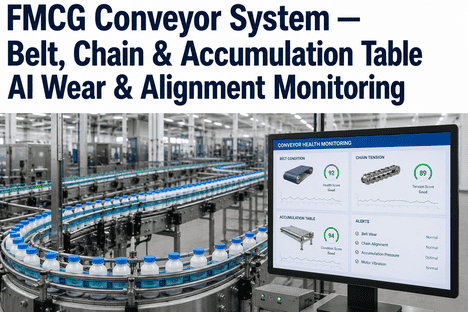
Every conveyor in the line appears on a single map view with colour-coded health status: green (normal wear within limits), amber (approaching replacement threshold), red (critical — intervene within the shift). Each conveyor displays its current wear index (0-100), remaining useful life in production hours, and the top contributing wear factor. The maintenance manager sees instantly which conveyors need attention and which can be scheduled for the next planned downtime.
Action: Conveyors in red receive immediate inspection. Amber conveyors are scheduled for the next planned maintenance window.
B
Wear Trend Analysis by Conveyor and Component
Each conveyor displays its wear trajectory for belts, chains, bearings, and sprockets with trend lines showing the current value, the replacement threshold, and the projected crossing date at the current wear rate. The belt edge wear trend shows the rate of thickness loss per production day. The chain elongation trend shows the weekly pitch increase. The bearing vibration trend shows the high-frequency acceleration envelope. The maintenance manager sees not just the current wear level but the velocity of degradation — whether wear is accelerating, stable, or decelerating.
Action: Accelerating wear trends trigger priority alerts. Stable trends at moderate levels are scheduled for the next planned replacement cycle.
C
Jam Prediction with Root-Cause Attribution
The AI model correlates conveyor health data with production events to predict jam risk per conveyor zone. When accumulation table fill-level velocity shows a sustained decline, the system predicts an impending deadlock and attributes the root cause to downstream machine speed variation. When belt tracking drift exceeds the safe operating envelope, the system predicts a product jam at the transfer point and identifies the contributing belt edge wear pattern. Alerts include the projected jam location, the estimated time to event, and the recommended corrective action.
Action: Jam predictions with location and cause enable operators to intervene minutes before the event occurs — not after.
Conveyor Fleet Dashboard + Shift Logbook
Time-Based Inspections Miss Progressive Wear. AI-Powered Continuous Monitoring Catches Every Millimeter of Degradation.
iFactory's conveyor health monitoring platform gives maintenance managers real-time visibility into belt wear, chain tension, accumulation table condition, and jam risk across every conveyor in the packaging line — unified in a single dashboard with shift logbook integration for complete audit trails.
We had 23 conveyors across three packaging lines, and our maintenance strategy was entirely reactive — respond to jams, replace broken belts, tighten chains after they started skipping. The weekly inspection checklist gave us a false sense of control. When we deployed iFactory AI, the first week of data revealed that five conveyors had belt edge wear exceeding 70 percent of the replacement threshold and two accumulation tables had micro-stall patterns that were about to cause cascade jams. We scheduled all replacements during the next planned shutdown. In three months, conveyor-related downtime dropped 67 percent, and our line OEE went from 84 percent to 93 percent. The biggest change was not the technology. It was knowing which conveyor to fix and when.
— Maintenance Manager, FMCG Beverage Bottling Plant, Three High-Speed Packaging Lines
ROI: The True Cost of Conveyor Failure vs. AI-Powered Monitoring
Conveyor failures in FMCG packaging lines carry costs that extend far beyond belt replacement or chain repair. Each jam event stops the line, idles downstream equipment, and risks product damage on the accumulation table. iFactory AI's predictive monitoring eliminates the gap between inspection cycles by providing continuous wear visibility, enabling maintenance managers to replace components at the optimal time rather than after failure.
Reactive Maintenance (per conveyor, per year)
$42,600
Emergency belt replacements, rush chain orders, product damage from jams, overtime labour for after-hours repairs, and lost production time during unplanned line stoppages.
With iFactory AI Predictive Monitoring
$14,000
Planned belt and chain replacements during scheduled downtime, zero emergency repairs, 94 percent fewer jam events, extended component life through optimal replacement timing, and fully documented audit trails.
Typical savings of $28,600 per conveyor per year — covering reduced downtime, fewer component replacements, lower product damage rates, and elimination of emergency maintenance call-outs. For a packaging line with 15 conveyors, that represents $429,000+ annual savings with a typical payback period of under four months.
Conclusion
Conveyor reliability is the backbone of FMCG packaging line performance. When belts wear, chains stretch, and accumulation tables jam, the entire line stops — regardless of how well the filling machines, labelers, and palletizers are running. Time-based inspection cycles cannot catch the progressive wear patterns that develop between checks, leaving maintenance managers reacting to failures rather than preventing them.
iFactory AI closes this gap by monitoring every conveyor continuously — belt edge wear, chain elongation, bearing degradation, accumulation table micro-stalls, and motor overload patterns — and translating raw sensor data into actionable wear trajectories with projected remaining useful life. The maintenance manager sees not just which conveyor is failing, but which component is degrading and when it will reach the replacement threshold. For FMCG operations running multiple packaging lines with diverse conveyor types, iFactory AI transforms conveyor maintenance from reactive firefighting into predictive reliability management.
iFactory AI's conveyor health monitoring platform is designed for maintenance managers in FMCG packaging who need to eliminate conveyor-related jams, extend belt and chain life, and keep their lines running at target OEE. Book a Demo to see the platform configured for your conveyor types and line layout, or talk to an expert about a free conveyor health assessment for your packaging operation.
Frequently Asked Questions
Stop Reacting to Conveyor Failures. Start Predicting Them. Get a Free Conveyor Health Assessment for Your Packaging Line.
iFactory AI's conveyor health monitoring platform for FMCG packaging maintenance managers — real-time wear tracking for belts, chains, and accumulation tables with multi-sensor fusion, wear trajectory prediction, jam risk scoring, and shift logbook integration for complete maintenance audit trails.