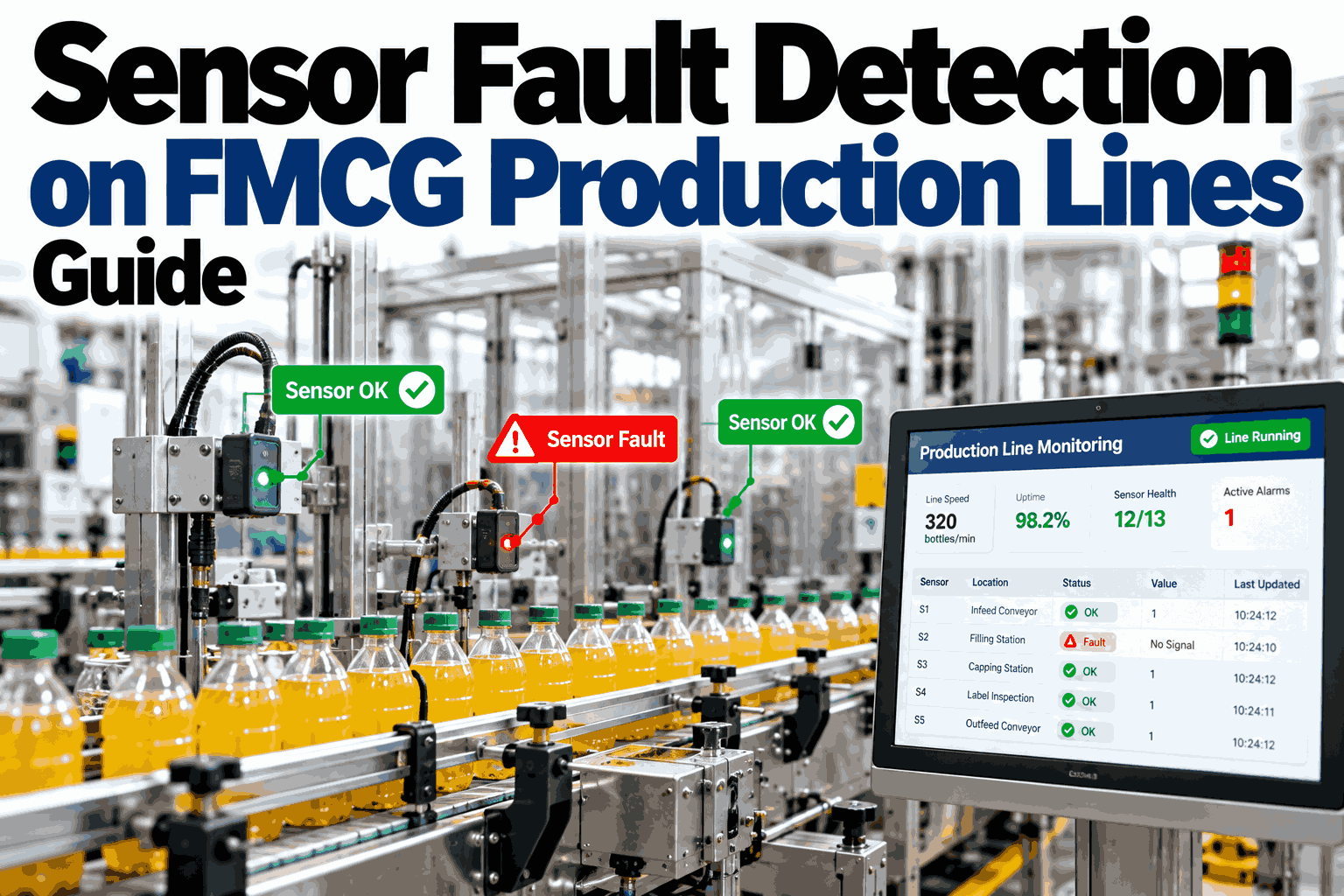
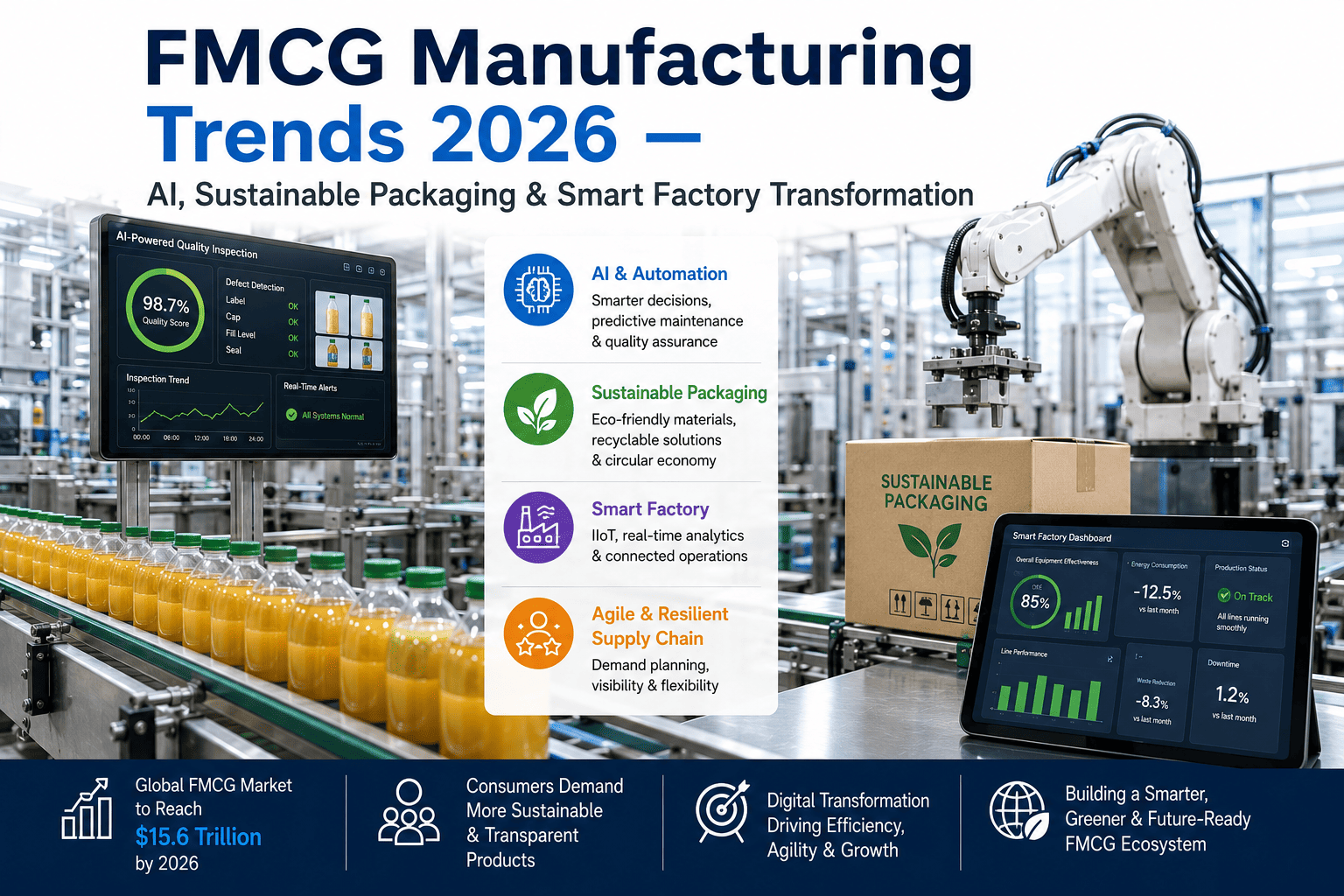
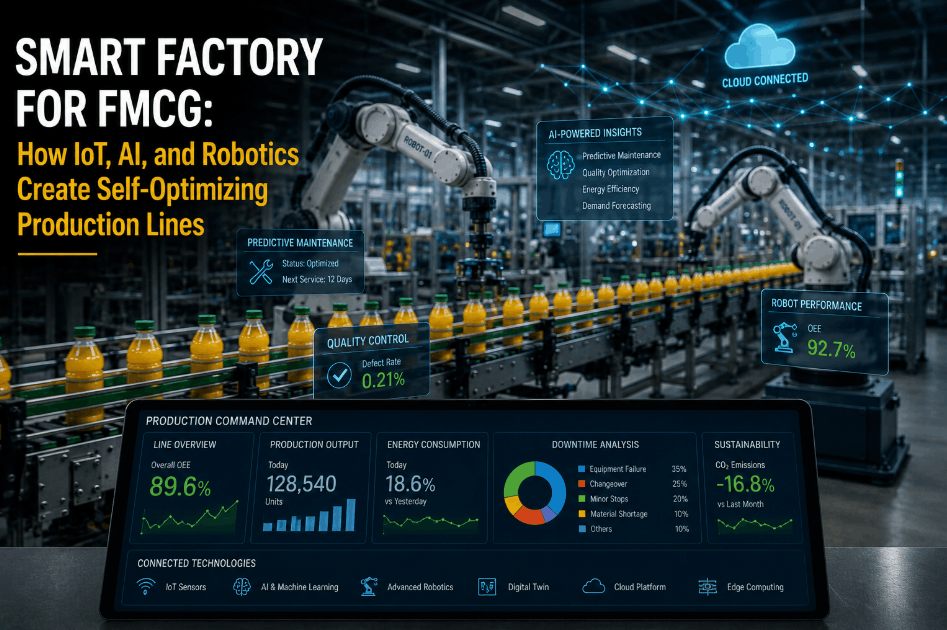
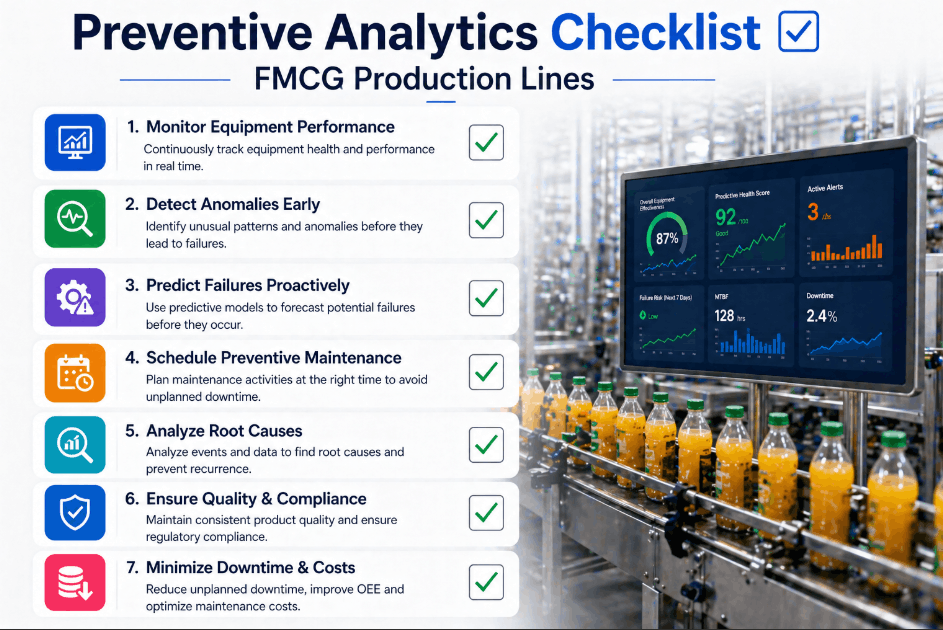
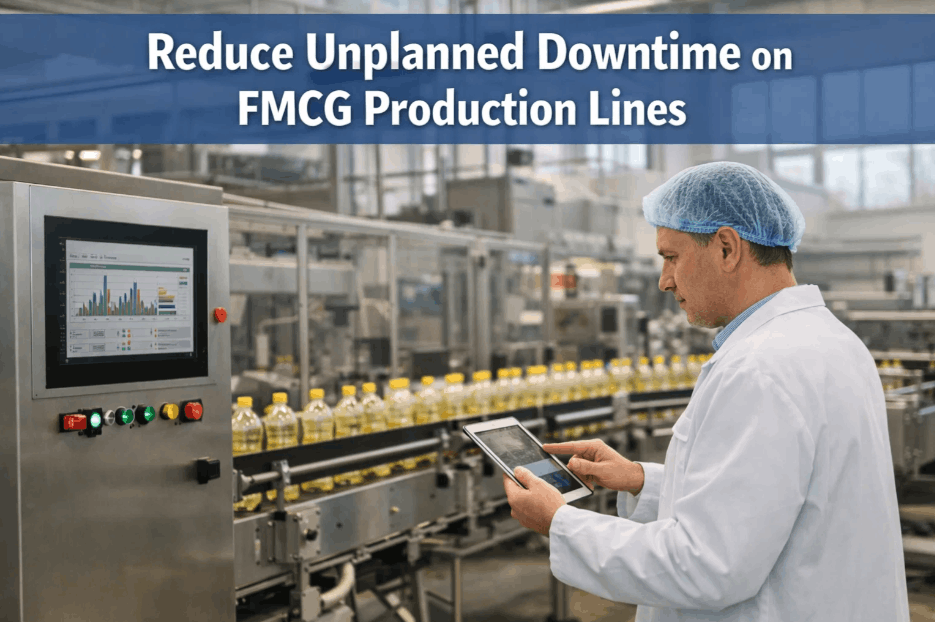
In FMCG manufacturing, the production line never really stops — it just breaks. A filling machine jams at 2 AM. A conveyor belt motor overheats during peak shift. A sealing unit drifts out of calibration and produces 40,000 defective packs before anyone notices. These are not exceptional events in reactive FMCG plants — they are the rhythm of the operation. And behind every unplanned stoppage is the same root cause: maintenance decisions made on schedules and assumptions rather than on the actual condition of the equipment. AI-powered predictive maintenance changes this entirely, giving FMCG production engineers the real-time equipment intelligence they need to prevent failures before they happen, sustain OEE above 85%, and reduce unplanned downtime by up to 50%.
AI-Powered Predictive Maintenance for FMCG Production Lines
How IoT sensors, edge computing, and ML-driven failure prediction are eliminating the unplanned stoppages that cost FMCG manufacturers millions in lost production every year.
Why FMCG Production Lines Need a Different Maintenance Approach
FMCG production lines operate under conditions that make traditional preventive maintenance fundamentally inadequate. Equipment runs continuously across multiple shifts, often 24/7, at speeds and throughput rates that leave almost no window for scheduled inspection without affecting production targets. The diversity of equipment — filling machines, capping units, labeling systems, conveyors, coding equipment, and packaging lines — creates a maintenance complexity that even well-staffed engineering teams struggle to manage comprehensively.
The economic stakes are uniquely high in FMCG because production losses are not just about machine repair costs — they cascade into missed delivery windows, retailer penalty charges, promotional stock shortfalls, and brand reputation damage with major retail customers. Production managers who get support gain an AI monitoring layer that tracks the health of every production line asset continuously, surfacing developing faults with enough advance warning to schedule interventions during planned downtime windows rather than reacting to failures mid-production.
Critical FMCG Equipment Failures AI Predicts Before They Stop the Line
Every FMCG production line has a hierarchy of failure risk — certain machines whose stoppage immediately halts all downstream operations, and others that have redundancy or buffer capacity. AI predictive maintenance on iFactory prioritizes monitoring investment based on this criticality hierarchy, ensuring that the highest-risk assets receive the most intensive monitoring and the earliest possible fault detection. Maintenance engineers who book a demo with iFactory typically identify 6–8 developing faults on their existing equipment during the first week of AI monitoring activation.
OEE Impact: What AI Predictive Maintenance Delivers for FMCG Plants
Overall Equipment Effectiveness is the primary production performance metric in FMCG manufacturing, combining availability, performance, and quality into a single number that reflects how much productive output a line delivers relative to its theoretical maximum. Most FMCG plants operate at OEE levels of 55–70% — a significant gap from the world-class benchmark of 85% that AI-enabled plants are achieving. The three components of OEE are each directly impacted by predictive maintenance: availability improves as unplanned stoppages decline, performance improves as equipment runs at intended speeds without degradation-related slowdowns, and quality improves as process parameters stay within specification rather than drifting between inspection cycles.
iFactory's AI platform addresses all three OEE dimensions simultaneously. Availability gains come from preventing unplanned failures. Performance gains come from detecting and correcting speed-degrading mechanical faults — bearing wear, drive belt stretch, pump cavitation — before they cause production rate reductions. Quality gains come from monitoring process parameters like fill weight, seal temperature, and cap torque in real time, with automatic alerts when drift begins. Production engineering teams who get support typically see OEE improvements of 12–18 percentage points within the first six months of full deployment.
Edge Computing: Why It Matters for High-Speed FMCG Lines
Standard cloud-based IoT architectures — where sensor data is sent to the cloud for processing and analysis — introduce latency that is acceptable for many industrial applications but problematic for high-speed FMCG production lines. A filling line running at 600 packs per minute generates a fault consequence every 0.1 seconds. If a developing seal failure generates an anomaly signal that takes 8–12 seconds to process through a cloud analytics pipeline before a production alert fires, hundreds of defective units have already been produced in that window.
iFactory addresses this through edge computing nodes deployed at line level. These edge processors run the AI anomaly detection models locally, enabling sub-second fault detection without cloud round-trip latency. When a fault signature is detected at the edge, the local alert fires within 200–400 milliseconds. The full diagnostic context — fault type, severity, recommended action — is then generated by the cloud AI layer and delivered to the technician's mobile device within 2–3 minutes. This two-tier architecture gives FMCG plants the speed they need for production line protection and the depth they need for maintenance decision support. Plant engineers can book a demo with iFactory to see the edge computing deployment model configured for their specific line speeds and equipment profile.
CMMS Integration: Connecting Predictive Intelligence to Maintenance Execution
The predictive intelligence generated by AI sensors and models only creates value when it translates into maintenance action — and that translation happens through the Computerized Maintenance Management System. iFactory's AI predictive maintenance platform includes a built-in CMMS layer specifically designed for production environments, where maintenance work must be coordinated against production schedules, spare parts availability, and technician skills. When the AI engine generates a fault prediction, it simultaneously creates a CMMS work order with all the information the executing technician needs: asset identification, fault description, recommended intervention, required parts, estimated time, and urgency ranking based on the predicted failure timeline.
This closed loop — from AI prediction to CMMS work order to technician execution to outcome recording back into the AI model — is what drives continuous improvement in predictive accuracy. Every recorded intervention teaches the AI engine more about how each specific piece of equipment behaves as it ages, making subsequent predictions more precise. FMCG plant maintenance managers who get support gain this complete closed-loop system from the first deployment rather than having to integrate separate predictive analytics and CMMS platforms.
Cut Unplanned FMCG Line Downtime by 50% with AI
iFactory deploys across your production line infrastructure and begins delivering AI-driven predictive maintenance intelligence within days. No lengthy IT projects. No disruption to ongoing production.