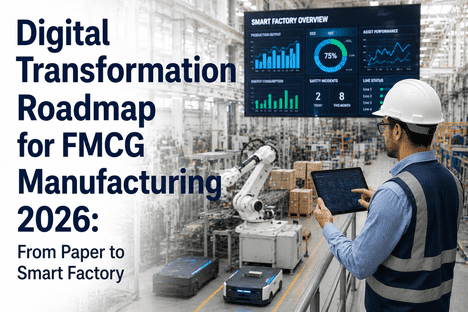
The FMCG sector is the engine of global commerce — a $13.63 trillion market producing billions of units daily across food, beverages, personal care, and household goods. Yet the manufacturing floor that powered this growth is under extreme pressure: thin margins squeezed by raw material volatility (impacting 28% of profitability), supply chain inefficiencies affecting 32% of firms, SKU proliferation demanding faster changeovers, and consumers expecting perfect quality with complete traceability. 75% of FMCG companies identify digital transformation as a top priority, yet only 12% achieve full technology ROI. The companies that get it right are growing sales at double the rate and expanding margins 8% annually. This guide shows how smart factory technologies close that gap. Book a free demo to see iFactory built for FMCG.
Why FMCG Manufacturing Is Different
FMCG plants face challenges that steel, cement, and other heavy industries don't — speed, variety, and regulatory pressure combine to make digital transformation both harder and more valuable:
Filling, packaging, and labeling lines run at thousands of units per minute. Even seconds of downtime cost significant production volume. OEE optimization at this speed demands real-time data, not shift-end reports.
Modern FMCG plants run hundreds of SKUs across shared lines. Changeover times directly cut into productive capacity. AI-driven scheduling and automated parameter adjustments reduce changeover time by 25-40%.
Raw material price fluctuations impact 28% of FMCG profitability. Every percent of waste, rework, or unplanned downtime erodes already-thin margins. Digital optimization targets these micro-losses at scale.
Food safety (FSMA, HACCP), labeling accuracy, allergen management, and batch traceability require airtight digital records. Paper-based systems create compliance gaps and audit vulnerabilities.
32% of FMCG firms face supply chain inefficiencies. Real-time demand signals, predictive inventory, and connected supplier networks turn reactive supply chains into responsive ones. AI improves forecast accuracy by 30%.
Brand reputation lives or dies on product consistency. A single quality incident can cost millions in recalls, lost shelf space, and consumer trust. AI quality inspection catches defects human eyes miss — in real time.
Smart Factory Technologies for FMCG Manufacturing
Six technologies, purpose-built for FMCG speed, complexity, and regulatory requirements:
Real-Time OEE & Production Monitoring
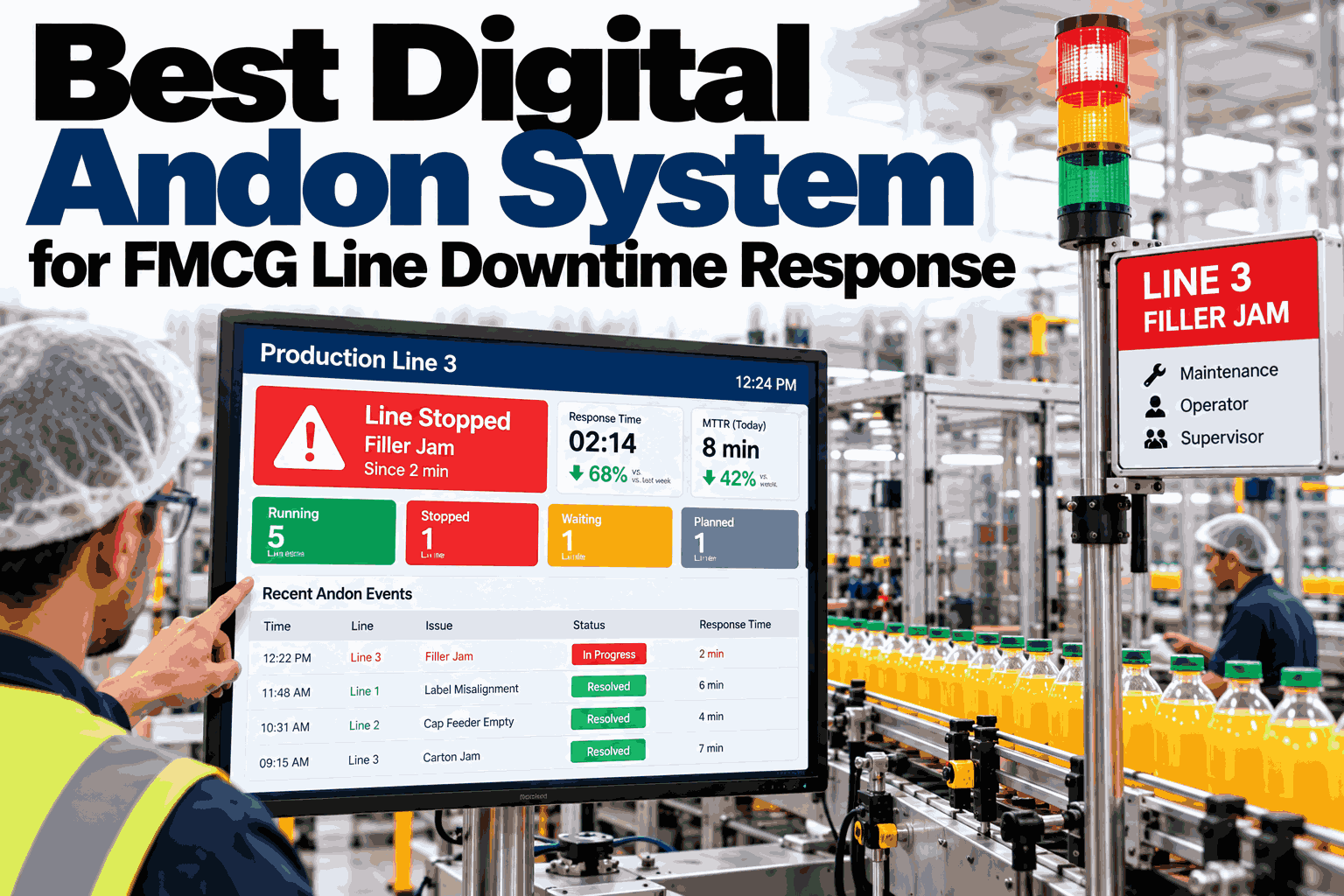
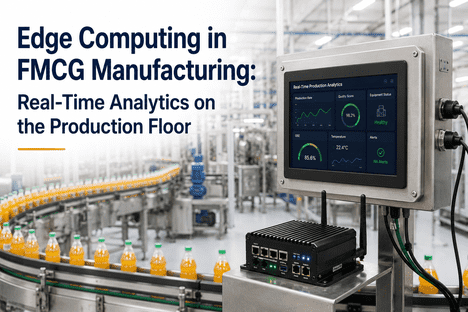
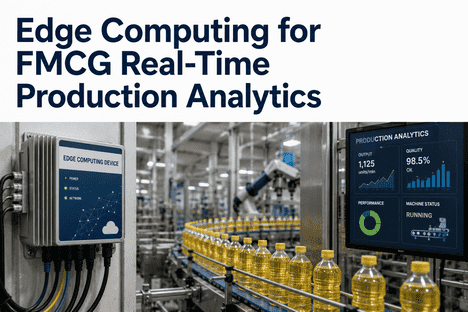
FoundationLive dashboards tracking availability, performance, and quality across every filling line, packaging station, and batch process. Instant alerts when OEE drops below threshold — operators respond in real time, not at shift-end. Connected CMMS links production data to maintenance workflows.
Predictive Maintenance for High-Speed Lines
IoT sensors on motors, bearings, conveyors, pumps, and packaging equipment monitor vibration, temperature, and acoustic signatures 24/7. ML algorithms detect early degradation patterns and auto-generate work orders — preventing the unplanned stops that destroy FMCG line efficiency.
AI Quality Inspection & Compliance
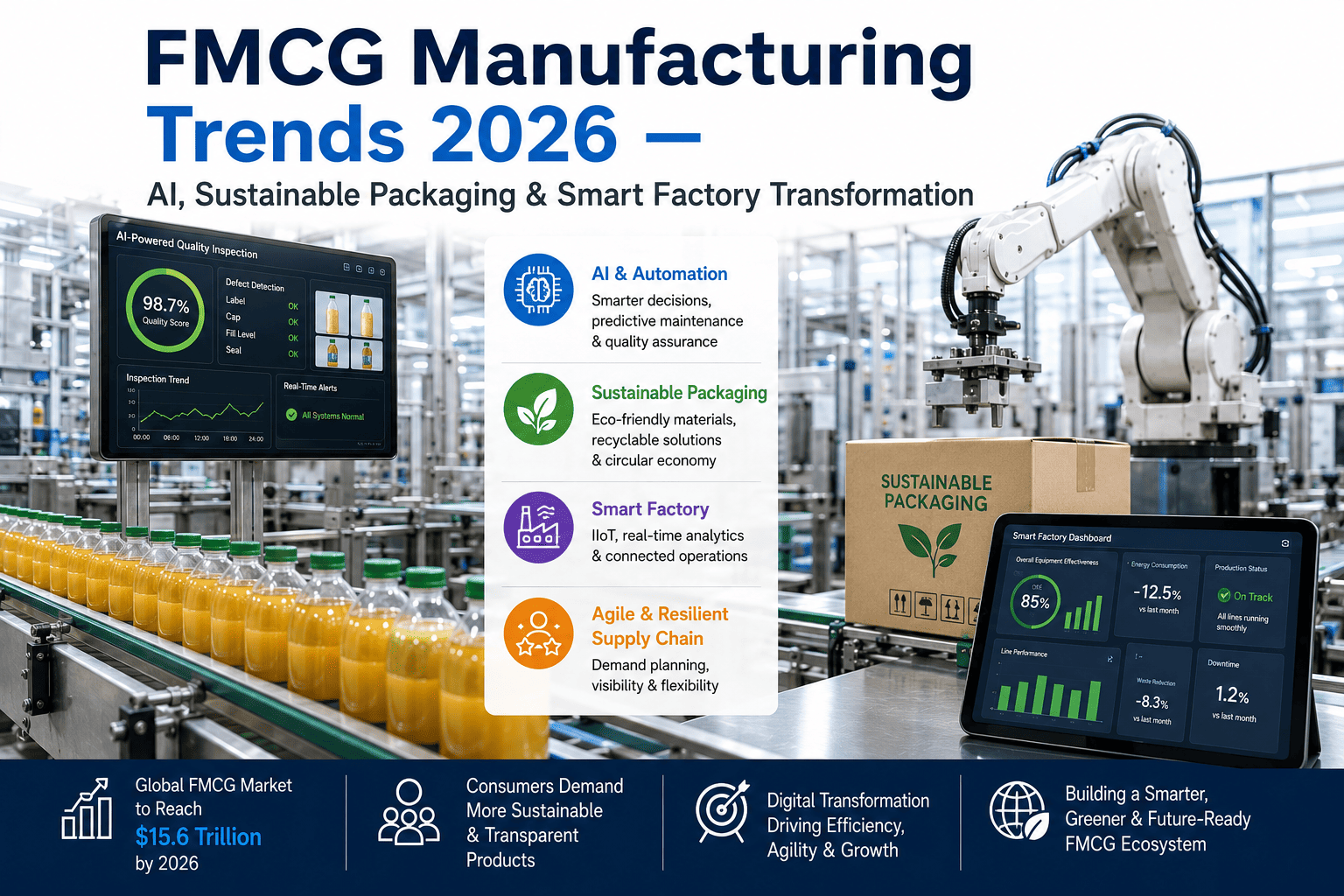
Computer vision systems inspect fill levels, label placement, seal integrity, package condition, and print quality at production speed. AI catches defects invisible to human inspectors — at thousands of units per minute. Every inspection is automatically logged for regulatory traceability.
Smart Scheduling & Changeover Optimization
AI scheduling algorithms optimize production sequences across multi-SKU lines to minimize changeover frequency and duration. Automated parameter pre-sets reduce manual configuration. Orders feed directly into MES, auto-configuring machines, validating designs, and scheduling production with minimal human intervention.
Energy & Waste Optimization
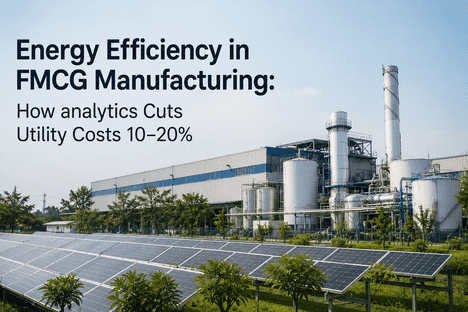
Real-time energy monitoring across heating, cooling, compressed air, and packaging processes identifies waste and optimizes consumption per unit. AI targets the micro-losses that accumulate at FMCG scale — 0.5% waste reduction on millions of units equals massive savings. Digital twins simulate process changes before physical implementation.
Demand-Driven Supply Chain Intelligence
AI-powered forecasting integrates POS data, seasonality, promotions, and market signals to predict demand with 30% more accuracy. Connected supply chains provide real-time visibility from raw material to shelf. Reduces both stockouts and overproduction while cutting waste across the chain.
See the FMCG Smart Factory Platform — In 30 Minutes
Our team will demo real-time OEE dashboards, predictive maintenance alerts, and quality inspection tailored to your production lines — filling, packaging, batch, or continuous.
Traditional vs. Smart FMCG Manufacturing
ROI: What FMCG Manufacturers Are Achieving
| Area | Impact | Timeframe |
|---|---|---|
| Overall Productivity | 20–30% increase from IoT + AI integration | 12–18 months |
| Unplanned Downtime | 50% reduction with predictive maintenance | 3–6 months for first results |
| Maintenance Costs | 25–40% cost reduction; $1 prevents $5 in losses | 6–12 months full ROI |
| Equipment Breakdowns | 70% fewer breakdowns (Deloitte) | Within first year |
| Forecast Accuracy | 30% improvement; 50-80% fewer delays (BCG) | Ongoing improvement |
| Energy Consumption | 10–15% savings; digital twins cut costs 40% | 6–12 months |
| Quality & Waste | 30–45% quality improvement; real-time defect detection | Immediate on deployment |
| First-Year ROI | Positive within 6–9 months for maintenance-quality integration | 6–9 months |
Implementation Roadmap
Start where margins leak most. Prove value. Expand with confidence.
Connect & Monitor
Deploy IoT sensors on highest-impact lines. Launch real-time OEE dashboards. Begin predictive maintenance on critical equipment. Digitize quality logging for compliance.
Optimize & Predict
Activate AI quality inspection and changeover optimization. Deploy energy management analytics. Expand sensor coverage to all critical assets. Connect production data to supply chain forecasting.
Scale & Automate
Deploy digital twins for process simulation. Integrate demand-driven supply chain intelligence. Roll out across all lines and sites. Target autonomous scheduling and self-optimizing production for select processes.
Your FMCG Lines, Digitally Connected — Demo in 30 Minutes
See real-time OEE, predictive maintenance, AI quality inspection, and changeover optimization running on your production profile — filling, batch, packaging, or continuous.