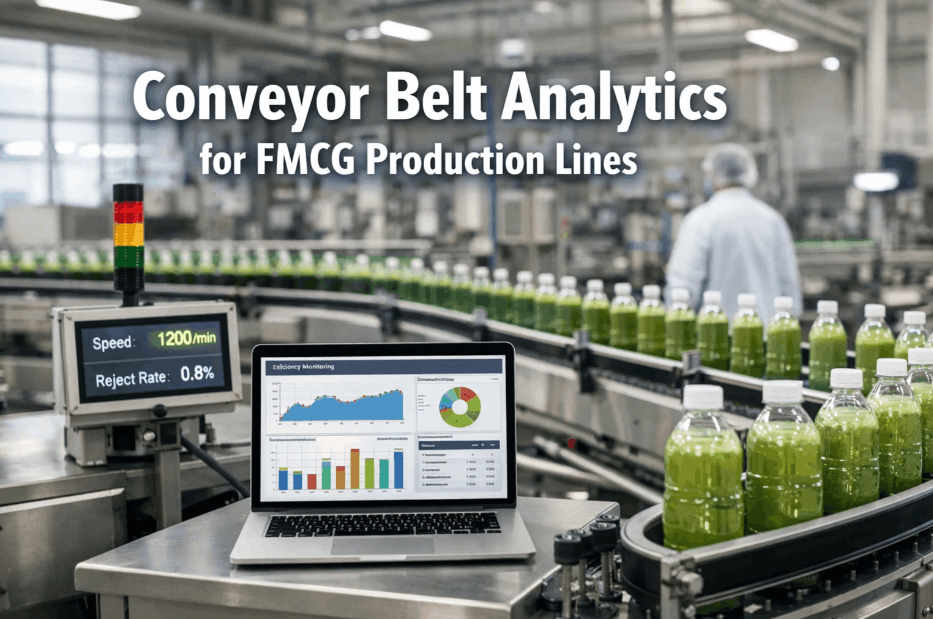
Managing preventive analytics across FMCG production lines is one of the most complex operational challenges in food and consumer goods manufacturing. With high-speed fillers running at 400+ units per minute, rotary packers cycling through dozens of SKUs per shift, and multi-lane conveyors linking every process stage, a single missed PM task can cascade into hours of unplanned downtime, rejected batches, and retailer penalty charges. World-class FMCG facilities do not rely on paper-based schedules or reactive repair models — they deploy structured, equipment-level PM checklists that are digitally tracked, AI-analyzed, and continuously optimized. Book a Demo to see how iFactory's cloud AI platform centralizes your entire FMCG preventive analytics program across every production line, shift, and facility in your network.
FMCG PM CHECKLIST
AI-DRIVEN PLATFORM
PRODUCTION LINE ANALYTICS
Automate Your FMCG Preventive Analytics Program Across All Production Lines
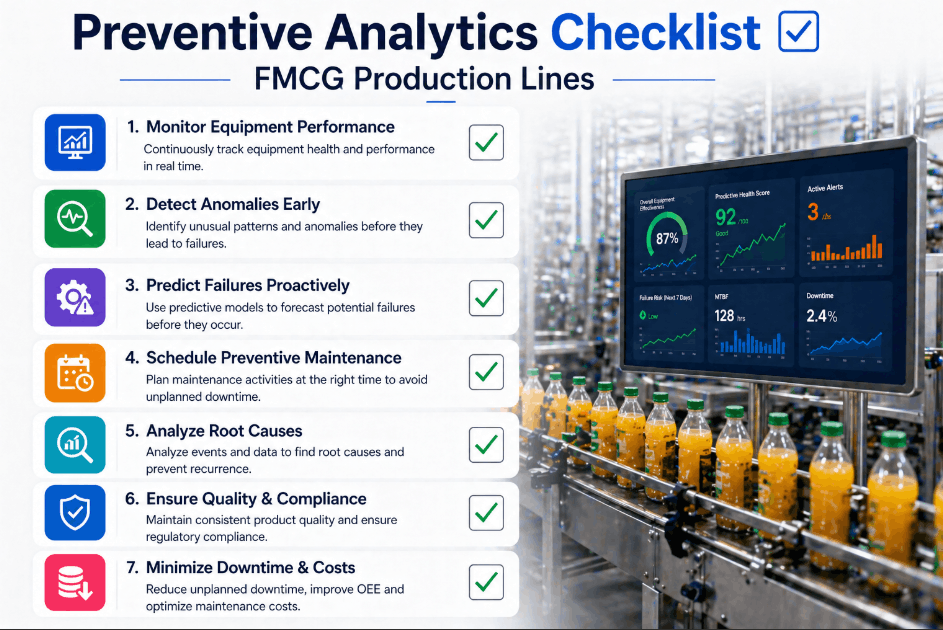
Digitize PM schedules for fillers, packers, conveyors, and processing equipment. Track compliance, reduce unplanned downtime, and stay audit-ready with real-time AI-driven maintenance analytics across your entire FMCG facility.
1. Filler & Dosing Equipment PM Checklist
Protect fill accuracy and hygienic performance on every production run. Fillers are the highest-criticality assets on most FMCG lines. A single calibration drift or seal failure can trigger mass underfill events, overfill waste, or product contamination incidents that result in costly regulatory holds. Book a Demo to digitize your filler PM schedule and connect it to real-time IoT monitoring.
2. Packaging & Wrapping Machine PM Checklist
Ensure seal integrity and throughput consistency on every wrapping cycle. Packaging machines operating at 300–600 packs per minute require precise PM intervals to prevent seal failures, film jams, and retailer-rejected SKUs at the quality gate. Even minor deviations in heat bar temperature or jaw timing create thousands of non-conforming packs per shift.
3. Conveyor & Material Handling PM Checklist
Keep product flow continuous and contamination-free across all conveyor systems. Conveyor failures are the single leading cause of unplanned line stoppages in FMCG plants, yet they are also the most preventable with a structured inspection schedule. Book a Demo to automate your conveyor PM tracking and vibration monitoring with AI-driven alerts.
4. Processing Equipment PM Checklist (Mixers, Blenders & Homogenizers)
Maintain batch consistency and hygienic integrity in all mixing and blending operations. Processing equipment failures mid-batch can result in complete batch write-offs in high-value FMCG categories including beverages, dairy, sauces, and personal care products. PM compliance on these assets directly protects your cost-of-goods performance. Book a Demo to configure your processing equipment PM intervals and CIP validation workflows.
5. Labeling, Coding & Inspection Equipment PM Checklist
Eliminate traceability gaps and print quality failures that generate retailer compliance penalties. Labeling and coding equipment are among the most frequently overlooked PM assets in FMCG plants, yet incorrect or missing date codes are a leading cause of product holds, shelf-life complaints, and regulatory enforcement actions. Book a Demo to integrate your entire coding and inspection equipment into a centralized, AI-driven PM schedule.
6. Refrigeration & Cold Chain Equipment PM Checklist
Safeguard product shelf life and food safety compliance through systematic cold chain maintenance. Refrigeration failures in chilled or frozen FMCG categories represent some of the highest-risk incidents for food safety liability, insurance claims, and regulatory enforcement — particularly in dairy, ready meals, and ambient-sensitive personal care products.
7. Compressed Air & Utility Systems PM Checklist
Maintain clean, dry compressed air supply to protect pneumatic equipment performance and product contact zone hygiene. Compressed air systems are the invisible utility backbone of FMCG production lines, and their degradation directly impacts packaging machine cycle rates, actuator response accuracy, and product zone contamination risk through moisture or oil carryover.
8. Electrical & Control Panel PM Checklist
Prevent electrical failures that cause full-line shutdowns and food safety documentation gaps. Electrical infrastructure is the least-visible yet highest-consequence PM category in FMCG manufacturing. A failed PLC program, tripped thermal overload, or degraded VFD can halt an entire production line for hours during peak retailer demand periods.
9. FMCG PM Program Validation & KPI Review
Close the loop on your preventive analytics program with structured performance reviews and continuous improvement cycles. A PM checklist is only as valuable as the data it generates and the decisions it drives. Use AI-driven analytics to transform your maintenance records into OEE improvement insights and cost reduction opportunities that stakeholders can act on.
DIGITIZE YOUR PM PROGRAM
ZERO UNPLANNED DOWNTIME
Launch Your FMCG Preventive Analytics Digital Transformation Today
Join leading FMCG manufacturers standardizing PM checklists for fillers, packers, conveyors, and processing equipment — tracking equipment health in real time and eliminating unplanned downtime within one AI-driven platform.
Frequently Asked Questions — FMCG Preventive Analytics Checklist
1. How often should preventive analytics be performed on FMCG production line equipment?
PM frequency varies by asset criticality and operating environment. High-speed fillers and packaging machines on continuous duty cycles typically require daily operator checks, weekly technician inspections, and monthly deep PM tasks. Conveyors and utility systems operate on weekly and monthly cycles. The optimal frequency is determined by your Asset Criticality Ranking matrix and refined using MTBF trend data from your AI-driven maintenance platform over time.
2. What is the difference between preventive and predictive analytics in FMCG manufacturing?
Preventive analytics (PM) involves scheduled, time-based or usage-based maintenance tasks performed at defined intervals regardless of asset condition. Predictive analytics (PdM) uses real-time IoT sensor data — vibration, temperature, current draw — to perform maintenance only when the data indicates an asset is approaching a failure threshold. The most effective FMCG maintenance programs combine both: structured PM checklists for inspections and replacements, with predictive monitoring layered on high-criticality assets to catch anomalies between PM cycles.
3. Which FMCG production assets have the highest PM priority and why?
Assets with the highest PM priority are those whose failure stops the entire production line, creates a food safety risk, or has a long spare parts lead time. In most FMCG facilities, this includes primary fillers, HACCP-critical CCP equipment such as metal detectors and pasteurizers, refrigeration compressors, and main conveyor drive systems. These assets should be assigned the highest Asset Criticality Ranking score and receive the shortest PM intervals with the most detailed inspection checklists.
4. How does a digital PM checklist improve FMCG audit readiness compared to paper-based systems?
Digital PM checklists create an immutable, timestamped record of every completed maintenance task, technician signature, corrective action raised, and spare part consumed. This provides auditors with an instantly retrievable, traceable maintenance history that paper-based systems cannot match. Digital systems also eliminate common paper audit failures including illegible handwriting, missing signatures, and lost logbooks, while providing real-time visibility to management on PM compliance rates across all shifts and production lines.
5. Can FMCG PM checklists be customized for different product categories and line speeds?
Yes, effective FMCG PM templates must be customized by product category, packaging format, and line speed. A high-speed confectionery packing line has different PM requirements than a low-speed glass jar filling line for ambient sauces. Key customization parameters include seal bar temperature ranges for different film substrates, fill volume tolerance windows per recipe, CIP cycle parameters per product viscosity, and lubricant specifications for different hygienic zone classifications within the same facility.
6. What is the expected ROI from implementing a structured PM program in an FMCG facility?
FMCG facilities implementing structured digital PM programs typically achieve measurable ROI within 6 to 12 months through three primary value streams: a 15–25% reduction in unplanned downtime, a 10–18% decrease in MRO spare parts spend through optimized ordering and elimination of emergency procurement, and a reduction in audit non-conformances related to maintenance record-keeping. The prevention of even a single product recall event, which can cost millions of dollars in FMCG, typically represents the single highest-value return on any maintenance investment.
7. How should FMCG teams handle PM tasks during high-demand production periods?
PM scheduling during high-demand periods requires a tiered criticality approach. Safety-critical PM tasks on CCP equipment such as metal detector validation and refrigeration temperature checks must never be deferred. Planned maintenance on non-critical assets can be rescheduled to the next available changeover window, provided the deferral is documented with a risk assessment in the maintenance management system. An AI-driven platform can automatically identify which tasks are overdue and flag deferral risks to the maintenance manager before they compound into failures.
8. How many PM checklist items are typically required for a full FMCG production line?
A fully scoped FMCG production line PM program typically contains 150 to 350 individual checklist items across all equipment classes when structured correctly. This includes daily operator checks (15–25 items per line), weekly technician inspections (30–60 items per asset group), monthly electrical and mechanical deep inspections (50–100 items), and quarterly or annual calibration and overhaul tasks (40–80 items). Platforms like iFactory organize these across equipment hierarchies so each technician receives only the relevant tasks for their assigned assets and shift schedule.
TRANSFORM YOUR COMPLIANCE
FMCG PM EXCELLENCE
Start Your FMCG Production Line Preventive Analytics Program Today
Join leading food and consumer goods manufacturers automating PM checklists, tracking equipment health in real time, reducing MRO spend, and passing every audit with complete, timestamped maintenance documentation — all in one AI-driven platform.


![fmcg-production-line-preventive-analytics-[complete-guide]](./manage-post-2k26/uploads/fmcg-production-line-preventive-analytics-[complete-guide].png)