![fmcg-production-line-preventive-analytics-[complete-guide]](./manage-post-2k26/uploads/fmcg-production-line-preventive-analytics-[complete-guide].png)
A complete FMCG production line preventive analytics strategy covers every asset from receiving dock to shipping bay — not just the high-profile packaging lines that get the most attention. Food and beverage manufacturers who deploy comprehensive production line analytics across the full equipment spectrum consistently outperform peers on OEE, food safety compliance, and maintenance labor efficiency. This guide covers every equipment category across a complete FMCG production line, with PM schedules, analytics frequency recommendations, and implementation priorities for each stage of the production process.
Why Complete Production Line Analytics Is Critical for FMCG Operations
Most food manufacturing plants apply analytics inconsistently — concentrating PM resources on packaging lines while neglecting raw material handling, utilities, and end-of-line logistics equipment. The result is a predictable pattern: visible production line assets are over-maintained while upstream and downstream equipment silently accumulates degradation until a failure disrupts the entire throughput chain. A complete food production line analytics program eliminates this structural vulnerability by treating every equipment category as part of an integrated reliability system.
Industry data consistently shows that 38% of unplanned production stoppages in FMCG environments originate outside the primary packaging and processing lines — in utilities, material handling, and ancillary systems that fall outside traditional PM scope. Book a demo to map your facility's analytics coverage gaps against this benchmark and identify the highest-ROI opportunities in your current maintenance program.
Stage 1: Receiving and Raw Material Handling — PM Schedules and Analytics Priorities
The receiving stage is the most consistently under-maintained section of FMCG production lines. Dock levelers, conveyor systems, bulk unloading equipment, and temperature monitoring infrastructure at the receiving dock carry direct food safety implications that are rarely reflected in their PM priority classification. A failure at receiving can contaminate an entire production batch before it reaches a single processing step. Book a demo to see how leading FMCG operators structure their receiving-stage analytics programs for both food safety compliance and uptime performance.
Receiving Dock and Bulk Unloading
Dock levelers, hydraulic loading systems, bulk pneumatic transfer equipment, and receiving conveyors require monthly mechanical inspections covering hydraulic fluid levels, seal condition, and drive chain lubrication. Quarterly full-service intervals should include actuator calibration and wear component replacement. Temperature monitoring sensors at dock doors require weekly calibration checks against reference standards under SQF and FSMA protocols.
PM Schedule Recommendations
Weekly: temperature sensor calibration verification, seal integrity visual inspection. Monthly: hydraulic system service, conveyor lubrication, drive alignment check. Quarterly: full actuator calibration, wear component audit, pneumatic transfer line inspection. Annual: complete overhaul of bulk transfer equipment with seal replacement across all product-contact surfaces. Receiving stage assets should be classified as Tier 2 or above in any hybrid analytics framework.
Raw Material Storage and Handling
Silo systems, bulk bag handling equipment, ingredient conveyors, and storage environment control systems. Silo level sensors, aeration systems, and bin activators require monthly functional testing. Ingredient transfer conveyors — screw, belt, and pneumatic — need quarterly inspection of wear surfaces, seals, and drive components. Cold storage compressors serving raw material areas carry Tier 1 criticality in any food safety-focused analytics framework.
PM Schedule Recommendations
Weekly: silo level sensor verification, cold storage temperature log review. Monthly: bin activator function test, screw conveyor wear inspection, aeration system filter replacement. Quarterly: full silo interior inspection, pneumatic transfer line integrity check, cold storage compressor service. Annual: complete seal replacement on all ingredient-contact conveyor surfaces, silo structural inspection, refrigeration system refrigerant charge verification.
Stage 2: Processing Equipment Analytics — The Heart of FMCG Production Line PM
Processing equipment represents the highest-consequence asset category in FMCG production line analytics. Mixers, blenders, heat exchangers, evaporators, homogenizers, pasteurizers, and fermentation systems sit at the intersection of food safety risk and throughput impact. A failure in any of these systems can trigger product holds, regulatory investigations, and batch losses that dwarf the cost of the underlying maintenance event. Complete analytics for food processing equipment requires both preventive schedule adherence and real-time condition monitoring on critical components.
| Processing Equipment Type | Critical Failure Modes | PM Frequency | Analytics Priority | Food Safety Risk |
|---|---|---|---|---|
| Pasteurizers / Heat Exchangers | Plate fouling, gasket failure, flow deviation | Weekly inspection, Monthly service | Tier 1 Critical | High — direct product safety impact |
| Industrial Mixers / Blenders | Agitator seal wear, gearbox degradation, blade imbalance | Bi-weekly lubrication, Quarterly overhaul | Tier 1 | Medium — batch consistency risk |
| Homogenizers | Valve seat wear, pressure fluctuation, piston seal failure | Weekly pressure check, Monthly seal inspection | Tier 1 Critical | High — product texture and safety |
| Evaporators / Concentrators | Scale buildup, vacuum seal degradation, heating element fouling | Weekly CIP verification, Bi-monthly full service | Tier 1 | Medium — process efficiency impact |
| Fermentation Vessels | Temperature control failure, agitator seal breach, DO sensor drift | Daily sensor calibration, Monthly mechanical service | Tier 1 Critical | High — batch loss and contamination risk |
| Pumps (Product Transfer) | Mechanical seal failure, impeller wear, bearing degradation | Monthly vibration check, Quarterly seal inspection | Tier 1 | Medium — CIP integrity and flow rate |
| CIP Systems | Pump seal failure, valve actuator wear, chemical dosing drift | Weekly flow verification, Monthly full inspection | Tier 1 Critical | Critical — direct food safety control |
CIP systems deserve special emphasis in any FMCG production line PM guide. A CIP pump seal failure mid-cycle does not simply interrupt cleaning — it creates an incomplete sanitation event that can invalidate the entire product batch from a regulatory compliance standpoint. CIP assets should be classified as Tier 1 Critical in all analytics frameworks, with continuous flow and pressure monitoring between scheduled PM events. Book a demo to see how iFactory's platform applies predictive analytics specifically to CIP system health monitoring in beverage, dairy, and protein processing environments.
Stage 3: Packaging Line Analytics — Complete PM Coverage for Every Equipment Type
Packaging line analytics is typically the most developed component of an FMCG maintenance program — yet even here, coverage gaps are common. Form-fill-seal machines, cartoners, labelers, case packers, and end-of-line stretch wrappers each carry distinct failure modes, wear profiles, and PM requirements that demand equipment-specific analytics schedules rather than a single interval applied across the line. A complete production line analytics guide for FMCG packaging addresses each machine category individually.
Form-Fill-Seal (FFS) and Aseptic Filling Machines
FFS machines and aseptic fillers represent the highest-consequence assets on most FMCG packaging lines. Jaw sealing mechanisms require weekly torque and temperature calibration. Film tracking and tension systems need bi-weekly inspection. Servo drive health monitoring should be continuous on high-throughput FFS lines. Aseptic filler sterile air systems and sterilant delivery mechanisms require daily verification against HACCP CCP records. Monthly full mechanical service should cover all product-contact seals, nozzle assemblies, and date code stamping systems. Quarterly overhaul should include complete servo drive inspection and film path wear assessment.
Labeling and Coding Systems
Label applicators, inkjet coders, laser marking systems, and vision inspection cameras are chronically under-maintained in FMCG packaging lines, yet their failure generates regulatory non-compliance events that carry consequences disproportionate to the mechanical simplicity of the failure. Label applicator web path rollers and pad assemblies require weekly cleaning and monthly wear inspection. Inkjet and thermal transfer printer heads require daily purge cycles and weekly deep cleaning. Vision inspection system calibration must be verified at every changeover and documented for FSMA compliance. Book a demo to see how automated analytics tracking eliminates coding and labeling compliance gaps in your production line PM program.
Case Packers, Cartoners, and Palletizers
Secondary packaging equipment — case erectors, cartoners, case sealers, and robotic or conventional palletizers — accumulates high wear rates due to the mechanical stress of handling rigid containers at production speed. Glue systems on case sealers and cartoners require daily temperature verification and weekly nozzle inspection. Case packer servo drives and pneumatic actuators need monthly vibration and pressure checks. Palletizer chain and conveyor systems require bi-weekly lubrication and monthly tension calibration. Robotic palletizer joint wear should be tracked via motor current monitoring for early degradation detection.
Stretch Wrappers, Strapping Systems, and Load Unitizers
End-of-line unitizing equipment is the most consistently neglected category in FMCG packaging line PM programs. Stretch wrapper film carriages and pre-stretch rollers require weekly tension calibration and monthly bearing inspection. Strapping machine feed tracks, sealing heads, and tensioning mechanisms need monthly cleaning and bi-quarterly wear component replacement. Turntable drive systems and wrap arm mechanisms should be included in quarterly drive train inspections alongside primary line equipment rather than treated as standalone maintenance items.
Stage 4: Utilities and Infrastructure Analytics — The Hidden Risk in FMCG Production Line PM
Utilities infrastructure — compressed air, steam, refrigeration, water treatment, and electrical distribution — represents the silent backbone of every FMCG production line. A utilities failure does not just stop one machine; it stops the entire production floor. Despite this outsized impact, utilities systems are frequently assigned lower PM priority than process and packaging equipment, creating a structural reliability gap that experienced plant managers recognize as a primary source of large-loss downtime events.
Stage 5: Material Flow, Conveying, and Sortation Analytics
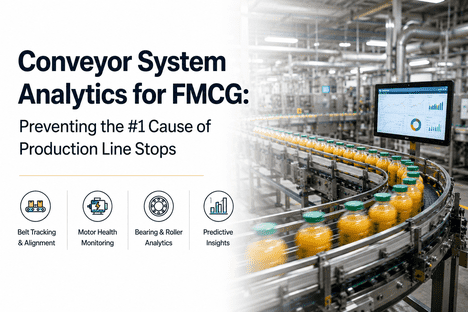
Conveyor systems, sortation equipment, elevators, and inter-stage material transfer infrastructure are the circulatory system of an FMCG production line. Their failure creates domino stoppages that shut down entire line segments rather than single machines. A complete FMCG PM guide treats material flow infrastructure as a distinct analytics category with its own PM schedule framework — not as an afterthought appended to packaging or processing equipment programs. Book a demo to see how iFactory's platform tracks conveyor system health across complex multi-line FMCG facilities with automated PM scheduling and condition monitoring integration.
PM Schedule and Analytics Requirements
Belt tension calibration and tracking adjustment — weekly. Drive motor current monitoring — continuous on main line conveyors. Belt splice and lace inspection — monthly visual with quarterly mechanical check. Conveyor frame and support structure integrity — quarterly. Full belt replacement cycles should be planned based on actual run-hour accumulation and surface wear measurement rather than fixed calendar intervals. Food-contact belt surfaces require documentation of cleaning validation compliance at each PM event for SQF and BRC audit readiness.
PM Schedule and Analytics Requirements
Accumulation conveyors, mass flow tables, and buffer spirals require weekly inspection of product-contact surfaces for wear, burring, and sanitation compliance. Drive chain and roller bearing lubrication — monthly under high-cycle operating conditions. Photo-eye sensor alignment and reflector cleaning — weekly in dusty or product-particulate environments. Spiral conveyor systems require quarterly inspection of drive chain tension, brake system response, and emergency stop function verification under loaded operating conditions.
PM Schedule and Analytics Requirements
Pop-up sorters, sliding shoe sorters, and divert gates require monthly actuator function testing, weekly sensor alignment verification, and quarterly mechanical wear inspection of all moving components. Scanner and barcode reading systems serving automated sortation require weekly calibration and monthly optics cleaning. Reject gate and checkweigher integration systems should be included in packaging line PM schedules — a failed reject system is a food safety non-conformance event, not simply a mechanical failure.
PM Schedule and Analytics Requirements
Bucket elevators, vertical conveyors, and product lifts require monthly inspection of bucket attachment integrity, elevator belt tension, and head and boot pulley alignment. Safety interlock function verification — monthly. Drive chain or belt elongation measurement — quarterly against manufacturer wear limits. Annual qualified inspection of all lifting equipment under local machinery safety regulations, with inspection documentation maintained for regulatory audit access.
Stage 6: Quality Control, Inspection, and Metal Detection Analytics
Quality control equipment — metal detectors, X-ray inspection systems, checkweighers, vision systems, and foreign body detection apparatus — represents a unique analytics category in FMCG production lines. These assets do not produce product; they protect it. Their failure mode is not a production stoppage — it is an undetected food safety non-conformance event that generates recalls, regulatory action, and brand damage. PM analytics for QC equipment must therefore prioritize detection performance verification above all mechanical service metrics.
Analytics and Verification Schedule
Test piece sensitivity verification at line start, after every CIP, after every jam clearance, and at line end — minimum. Weekly aperture cleaning and conveyor belt inspection. Monthly head calibration against certified test pieces. Quarterly full performance validation including product effect testing and sensitivity mapping across the full aperture. Annual third-party calibration verification for BRCGS and SQF compliance documentation.
Analytics and Verification Schedule
Calibration verification with certified reference weights at line start and after every product changeover. Weekly load cell cleaning and zero-point stability check. Monthly full span calibration across the complete product weight range. Quarterly conveyor belt and belt guide inspection for wear that affects product presentation consistency. Annual Legal Metrology re-verification where checkweigher outputs feed trade measurement records.
Analytics and Verification Schedule
Test piece challenge verification at line start, mid-shift, and line end. Weekly detector array cleaning and conveyor belt inspection. Monthly sensitivity and resolution validation against reference test pieces. X-ray tube output monitoring — continuous where system telemetry permits. Quarterly full system calibration with documented challenge test results retained for a minimum of 12 months for FSMA, BRC, and SQF compliance. Book a demo to see automated QC equipment PM tracking in action.
Stage 7: Warehouse, Dispatch, and Shipping Analytics — Completing the Production Line PM Loop
End-of-line warehouse and dispatch equipment closes the complete FMCG production line analytics loop. Automated storage and retrieval systems (AS/RS), pallet conveyors, dock equipment, temperature-controlled dispatch areas, and fleet charging infrastructure each carry production impact if they fail. A batch of finished product held in a warehouse with a malfunctioning AS/RS crane or a dispatch dock with a failed temperature monitoring system creates downstream supply chain disruption that traces directly back to a PM program gap. Complete food line analytics must include warehouse and dispatch infrastructure on the same PM schedule management platform as production equipment.
AS/RS, Pallet Conveyor, and Storage Systems
AS/RS crane mast alignment and rail inspection — monthly. Pallet conveyor chain lubrication and tension — bi-weekly. Reach truck and forklift fleet battery system maintenance — weekly under high-cycle operation. WMS scanner and communication infrastructure — monthly function test. Cold store door and dock seal integrity — weekly visual, monthly mechanical inspection. Automated guided vehicle (AGV) navigation calibration and safety system function — monthly verification under loaded operating conditions with documented test records.
Dock Equipment and Temperature Monitoring
Dock leveler hydraulic and mechanical service — monthly. Dock shelter and seal integrity — monthly visual, quarterly mechanical. Temperature monitoring in finished goods cold stores and dispatch areas — continuous with calibration verification monthly. Door sealing and refrigeration curtain integrity at all chilled and frozen dispatch doors — weekly visual inspection with formal monthly reporting for HACCP cold chain control documentation. Automated dock scheduling and vehicle temperature verification systems require monthly software and sensor verification cycles.
Implementing a Complete FMCG Production Line PM Analytics Program: Prioritization Framework
Deploying comprehensive production line analytics across all seven stages simultaneously is neither practical nor cost-effective. The implementation framework that consistently delivers the fastest ROI begins with a structured asset classification exercise that maps every equipment category against two variables: production impact severity and food safety consequence. The intersection of these two dimensions determines deployment priority sequence — and the analytics method (predictive, condition-enhanced PM, or fixed-interval PM) appropriate for each equipment class.
High Production Impact + High Food Safety Risk
CIP systems, pasteurizers, aseptic fillers, refrigeration compressors (cold chain), metal detection and X-ray systems. Full predictive analytics deployment with continuous condition monitoring. 100% coverage target within Phase 1 of implementation. These assets justify the highest PM investment and deliver the fastest unplanned downtime reduction and compliance improvement ROI.
High Production Impact + Medium Food Safety Risk
Primary packaging line drives, main conveyor systems, compressed air generation, homogenizers, and case packing equipment. Condition-enhanced PM with vibration and thermal monitoring informing interval decisions. Target: condition-informed PM intervals within 90 days of primary asset deployment. These assets deliver significant throughput protection at moderate analytics investment levels.
Medium Production Impact + Medium Food Safety Risk
Secondary packaging equipment, labeling systems, sortation equipment, accumulation conveyors, steam distribution, and water treatment systems. Optimized fixed-interval PM with intervals calibrated to actual asset stress loads and scheduled during lowest production-impact periods. Target: zero PM windows during peak production runs across this asset tier.
Low Production Impact + Low Food Safety Risk
Non-critical ancillary conveyors, stretch wrappers, dock levelers, and run-to-failure eligible components. Formally classify as RTF (Run-To-Failure) with fast-replacement protocols. Maintain a documented RTF asset register to prevent over-investment of PM labor on components that do not justify the maintenance cost relative to their production and safety impact.
FMCG Production Line PM Analytics: Frequently Asked Questions
How many PM schedules does a complete FMCG production line analytics program require?
A complete FMCG production line analytics program spanning all seven stages — receiving, processing, packaging, utilities, material flow, quality control, and warehouse/dispatch — typically encompasses 80–150 distinct PM schedule configurations depending on facility scale. The critical requirement is that each schedule is calibrated to the specific failure mode profile of its asset class rather than using a single interval applied broadly. PM interval standardization across dissimilar equipment is the primary cause of both over-maintenance and under-maintenance in FMCG plants.
What is the recommended starting point for a complete production line PM analytics rollout in FMCG?
Begin with a full asset inventory and criticality classification exercise before deploying any new analytics schedules or predictive tools. Map every equipment item against production impact and food safety consequence. Identify where PM schedules currently exist, where gaps exist, and which assets have condition monitoring data available. This baseline assessment — typically a 2–3 week structured exercise — provides the prioritization framework that makes all subsequent analytics investment decisions defensible and ROI-focused.
Which FMCG production line stage is most commonly under-maintained despite high risk?
Utilities infrastructure — particularly compressed air, refrigeration, and CIP systems — is consistently the most under-maintained category relative to its production and food safety risk profile. These systems sit outside the visual production line and are often managed by separate engineering teams with less rigorous PM scheduling than process and packaging equipment. Yet a single compressor failure or CIP system malfunction can stop an entire production floor and generate food safety non-conformances that calendar-based inspection programs at the process level cannot prevent.
How does complete production line analytics affect food safety audit outcomes?
A documented, comprehensive production line PM analytics program covering all seven stages creates a substantially stronger audit position under BRC, SQF, FSMA, and HACCP frameworks than a program focused exclusively on process equipment. Auditors specifically examine PM coverage of food safety control points — pasteurizer performance, CIP system integrity, metal detection calibration, cold chain monitoring — and the absence of documented PM schedules for these systems is a common source of major non-conformances. Complete line-wide analytics documentation directly converts into faster audit clearance and fewer CAP requirements.
Can existing CMMS systems support a complete FMCG production line PM analytics program?
Most CMMS platforms can store and schedule PM work orders across all asset classes, but lack the condition monitoring integration, AI-driven interval optimization, and predictive escalation capabilities required for a high-performance hybrid analytics strategy. The most effective approach integrates existing CMMS infrastructure with an AI-driven reliability layer that augments scheduling decisions with real-time condition data — rather than replacing the CMMS or attempting to replicate predictive capabilities through manual PM schedule management alone.