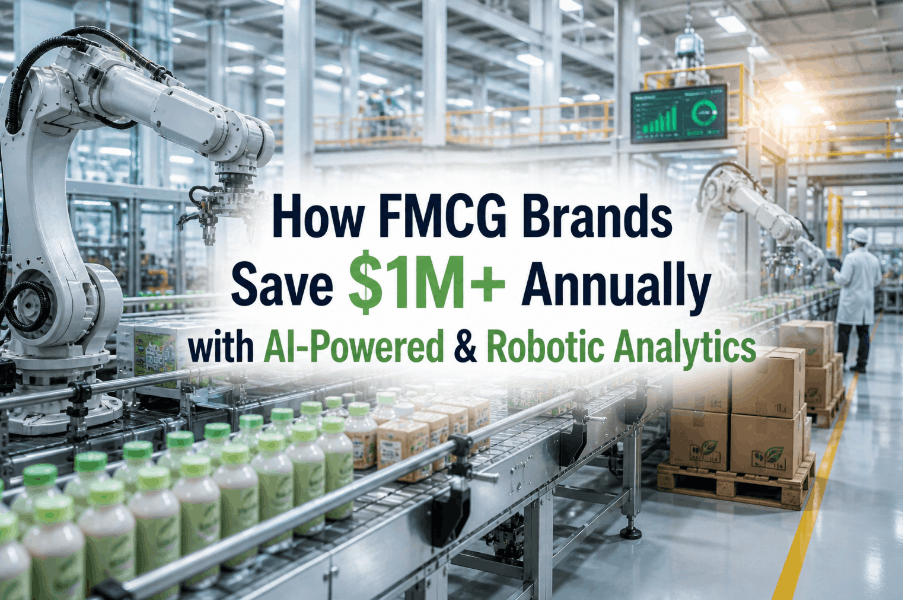
Leading FMCG brands — from Nestlé and Unilever to Procter & Gamble — are no longer experimenting with artificial intelligence. They are scaling it across manufacturing plants, supply chains, and quality control systems to capture measurable competitive advantages. AI in FMCG manufacturing has moved from pilot projects to enterprise-wide deployment, delivering double-digit reductions in production waste, dramatic improvements in forecast accuracy, and real-time visibility into operations that were previously managed by intuition and spreadsheets. If your organization is still evaluating where AI fits, Book a Demo to see how AI-powered operations intelligence is closing the gap between industry leaders and everyone else.
FMCG AI · CONSUMER GOODS OPERATIONS · MANUFACTURING INTELLIGENCE
See How AI Transforms FMCG Operations in Real Time
Deploy the same AI-driven operations platform used by leading consumer goods manufacturers to reduce waste, boost line efficiency, and eliminate unplanned downtime across every facility.
Why FMCG Brands Are Accelerating AI Adoption in Manufacturing
The consumer goods sector faces a unique convergence of pressures: commodity price volatility, compressed profit margins, shortened product lifecycles, and consumer demand for greater product variety at consistent quality. Global CPG companies collectively lose an estimated $75 billion annually to supply chain inefficiencies, quality failures, and unplanned production downtime — and AI in FMCG manufacturing directly targets each of these cost centers. The brands winning on shelf are increasingly the brands winning on the factory floor first. Interested in benchmarking your operations? Book a Demo and receive a facility-specific efficiency gap analysis.
Nestlé AI Manufacturing: How the World's Largest Food Company Scaled Intelligence
Across more than 400 factories worldwide, Nestlé has embedded machine learning into production scheduling, quality inspection, and predictive maintenance workflows. Computer vision systems perform real-time defect detection — flagging fill-weight deviations, packaging misalignments, and label errors before products move downstream — while AI demand forecasting models incorporate weather patterns, social media sentiment, and point-of-sale data to reduce safety stock requirements and eliminate end-of-life product write-offs at scale.
Unilever AI Operations: Driving Sustainability and Efficiency Simultaneously
Unilever uses AI-powered energy management to dynamically reallocate production loads in real time, cutting electricity costs by over 15% without capital investment in new equipment. Machine learning models simultaneously accelerate new product development by analyzing ingredient interactions, consumer preference signals, and regulatory requirements — compressing formulation cycles from months to days. Exploring similar gains at your facility? Book a Demo to map Unilever-style AI capabilities onto your operations.
P&G AI Manufacturing: Precision Operations at Scale
Procter & Gamble deploys AI systems that adjust process parameters — mixing times, temperature profiles, chemical dosing rates — in real time based on upstream ingredient variability, holding finished product specifications within tighter tolerances than traditional fixed-recipe manufacturing allows. During the supply disruptions of 2020–2021, P&G's AI-powered supply models enabled rapid sourcing reroutes and SKU prioritization, maintaining retail availability rates significantly above industry peers — a capability now institutionalized as a permanent risk management function.
Nestlé
↓ 67%
Defect escape rate via AI computer vision
Unilever
↓ 15%
Energy cost per unit via AI load management
P&G
↑ 20%
On-shelf availability during supply disruptions
Danone
↓ 30%
Demand forecast error via AI demand sensing
Core AI Applications Reshaping FMCG Manufacturing Operations
Leading consumer goods brands concentrate AI investment across six proven use cases — each delivering measurable ROI within the first production year. Book a Demo to see which applications align with your facility's highest-priority operational challenges.
01
Predictive Maintenance
Analyzes vibration, temperature, and motor data to predict failures — auto-triggering work orders and pre-positioning spare parts before breakdown occurs.
↓ 50% unplanned downtime
02
AI Quality Inspection
Computer vision inspects 100% of output at full line speed — catching fill-weight deviations, seal failures, and label errors that statistical sampling misses.
↓ 67% defect escape rate
03
Demand Sensing
Ingests live POS data, weather signals, and promo calendars to update SKU-level forecasts daily — replacing the outdated monthly S&OP cycle entirely.
↓ 30% forecast error
04
Process Yield Optimization
Identifies optimal temperatures, pressures, and mixing times continuously — maximizing raw material yield and reducing batch waste without manual intervention.
↑ 12% yield improvement
05
Workforce Intelligence
AI labor planning aligns staffing with actual production demand across 24/7 operations — eliminating overstaffing costs and safety risk from understaffing simultaneously.
↓ 18% labor overhead
06
Supply Chain Resilience
Continuous AI scenario modeling detects supply disruption signals early — rerouting sourcing and reprioritizing SKUs before a crisis reaches the production floor.
↑ 20% OTIF delivery rate
AI vs. Traditional Operations: What Changes and What It Costs Not to Change
The performance gap between FMCG brands running AI-driven operations and those still relying on legacy management practices is widening every quarter. The comparison below captures the structural difference across the dimensions that matter most to plant managers, supply chain directors, and CFOs.
Operational Dimension
Traditional Approach
AI-Driven FMCG Operations
Maintenance Planning
Reactive repairs after failure occurs
Predictive alerts 30–90 days before failure
Quality Control
Statistical sampling — defects slip through
100% vision inspection at full line speed
Demand Forecasting
Monthly S&OP cycle with 3–4 week lag
Daily AI demand sensing from live POS data
Process Control
Fixed-recipe parameters, manual adjustments
Real-time closed-loop parameter optimization
Supply Chain Risk
Reactive escalation after disruption hits
Continuous early-warning scenario modeling
Energy Management
Fixed schedules, high peak demand charges
AI load balancing cuts energy cost by 15%+
Decision Speed
Hours or days via manual reporting cycles
Real-time alerts with automated work triggers
Multi-Site Visibility
Siloed plant-level spreadsheets
Unified fleet dashboard, cross-site benchmarking
FMCG AI Implementation: What the Leaders Do Differently
Brands that extract maximum value from consumer goods AI share one non-negotiable starting point: a clean data infrastructure. Production systems, quality databases, and ERP platforms must generate structured, timestamped data before any model is deployed — because AI built on fragmented inputs produces fragmented outputs. The second differentiator is operational ownership: the most successful FMCG AI programs are run by plant managers and reliability engineers, not IT teams, ensuring that AI recommendations translate into production decisions rather than unused dashboard data. Need a structured deployment path? Book a Demo for a step-by-step implementation roadmap tailored to your facility.
ROI Benchmarks: Measuring AI Performance in Consumer Goods Manufacturing
Quantifying FMCG AI return requires tracking OEE improvement, unplanned downtime cost, first-pass quality yield, demand forecast MAPE, and total maintenance spend per unit produced — measured before and after deployment at the production line level. The benchmarks below reflect published outcomes from food and beverage manufacturers deploying integrated AI manufacturing platforms across single and multi-site networks.
38%
Average OEE improvement within 12 months of AI deployment
4.2x
Median ROI vs. traditional time-based operations management
44%
Raw material waste reduction via AI yield optimization
89%
On-time-in-full delivery improvement from AI supply chain visibility
FMCG AI Deployment Timeline: From First Sensor to Full-Scale ROI
Most FMCG facilities go live with measurable AI outcomes within one production quarter — but knowing what happens at each phase removes the guesswork from budgeting, resourcing, and stakeholder alignment. Here is how a structured AI deployment unfolds from day one to enterprise scale.
Phase 1 — Days 1–14
Data Audit & Sensor Commissioning
ERP, CMMS, and production databases are mapped. IoT sensors are installed on Tier 1 and Tier 2 assets. Baseline OEE and downtime benchmarks are recorded before any AI model is activated.
Foundation
Phase 2 — Days 15–45
AI Model Training & Initial Scoring
Criticality scores are generated within 72 hours of data integration. Predictive maintenance models are trained on historical failure records. First anomaly alerts begin surfacing within 30 days.
First Alerts Live
Phase 3 — Days 46–90
CMMS Integration & Workflow Automation
AI alerts are connected to automatic work order generation in SAP PM, Oracle EAM, or existing CMMS. Maintenance planners begin acting on AI recommendations. First measurable downtime reductions recorded.
ROI Begins
Phase 4 — Month 4–12
Full Fleet Deployment & Continuous Optimization
AI rolls out across all asset tiers and production lines. Demand sensing, quality inspection, and supply chain AI are activated. Multi-site benchmarking dashboard goes live. Facilities consistently report 35–50% unplanned downtime reduction at this stage.
Full Scale
Frequently Asked Questions: AI in FMCG Manufacturing
How are leading FMCG brands like Nestlé and Unilever funding their AI manufacturing programs?
Most major FMCG brands fund AI programs through operational savings reinvestment — Nestlé funded much of its AI quality inspection rollout from recall cost avoidance, while Unilever used energy savings to finance further platform expansion. AI programs typically become self-funding within 18 to 24 months when deployed on high-impact use cases first.
Can mid-size FMCG manufacturers access the same AI capabilities as Nestlé or P&G?
Yes. Cloud-based AI manufacturing platforms have democratized access to enterprise-grade intelligence without requiring internal data science teams or heavy IT infrastructure. Mid-size consumer goods manufacturers are increasingly achieving ROI timelines competitive with the largest global FMCG companies.
What data does an AI manufacturing platform require from an FMCG facility?
The core inputs are production sensor telemetry (vibration, temperature, motor current), CMMS maintenance history, ERP production and inventory records, and quality inspection outcomes. Modern platforms integrate via API with existing systems, meaning deployment begins with whatever structured operational data the facility currently generates.
How long does it take to see measurable results from FMCG AI deployment?
Predictive maintenance and quality inspection results typically emerge within 60 to 90 days of sensor commissioning. Supply chain AI applications require one full seasonal cycle for calibration, with meaningful improvements visible within 6 to 9 months. OEE improvements from process optimization often appear within the first production quarter.
Does FMCG AI replace operations staff or augment them?
AI augments operations teams — it surfaces decisions faster and with greater precision than manual analysis allows, but experienced plant managers, reliability engineers, and quality teams remain essential for acting on AI recommendations. The human-in-the-loop model is what converts AI outputs into production improvements rather than dashboards nobody reads.
Your Competitors Are Already Deploying AI. Don't Let Them Widen the Gap.
See exactly how AI-powered manufacturing intelligence can reduce your unplanned downtime, improve quality yield, and optimize your maintenance spend — with a personalized demo built around your facility's actual asset profile.
![how-fmcg-brands-use-ai-to-improve-operations-[real-results]](./manage-post-2k26/uploads/how-fmcg-brands-use-ai-to-improve-operations-[real-results].png)