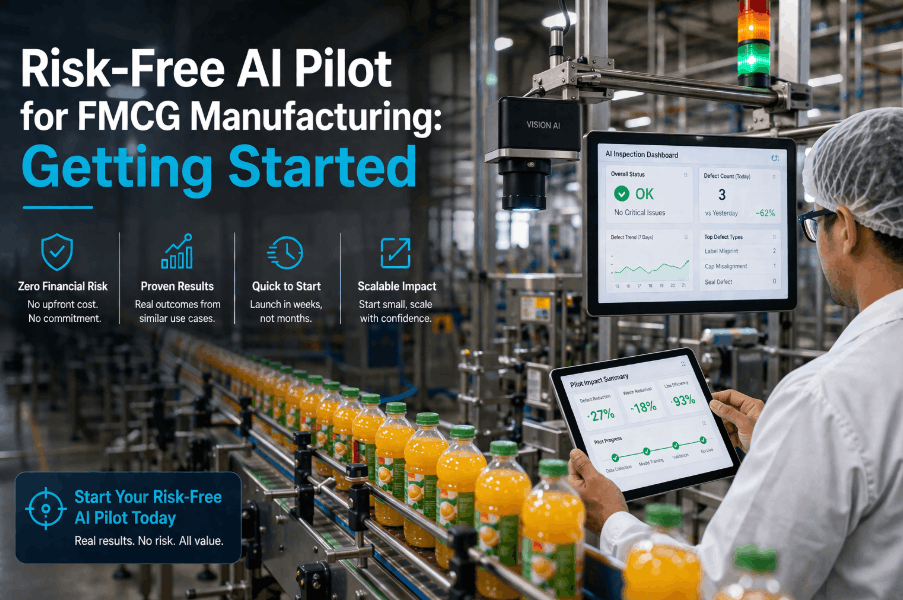
Launching an AI pilot in FMCG manufacturing no longer requires a multi-million-dollar budget, a dedicated data science team, or months of infrastructure build-out. Food and consumer goods plants that are winning with AI in 2025 started exactly where you are — with one production line, one high-impact problem, and a structured approach to proving value before scaling. This guide walks you through every stage of a risk-free AI pilot: equipment selection, sensor deployment, capturing quick wins, and building the business case that unlocks enterprise-wide rollout. Ready to see what a pilot looks like in your facility? Book a Demo for a no-obligation facility assessment.
AI PILOT · FMCG MANUFACTURING · RISK-FREE DEPLOYMENT
Start Your AI Pilot with Zero Guesswork
Get a facility-specific AI pilot roadmap — asset prioritization, sensor deployment plan, and 90-day quick-win targets built around your production environment.
Why FMCG Plants Should Start an AI Pilot Now — Not After "Full Readiness"
The most common reason food and consumer goods manufacturers delay AI adoption is the belief that they need perfect data, fully integrated systems, or a greenfield facility before a pilot can succeed. That belief is costing them competitive ground every quarter. The reality is that a well-scoped AI pilot in a food manufacturing plant can deliver measurable results within 60 to 90 days using the operational data your facility already generates — CMMS records, production logs, vibration readings from existing sensors, and ERP inventory exports. Waiting for perfect conditions is not risk management. It is the risk.
The FMCG sector faces compounding pressure from commodity price volatility, SKU proliferation, tightening food safety regulations, and rising energy costs. AI addresses each of these levers — but only for manufacturers who move. If you're evaluating where to start, Book a Demo and receive a pre-scoped pilot recommendation based on your facility type and asset profile.
The 4 Principles of a Risk-Free AI Pilot in Food and Consumer Goods Manufacturing
A risk-free AI pilot for FMCG is not about minimizing ambition — it is about maximizing the probability of a measurable outcome within a defined window. Every successful AI rollout in food manufacturing shares four foundational principles.
01
Narrow the Scope
Pilot on one production line or one asset class — not the entire plant. Narrowing scope eliminates integration complexity, reduces cost, and produces a clean before-and-after comparison that leadership can act on.
02
Pick the Highest-Pain Problem
Start with the failure mode or inefficiency that costs the most — unplanned downtime, first-pass quality failures, or demand forecast error. High-pain problems produce high-visibility wins that justify the next phase of investment.
03
Use Existing Data First
Modern AI platforms integrate with CMMS history, ERP exports, and existing PLC data before a single new sensor is installed. Starting with existing data reduces upfront cost and accelerates time-to-first-insight.
04
Define Success Before You Start
Set a specific, measurable KPI for the pilot — a 20% reduction in unplanned downtime, a 15% drop in defect escape rate, or a 25% improvement in forecast MAPE. Without a pre-agreed success metric, every result is debatable.
How to Select the Right Equipment for Your First AI Pilot
Equipment selection is the highest-leverage decision in any FMCG AI implementation. The wrong asset choice produces noisy data, weak results, and a pilot that stalls before it generates momentum. Use the following framework to identify your highest-value pilot asset — and if you want an expert to do this analysis for your facility, Book a Demo for a guided asset criticality assessment.
Failure Frequency
Assets that fail 2–4 times per year generate enough failure history for a predictive model to train on without multi-year wait times
2+ failures in past 18 months
Downtime Cost
Prioritize assets where each unplanned stoppage costs more than $10,000 in lost production, labor, and material waste — ROI appears fastest here
$10K+ per unplanned event
Data Availability
Assets already connected to a PLC, SCADA system, or existing vibration monitoring provide a faster path to model training than assets with zero digital history
Existing CMMS records or PLC data
Bottleneck Position
Assets on the critical production path — where failure stops the entire line — amplify the business impact of every hour of uptime gained
Upstream of line constraint
Failure Mode Clarity
Assets with well-understood failure modes — bearing degradation, seal wear, pump cavitation — are easier to model than assets with random or multi-cause failures
Known mechanical degradation pattern
Sensor Deployment for FMCG AI Pilots: What You Actually Need
One of the most common misconceptions about starting AI in a food plant is that sensor deployment is expensive, disruptive, and time-consuming. For a focused pilot, the opposite is true. A three-sensor installation on a critical asset — vibration, temperature, and motor current — can be completed in under four hours without halting production. This minimal sensor footprint is sufficient to detect 80% of the failure modes that cause unplanned downtime in rotating FMCG equipment including compressors, conveyors, mixers, and pumps.
Vibration
Detects bearing wear, imbalance, misalignment, and structural resonance. The single highest-signal sensor type for rotating asset health in food manufacturing environments.
Detects 60%+ of failure precursors
Temperature
Motor winding temperature and bearing housing temperature confirm whether vibration anomalies are developing into thermal failures — reducing false alert rates significantly.
Confirms thermal degradation
Motor Current
Current draw signature analysis reveals rotor bar faults, mechanical load changes, and lubrication degradation without any physical contact with the rotating assembly.
Non-invasive installation
Acoustic Emission
High-frequency acoustic sensors catch early-stage lubrication failures and micro-crack propagation in gearboxes and bearings up to 8 weeks before vibration signals emerge.
Earliest possible warning signal
The 90-Day AI Pilot Roadmap for FMCG Manufacturers
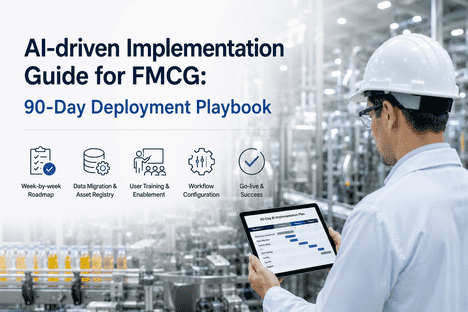
A structured 90-day timeline converts an AI pilot in food manufacturing from a technology experiment into a business case. Each phase has a specific deliverable — not a vague milestone — so stakeholders at every level of the organization can track progress and make resourcing decisions. Want this roadmap applied to your specific facility and production environment? Book a Demo and walk away with a customized 90-day deployment plan.
Days 1 – 14
Baseline & Data Audit
Map existing data sources — CMMS maintenance history, ERP downtime logs, PLC sensor exports. Install sensors on the two highest-criticality pilot assets. Record baseline OEE, unplanned downtime frequency, and maintenance cost per unit for the pilot line. This baseline is the benchmark every subsequent measurement is compared against.
Deliverable: Baseline KPI Report
Days 15 – 30
Model Training & First Anomaly Alerts
AI models are trained on historical CMMS failure records combined with live sensor telemetry. Criticality scoring is generated within 72 hours of data ingestion. The first anomaly alerts surface within three weeks — giving maintenance planners their initial opportunity to act on AI recommendations before any failure occurs.
Deliverable: First Live Alerts
Days 31 – 60
Workflow Integration & Quick Wins
AI alerts are connected to automatic work order generation in your existing CMMS — SAP PM, IBM Maximo, or equivalent. Maintenance planners begin acting on predictions. The first avoided failures are documented and quantified in lost-production terms. This is where the pilot generates its first hard ROI data point for the CFO conversation.
Deliverable: First Avoided Failure
Days 61 – 90
Business Case & Scale Decision
Pilot KPIs are compiled against the pre-agreed success metrics: downtime reduction percentage, maintenance cost change, quality yield improvement. A full-facility scaling proposal — asset prioritization, phased rollout timeline, and projected 12-month ROI — is prepared for leadership sign-off. Most FMCG pilots at this stage report 30–50% unplanned downtime reduction on pilot assets.
Deliverable: Scale Proposal & ROI Model
AI Quick Wins in FMCG: The 5 Results Most Plants See in the First Quarter
Understanding what AI quick wins in food manufacturing look like in practice helps set realistic expectations and gives plant managers the right metrics to track from day one. The five outcomes below are the most consistently reported results from FMCG facilities in their first 90-day AI pilot — and each one is measurable at the production line level without enterprise-level data infrastructure.
1
An Avoided Unplanned Stoppage
The clearest early win in any predictive maintenance pilot is a documented avoided failure — where an AI alert triggered a planned intervention that prevented an unplanned breakdown. A single avoided stoppage on a critical FMCG line typically saves between $15,000 and $80,000 in lost production, emergency labor, and component replacement costs.
2
Reduction in Reactive Maintenance Work Orders
As AI-driven planned interventions replace reactive callouts, maintenance teams report a measurable shift in work order mix — from reactive to planned — within the first production quarter. This shift reduces overtime costs, spare parts expediting fees, and the safety risk associated with emergency repairs.
3
Improved First-Pass Quality Yield
For pilots incorporating AI quality inspection, the first measurable result is a reduction in end-of-line defect rates — typically 15–25% within 60 days of computer vision deployment. For food manufacturers operating under strict retailer quality agreements, this improvement directly reduces charge-backs and returns.
4
Visibility Into Previously Hidden Losses
AI dashboards surface micro-stoppages, speed losses, and quality rejects that traditional OEE reporting misses because they fall below the threshold of a logged event. Most plants discover that 20–35% of their true production losses were invisible before AI monitoring was deployed.
5
Maintenance Team Confidence in AI Recommendations
The most underrated quick win is operational: when a maintenance engineer acts on an AI alert and the intervention prevents the predicted failure, it builds trust in the system. That trust is the social infrastructure that makes full-scale AI rollout fast and smooth — and it is built in the pilot phase, not after.
Common Pilot Failure Modes — and How to Avoid Them
The majority of FMCG AI pilot failures are not technology failures. They are organizational failures — scope creep, absent executive sponsorship, and success metrics that nobody agreed on before the sensor was installed. Knowing the failure modes in advance is what separates a successful 90-day pilot from a project that quietly dies in month four. If you want a structured deployment framework that addresses these risks from day one, Book a Demo and our implementation team will walk you through the safeguards built into every iFactory deployment.
Pilot Failure Mode
Too Many Assets, Too Soon
Starting a pilot across 20 assets generates fragmented data, diffuse attention, and no clear success story. Narrow to two or three assets and achieve a definitive result before expanding.
Pilot Failure Mode
No Pre-Agreed Success Metric
Without a specific KPI agreed before deployment, every result is open to interpretation. Lock in one measurable target — downtime reduction percentage, forecast error MAPE, or defect rate — before sensors go in.
Pilot Failure Mode
IT Ownership Instead of Operations
AI pilots owned by IT teams produce dashboards nobody reads. Successful pilots are owned by plant managers and reliability engineers who convert AI recommendations into production decisions daily.
Pilot Failure Mode
Waiting for Perfect Data
No FMCG facility has perfect data. Modern AI platforms are designed to start with imperfect, incomplete historical data and improve model accuracy iteratively as new sensor data accumulates.
Scaling from Pilot to Plant-Wide AI Deployment in FMCG
A successful 90-day pilot creates two things: a validated ROI model and organizational confidence. Both are essential inputs to the scale decision. The validated ROI model translates directly into a capital expenditure proposal — every additional production line added to the AI platform has a projected payback period based on actual pilot data, not vendor projections. Organizational confidence means that reliability engineers, plant managers, and quality teams have seen AI recommendations work in their facility, with their assets, on their specific failure modes.
The most effective FMCG AI rollout strategies use a hub-and-spoke expansion model: the pilot line becomes the reference site, and each subsequent line or facility is onboarded against a playbook built from pilot learnings. This approach compresses subsequent deployment timelines from 90 days to 30–45 days per additional site. To understand what a multi-site AI expansion looks like for your production network, Book a Demo and receive a facility-by-facility scaling projection.
60–90
Days to first measurable AI result in FMCG predictive maintenance pilot
30–50%
Unplanned downtime reduction reported at 90-day pilot completion
4 hrs
Average sensor installation time per asset — no production shutdown required
3.8x
Median ROI within 12 months of full-facility AI deployment post-pilot
Frequently Asked Questions: Starting an AI Pilot in FMCG Manufacturing
How much does an AI pilot in food manufacturing typically cost?
A focused two-asset predictive maintenance pilot — including sensors, platform access, integration, and model training — typically ranges from $15,000 to $40,000 depending on asset complexity and data availability. Most FMCG facilities recover this investment within one avoided unplanned stoppage event on a high-value production line.
Do we need a data scientist on staff to run an AI pilot?
No. Modern AI manufacturing platforms are designed to be operated by plant managers and reliability engineers without data science expertise. The platform handles model training, alert generation, and performance tracking — your team acts on recommendations and evaluates outcomes against the pre-agreed pilot KPIs.
What if our CMMS data is incomplete or inconsistently logged?
Incomplete CMMS data is the norm in FMCG manufacturing, not the exception. AI platforms that are purpose-built for food and consumer goods facilities are designed to handle sparse historical failure records by using statistical methods to estimate failure probabilities from partial data — then improving accuracy as live sensor data accumulates over the first 30 to 60 days of deployment.
How do we know if the AI pilot has succeeded?
Success is measured against the pre-agreed KPI set before deployment began. The most commonly used metrics in FMCG AI pilots are unplanned downtime reduction percentage, reactive-to-planned maintenance work order ratio, first-pass quality yield improvement, and total maintenance cost per unit produced. A successful pilot produces at least one statistically significant improvement in the primary metric within 90 days.
Can a pilot be run without disrupting existing production schedules?
Yes. Sensor installation on rotating assets takes two to four hours per asset and is performed during scheduled downtime windows. The AI platform operates in monitoring mode initially — it surfaces alerts and recommendations but does not control any production process. Your team decides when and how to act on recommendations, meaning the pilot does not alter production schedules or introduce operational risk.
Your 90-Day AI Pilot Starts With One Conversation.
Get a facility-specific pilot scope, asset prioritization, and projected ROI — built around your actual production environment, not a generic template. No commitment required.