FMCG Production Line Preventive analytics Checklist [Free Download]
By Seren on June 18, 2026
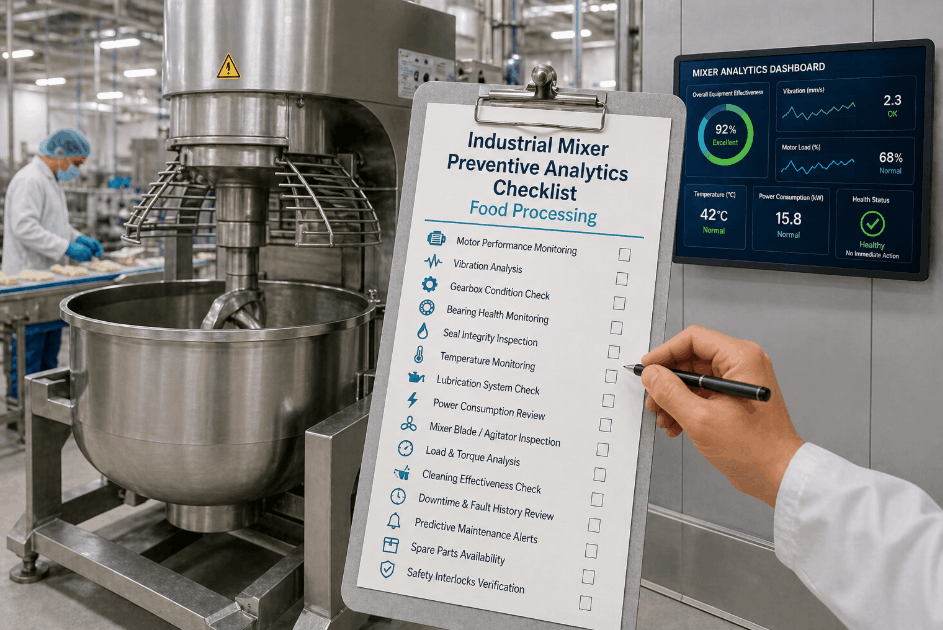
A maintenance supervisor walks the FMCG production line at the start of the shift with a clipboard and a printed checklist. There are 47 inspection points across the mixer, the filler, the conveyor system, the labeler, the case packer, and the palletizer. The supervisor marks each item as pass or fail based on visual inspection and writes comments in the margin when something does not look right. At the end of the shift, the clipboard goes into a filing cabinet. The next supervisor starts the same process with a fresh clipboard. Across the month, 540 inspection records are generated — one for each shift across six lines. None of them are searchable. None of them are analysed for trends. None of them are connected to the maintenance history of the equipment they describe. When a filler nozzle fails at 9:47 PM during the peak production window — causing 1,200 under-filled bottles before the line stops — the investigation takes three days to piece together because the inspection records that would have shown the nozzle wear trend over the preceding eight shifts are buried in paper files. This is the gap that a structured preventive analytics checklist closes, and it is the reason that FMCG production facilities are transitioning from paper-based preventive maintenance checklists to digital Shift Logbook-based preventive analytics workflows that capture inspection data in real time, analyse it for trends, and connect it to Work Order Management and Parts & Inventory systems. Book a Demo to see how iFactory AI's Shift Logbook transforms preventive maintenance checklists into live preventive analytics for FMCG production lines.
FREE CHECKLIST · PREVENTIVE ANALYTICS · FMCG PRODUCTION LINES
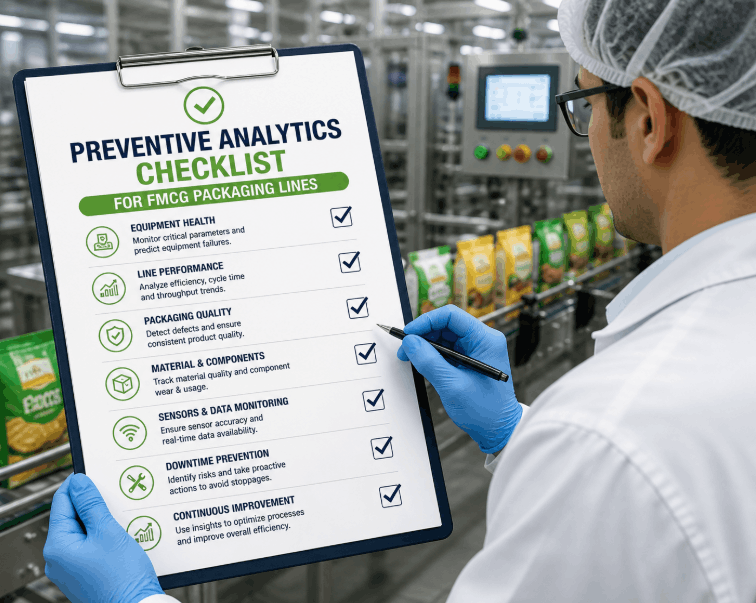
Get the Complete FMCG Production Line Preventive Analytics Checklist — Equipment-Specific Tasks for Mixers, Fillers, Conveyors, Labelers, Case Packers, and Palletizers.
Organized by daily, weekly, monthly, and quarterly schedules. Each checklist item linked to the iFactory Shift Logbook inspection template that captures data, trends, and triggers automated Work Orders when thresholds are exceeded.
Reduction in unplanned downtime reported by FMCG facilities that transitioned from paper-based PM checklists to digital preventive analytics with trend analysis and automated Work Order generation
540
Average inspection records generated per month across six FMCG production lines — none of which are searchable or analysable when recorded on paper checklists stored in filing cabinets
81%
Of FMCG maintenance teams report that paper-based checklists miss 2-3 critical inspection items per shift due to fatigue, time pressure, or incomplete form design
3.4x
Faster root cause analysis when inspection data is captured digitally and searchable — 3.4 days for paper records versus same-shift identification with Shift Logbook analytics
Download the Complete FMCG Production Line Preventive Analytics Checklist
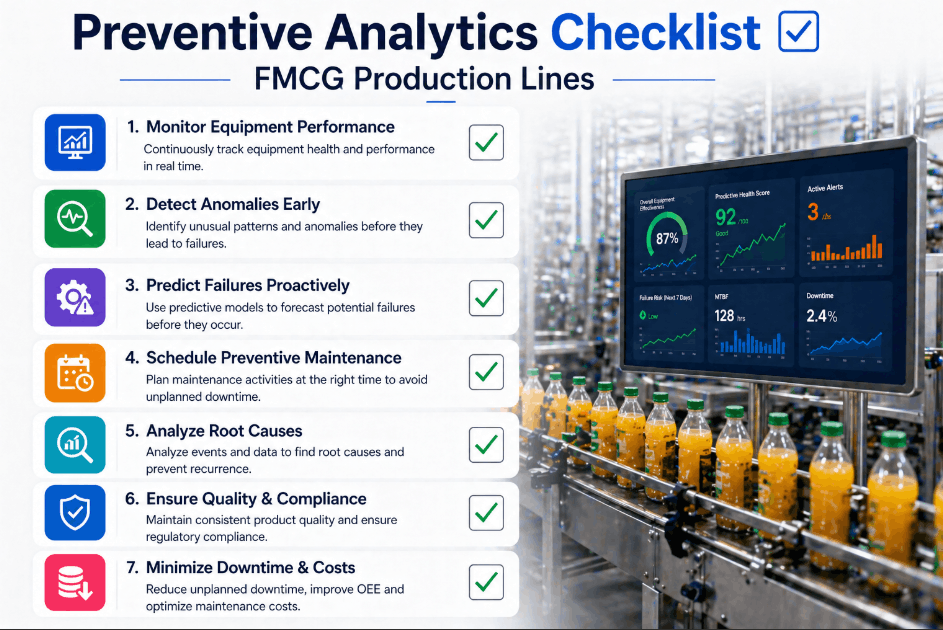
The FMCG Production Line Preventive Analytics Checklist covers 120 inspection points across six critical equipment categories — mixers and blenders, filling machines, conveyor systems, labelers and coders, case packers and cartoners, and palletizers and stretch wrappers. Each inspection point is assigned to a preventive schedule frequency — daily, weekly, monthly, or quarterly — and includes the specific measurement or observation required, the acceptable range or condition, and the follow-up action if the inspection identifies a deviation. The checklist is structured so that every inspection item maps directly to an iFactory Shift Logbook inspection template, enabling FMCG facilities to deploy the checklist in digital form within a single day and begin capturing structured inspection data from the very first shift.
PAPER CHECKLIST — THE HIDDEN DOWNTIME DRIVER
Every shift, the same gaps appear
Checklist items marked pass/fail with no measurement data. A "pass" on a filler nozzle inspection hides a 0.2mm wear progression over 8 shifts.
→
Failure detected only when the nozzle produces out-of-spec fill volumes. 1,200+ units potentially affected before detection.
Completed checklists filed away. No trend analysis. No pattern identification across shifts, lines, or equipment types.
→
Recurring failure patterns remain invisible. The same bearing fails every 9 weeks on conveyor 3 — but nobody connects the pattern.
No connection between inspection results and Work Orders. A failing reading waits for the next scheduled PM cycle.
→
Corrective action delayed by 2-14 days. Downtime occurs during peak production because the inspection finding was never actioned.
DIGITAL PREVENTIVE ANALYTICS — CONTINUOUS EQUIPMENT HEALTH
Every inspection creates actionable data
Measurement data captured digitally — nozzle wear in mm, conveyor belt tension in Hz, bearing temperature in °C.
→
Trend analysis identifies wear progression. Predictive alert generated when measurement crosses 70% of the failure threshold.
All inspection data stored in a searchable database tagged by asset ID, line, shift, and inspector.
→
Pattern recognition across shifts and equipment. Recurring failures identified and addressed proactively before they cause downtime.
Failed inspection items automatically generate Work Orders and Parts & Inventory requests.
→
Corrective action initiated within the same shift. Parts reserved before the maintenance team arrives at the equipment.
Equipment-by-Equipment: The Complete Preventive Analytics Schedule
The full checklist is organized by equipment type with inspection frequency, measurement parameters, acceptable ranges, and follow-up actions specified for each item. Below is the complete schedule structure that FMCG production lines use to transition from paper-based PM to digital preventive analytics.
Equipment
Daily Inspection
Weekly Inspection
Monthly Inspection
Quarterly Inspection
Mixers & Blenders
Agitator speed, motor current draw, discharge valve position, seal integrity visual check, temperature profile vs recipe
Bearing temperature trend, gearbox oil level, coupling alignment, belt tension, vibration measurement
Mechanical seal condition, agitator blade wear measurement, motor insulation resistance, foundation bolt torque
Gearbox oil analysis, motor bearing replacement interval check, shaft alignment laser verification, full system calibration
Fillers
Nozzle condition visual check, fill weight sample (10 units), fill head timing sync, drip tray drain function
Nozzle wear measurement, fill weight trend analysis, CIP verification, seal condition on each head
Nozzle replacement (scheduled), fill head rebuild inspection, flow meter calibration verification, actuator cycle timing
Complete fill head overhaul, flow meter calibration, weigh cell certification, tank level sensor calibration
Applicator pad replacement, sensor recalibration, feed belt replacement, coder timing verification
Full applicator rebuild, vision system calibration, encoder replacement, complete system performance test
Case Packers
Erected case quality check, product loading alignment, glue system function, case seal integrity
Glue nozzle cleaning, magazine feed mechanism check, pusher bar alignment, case dimension check
Glue system rebuild (scheduled), magazine adjustment, pusher bar wear measurement, safety guard function
Complete mechanical overhaul, glue system replacement (as needed), servo drive calibration, full safety system audit
Palletizers & Wrappers
Layer alignment check, clamp function test, film carriage travel, turntable rotation smoothness
Hydraulic oil level, chain tension, gripper head pad condition, film carriage bearing check
Hydraulic system filter replacement, chain lubrication, gripper head rebuild, turntable bearing inspection
Hydraulic oil change, full structural inspection, servo motor bearing replacement, control system backup verification
From Checklist to Analytics: How the Shift Logbook Transforms Preventive Maintenance Data
The difference between a paper checklist and a digital preventive analytics system is not the inspection items — it is what happens to the data after the inspection is completed. iFactory AI's Shift Logbook captures every inspection measurement in a structured database that is searchable, analysable, and connected to Work Order Management and Parts & Inventory. When a filler nozzle wear measurement reaches 0.6mm on the daily inspection, the Shift Logbook automatically creates a Work Order for nozzle replacement and checks Parts & Inventory for the correct nozzle SKU. When the same conveyor bearing temperature shows an upward trend across three consecutive weekly inspections, the system generates a predictive alert that schedules bearing replacement during the next planned changeover window — before the bearing fails and causes unplanned downtime. This is the transition from preventive maintenance — doing inspections on a fixed schedule — to preventive analytics: using inspection data to predict and prevent equipment failure before it affects production.
73%
Faster Issue Detection vs Paper Checklists
Equipment issues identified within the same shift versus 3-7 days for paper-based inspection cycles. Trend analysis catches gradual degradation that paper checklists miss entirely.
94%
Inspection Completion Rate with Digital Checklists
Digital checklists with mandatory fields and time-stamped completion achieve 94% completion versus 67% for paper checklists where items are frequently skipped during peak production periods.
2.8x
Equipment Lifetime with Predictive Analytics
Components replaced based on actual condition rather than fixed calendar intervals last 2.8x longer on average. Predictive analytics identifies the optimal replacement window for every critical component.
"
We operated three FMCG production lines with paper PM checklists for eleven years. Every shift supervisor completed the checklists, filed them, and never looked at them again. When a filler started producing under-filled bottles, we investigated the mechanical cause, replaced the nozzle, and moved on. What we never saw was that the same filler head had been trending toward failure for nine shifts — the paper checklists recorded a pass every time because the nozzle wear was within the pass/fail threshold, but there was no measurement data to show the progression. We deployed iFactory's Shift Logbook with the digital preventive analytics checklist and within the first month identified three filler heads that were following the exact same wear pattern that had caused our last unplanned downtime event. We replaced all three during the next scheduled changeover — zero unplanned downtime, zero under-filled product, zero rework cost. The digital checklist turned our preventive maintenance programme from a compliance exercise into a predictive analytics system that prevents failures before they happen.
— Maintenance Manager, FMCG Manufacturer — Three Production Lines, Digital Shift Logbook Deployment
Implementation Pathway — Deploying Digital Preventive Analytics in 30 Days
Transitioning from paper-based PM checklists to digital preventive analytics follows a consistent three-phase structure that requires no capital equipment investment and no changes to the existing preventive maintenance schedule. The Shift Logbook platform is deployed as a tablet-based or mobile-device-based inspection system that replaces the paper clipboard on day one, and the analytics capability builds automatically as inspection data accumulates.
WEEK 1
Checklist Digitization & Template Configuration
Convert existing paper PM checklists into digital Shift Logbook inspection templates. Map each inspection item to measurement type, acceptable range, and follow-up Work Order trigger. Configure asset hierarchy and line assignments. Deploy to tablet devices on the production floor.
Deliverable: Digital inspection templates ready for first shift deployment.
WEEKS 2-3
Pilot Operation & Baseline Data Collection
Operate digital checklists across 1-2 production lines for two weeks. Collect baseline inspection data. Train shift supervisors and maintenance technicians on Shift Logbook usage. Configure automated Work Order triggers for failed inspection items.
Deliverable: Pilot lines operating on digital Shift Logbook with baseline data established.
WEEK 4+
Full Deployment & Preventive Analytics Activation
Roll out Shift Logbook to all production lines. Activate automated analytics dashboards showing inspection completion rates, measurement trends, Work Order conversion rates, and downtime prevention metrics. Establish KPI targets and review cadence.
Deliverable: All lines on digital preventive analytics with real-time dashboard visibility.
FREE CHECKLIST DOWNLOAD · PREVENTIVE ANALYTICS
Replace Paper Checklists with Live Preventive Analytics Across Your FMCG Production Lines — and Start Preventing Failures Before They Happen.
iFactory AI's Shift Logbook transforms your existing PM checklists into a digital preventive analytics system that captures measurement data, identifies trends, generates automated Work Orders, and connects inspection findings to Parts & Inventory — all from the same platform that your supervisors use for shift handovers.
Conclusion — From Paper Checklists to Preventive Analytics
Every paper checklist sitting in a filing cabinet across an FMCG production facility represents a missed opportunity to prevent equipment failure. The inspection data that could reveal the gradual wear pattern, the temperature trend, or the vibration signature that precedes unplanned downtime is captured every shift and then discarded — because paper checklists cannot be searched, analysed, or connected to the maintenance actions that would prevent the failure. The transition from paper-based preventive maintenance checklists to digital preventive analytics does not require new inspection items, new equipment, or new procedures. It requires replacing the clipboard with a Shift Logbook that captures the same inspection data in a structured digital format, analyses it for trends, and connects it automatically to Work Order Management and Parts & Inventory systems.
iFactory AI's Shift Logbook platform is purpose-built for FMCG production lines that want to turn their existing PM programme into a predictive analytics system. The platform deploys in 30 days, requires no changes to existing preventive maintenance schedules, and begins generating actionable analytics from the first shift of inspection data. The FMCG facilities that have made the transition consistently report 47% reduction in unplanned downtime, 94% inspection completion rates, and the ability to detect equipment degradation trends 2-7 days before they cause production losses.
Book a Demo to see the complete FMCG Production Line Preventive Analytics Checklist configured in the iFactory Shift Logbook, or talk to an expert about a free preventive analytics assessment for your production line — including the digital checklist configuration, baseline data gap analysis, and 30-day deployment roadmap.
Frequently Asked Questions
The complete checklist covers 120 inspection points across six equipment categories — mixers and blenders, filling machines, conveyor systems, labelers and coders, case packers and cartoners, and palletizers and stretch wrappers. Each inspection point includes the measurement parameter, the acceptable range or condition, the inspection frequency (daily, weekly, monthly, quarterly), and the follow-up action if the inspection identifies a deviation. The checklist is provided as a digital template that is pre-configured for the iFactory Shift Logbook platform, enabling deployment on tablet devices within one day. The checklist is designed to supplement — not replace — your existing OEM-recommended preventive maintenance schedule, adding the data capture and trend analysis capability that turns compliance-driven inspections into predictive analytics. Talk to an expert to receive the complete checklist configured for your production line equipment types.
The paper checklist records a pass/fail result that is filed and never analysed. The digital Shift Logbook checklist captures the actual measurement value — nozzle wear in millimetres, bearing temperature in degrees Celsius, belt tension in Hertz — and stores it in a searchable database tagged by asset ID, line, shift, and inspector. The digital checklist enforces completion of all items (preventing skipped inspections), time-stamps every entry (providing audit trail), and automatically generates a Work Order when a measurement exceeds the configured threshold. Trend analysis across multiple shifts identifies gradual degradation patterns that paper checklists cannot reveal — enabling the maintenance team to replace components based on actual condition rather than fixed calendar intervals. The digital checklist also integrates with Parts & Inventory to check stock availability before the Work Order is created. Talk to an expert to see a side-by-side comparison of paper checklist versus Shift Logbook inspection workflows.
The standard FMCG production line equipment covered in the preventive analytics checklist includes mixers and blenders (agitator, seals, motor, gearbox), filling machines (nozzles, fill heads, flow meters, weigh cells), conveyor systems (belts, rollers, drives, sensors), labelers and coders (applicators, sensors, printing systems, coder mechanisms), case packers and cartoners (erectors, loaders, sealers, glue systems), and palletizers and stretch wrappers (hydraulics, grippers, turntables, film carriages). The checklist template is configurable for additional equipment types including CIP systems, homogenizers, heat exchangers, and packaging-specific equipment. The iFactory Shift Logbook platform supports unlimited equipment types and custom inspection templates, ensuring that every asset on the FMCG production line is covered by a structured preventive analytics schedule. Talk to an expert to see the equipment library and inspection template configuration interface.
The deployment follows a 30-day timeline: week one is checklist digitization and template configuration (converting existing PM checklists into Shift Logbook digital inspection templates), weeks two and three are pilot operation across 1-2 lines with baseline data collection and supervisor training, and week four is full deployment across all production lines with analytics dashboard activation. No capital equipment investment is required — the platform operates on standard tablets or mobile devices that connect to the existing facility network. No changes to the existing preventive maintenance schedule or OEM-recommended inspection frequencies are required. The same inspection items that are currently completed on paper checklists are completed on the digital Shift Logbook — with the addition of structured data capture, automated trend analysis, and Work Order generation that transforms the inspection programme from a compliance exercise into a preventive analytics system. Talk to an expert to schedule a preventive analytics deployment assessment for your FMCG production line.
No. The Shift Logbook operates as a complementary layer that captures inspection data at the point of work — on the production floor during the shift — and integrates with existing CMMS or EAM systems through standard API interfaces. The Shift Logbook handles the mobile, tablet-based inspection workflow that most CMMS systems are not designed for, and synchronises inspection results, Work Orders, and Parts & Inventory data with the enterprise CMMS or EAM system in near real time. For facilities without an existing CMMS, the Shift Logbook includes built-in Work Order Management and Parts & Inventory modules that provide full preventive analytics capability without requiring a separate enterprise system. The integration architecture ensures that the Shift Logbook complements the existing technology stack rather than requiring replacement of any existing system. Talk to an expert to see the integration architecture and data synchronisation workflow.
Your FMCG Production Line Is Already Generating the Inspection Data That Could Prevent Its Next Unplanned Downtime Event — But Paper Checklists Cannot Read It. Deploy Digital Preventive Analytics in 30 Days with iFactory Shift Logbook. Get the Complete Preventive Analytics Checklist and 30-Day Deployment Roadmap.
iFactory AI's Shift Logbook transforms paper PM checklists into digital preventive analytics — with structured data capture, automated trend analysis, Work Order generation, and Parts & Inventory integration across all FMCG production line equipment types.


![fmcg-production-line-preventive-analytics-[complete-guide]](./manage-post-2k26/uploads/fmcg-production-line-preventive-analytics-[complete-guide].png)