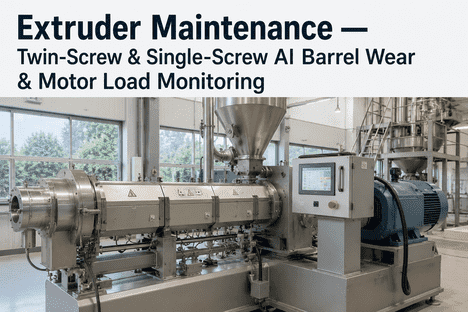
Food extrusion lines represent some of the highest-throughput, highest-wear assets in snack food, cereal, pet food, and pasta manufacturing. A single twin-screw extruder running at 300–500 RPM can process several tonnes of raw material per hour, with screw elements, barrel liners, and die plates experiencing continuous abrasive and corrosive wear from flour-based feedstocks, colourants, and fat inclusions. The cost of an unscheduled extruder shutdown is not limited to replacement parts. Every hour of unplanned downtime on a high-output extrusion line can exceed $15,000 in lost production, and the secondary effects — interrupted downstream drying, coating, and packaging operations — can cascade across multiple shifts. Despite this economic reality, many food manufacturing facilities still rely on fixed-interval rebuilds and operator-reported wear observations rather than continuous condition monitoring. The gap between the maintenance data that extrusion lines generate and the decisions that data could drive is not a sensor availability problem. It is a monitoring, trending, and documentation problem. Reliability engineers who have invested in barrel temperature profiling, motor load trending, and screw element wear tracking report that the data alone changes nothing. What changes outcomes is the operational discipline around the monitoring programme: whether barrel zone temperatures are reviewed against baseline profiles, whether motor load deviations are investigated before product quality drifts, whether screw element wear is documented with dimensional measurements at each rebuild, and whether leadership holds the maintenance organisation accountable to condition-based metrics rather than calendar-based schedules. Building a data-driven extruder maintenance culture is not a sensor installation project. It is a sustained reliability and monitoring programme with defined stages, deliberate documentation discipline, and a framework that connects daily machine data to strategic maintenance outcomes. This guide is written for reliability engineers, plant maintenance managers, and extrusion process engineers at the point of making that transition.
$15K+
Average hourly lost production cost for a high-output extrusion line during unplanned downtime — before counting downstream disruption to drying, coating, and packaging
40–60%
Of unscheduled extruder downtime is caused by barrel wear and screw element degradation that could be detected 3–5 weeks earlier with continuous motor load trending
300–500
RPM operating range for twin-screw food extruders — at these speeds, abrasive wear on screw elements and barrel liners accelerates non-linearly with each production hour
3–5
Early detection window in weeks before a barrel wear condition would produce visible product quality drift — AI trend analysis is the only practical detection method at this lead time
Extruder Maintenance · Barrel Wear · Screw Element · Motor Load · AI Monitoring
Sensors Collect the Data. Your Maintenance Culture Makes It Actionable. iFactory Connects Both.
iFactory's predictive maintenance and monitoring platform gives reliability engineers the infrastructure to track barrel zone temperatures, motor load trends, screw element wear documentation, and build a condition-based maintenance culture that reduces unplanned downtime and extends extruder service life.
Why Most Extruder Maintenance Programmes Underdeliver — and What the Data Reveals
A 2025 analysis of unscheduled downtime events across 14 food extrusion facilities found that 62% of extruder failures could be attributed to progressive wear conditions that were detectable through existing process data — motor load trends, barrel zone temperature deviations, and specific mechanical energy (SME) drift — at least two weeks before the failure event. The study concluded that the primary barrier to earlier detection was not sensor coverage but data review discipline: fewer than one in five facilities had established trend review protocols for extrusion process data that included defined action levels for motor load deviation and barrel temperature spread. The pattern is consistent across food extrusion operations that invest in monitoring instrumentation without investing equally in the documentation culture and trend review discipline needed to use the data effectively. Three root causes appear in nearly every case.
01
Barrel Temperature Profiles Are Logged but Never Trended Against Baseline
Every extruder control system records barrel zone temperatures continuously. But in most facilities, these data streams are reviewed only when product quality drifts outside specification. A 3–5°C increase in zone 3 temperature spread over a two-week period is one of the earliest indicators of barrel liner wear or screw element degradation — yet it is detectable only when temperature data is trended against a defined baseline and reviewed on a daily or weekly cadence. Without this review discipline, the temperature data that could predict a wear condition three weeks before product impact is filed and forgotten.
02
Motor Load Data Is Collected Without Connecting to Wear Models
Motor load (percent rated amperage) is a direct indicator of the mechanical resistance the screw encounters as it conveys and works the material. A gradual motor load increase over time — typically 2–5% above baseline — signals increasing barrel friction from liner wear or material buildup. A gradual decrease signals screw element wear reducing conveying efficiency. But without a trend baseline and defined action levels mapped to specific wear mechanisms, motor load data remains a real-time display value rather than a predictive maintenance input. The data that could schedule a barrel inspection three weeks before a product quality event is viewed after the event, not before it.
03
Screw Element Wear Is Documented at Rebuild but Not Tracked Across Lifecycles
Screw elements — conveying, kneading, and mixing blocks — wear at different rates depending on their position along the screw profile and the abrasiveness of the feedstock. A kneading block in the melt zone may wear three times faster than a conveying element in the feed zone. But most facilities record element dimensions only at the time of rebuild, without tracking wear progression across consecutive production runs. This means that element life predictions are based on calendar intervals rather than measured wear rates, leading to premature replacement of serviceable elements or delayed replacement of worn elements that reduce extrusion efficiency and increase specific energy consumption.
The Extruder Condition Monitoring Maturity Model — Four Stages Every Maintenance Programme Passes Through
Understanding where your extruder maintenance programme sits on the condition monitoring maturity curve is the starting point for any reliability improvement strategy. Most food extrusion operations are at Stage 1 or Stage 2. The programmes that consistently achieve mean time between failure (MTBF) targets above industry benchmarks and demonstrate measurable reduction in unplanned downtime are operating at Stage 3 or Stage 4. The difference is not the sensors they have installed — it is the trend review discipline, documentation accuracy, and data-driven decision culture they have built around the extrusion process.
Extruder Condition Monitoring Maturity Model — Where Does Your Maintenance Programme Stand?
Stage
Maintenance Behaviour
Data Characteristics
Leadership Priority
Extruders run until failure or visible product quality drift. Barrel and screw element replacements occur as emergency repairs. No condition monitoring data is collected or trended.
No structured data collection. Maintenance decisions based on operator observations and OEM fixed-interval recommendations. No trend baselines exist.
Begin collecting motor load and barrel temperature data at daily intervals. Establish baseline profiles for each extruder and product type. Any CMMS with trend capability is a step forward.
Extruder rebuilds performed on fixed calendar intervals. Motor load and barrel temperature data logged but reviewed monthly. Condition data is used for post-event analysis rather than prediction.
Centralised data logs, basic trend charts for motor load and barrel zone temperatures. PM schedules linked to calendar rather than condition indicators.
Move from monthly data review to weekly motor load and barrel temperature trend review. Define action level thresholds for each critical extruder parameter.
Extruder maintenance is triggered by condition indicators — motor load deviation, barrel temperature spread increase, SME drift. Rebuild scheduling is driven by trend analysis rather than calendar intervals.
Real-time dashboards for motor load, barrel zone temperatures, and SME. Defined action levels with automatic alerts. Screw element wear tracked with dimensional measurements per lifecycle.
Build maintenance team data literacy in extrusion trend analysis. Establish weekly data review rituals. Reward condition-based decision-making in maintenance performance conversations.
AI-driven anomaly detection identifies developing wear conditions before action level thresholds are breached. Barrel and screw element replacements are scheduled based on predicted remaining useful life, not trend-crossing events.
AI-powered trend analysis with automated anomaly detection. Integrated motor load, temperature, and SME data streams. Screw element wear models calibrated against actual lifecycle data.
Integrate extruder monitoring analytics into plant-wide OEE reporting. Use condition data for capital planning and rebuild budget allocation. Benchmark extruder MTBF against industry peers.
Motor Load Trending · Barrel Wear · SME Monitoring · Condition-Based · Predictive
A Maintenance Programme That Only Rebuilds Extruders on Calendar Intervals Is Not a Reliability Programme. iFactory Makes Your Condition Data Actionable Every Day.
iFactory documents every motor load deviation, barrel temperature trend shift, and screw element wear measurement in a structured digital trail that supports condition-based maintenance decisions with evidence that speaks for itself.
Critical Extruder Metrics — What to Track at Each Level of Your Maintenance Programme
The following monitoring taxonomy is grounded in the decision architecture principle: every extruder process parameter connects to an action level, a decision-maker, and a maintenance response protocol. iFactory's predictive maintenance platform tracks all of these in real time with configurable threshold alerts and trend visualisations at every level of the organisation.
Motor load (amps or % rated) — recorded at shift start and during steady-state production, compared to baseline for the current product recipe
Barrel zone temperature deviation — actual vs. setpoint for each zone, with automatic flag at >3°C spread increase from baseline
Die pressure and melt temperature — recorded at steady state, with trend tracking for progressive buildup or restriction development
Specific Mechanical Energy (SME) — calculated from motor load and throughput, trended as the primary indicator of extrusion efficiency and wear progression
Barrel temperature profile — zone-by-zone trend comparison against baseline, with automatic alert when zone-to-zone spread exceeds operational threshold
Screw element wear measurement — flight tip clearance and element outside diameter recorded at each rebuild, trended across consecutive lifecycles per element position
Extruder MTBF — mean time between failures trended by extruder model, product type, and screw profile configuration over rolling 12-month periods
Condition indicator alert frequency — number and severity of motor load and temperature deviation alerts per extruder per month, with escalation tracking
Rebuild interval trend — actual operating hours between consecutive rebuilds compared to OEM recommended interval, with variance analysis by failure mode
Unplanned downtime trend — extrusion-related downtime as a percentage of total scheduled operating time, trended monthly and compared to plant OEE target
Condition-based maintenance adoption rate — percentage of extruder maintenance events triggered by condition indicators vs. fixed intervals, trended quarterly
Spend per extruder operating hour — combined rebuild, parts, and labour cost normalised by operating hours, with year-over-year trend and variance analysis
The Reliability Playbook — Five Actions That Build a Condition-Based Extruder Maintenance Culture
Culture in extruder maintenance does not change through sensor installation projects or reliability policy announcements. It changes through consistent leadership behaviour, visible accountability mechanisms, and the gradual replacement of calendar-based maintenance decisions with condition-based ones. These five actions distinguish extruder maintenance programmes that consistently meet MTBF targets from those that produce post-event analysis reports before every budget cycle.
Action 01
Establish Motor Load and Barrel Temperature Baselines for Every Extruder-Product Combination
Foundation Step
Before configuring any monitoring dashboard, establish baseline motor load and barrel zone temperature profiles for every extruder-product combination in your facility. Motor load at steady state for a twin-screw extruder producing high-protein snack pellets will differ significantly from the same extruder running a cereal-based recipe. Baseline profiles should be recorded over at least three consecutive production runs under stable operating conditions, capturing the mean and standard deviation for each parameter. These baselines become the reference against which all future trend deviations are measured. A motor load that drifts 5% above baseline for a given product is not a data point — it is a trigger for a screw element wear inspection. This decision architecture, built before the dashboard is configured, is what separates condition-based maintenance programmes from data collection exercises.
Action 02
Start Every Maintenance Review with the Live Condition Monitoring Dashboard
Leadership Behaviour
The most powerful signal a plant maintenance manager sends about the importance of condition monitoring data is how they open every review meeting. If weekly extruder maintenance reviews, monthly reliability meetings, and quarterly OEE reviews begin with a live condition dashboard review rather than a verbal briefing, the message to every engineer and technician is unambiguous: condition data is how we measure extruder health here. Establish a standing protocol where the first five minutes of any maintenance review involves opening iFactory's condition monitoring dashboard and reviewing the previous period's motor load trends, barrel temperature profiles, and SME readings against defined action level thresholds. Leaders who do this consistently see their teams begin preparing data before they arrive at meetings, rather than constructing post-hoc explanations after condition thresholds have already been breached.
Action 03
Build Documentation Discipline at the Operator Data Entry Level
Team Capability
The quality of every extruder condition-based maintenance decision is entirely dependent on the quality of process data documentation at the point of collection. An operator who records motor load at start-up but not at steady-state, or who estimates barrel zone temperature rather than reading the actual controller display, creates a data gap that no trend dashboard can recover. The solution is not a data entry checklist — it is understanding and motivation. Operators who understand why accurate process data matters — this motor load reading is what triggers the next condition review or this temperature trend is what tells the engineer there is a developing barrel wear condition — document more accurately than those who see data entry as administrative overhead. Invest in role-specific training sessions that show operations teams how their data inputs connect to the maintenance decisions the organisation makes.