Every shift, a quality technician at a mid-size FMCG plant pulls 24 samples from three production lines, runs moisture analysis, measures fill weights, checks seal integrity, and enters results into a spreadsheet that nobody looks at until the weekly review. By Thursday, the line has already produced 14,000 units with seal strength trending below spec — because the data sat in a cell for three days before anyone noticed. That single gap costs $38,000 in rework and write-offs per quarter. Across the plant floor, paper-based checklists, disconnected QC instruments, and a legacy ERP that only records final-goods acceptance mean the quality team has no real-time visibility into the process variables that actually drive defects. Incoming raw material variance from three different suppliers, hotter-than-ambient filling conditions on the afternoon shift, and packaging film tension drift all accumulate into a finished-product quality signal that arrives too late to act on. These aren't discipline problems — they're data architecture problems that a modern quality control program can solve.
Build a Quality Control Program That Prevents Defects — Not Just Records Them
iFactory connects every QC checkpoint — incoming inspection, in-process testing, finished goods — into a single platform that surfaces issues in real time and eliminates rework before it reaches the warehouse.
FMCG quality control programs have traditionally been reactive — inspect at the end of the line, reject what fails, investigate the root cause after the fact. That model worked when margins were wider and recalls were rare. Today, a single undetected seal integrity issue or metal contamination event can trigger a retailer chargeback of $50,000 or a public recall that erodes years of brand equity. The shift toward proactive, data-driven quality programs is being driven by retailers mandating GS1-128 label compliance, FSMA 204 traceability rules, and zero-defect contracts that penalize suppliers for complaint rates above 50 ppm. iFactory's quality control module replaces clipboard-based inspection with a connected, real-time QC operations platform that standardizes how every checkpoint is performed, recorded, escalated, and analyzed — without replacing your existing lab instruments or ERP system. Book a Demo to see how real-time SPC eliminates the latency that paper-based QC introduces.
Five Pillars of a Modern FMCG Quality Control Program
These five capability areas define the difference between a compliance-focused QC program and one that actively drives quality improvement and cost reduction.
Incoming Raw Material Verification
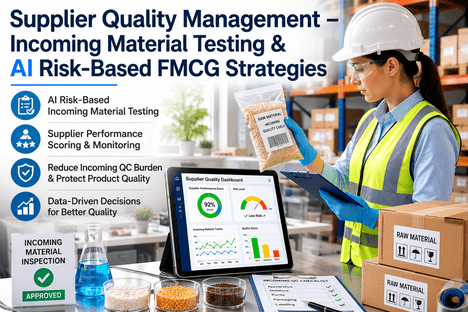
Every lot from every supplier is tested against spec before it enters production. iFactory integrates with moisture analyzers, viscometers, and pH meters to capture results digitally — no manual transcription. Lots that fail are automatically flagged for quarantine, and supplier scorecards update in real time. When a palm oil shipment arrives with an FFA content of 0.18% instead of the agreed 0.12%, the system alerts procurement before the tanker is discharged.
In-Process Statistical Process Control
Real-time SPC charts for every critical control point — filling weights, cooking temperatures, sealing pressures, pH levels, dwell times. Operators see control limits and trend warnings on shop-floor dashboards. When a filler head drifts 0.3 g above the upper control limit, iFactory triggers an alert and a corrective action workflow before the line produces a single out-of-spec unit.
Finished Product Testing & Disposition
All finished-good samples are logged against their production batch with test results from tensile testers, headspace analyzers, metal detectors, and checkweighers. iFactory applies your AQL sampling plan automatically and holds lots until all tests pass. A batch of carbonated beverage that fails carbonation by 0.2 volumes is automatically blocked from shipment until QA reviews and dispositions.
Non-Conformance & CAPA Management
Every out-of-spec event is automatically captured as a non-conformance record with the process context — operator, shift, machine, raw material lot. Corrective and preventive actions are assigned, tracked, and verified for effectiveness. iFactory correlates CAPAs with complaint data to identify repeating failure patterns that no individual operator would see.
Supplier Quality & Traceability
Full lot-level traceability from raw material receipt through finished product shipment. iFactory builds a digital thread that links every unit in a pallet back to the specific supplier lot, production line, shift, and QC test result. When a retailer reports a complaint about a specific production date, the quality team can trace the affected lots and contain them in under 15 minutes — not 15 hours.
Instrument & System Connectivity
iFactory connects directly to lab balances, moisture analyzers, pH meters, viscometers, colorimeters, texture analyzers, and checkweighers via RS-232, Ethernet, or Bluetooth. Results flow into the QC record automatically — no manual data entry, no transcription errors. The platform also integrates with your ERP for lot creation, inventory status updates, and non-conformance accounting.
Ready to Transform Your QC Program?
iFactory's quality control module is deployed in weeks, not months. Your operators keep their existing workflows — the clipboards just disappear.
Deploy a Connected QC Program in Four Phases
iFactory's deployment methodology mirrors how mature FMCG quality programs are built — phase by phase, checkpoint by checkpoint.
Audit & Map Existing QC Points
Our quality engineers walk your plant floor and document every inspection point, instrument, sampling frequency, and data flow — from raw material receiving to final pallet disposition.
Connect Instruments & Configure Workflows
We connect your existing QC instruments to iFactory and configure digital inspection forms that mirror your paper checklists — so operators adopt the system on day one with zero retraining.
Deploy Dashboards & Alerts
Role-specific dashboards for operators, supervisors, and quality managers. Real-time alerts for out-of-spec conditions, missed inspections, and trending violations are live from the first production run.
Analyze & Improve
With 30 days of connected data, iFactory surfaces the top defect contributors by line, shift, material lot, and operator. Your team uses this insight to prioritize CAPAs and drive continuous improvement.
Three Cost Centers That Disappear When You Go Digital
Paper-based quality programs don't just introduce latency — they introduce measurable cost across three dimensions that most plants never quantify.
Delayed Defect Detection
When QC results are entered into spreadsheets at the end of shift, a filler drift or temperature excursion can produce 8,000–12,000 out-of-spec units before anyone sees the trend. iFactory delivers SPC alerts in real time — containment happens in minutes, not days.
Manual Data Entry Errors
QC technicians transcribe instrument readings by hand — an estimated 3–5% of entries contain errors that lead to false passes or false rejects. iFactory captures readings directly from connected instruments with zero manual input.
Supplier Dispute Resolution
When a raw material lot causes a finished-product defect, resolving the supplier chargeback requires manual paper trail reconstruction. iFactory maintains an immutable digital thread that proves the lot failed spec before it entered production.
Measurable Outcomes from Digitized QC Programs
These results reflect iFactory deployments across food, beverage, and personal care FMCG plants running 1–6 production lines each. Book a Demo to see what your plant's ROI looks like with your actual complaint and rework data.
Your quality program already generates the data you need to eliminate defects — but if it's trapped in clipboards and spreadsheets, it's costing you more than you realize. Book a 30-min walkthrough and we'll show you how a connected QC program works on a real FMCG production line.
Common Questions from FMCG Quality Leaders
Stop Managing Quality in Spreadsheets
Your FMCG plant has every data point needed to prevent defects, reduce complaints, and lower rework costs — but not when it's scattered across paper forms, disconnected instruments, and end-of-shift spreadsheets. iFactory connects every QC checkpoint into a single real-time platform that your operators, supervisors, and quality managers can actually act on.