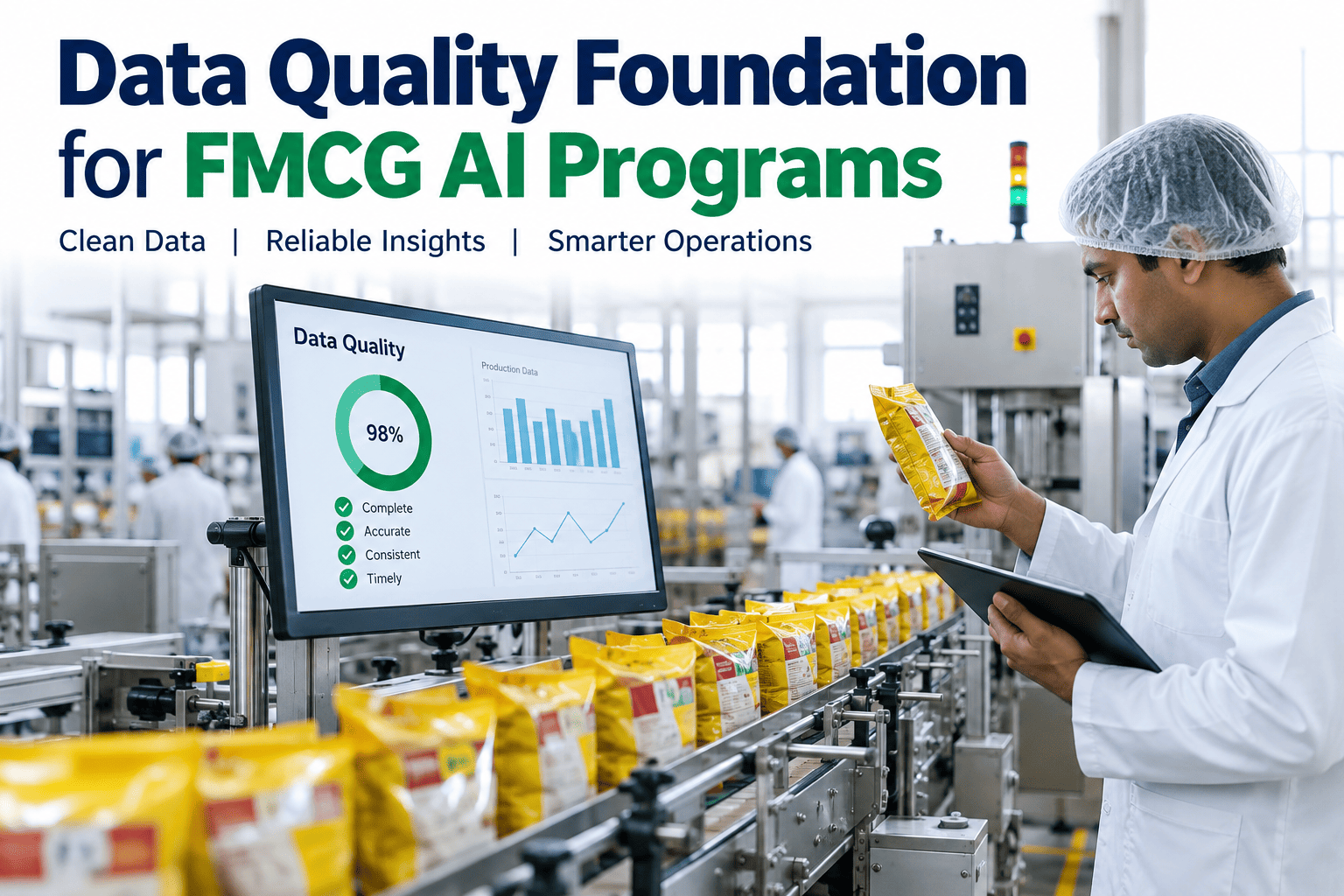
An AI model is a mirror held up to the data it was trained and fed on, and no amount of algorithmic sophistication compensates for data that is incomplete, inaccurate, stale, or inconsistent across the systems feeding it — a model built on flawed data will produce confident, plausible-looking, and wrong outputs, which is arguably worse than an obvious failure because it invites trust the data does not deserve. Completeness, accuracy, timeliness, and consistency are the four dimensions that most data quality frameworks converge on, and scoring a plant's data against all four, with a defined remediation cadence for what falls short, is what keeps an AI program running on a foundation that actually holds weight. Plants building this scoring and remediation discipline can start with a conversation with iFactory's support team about what a practical data quality program looks like for a specific plant landscape.
An AI Model Is Only a Mirror — Flawed Data Just Reflects Back Confidently
Completeness, accuracy, timeliness, and consistency scoring, backed by a real remediation cadence, is what keeps an AI model from confidently reflecting back bad data as if it were insight.
Why Data Quality Problems Stay Hidden Until the Model Fails
A data quality gap rarely announces itself before an AI model is deployed, because the systems generating the data usually work fine for their original operational purpose — a sensor that occasionally drops a reading, a manual data entry field that is sometimes left blank, or two systems that label the same product differently are all tolerable quirks for day-to-day operations but become serious problems the moment a model is trained on that same data and expected to generalize reliably across every record it encounters.
The Four Dimensions of Data Quality
Each dimension captures a different way data can fail to support a reliable AI model, and a plant can score well on one dimension while failing badly on another.
Completeness
Measures how much expected data is actually present versus missing, since gaps in sensor readings or unfilled manual fields silently reduce the effective sample size a model actually learns from.
Accuracy
Measures whether the data that is present correctly reflects reality, since a miscalibrated sensor or a mistyped manual entry can pass a completeness check while still feeding the model wrong information.
Timeliness
Measures how current the data is relative to when a decision needs to be made, since data that is accurate but delayed can be functionally useless for a real-time or near-real-time application.
Consistency
Measures whether the same entity is represented the same way across systems, since inconsistent naming or units between systems can cause a model to treat one product or process as two different ones entirely.
Score Your Data Before It Undermines a Model
Book a 30-minute walkthrough of how iFactory scores completeness, accuracy, timeliness, and consistency with a built-in remediation workflow.
Remediation Approaches Compared
Once a data quality gap is identified, how a plant chooses to fix it has lasting consequences for whether the same gap reappears later.
| Approach | What It Fixes | Durability of the Fix |
|---|---|---|
| One-Time Manual Cleanup | Existing bad records at a single point in time | Low, the same issues recur as new data arrives |
| Automated Validation Rules | New records that violate defined quality rules | Moderate, catches recurring patterns going forward |
| Root-Cause Process Fix | The upstream system or process generating bad data | High, prevents the issue from recurring at all |
Building a Recurring Scoring and Remediation Cadence
A one-time data quality assessment tells a plant where things stand today, but data quality is not static, and a program that scores once and moves on will eventually be surprised by exactly the kind of drift that caused the scenario above.
Automated Ongoing Scoring
Rules checking completeness, accuracy, timeliness, and consistency run continuously against new data as it arrives, rather than only at a scheduled review point.
Scheduled Deep Review
A periodic, more thorough review looks for subtler issues that automated rules might miss, such as the kind of blank-field misinterpretation that caused the forecasting gap above.
Model Performance Trigger
Any unexpected model performance change automatically triggers a targeted data quality check on the relevant data segment before any model architecture investigation begins.
A Composite Scenario: The Demand Model That Learned the Wrong Lesson From a Blank Field
An FMCG manufacturer deployed a demand forecasting model that performed well in testing but produced unexpectedly poor forecasts for a specific subset of products once live, systematically underestimating demand for items sold through a particular regional distribution channel. The data science team initially suspected the model architecture itself, spending time tuning parameters without meaningful improvement.
Investigation eventually traced the problem to a completeness gap: a promotional flag field, used to indicate when a product was running a promotion, was frequently left blank for orders processed through that specific regional channel due to a data entry workflow difference at that location, and the model had learned to associate the blank field with lower baseline demand rather than recognizing it as missing information about an active promotion. Fixing the upstream data entry workflow to make the field mandatory, combined with backfilling historical records where possible, resolved the forecasting gap without any change to the model itself.
Mistakes That Undermine Data Quality Programs
Tuning the Model Before Checking the Data
When a model underperforms, the data feeding it deserves scrutiny before the model architecture itself, exactly the order that would have saved time in the scenario above.
Treating a Blank Field as Equivalent to a Negative Value
A model that is not told to distinguish missing data from a genuine negative or zero value will learn incorrect associations, exactly as happened with the promotional flag field above.
Fixing Bad Data Without Fixing the Process That Created It
A one-time cleanup addresses the symptom but leaves the upstream workflow difference in place, guaranteeing the same completeness gap will reappear with the next batch of data.
Scoring Data Quality Once Before Launch and Never Again
Data quality is not static, and a score taken once before a model launches cannot catch a workflow change or a new data source introduced afterward that silently degrades quality over time.
Is Your Data Quality Program Actually Catching Gaps
All four dimensions are scored, not just completeness
A plant that only checks for missing data can still miss the kind of subtle accuracy or consistency gap that caused the forecasting problem in the scenario above.
Model performance issues trigger a data quality check before a model architecture review
Checking the data first, rather than jumping straight to model tuning, is the ordering that would have found the root cause faster in the scenario above.
Remediation addresses the upstream process, not just the existing bad records
A root-cause fix to the data entry workflow, rather than a one-time cleanup, is what actually prevents the same gap from recurring in future data.
Frequently Asked Questions
Why is a blank or missing data field more dangerous than an obviously wrong value?
An obviously wrong value, like a negative inventory count, is often easy to catch with a simple validation rule, but a blank field can be silently interpreted by a model as meaningful information rather than absent information, exactly the mechanism that caused the demand forecasting model in the scenario above to learn an incorrect association between a blank promotional flag and lower baseline demand.
How often should data quality be re-scored once an AI model is in production?
Data quality should be scored on a recurring cadence, not just before initial model launch, since workflow changes, new data sources, and process drift can all silently degrade a previously acceptable data quality score, and the gap that caused the scenario above had likely existed for some time before it was traced back to its source. A monthly or quarterly re-score, combined with automated ongoing validation rules, catches this kind of drift before it produces a model failure.
Should a data quality issue always be traced back to its root cause?
Wherever practical, yes, since a root-cause fix, such as making the promotional flag field mandatory in the scenario above, prevents the same issue from recurring in every future batch of data, while a one-time cleanup of existing records only addresses the historical data and leaves the underlying process gap in place to keep generating the same problem going forward.
How can a plant distinguish a data quality problem from a genuine model performance issue?
Checking data quality across all four dimensions for the specific segment where the model is underperforming, before investing time in model architecture changes, is the more efficient diagnostic order, since the scenario above shows how much time can be lost tuning a model when the actual issue was entirely upstream in the data. A systematic data quality check should be the first diagnostic step whenever a model's performance varies unexpectedly across different segments of its input data. Book a demo to see how iFactory surfaces this kind of segment-level data quality issue.
What is the first step for a plant wanting to build a data quality program from scratch?
The first step is scoring existing data across completeness, accuracy, timeliness, and consistency for the specific data sources feeding any planned or existing AI initiative, establishing a baseline before assuming the data is ready, which is exactly the check that could have caught the promotional flag gap in the scenario above before it ever reached a live forecasting model. Plants wanting help establishing this kind of baseline scoring can reach iFactory support directly.
Give Every AI Model a Data Foundation That Actually Holds Weight
iFactory scores completeness, accuracy, timeliness, and consistency with a built-in remediation workflow, catching data gaps before they become confident, wrong model output. Book a walkthrough to see it running on a live data pipeline.