Allergen Management & Equipment analytics for FMCG
By Seren on June 2, 2026
Undeclared allergens were responsible for 101 food recalls in 2024, representing 34% of all FDA recall events and maintaining their position as the single largest cause of food product withdrawals for three consecutive years. For FMCG manufacturers producing allergen-containing foods on shared equipment, compliance depends on eliminating cross-contact through validated cleaning procedures, structured changeover workflows, and digital audit trails that prove every allergen risk was controlled before the next production run started. When these controls exist only as paper checklists and spreadsheet logs, plants face the recurring risk of undeclared allergen incidents a single recall costs an average of $1.8 million in direct expenses plus lost retail partnerships and brand damage. iFactory AI's allergen analytics platform digitizes the entire allergen control lifecycle equipment-specific cleaning protocols with ELISA verification, swab-gated changeover release, real-time batch traceability, and audit-ready documentation that satisfies BRCGS Clause 5.3, SQF Element 2.8, and FSSC 22000 allergen management requirements. Book a Demo
Why Equipment Analytics Is the Frontline of Allergen Prevention in FMCG
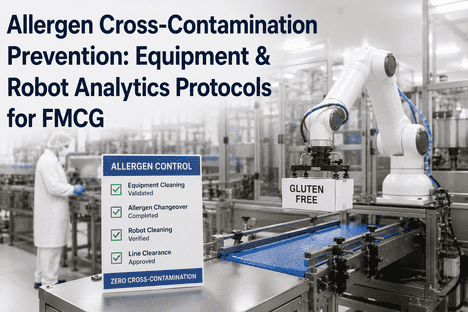
Ingredient control gets the most attention in allergen management, but equipment is where cross-contamination actually happens. Residual allergen proteins survive in gaskets, seals, conveyor belt surfaces, filler nozzles, robotic grippers, and dead legs of piping systems — persisting through standard rinse cycles that remove visible soil but leave microscopic protein deposits at levels that trigger anaphylaxis. 38% of allergen recalls trace directly to inadequate equipment cleaning during product changeovers. For facilities handling any of the nine FDA-recognized major food allergens — milk, eggs, fish, crustacean shellfish, tree nuts, peanuts, wheat, soybeans, and sesame — equipment analytics is not optional. It is a regulatory requirement under FSMA Preventive Controls, a fundamental requirement under BRCGS Issue 9 Clause 5.3 where noncompliance results in automatic audit failure, and a documented program requirement under SQF Edition 9 Element 2.8 and FSSC 22000 Version 6.
Three Operational Problems iFactory Solves for Allergen Management
01
Paper-Based Changeover Protocols That Cannot Be Enforced
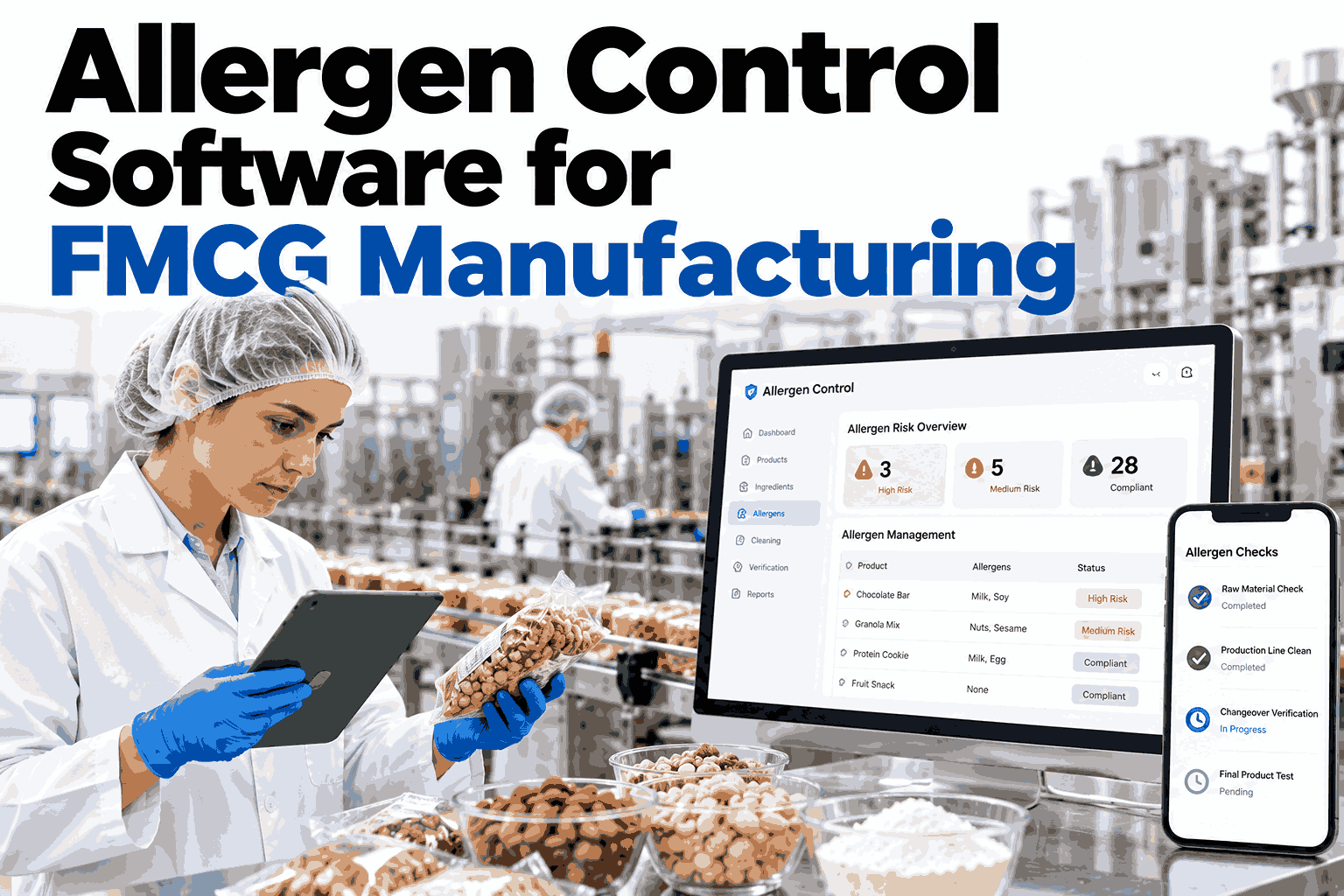
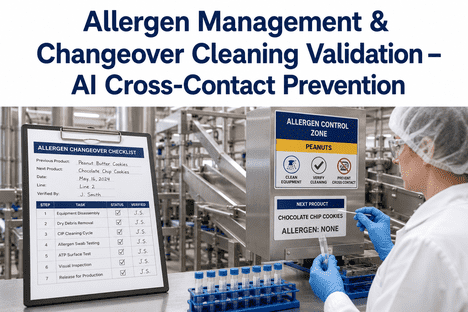
Paper allergen changeover checklists are signed off in under 30 seconds — often before cleaning is actually performed. Without digital enforcement, there is no way to verify that every disassembly step, cleaning agent application, contact time, and rinse protocol was executed in sequence. iFactory's Shift Logbook and changeover workflow module require step-by-step digital sign-off with photo verification and barcode scanning of cleaning agents. A checklist cannot be completed until every step is digitally verified — eliminating the execution gap that generates undeclared allergen recalls.
Digital step enforcementPhoto verificationCleaning agent barcode scan
02
No Verification That Cleaning Actually Removed Allergen Residues
Cleaning execution and cleaning effectiveness are two different things. ATP swabbing measures general organic residue — not specific allergenic protein. iFactory's platform integrates with lateral flow devices and ELISA lab systems to capture post-clean allergen test results directly into changeover work orders. A positive swab result automatically re-triggers the cleaning procedure and locks the production line until retest confirms allergen levels are below threshold. Production cannot restart without verified swab clearance — no manual override, no production pressure bypass.
LFD & ELISA integrationSwab-gated line releaseAuto-retest on failure
03
Audit Documentation That Takes Weeks to Assemble
BRCGS, SQF, and FSSC 22000 auditors require timestamped, attributable records for every allergen changeover — cleaning protocols, swab results, corrective actions, and batch traceability. Paper-based systems require manual assembly of documentation during audit preparation, creating the risk of missing records that generate major nonconformities. iFactory automatically generates audit-ready allergen control reports from live changeover execution data — cleaning validation records, swab verification history, run sequence documentation, and corrective action logs — reducing audit preparation from weeks to minutes.
How Allergen Cross-Contamination Happens During Changeovers
Understanding the contamination mechanism is essential to building effective equipment cleaning protocols. Allergen proteins are not removed by water alone — they require specific detergent chemistry, contact time, temperature, and mechanical action. A changeover that looks visually clean can still carry 50–200 ppm of allergenic protein on food-contact surfaces. The following equipment zones represent the highest-risk areas where residual proteins persist after standard cleaning cycles.
High-Risk Equipment Zones for Allergen Cross-Contamination
Filler Nozzles
Residue Traps
Product residue accumulates in nozzle orifices and gaskets. Requires disassembly and soak protocol for allergen removal.
Robot Grippers
Invisible Transfer
62% of plants have no documented allergen cleaning for robotic end-effectors. Silicone grippers absorb protein residues.
Conveyor Belts
Surface Persistence
Porous belt materials trap protein. Standard rinse cycles remove visible soil but leave allergenic residues at 50–200 ppm.
Pipe Dead Legs
Biofilm Harborage
CIP shadow zones where flow velocity drops below 1.5 m/s. Protein and biofilm accumulate undetected.
Industry finding: 38% of allergen recalls in FMCG trace back to inadequate equipment cleaning during changeovers, not ingredient formulation errors. The majority of these involve equipment zones that had no documented allergen cleaning protocol.
Source: FDA Recall Data Analysis, 2024
How iFactory's Equipment Analytics Maps to Allergen Control
Phase 1 — Foundation
Equipment Asset Classification
Tag every food-contact asset with its allergen exposure profile
Every food-contact asset is registered in iFactory's CMMS with its complete allergen profile — which allergens it contacts, which products run on it, which lines it belongs to, and its cleaning validation status. Robotic end-effectors, filler nozzles, conveyor belts, CIP circuits, and packaging equipment are each tagged with specific cleaning protocols and validation thresholds. This equipment classification layer is the foundation for all downstream allergen control workflows.
Per-asset allergen exposure profileRobotic end-effector trackingCleaning validation status
Phase 2 — Execution
Changeover Workflow Engine
Step-by-step digital cleaning protocols triggered by SKU change
When a product changeover is initiated, iFactory's changeover engine triggers the equipment-specific validated cleaning protocol for every asset on the line. Operators follow step-by-step digital checklists with photo verification, cleaning agent barcode scanning, and timer confirmation for contact durations. The checklist cannot be signed complete until every step is digitally verified. Post-cleaning ATP and allergen-specific lateral flow test results are logged directly into the work order — and production is blocked until swab results confirm allergen levels are below threshold.
Photo-verified step completionLFD & ELISA result loggingSwab-gated production release
Phase 3 — Proof
Audit-Ready Traceability
Every changeover becomes an immutable, timestamped audit record
Every allergen changeover generates a complete digital record: equipment-specific cleaning protocol executed, cleaning agent batch numbers, contact time logs, ATP and allergen test results with pass/fail, corrective actions if applicable, and the operator and supervisor digital signatures. These records link directly to batch production records, creating full traceability from finished product lot back through the changeover cleaning history. Audit reports are generated at the click of a button — reducing audit preparation from weeks to minutes and eliminating the risk of missing records during regulatory inspection.
FMCG Use Cases: What iFactory Delivers for Allergen Control
Allergen Changeover Cleaning Validation
Validated protocols per equipment type per allergen
A confectionery manufacturer recalling 28,000 "peanut-free" units discovered a robotic gripper transferring peanut protein at 42 ppm — invisible to visual inspection. iFactory's equipment classification module registers every robotic end-effector, filler nozzle, and conveyor belt with its allergen exposure profile. Changeover workflows trigger equipment-specific cleaning protocols with validated parameters — disassembly steps, cleaning agent type and concentration, contact time, rinse protocol, and swab sampling points. Each procedure links to the validation study confirming allergen removal to non-detectable levels.
38% of allergen recalls trace to equipment cleaning failures during changeovers. iFactory ensures every changeover is validated, verified, and documented.
Swab-Gated Production Release with ELISA Integration
No verified swab clearance = no production restart
iFactory integrates directly with lateral flow devices and lab ELISA systems. Post-cleaning allergen swab results are captured in real time into the changeover work order. A positive result — allergen detected above the validated threshold — automatically re-triggers the complete cleaning protocol and locks the production line until retest confirms levels are below threshold. The system enforces two-tier verification: ATP swabbing as a general cleanliness indicator, then allergen-specific lateral flow immunoassay for the target allergen. No manual override, no production pressure bypass.
Two-tier testing: ATP (≤10 RLU) + allergen-specific LFD (≤10 ppm). Production blocked until both pass.
Allergen-Safe Run Sequencing
System-enforced production order on shared lines
iFactory's changeover management engine enforces allergen-safe run sequencing — requiring allergen-free products to run before allergen-containing products on shared lines, or triggering a mandatory full-clean changeover workflow if the sequence is violated. The production scheduling module incorporates allergen status as a routing constraint, preventing the scenario where a line runs a peanut SKU followed by a peanut-free SKU without proper cleaning between. Every sequencing decision is logged with the supporting risk assessment.
Allergen-free first enforcementMandatory clean on sequence violation
CIP Allergen Analytics & Optimization
Continuous validation of CIP cleaning signatures
iFactory's CIP analytics module monitors conductivity, temperature, flow rate, and pH in real time during clean-in-place cycles. The platform compares the live cleaning signature against the validated "Golden Batch" profile for each allergen changeover — identifying drift in flow velocity, chemical concentration, or contact temperature that would compromise allergen removal. When a CIP cycle deviates from the validated profile, the system alerts the sanitation team and prevents line release until corrective action is confirmed. This continuous validation approach reduces water and chemical usage by up to 25% while maintaining absolute allergen safety thresholds.
Golden Batch comparison25% water/chemical reduction
"
We had been doing paper allergen changeover sign-offs for years. What we didn't know was that our operators were completing the checklist in under a minute — long before any cleaning actually happened. The first time iFactory's changeover engine blocked a line release because a swab hadn't been logged, our quality team realized we had never actually verified a single allergen clean in five years of production. The digital enforcement changed everything — our next BRCGS audit passed with zero nonconformities.
Your Allergen Control Program Is Only as Strong as Your Equipment Cleaning Analytics.
iFactory digitizes allergen management from equipment classification through changeover execution, swab verification, and audit-ready batch traceability — connecting to your existing sensor and lab infrastructure without rip-and-replace. Talk to an Expert about your specific allergen portfolio and line configuration.
FAQ: Allergen Management & Equipment Analytics with iFactory
Every food-contact asset in your facility: filler nozzles and valves, conveyor belts and modular chain, robotic pick-and-place end-effectors, CIP circuits and piping networks, packaging and sealing equipment, mixers, blenders, and depositors, and manual tools and utensils. Each asset type has a pre-configured allergen management template with validated cleaning protocol parameters, swab sampling point maps, and audit documentation requirements. The platform supports both wet and dry cleaning environments, including dedicated dry-cleaning protocols for low-moisture processing lines where water-based cleaning would introduce microbial risk. Book a Demo to review your equipment list against pre-built templates.
iFactory integrates with lateral flow readers and lab ELISA platforms via API, serial connection, or manual data entry through the Shift Logbook mobile app. Test results — including quantitative ppm values for ELISA or qualitative pass/fail for LFDs — are captured directly into changeover work orders and linked to the specific equipment asset and production batch. When a test result exceeds the validated threshold, the platform automatically triggers the corrective action workflow: re-clean, re-test, root cause log, and preventive action assignment. The system maintains a complete test history per equipment asset, enabling trend analysis that identifies equipment zones with recurring allergen detection issues. Talk to an Expert about your current testing infrastructure.
When a lateral flow test returns a positive result (allergen detected above threshold), iFactory automatically blocks the line from starting production and triggers a corrective action workflow: re-clean the failed zone with the validated protocol, re-test at the same sampling points, log root cause analysis identifying which surface, which allergen, and which cleaning step was insufficient, and document the preventive action. If the same failure point recurs three or more times, the system flags it for cleaning protocol review — triggering a revalidation study requirement. All failure data feeds into trending reports that identify systematic cleaning gaps across equipment types, allergen groups, and production lines.
Every robot end-effector — pick-and-place grippers, vacuum cups, vision-guided handlers, cobot arms — is registered as a food-contact asset with its allergen exposure profile, material composition (silicone, polyurethane, stainless steel), and validated cleaning procedure. Dedicated cleaning SOPs are created for each end-effector type: silicone grippers require soak protocols, vacuum cups need disassembly and brush cleaning, vision lenses need approved solvents. End-effectors are included in the changeover workflow engine so they cannot be bypassed or forgotten. Cleaning effectiveness is validated with allergen-specific swabs on gripper surfaces after cleaning. The platform tracks end-effector service life and wear, because worn gripper surfaces have higher protein retention and require more intensive cleaning protocols.
Most plants have allergen changeover workflows live within 3–4 weeks. The first two weeks cover equipment asset classification — tagging every food-contact asset with its allergen exposure profile, cleaning protocol, and validation status — and changeover protocol configuration. Week three covers operator training on mobile changeover workflows. Week four runs the first validated changeovers with full digital tracking. Cleaning validation studies — proving your cleaning method achieves ≤10 ppm on each equipment surface — typically run in parallel over 4–6 weeks and are managed within the platform's validation study tracking module. iFactory includes 90-day implementation support from a dedicated industry specialist with FMCG allergen management domain expertise.
Your Next Allergen Recall Won't Start With an Ingredient Error. It Will Start With an Equipment Cleaning Gap That Was Never Tracked.
iFactory's allergen analytics platform digitizes equipment protocols, enforces swab-gated changeover release, and maintains audit-ready batch traceability — connecting to your existing production, testing, and lab infrastructure. 3–4 week deployment with 90-day implementation support.