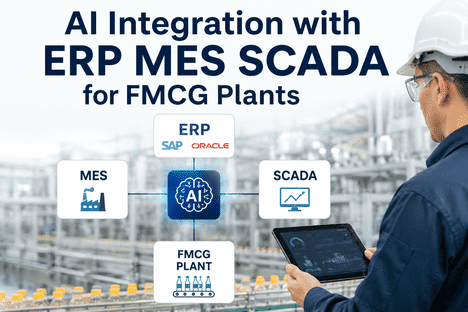
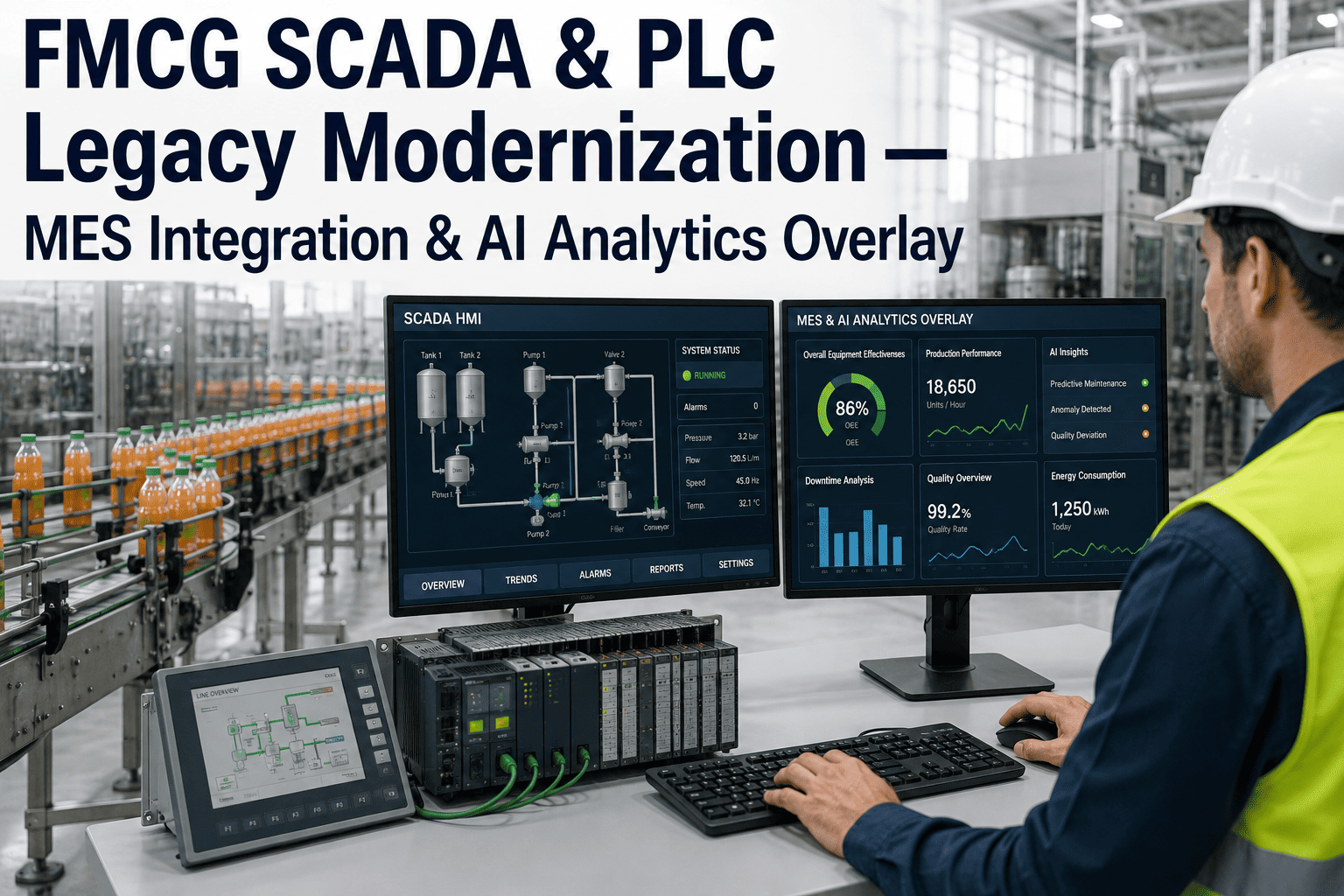
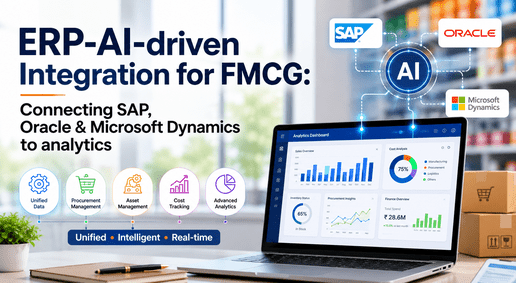
A typical FMCG production line runs on a stack of software systems an ERP for planning and procurement, a MES for shop-floor execution, SCADA for real-time machine control, and a growing layer of AI models attempting to make sense of it all. The problem is that these systems were never designed to talk to each other at the speed modern food manufacturing demands. AI integration bridges the gap between enterprise planning and line-level execution, creating a unified data flow that turns disconnected information into real-time production intelligence from raw material tracking through SAP to predictive quality control on the packaging line. This article examines the architecture, integration patterns, and practical outcomes of connecting AI with ERP, MES, and SCADA systems in FMCG environments.
ERP · MES · SCADA · AI Integration · FMCG
Unify Your Plant Systems. Unlock Real-Time Intelligence.
iFactory's AI platform connects to SAP, Oracle, MES platforms, and SCADA systems — creating a single data layer that spans enterprise planning to line-level machine data. No rip-and-replace required.
Why FMCG Plants Struggle with System Integration — and Why It Costs More Than You Think
FMCG manufacturing environments are uniquely fragmented. A single plant might run SAP S/4HANA for enterprise resource planning, a proprietary MES from the line integrator, a SCADA system monitoring 200+ PLCs, and standalone quality management software — none sharing a common schema, data model, or update cadence. The result is that production decisions are made using delayed, manually reconciled data that arrives too late to prevent waste, downtime, or quality deviations.
1
Disconnected planning
ERP production orders are created without real-time line status. The plan assumes capacity that may not exist, leading to over-scheduling and changeover chaos.
2
Latent quality data
SCADA captures real-time process parameters but cannot correlate them with batch quality results from the lab system. Non-conformance is detected hours after the root cause passed.
3
Inventory blind spots
ERP inventory levels update on batch completion, not in real time. Work-in-progress sits invisible between systems, causing material shortages or excess safety stock.
4
Manual data reconciliation
Operators manually key production counts from SCADA into ERP. The time lag, transcription errors, and missed entries compound into inaccurate OEE reporting and demand planning.
$3.7M
Average annual cost of poor system integration in a mid-size FMCG plant — from waste, downtime, and manual reconciliation
Source: Industry analysis, integrated FMCG operations
82%
of FMCG manufacturers cite data silos between ERP and shop-floor systems as their top barrier to digital transformation
Source: MESA International survey 2025
The Integration Gap
67%
of plants still use manual data entry to transfer production data from SCADA to ERP systems
91%
of food manufacturers say real-time integration between production and enterprise systems is critical for food safety compliance
3.2 hrs
Average daily time operators spend reconciling production data between systems
How AI Integration Works: The Architecture Connecting Enterprise to Shop Floor
AI-driven integration is not about replacing existing ERP, MES, or SCADA investments. It is about adding an intelligent orchestration layer that connects these systems at data level and applies machine learning to the unified data stream — without changing the underlying systems or requiring new hardware.
AI Integration Architecture — FMCG Plant Systems
Layer 1 — Enterprise
ERP & Planning
SAP, Oracle, Microsoft Dynamics
Production ordersMaterial master dataInventory levelsBill of materialsProcurement schedulesQuality specifications
Bidirectional API / RFC / IDoc / OData
Layer 2 — AI Core
Intelligence Layer
iFactory AI Platform
Data normalisation
Unifies schemas across ERP, MES, SCADA, and quality systems into a single real-time data model
AI model execution
Predictive quality, demand-driven scheduling, anomaly detection running on unified data stream
Bidirectional sync
AI insights write back to ERP (updated schedules) and SCADA (parameter adjustments) in real time
OPC-UA / Modbus / MQTT / API connectors
Layer 3 — Operations
MES & SCADA
Shop-floor execution & control
PLC data streamsLine speed & OEETemperature profilesPackaging parametersChangeover statesEnergy consumptionDowntime eventsBatch records
Processed insights, alerts, work orders
Layer 4 — Outcomes
Decision & Action
Intelligence that drives results
Real-time production dashboardsAI-optimised production schedulesPredictive quality alertsAutomated work order creationShift handover reportsFood safety compliance logs
Integration Architecture · Multi-System Connectivity · FMCG Production
Your ERP, MES, and SCADA Already Exist. The Missing Layer Is Intelligence.
iFactory connects to SAP, Oracle, Siemens MES, Rockwell SCADA, and 200+ industrial protocols — creating a unified AI layer that spans enterprise to sensor without replacing any existing system. Book a Demo to see the integration map for your plant.
Five Integration Capabilities That Transform FMCG Production
The value of AI integration across ERP, MES, and SCADA is not in the connection itself — it is in what the unified data enables. These five capabilities represent the practical outcomes that become possible when the enterprise-to-shop-floor data gap is closed.
01
Demand-driven production scheduling
The AI layer reads real-time line status from SCADA, current WIP from MES, and demand signals from ERP — then optimises the production schedule dynamically. When a line goes down or a rush order arrives, the schedule adjusts within minutes, not at the next planning cycle. The ERP receives updated completion estimates automatically, and procurement is alerted to any material timing changes.
Real-world impact
A dairy processor using AI-driven scheduling reduced changeover time by 27% and improved on-time delivery from 82% to 96% within three months of integration.
02
Predictive quality control with closed-loop adjustment
SCADA streams real-time process parameters — temperature, pressure, dwell time, fill weight — into the AI model, which correlates them against historical batch quality results from the lab system. When the model detects a parameter drift that historically preceded a quality deviation, it triggers an alert to the MES and, where configured, adjusts the SCADA setpoint automatically — preventing non-conforming product before it is produced.
Real-world impact
A snack foods manufacturer reduced product waste by 34% and cut quality hold events by 52% after deploying AI-driven closed-loop quality control across three frying lines.
03
Real-time OEE with root-cause correlation
Traditional OEE is calculated from manually entered production counts. AI-integrated OEE pulls actual line speed, downtime events, and quality data directly from SCADA and MES — then correlates performance drops with specific causes: a bearing temperature trend, a packaging film tension change, a cleaner changeover delay. The ERP receives accurate, verified OEE data without operator intervention.
Real-world impact
Plants using automated OEE data from integrated systems report 8-12% higher measured OEE than those relying on manual entry — reflecting the gap between perceived and actual line performance.
04
Automated material reconciliation and inventory visibility
The AI platform tracks material consumption in real time from SCADA-level weighing and counting systems, reconciles it against batch records in MES, and updates ERP inventory continuously not on batch completion. Discrepancies between actual and expected consumption trigger immediate investigation, reducing material waste and improving inventory accuracy for just-in-time procurement.
Real-world impact
Real-time material tracking reduced raw material write-offs by 22% at a confectionery plant, where over-portioning was running at 4.7% before the integration was deployed.
05
Food safety and traceability automation
Integrated AI creates a continuous digital thread from raw material lot in ERP through every process step in MES to finished product pallet. When a quality issue is detected, the AI traces the affected batches across all three systems in seconds identifying the supplier lot, the production runs, the specific line conditions from SCADA, and the customer shipments. This capability is transformative for FSMA 204 and EU Food Law traceability compliance.
Real-world impact
Traceability that once took 2-3 days of manual cross-system investigation is reduced to under 30 seconds with AI-powered lot tracing — containing food safety events before they reach consumers.
Cost vs Performance: What Integrated AI Delivers Over 3 Years
The decision to integrate AI across ERP, MES, and SCADA is an investment decision — and the data shows that the return accelerates over time as the unified data set grows and the AI models become more accurate. Book a Demo to see a cost-benefit analysis tailored to your plant's system landscape and production volumes.
Metric
Before Integration
After AI Integration
Production schedule accuracy
Weekly frozen schedule with ~65% adherence. Disruptions cause cascading delays that take days to resolve manually.
Daily dynamic re-optimisation with 92%+ adherence. Schedule adjusts within 5 minutes of a disruption. ERP updated automatically.
Quality deviation detection time
Detected on lab test, 2-6 hours after the deviation occurred. Affected product already in buffer or downstream.
Detected in <30 seconds via SCADA parameter drift. Corrective action triggered before any non-conforming product is produced.
Manual data entry hours per shift
3.2 hours per shift spent transcribing production data from SCADA/MES into ERP. Errors in 8-12% of entries.
Automated data flow. Zero manual entry for standard production reporting. Operators redeployed to value-added tasks.
Food safety traceability time
2-3 days for full lot-level trace across ERP, MES, and paper records. Manual cross-referencing required.
<30 seconds end-to-end digital trace. Automated lot genealogy from supplier to customer shipment with full process context.
"
We had SAP, a Siemens MES, and four different SCADA systems across three production sites. Before integration, our production planners spent 40% of their week manually reconciling data between them. iFactory connected all six systems in eight weeks. Now the AI layer creates a single schedule across all three sites, pulling real-time line status from SCADA and demand from SAP. Our planning team went from firefighting to strategic optimisation within one quarter.
— Head of Manufacturing Technology, European Food Group — 18 Years FMCG Operations and System Integration Experience
Three Advanced Integration Patterns Available Only with AI
Beyond the core capabilities, AI integration unlocks integration patterns that are structurally impossible with traditional point-to-point or ESB approaches — because they require the AI's ability to learn, predict, and adapt across the unified data stream.
Cross-system anomaly correlation
The AI correlates events across ERP, MES, and SCADA that no single system could detect alone — a supplier lot change in ERP combined with a temperature drift in SCADA that historically predicted a texture defect. The model flags the risk before the line even starts processing the new lot.
Eliminates the blind spot between systems. Events that are benign in isolation but dangerous in combination are caught automatically.
Self-adjusting process setpoints
The AI learns how process parameter adjustments in SCADA affect downstream quality metrics in MES and yield data in ERP. Over time, it builds a model that can recommend — or autonomously apply — setpoint adjustments that optimise for yield, quality, or throughput, depending on the current production priority set in the ERP.
Transforms SCADA from a control interface into an optimisation engine, guided by enterprise-level objectives from ERP.
Predictive maintenance with production context
By combining SCADA vibration and temperature data with MES production schedules and ERP order priorities, the AI schedules maintenance at the precise optimal moment — when the asset needs attention but the production impact is minimal. The model considers not just the machine's condition but the value of the production time it would interrupt.
Reduces unplanned downtime by up to 45% while ensuring maintenance windows align with low-impact production periods rather than calendar cycles.
Conclusion
FMCG plants do not need to replace their ERP, MES, or SCADA systems. They need an intelligence layer that connects them. AI integration creates a unified data flow from enterprise planning to line-level machine control — enabling demand-driven scheduling, predictive quality control, real-time OEE, automated traceability, and material visibility that no single system can deliver alone.
iFactory's AI platform connects to SAP, Oracle, Siemens MES, Rockwell SCADA, and 200+ industrial protocols — bridging the gap between enterprise and shop floor without rip-and-replace. Book a Demo to see the integration map for your plant, or Talk to an Expert to discuss your specific system landscape.
Frequently Asked Questions
Yes. iFactory supports SAP S/4HANA, SAP ECC 6.0, and older ECC versions via RFC, BAPI, IDoc, OData, and SOAP web services. The integration reads production orders, material masters, BOMs, inventory levels, and quality specs from SAP, and writes back confirmed production quantities, quality results, and asset status updates. For plants running legacy SAP landscapes, the connector adapts to the available interface protocol without requiring SAP upgrade. Book a Demo to review your SAP integration scope.
No changes to SCADA configuration or PLC logic are required. iFactory connects to SCADA systems via read-only OPC-UA, Modbus TCP, MQTT, or API — extracting real-time process data without writing to the control layer. For plants that want closed-loop setpoint adjustment (the AI adjusting SCADA parameters automatically), a controlled write channel can be configured with safety limits and manual override, but this is optional and implemented only where the plant is comfortable with the safety architecture. Talk to an Expert to discuss your SCADA connectivity requirements.
For a typical FMCG plant with one ERP instance, one MES platform, and SCADA covering the main production lines, initial integration and data visibility are live within 4-8 weeks. This timeline covers connector deployment to each system, schema mapping, data validation, and the first AI model calibration using historical data. Full model accuracy maturity — where the AI is reliably detecting patterns and generating actionable recommendations — typically reaches production readiness after 60-90 days of live operation. Multi-site rollouts follow a similar per-site timeline but benefit from reusable connector configurations and model transfer learning. Book a Demo to get a timeline specific to your plant's system landscape.
iFactory has extensive experience connecting to legacy and proprietary systems. Where no modern API exists, the platform deploys lightweight data connectors that read from the system's database layer (with appropriate read-only permissions), or from historian databases, CSV exports, or OPC-DA bridges where OPC-UA is not available. In cases where even these routes are blocked — typically on very old or highly customised systems — iFactory can integrate via the MES or SCADA's own reporting module output. No system is too old to connect; the approach adapts to what the plant has. Talk to an Expert to assess your legacy system connectivity.
Your ERP, MES, and SCADA already hold the data. AI integration turns it into a unified intelligence layer that transforms your production.
iFactory connects to any ERP, MES, or SCADA system — modern or legacy — creating a real-time AI layer across your entire FMCG operation without replacing existing infrastructure. Book a Demo to see the integration in action on your plant's data.