The fast-moving consumer goods (FMCG) industry operates on razor-thin margins, high-speed production lines, and relentless changeover schedules. In this environment, unplanned downtime from equipment failure is not merely an inconvenience it is a direct hit to revenue, with losses that can exceed $100,000 per hour on a single packaging line. Autonomous analytics (AM) represents the next frontier in FMCG maintenance: a closed-loop operating model where AI detects anomalies, generates work orders, dispatches the nearest qualified resource human or cobot and captures the outcome automatically. But the success of AM depends entirely on how well operators are trained to work alongside robots, perform basic equipment care, and trust the data that autonomous systems deliver. This guide explores the complete intersection of autonomous analytics, operator training, and human-robot collaboration in FMCG environments.
See how iFactory's autonomous analytics platform trains operators, tracks checklists, and integrates cobots into your equipment care workflow.
What Autonomous Analytics Means in the FMCG Context
Autonomous analytics is the application of AI, machine learning, and closed-loop feedback systems to equipment maintenance without requiring human intervention at every step. In an FMCG plant, this means sensors on a flow-wrapper or cartoner detect vibration drift, the AI diagnoses the root cause as a bearing fault, a work order is auto-generated in the CMMS, and the nearest technician — or a collaborative robot is dispatched to investigate. The entire sequence happens in minutes, not hours, and the outcome data trains the model for future accuracy.
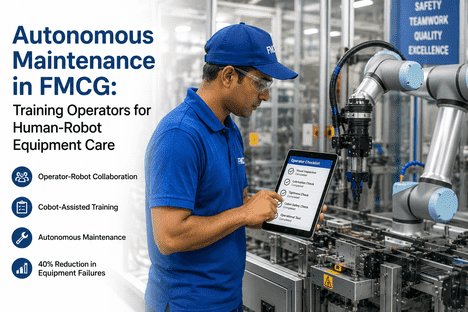
The Autonomous Maintenance (AM) pillar of Total Productive Maintenance (TPM) is the operational foundation that makes autonomous analytics possible. AM shifts the responsibility for basic equipment care cleaning, inspection, lubrication, and tightening from maintenance technicians to production operators. When combined with AI-driven analytics, operators become the first line of defense against equipment degradation, supported by digital checklists, real-time sensor data, and robotic teammates that handle repetitive or high-precision tasks. Book a Demo to see how iFactory enables this transformation in real FMCG production environments.
The 7-Step AM Implementation for Operator Equipment Care
Implementing autonomous maintenance in an FMCG facility requires a structured approach. The TPM framework defines seven steps that progressively transfer equipment care competence from maintenance to operations, creating the human foundation that autonomous analytics builds upon.
How Cobots and Robots Change the Training Landscape
The introduction of collaborative robots (cobots) and autonomous mobile robots (AMRs) into FMCG production lines fundamentally changes what operators need to learn. Training is no longer limited to equipment care — it now includes robot programming, human-robot interaction protocols, safety zone management, and exception handling when autonomous systems encounter unexpected conditions.
iFactory's approach to operator-robot training is structured around three competence tiers. Tier 1 covers basic cobot awareness: how to interpret the cobot's status lights, how to enter and exit the collaborative workspace safely, and how to pause the robot if a safety concern arises. Tier 2 trains operators to load and unload cobot end-effectors, interpret cobot-generated inspection data, and perform first-line troubleshooting when the cobot flags an anomaly. Tier 3 develops advanced skills: programming new inspection routes, adjusting torque parameters for changeover tasks, and analyzing cobot-collected trend data to identify emerging failure patterns. Book a Demo to see how iFactory's training tracking maps operator competence across these tiers.
iFactory's Operator Checklists and Training Tracking ensure every operator is competent and confident working alongside cobots.
Operator-Robot Inspection Programs
An operator-robot inspection program pairs human judgment with robotic precision. The cobot performs systematic data collection — thermal images, vibration spectra, acoustic signatures — at predefined measurement points while the operator simultaneously conducts visual and tactile checks that require human senses. The combined dataset provides a richer equipment health picture than either could produce alone.
iFactory's platform orchestrates these joint inspections by sending the inspection schedule to both the operator's mobile device and the cobot's control system simultaneously. The operator checks off items on the digital checklist as they are completed; the cobot's readings stream into the same work order in real time. When all inspection points are covered, the AI analyzes the combined data set and updates the asset's health score. Any anomaly triggers an automatically generated follow-up work order with the specific finding and recommended corrective action. Book a Demo to see operator-robot inspection workflows in action.
Training Tracking with iFactory's Operator Checklists
Training tracking is the backbone of any successful AM implementation. Without a system that records who has been trained, on what equipment, to what standard, and when refresher training is due, the AM program loses accountability and competence gaps go unnoticed until a failure occurs. iFactory's Operator Checklists and Training Tracking modules close this gap completely.
The Operator Checklists module digitizes every AM task — cleaning steps, inspection points, lubrication routes, torque checks — into structured checklists that operators complete on their mobile devices. Each checklist is tied to a specific asset and skill level. When an operator completes a checklist, the system logs the timestamp, operator ID, asset ID, and any observations or defects noted. Supervisors receive real-time completion dashboards showing which tasks are done and which are overdue.
The Training Tracking module maps each operator's competence against every AM task they are authorized to perform. When a new piece of equipment is installed, or when a cobot is introduced to a line, the system identifies which operators need updated training and auto-generates training assignments. Competency expiry dates trigger refresher alerts. Training records are fully audit-ready for internal audits, customer audits, and certification bodies. Book a Demo to see the Training Tracking dashboard configured for your FMCG plant.
| Training Module | Competency Area | Delivery Method | Assessment Type | Refresh Interval |
|---|---|---|---|---|
| AM Step 1-3 | Basic cleaning, inspection, lubrication | On-floor + mobile checklist | Practical demonstration | Annual |
| AM Step 4-5 | General inspection, cobot-assisted inspection | Simulation + on-floor | Written + practical | Semi-annual |
| Cobot Tier 1 | Safety, status interpretation, emergency stop | E-learning + hands-on | Simulation pass/fail | Quarterly |
| Cobot Tier 2 | End-effector change, data interpretation | Mentored on-floor | Practical + oral exam | Semi-annual |
| Cobot Tier 3 | Route programming, trend analysis, escalation | Classroom + project | Capstone project | Annual |
ROI of Autonomous Analytics Implementation in FMCG
The return on investment for autonomous analytics in FMCG is compelling and measurable. Facilities that have deployed AM programs combined with AI-driven analytics and cobot integration consistently report significant improvements across multiple KPIs within the first 12 months.
Planning labor for maintenance events drops by 50-70% as AI takes over work order creation, resource assignment, and parts reservation. Unplanned downtime on AM-covered assets declines by 35-55% because operator-cobot inspection teams catch developing failures before they cause production stoppages. Training time for new operators is reduced by 3.2x through digital checklists, structured competency tracking, and cobot-assisted mentoring. The average ROI timeline for a fully integrated AM + analytics + cobot deployment is 14-20 months, with the fastest payback coming from reduced emergency parts spend and avoided production losses. Book a Demo to see an ROI model customized for your FMCG plant.
Building the Human-Robot Training Program
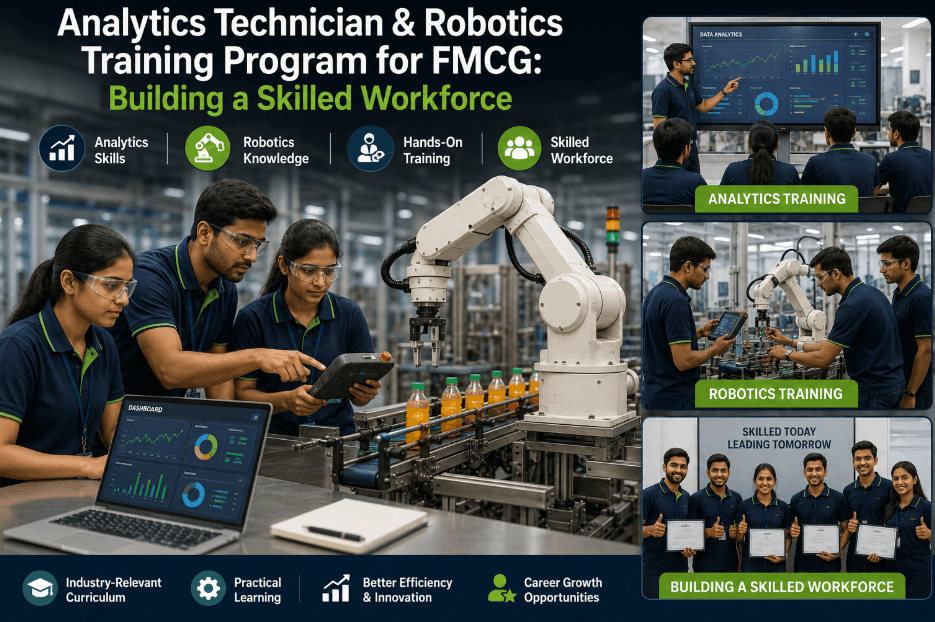
Training operators to work effectively alongside cobots and autonomous systems requires a deliberate program design that addresses both technical skills and cultural adoption. The most successful programs share four common elements. First, they start with foundational AM training before introducing any robotic element — operators must understand basic equipment care before they can supervise a cobot performing it. Second, they use a phased rollout where the cobot initially performs simple data collection while the operator builds trust in the system's reliability. Third, they incorporate the cobot itself as a training tool — the robot can demonstrate proper inspection technique, guide the operator to correct measurement points, and provide real-time feedback on task completion. Fourth, they close the loop with iFactory's Training Tracking, which maps every operator's competence progression and flags gaps before they become risks. Book a Demo to see iFactory's human-robot training program framework.
iFactory provides the complete platform for autonomous analytics, operator training tracking, and cobot integration in FMCG production environments.