Transformation Roadmap for FMCG Manufacturing 2026: From Paper to Smart Factor
By Seren on June 11, 2026
The typical FMCG production line in 2026 still runs on a foundation of paper-based processes: shift handovers documented in physical logbooks, quality checks recorded on clipboards, maintenance requests submitted on printed forms, and production data transcribed from control panels into spreadsheets. Seventy-five percent of FMCG companies now identify digital transformation as their top strategic priority, yet fewer than 20% have progressed beyond the pilot phase of smart factory adoption. The gap between aspiration and execution is not a technology gap — the sensors, platforms, and robotics exist at maturing price points. The gap is a roadmap gap: FMCG manufacturers lack a sequenced, phase-gated plan that respects their operational constraints while delivering measurable returns at each stage. This article provides that roadmap — a five-phase sequence from paper-based operations to AI and robotics-driven smart factory, with realistic timelines, investment profiles, and ROI expectations calibrated for FMCG production environments. Manufacturing leaders planning their 2026-2028 digital strategy Book a Demo to see how iFactory's Digital Platform stages the transition from paper to AI-driven operations.
Phased Roadmap · Paper to Digital · AI & Robotics · Smart Factory Implementation
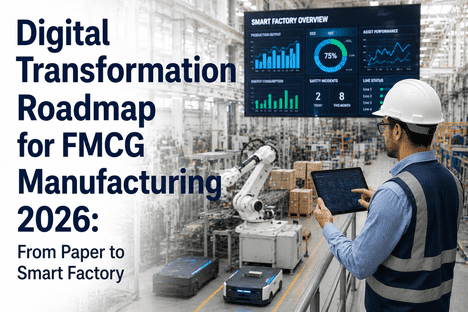
Digital Transformation Roadmap for FMCG Manufacturing 2026: From Paper to Smart Factory in Five Phases
iFactory's Digital Platform provides the staged implementation framework that takes FMCG manufacturers from paper-based shift logs and clipboard quality checks to AI-driven predictive operations and robotics-integrated production — with measurable ROI at every phase.
of FMCG companies identify digital transformation as their top strategic priority for 2026, yet most lack a phased roadmap to execute beyond pilot projects
5
Phases in the structured digital transformation roadmap — from paper digitization to autonomous AI-driven operations with robotics integration
18-24
Month target timeline from paper-based start to smart factory foundation, with ROI delivered at each phase gate before proceeding to the next
3-5x
ROI multiplier reported by FMCG manufacturers that follow a phased digital roadmap versus those attempting big-bang transformation without sequenced stages
The Paper-to-Digital Gap: Why FMCG Manufacturing Still Relies on Clipboards and Logbooks
FMCG manufacturing operates on thin margins, high throughput, and fast changeovers — conditions that make every minute of production downtime expensive and every quality deviation potentially brand-damaging. Yet most FMCG plants in 2026 manage their core operational processes through paper-based systems that create three structural disadvantages: delayed data visibility, inconsistent process adherence, and unmeasurable operational losses. A production supervisor on a beverage line records CIP completion time on a paper logbook that the plant manager sees 24 hours later, if at all. A quality technician fills out a paper checklist for packaging integrity that sits in a binder until the monthly quality review. A maintenance request submitted on a handwritten form waits for the shift supervisor to transcribe it into a digital system before the work order is created.
These paper-based workflows are not relics of technological neglect. They persist because FMCG manufacturers have not had a sequenced roadmap that justifies replacing them. The business case for digitizing a single paper logbook is weak. The business case for digitizing 50 interconnected paper workflows as part of a structured transformation roadmap that delivers cumulative ROI at each phase is compelling. The difference is the roadmap — and that is what FMCG manufacturing has been missing.
Paper-Based Operations
Typical FMCG Baseline
Shift logs on paper: data enters the system 24-48 hours after the shift ends, if at all. Supervisors make decisions based on memory and verbal handover.
Quality checks on clipboards: inspection results sit in binders until monthly review. Non-conforming product may run for hours before the trend is noticed.
Maintenance requests on printed forms: average 4-hour delay from fault detection to work order creation. Emergency repairs dominate the schedule.
Digital shift logs captured on tablets: data available to plant management in real time. Trend analysis identifies recurring handover issues within the same shift.
Digital quality checklists with automated alerts: out-of-spec readings trigger immediate notification to the quality supervisor. Non-conformance records are searchable in seconds.
Digital work order creation from any device: maintenance requests routed automatically based on asset criticality. Preventive maintenance scheduled by the system.
The Five-Phase Digital Transformation Roadmap for FMCG Manufacturing
The roadmap below is structured as a phased sequence with defined gate criteria at each stage. Each phase delivers measurable operational improvement and ROI before the next phase begins. The total timeline from paper-based start to smart factory foundation is 18 to 24 months, with each phase lasting 3 to 6 months depending on plant size, process complexity, and organizational readiness.
1
Phase 1: Digital Foundation (Months 1-3)
Replace paper logs with digital forms, implement mobile-first shift logging and quality checklists
The first phase targets the highest-friction paper processes: shift logbooks, quality inspection checklists, and maintenance request forms. These are replaced with digital equivalents deployed on tablets or smartphones already present on the production floor. The implementation requires no changes to existing machinery, no PLC integrations, and no data infrastructure upgrades. Operators and technicians continue their existing workflows but record data digitally. The immediate benefit is data availability: plant managers see shift reports in real time rather than 24 hours later. Quality supervisors receive instant alerts when an inspection reading falls outside specification. Maintenance requests are routed automatically to the appropriate technician without manual transcription. Phase 1 typically achieves a 3-6 month payback through reduced administrative overhead, faster issue escalation, and elimination of data entry errors. Acceptable performance at this phase gate: 90%+ adoption of digital forms by operators and technicians across all shifts, verified by system usage analytics.
2
Phase 2: Connected Operations (Months 4-8)
Connect PLCs, sensors, and IoT devices; unify data streams into a single platform with real-time dashboards
With digital workflows established, Phase 2 connects the production floor. PLC data streams from packaging lines, filling machines, conveyors, and utilities are ingested into the digital platform through OPC-UA or Modbus TCP gateways. Temperature sensors on refrigeration systems, vibration monitors on motors, and flow meters on CIP circuits are added to the data model. The platform presents real-time dashboards showing OEE, line speed, downtime reasons, quality yield, and energy consumption per SKU. Production supervisors shift from walking the floor to collect data from individual control panels to monitoring the entire plant from a single screen. The key metric at this phase is visibility: operators and supervisors can see the current state of every line, every asset, and every quality parameter without walking to a panel or calling a colleague. Phase 2 typically delivers a 5-12 month payback through reduced downtime (faster issue detection), improved OEE (visibility-driven operator response), and energy optimization (real-time consumption monitoring). Phase gate criterion: all critical production lines and assets connected with data updating at intervals of 60 seconds or less.
3
Phase 3: Predictive Analytics (Months 9-13)
Deploy AI models for predictive maintenance, quality deviation detection, and anomaly identification
With connected operations generating a continuous data stream, Phase 3 applies AI and machine learning models to predict failures before they occur, detect quality deviations at the earliest possible moment, and identify operational anomalies that would escape rule-based monitoring. Predictive maintenance models on filling machine servos, packaging line conveyors, and refrigeration compressors forecast remaining useful life and schedule maintenance during planned changeovers rather than emergency breakdowns. Quality models trained on historical inspection data detect subtle parameter shifts that precede non-conformance events. Anomaly detection models identify unusual patterns in energy consumption, throughput, or temperature profiles that indicate developing problems. The ROI at Phase 3 is driven by unplanned downtime reduction (typically 30-50% reduction after model maturity), quality yield improvement (5-15% reduction in rework and scrap), and extended asset life (predictive rather than reactive maintenance regimes). Phase gate criterion: AI models operating on at least 80% of critical assets with demonstrated prediction accuracy above 85% validated against actual outcomes over a 90-day period.
Integrate AMRs, AGVs, cobots, and robotic inspection with the digital platform for coordinated operations
With predictive analytics providing operational intelligence, Phase 4 introduces physical automation through AMRs, AGVs, cobots, and robotic inspection stations that execute tasks informed by the digital platform's data. AMRs transport raw materials from warehouse to production line based on real-time consumption data from the platform. AGVs move finished goods from packaging to the warehouse following routes optimized by production throughput forecasts. Cobots on packaging lines handle case packing and palletizing with flexible changeover programming that adjusts to the production schedule. Robotic inspection stations apply AI vision to quality checks at speeds and consistency levels that human inspectors cannot sustain across extended shifts. The platform orchestrates these robotic assets, dispatching jobs based on priority, monitoring their operational status, and adjusting their assignments as production conditions change. Phase 4 delivers ROI through labor optimization (robots handling repetitive tasks, skilled workers focusing on exception handling), throughput increase (automated material handling reduces line starvation), and quality consistency (robotic inspection eliminates inspector fatigue variation). Phase gate criterion: at least three robotic asset types integrated with the platform, executing autonomously for 90%+ of scheduled tasks with human intervention required only for exceptions.
5
Phase 5: Autonomous Operations (Months 19-24)
AI-driven closed-loop process control, self-optimizing production schedules, and autonomous quality correction
The final phase closes the loop: AI models that previously generated recommendations are connected to automated control systems that execute adjustments without human intervention. The predictive maintenance model that detected a developing bearing fault on a critical filler now automatically adjusts the production schedule to accommodate the maintenance window and dispatches the AMR to deliver the replacement part to the technician's workstation. The quality model that detected a temperature drift in the pasteurizer sends a setpoint adjustment directly to the PLC, correcting the deviation before it produces off-spec product. The energy optimization model adjusts the refrigeration system staging based on the production load forecast, minimizing power consumption without operator action. The shift supervisor's role transforms from manual decision-maker to exception handler and process optimizer — reviewing system decisions, fine-tuning thresholds, and managing the human elements that automation cannot replace. Phase 5 delivers the full smart factory value: closed-loop quality control that holds Cpk targets automatically, production scheduling that optimizes across multiple lines in real time, and energy management that responds dynamically to production conditions. The cumulative ROI across all five phases typically reaches 3-5x within 24 months of starting Phase 1, with ongoing improvement as AI models continue learning from operational data.
Your FMCG Smart Factory Roadmap Starts with Phase 1 — Digital Forms Today, AI-Driven Autonomous Operations in 24 Months. Every Phase Delivers ROI Before the Next Begins.
iFactory's Digital Platform provides the phased implementation framework — from paper digitization to autonomous AI-driven production — with defined gate criteria, realistic timelines, and measurable ROI at every stage. Book a roadmap review to see how your plant's digital maturity maps to the five-phase sequence.
ROI Expectations by Phase: What Each Stage Delivers
Digital transformation ROI is not deferred to a distant end state. Each phase of the roadmap is designed to deliver measurable financial return within its duration, funding the next phase from operational savings rather than requiring incremental capital allocation. The table below shows realistic ROI ranges for each phase based on implementation data from FMCG plants that have completed similar sequential transformations.
Phase
Timeline
Primary ROI Driver
Typical Payback
1. Digital Foundation
Months 1-3
Admin productivity, reduced data latency, faster escalation
3-6 months
2. Connected Operations
Months 4-8
Downtime reduction, OEE improvement, energy optimization
5-12 months
3. Predictive Analytics
Months 9-13
Unplanned downtime reduction (30-50%), quality yield, asset life extension
Closed-loop quality, self-optimizing schedules, energy auto-optimization
12-18 months
What Industry Experts Say
We spent two years trying to jump directly to predictive maintenance and robotics without first digitizing our foundational processes. The analytics team kept asking for clean historical data that did not exist because our shift logs and quality records were still on paper. The robots we piloted had no digital orchestration layer to tell them what to do based on real-time production conditions. We stepped back, digitized our shift logs and quality checklists in three months, and within six months we had enough structured data to start training predictive models. The roadmap works exactly in the sequence it is described here. We are entering Phase 4 now, and the cumulative ROI on the first three phases has fully funded our robotics investment without additional capital request.
VP of Operations
Top 10 Global FMCG Beverage and Food Manufacturer, Multi-Plant Digital Transformation Lead
Conclusion
Digital transformation for FMCG manufacturing is not a technology project. It is a sequenced operational transformation that respects the reality that FMCG plants cannot stop production to install new systems, cannot replace experienced operators with algorithms overnight, and cannot fund a multi-million dollar smart factory program from a single capital budget cycle. The five-phase roadmap — Digital Foundation, Connected Operations, Predictive Analytics, Automation & Robotics, and Autonomous Operations — provides the structured path that has been missing from FMCG digital strategy discussions.
Each phase delivers measurable ROI within its duration, funds the next phase from operational savings, and builds the data infrastructure and organizational capability that the subsequent phase requires. The timeline is 18 to 24 months from paper-based start to smart factory foundation — not a five-year megaproject with deferred returns, but a two-year phased journey with cumulative value delivered quarterly.
iFactory's Digital Platform provides the full-stack foundation for every phase of this roadmap — from digital shift logs and quality checklists in Phase 1 through AI-driven predictive maintenance in Phase 3 and robotics orchestration in Phase 4. Book a Demo to map your plant's current digital maturity to the five-phase sequence and build your 2026-2028 implementation timeline, or Talk to an Expert about a digital maturity assessment for your facility.
Frequently Asked Questions
The phases are not sequential in the sense that each must be 100% complete before the next begins. Plants with existing digital systems — such as an ERP, a basic SCADA, or partial PLC connectivity — can enter the roadmap at a higher starting maturity level. However, skipping Phase 1 entirely is not recommended even for digitally mature plants because the foundational layer of operator-level digital workflows (shift logs, quality checks, maintenance requests) provides the consistent, structured data that predictive models in Phase 3 depend on. If your plant has strong Phase 1 equivalent systems already in place, the roadmap can be compressed by starting Phases 2 and 1 in parallel or by allocating a shorter Phase 1 period to validate and standardize existing digital workflows. iFactory's digital maturity assessment evaluates your current state and calibrates the phase timeline to your specific starting point.
The platform is designed for heterogeneous environments where Line 1 may be fully instrumented with PLCs and sensors while Line 3 still relies on operator data entry. The platform applies the appropriate data collection method per line: direct PLC integration for instrumented lines, tablet-based operator input for manual lines, and mobile forms for quality checks regardless of line instrumentation level. The unified data model normalizes data from all sources so that dashboards, reports, and AI models operate consistently across the plant regardless of the underlying data collection method. This means a plant can begin the digital transformation on a single pilot line while keeping other lines on their current systems, then expand the digital coverage line by line as the transformation progresses. The platform does not require all lines to reach the same maturity level before delivering value on the lines that are ready. Talk to an Expert about multi-line implementation planning for your plant configuration.
Budget varies significantly by plant size, number of lines, existing infrastructure, and organizational readiness, but typical ranges for a mid-size FMCG plant with 4-8 production lines are: Phase 1 at $30K-$80K (software licensing, tablet deployment, training), Phase 2 at $80K-$180K (PLC integration gateways, sensor deployment, dashboard configuration), Phase 3 at $100K-$250K (AI model development, historical data preparation, model validation), Phase 4 at $200K-$500K (AMR/AGV/cobot procurement and integration, facility modifications), and Phase 5 at $150K-$350K (closed-loop control configuration, autonomous workflow design, exception handling protocols). The critical financial principle is that Phase 1 ROI funds Phase 2 investment, Phase 2 ROI funds Phase 3, and so on — so the total program cost does not need to be available as a single capital allocation. iFactory's phased licensing model aligns with this pay-as-you-go approach, with per-phase pricing that starts after the previous phase's ROI metrics have been achieved.
Change management is addressed through the phased approach itself. Phase 1 introduces digital forms that replicate existing paper workflows almost exactly — the operator fills out the same information fields on a tablet that they previously filled on paper. The immediate benefit to the operator is that they no longer need to walk their paper logbook to the supervisor's office at shift end, and they can see previous entries without flipping through a binder. Phase 2 adds real-time dashboards that make the operator's work visible and valued — line performance metrics that were previously invisible to anyone outside the shift are now displayed on the plant floor screen. By the time Phase 3 introduces AI predictions, operators have been using the digital platform for 9-13 months and understand the system's value from personal experience. Resistance to technology adoption drops significantly when operators see that the system reduces their administrative burden rather than adding to it. iFactory provides on-floor training and support during each phase deployment, with training sessions designed for operators who may have limited computer experience. Talk to an Expert about change management resources and training programs available with each phase.
The recommended approach is to complete Phases 1 and 2 in a single pilot plant before expanding to additional plants, then to deploy Phases 3-5 across the plant network using the pilot plant's implementation playbook. The pilot plant validates the digital workflows, establishes the training materials, identifies the integration challenges specific to your product and process types, and builds the internal expertise that subsequent plant deployments will rely on. Once the pilot plant has passed the Phase 2 gate criterion, the subsequent plant deployments typically proceed 2-3x faster because the workflows, templates, and training are already developed and proven. iFactory supports multi-plant deployments with a central platform instance that provides consolidated visibility across all plants while allowing each plant to configure its own workflows, dashboards, and alert thresholds.
Your FMCG Smart Factory Journey Starts Here. The Five-Phase Roadmap Delivers ROI at Every Step — No Megaproject Required.
iFactory's Digital Platform provides the full-stack foundation for every phase of the FMCG digital transformation roadmap — from digital shift logs and quality checklists in Phase 1 through AI-driven predictive operations in Phase 3 to robotics orchestration and autonomous operations in Phases 4 and 5. See your plant's current maturity level mapped to the phased sequence.