Digital transformation in FMCG manufacturing is no longer a strategic aspiration reserved for enterprise conglomerates — it is the operational baseline that separates resilient, margin-positive food and consumer goods manufacturers from facilities perpetually absorbing cost shocks, compliance failures, and demand volatility without the data infrastructure to respond intelligently. In 2026, FMCG digitalization spans every layer of plant operations: real-time production visibility, AI-driven demand sensing, automated quality assurance, and connected supply chain intelligence that converts raw operational data into decisions fast enough to matter. Building a credible digital transformation roadmap for FMCG manufacturing requires a disciplined, phased approach — technology assessment, change management investment, ROI modeling, and sequenced implementation that generates measurable returns before committing to full-scale deployment. To explore how a structured FMCG digital strategy translates into operational results at your facility, book a demo and see the platform built specifically for food and consumer goods manufacturing modernization.
Build Your FMCG Digital Transformation Roadmap with iFactory
iFactory's manufacturing intelligence platform delivers real-time production visibility, predictive analytics, and automated compliance documentation — purpose-built for food and consumer goods manufacturing modernization.
Why FMCG Digital Transformation Demands a Structured Roadmap in 2026
The FMCG sector faces a uniquely compressed set of operational pressures in 2026 — shrinking consumer product lifecycles, private-label margin erosion, post-pandemic supply chain fragility, and retailer demand for tighter replenishment windows have simultaneously raised the stakes for manufacturing agility while narrowing the tolerance for operational inefficiency. Food and consumer goods manufacturers that approach digital transformation as a collection of isolated technology purchases — an MES here, a quality management system there — consistently underperform against facilities that execute FMCG digitalization as an integrated program with a coherent technology architecture, phased deployment logic, and defined ROI milestones at each stage. A structured digital roadmap for food manufacturing begins with an honest technology assessment of the current state: what operational data is being captured, where visibility gaps exist, and which process failures are absorbing the most cost — because without that baseline, technology investment tends to automate existing inefficiencies rather than eliminating them. FMCG manufacturers beginning their technology assessment can book a demo to walk through a structured baseline analysis of their current operational architecture.
Phase 1: FMCG Technology Assessment — Mapping the Digital Baseline
Effective FMCG technology strategy begins with a comprehensive audit of existing systems, data flows, and operational pain points — not with a technology selection process. The technology assessment phase establishes four critical inputs: current production visibility coverage (what percentage of assets and processes generate structured operational data), integration architecture (how existing ERP, MES, and quality systems communicate and where data silos exist), failure mode cost profiling (which equipment failures, quality deviations, and compliance events carry the highest financial consequence), and workforce readiness assessment (the change management investment required to drive adoption across maintenance, production, and quality teams). Facilities that skip this phase and move directly to technology procurement consistently experience implementation delays, integration conflicts, and adoption failures that destroy ROI timelines. FMCG digitalization requires knowing exactly which operational gaps a digital strategy is solving before selecting the technology that addresses them — and manufacturers who want to structure their assessment phase efficiently can book a demo to review an assessment framework calibrated specifically for food and consumer goods production environments.
Production Visibility Audit
Map every production asset and process against current data capture coverage — identifying where operational decisions are still being made on manual observation, lagging reports, or institutional memory rather than real-time data. Visibility gaps are the primary cost driver in FMCG manufacturing modernization programs.
Integration Architecture Review
Evaluate how existing ERP, MES, LIMS, and quality management systems share data — and where integration gaps force manual data transfer, duplicate entry, or reconciliation workarounds that consume skilled labor and introduce latency into operational decision-making across the food plant.
Failure Mode Cost Profiling
Quantify the financial impact of the facility's most consequential operational failures — unplanned downtime events, quality rejections, compliance deviations, and cold chain excursions — to establish the cost baseline that digital strategy ROI modeling must demonstrate it can measurably reduce.
Workforce Readiness Evaluation
Assess the digital capability maturity of maintenance, production, and quality teams — identifying training requirements, change management resistance patterns, and organizational structure adjustments needed to support adoption of digital tools without disrupting ongoing production operations.
Phase 2: FMCG Digital Strategy — Technology Architecture and Prioritization
With the technology assessment complete, the digital strategy phase translates operational gap findings into a sequenced technology architecture — defining which platforms to deploy, in what order, and against what performance targets. The most effective FMCG digital strategy frameworks prioritize technology investments by consequence severity: the process failures that carry the highest combined cost of downtime, quality exposure, and regulatory risk get addressed first, generating early ROI that funds subsequent deployment phases and builds organizational confidence in the transformation program. Digital factory FMCG programs that sequence deployment correctly — starting with high-consequence asset monitoring and production visibility before expanding to demand sensing, supply chain integration, and advanced analytics — consistently achieve faster payback periods than implementations that attempt comprehensive platform deployment simultaneously. For FMCG manufacturers developing technology prioritization frameworks, book a demo to review how iFactory's deployment sequencing model maps to food and consumer goods manufacturing environments specifically.
Real-Time Production Monitoring and Asset Health Visibility
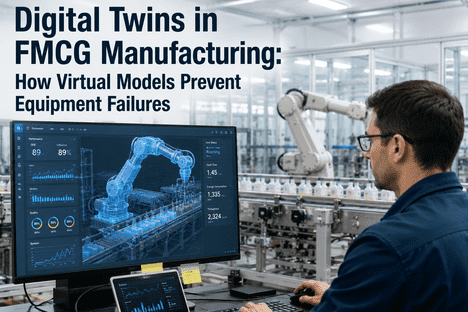
The foundation layer of any FMCG digital transformation roadmap: deploying IoT sensor networks and AI monitoring platforms on critical production assets to establish real-time visibility into equipment health, process performance, and production throughput — converting reactive maintenance programs into condition-based predictive interventions that eliminate unplanned line stoppages.
Automated Quality Assurance and Compliance Documentation
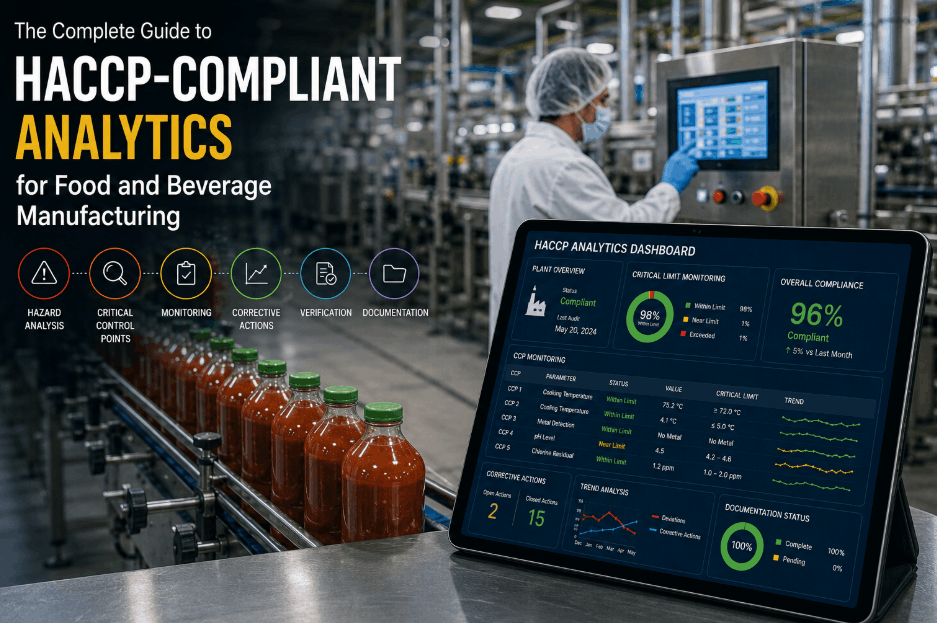
Automated quality monitoring systems that capture in-line inspection data, validate critical control points in real time, and generate HACCP, FSMA, and retailer audit documentation without manual record-keeping — simultaneously improving food safety outcomes and reducing the compliance labor burden on quality management teams.
Demand Sensing and Supply Chain Integration
AI-driven demand sensing platforms that integrate retailer point-of-sale data, promotional calendars, and external demand signals into production scheduling logic — enabling FMCG manufacturers to reduce finished goods inventory, minimize overproduction waste, and respond to demand shifts without emergency changeover disruptions or service level failures.
Advanced Analytics and Continuous Improvement Intelligence
The highest-maturity layer of FMCG digitalization: cross-functional analytics platforms that correlate equipment performance data, quality outcomes, energy consumption, and supply chain events into systemic improvement opportunities — surfacing the compounding efficiency gains that scheduled maintenance and manual reporting programs are structurally unable to identify.
ROI Modeling for FMCG Digital Transformation: Building the Business Case
The business case for digital transformation in food manufacturing must be grounded in quantified, facility-specific financial models — not industry averages or vendor case studies from different production contexts. Effective FMCG digital transformation ROI modeling captures value across five interconnected categories: unplanned downtime elimination (the most immediate and measurable return, typically representing 40–60% of total program ROI in Year 1), quality cost reduction (yield improvement, rework elimination, and finished goods rejection rate reduction), compliance cost reduction (audit preparation labor, documentation error remediation, and regulatory penalty avoidance), energy efficiency improvement (the compounding return from optimized equipment operation and reduced idle run time), and maintenance cost restructuring (the shift from emergency reactive spend to planned, parts-procured-in-advance maintenance that eliminates premium sourcing costs). FMCG manufacturers building ROI models for digital strategy investment cases can book a demo to review iFactory's ROI modeling framework and benchmark against facilities with comparable production profiles.
FMCG Digitalization vs. Traditional Operations: A Performance Comparison
The operational case for food manufacturing digital transformation is most clearly demonstrated through direct comparison with conventional manufacturing management approaches — showing precisely where connected, AI-driven operations outperform manually managed facilities across every dimension that determines FMCG competitiveness in 2026.
| Operational Dimension | Traditional FMCG Operations | Digitalized FMCG Factory | Competitive Impact |
|---|---|---|---|
| Production Visibility | Shift reports, manual line checks | Real-time OEE and asset health dashboards | Decisions made on current data, not yesterday's report |
| Equipment Maintenance | Reactive breakdown or fixed-schedule service | AI-predicted condition-based intervention | Unplanned stoppages eliminated; maintenance costs planned |
| Quality Assurance | Periodic sampling, manual inspection logs | Continuous in-line monitoring with automated alerts | Defects caught at source; finished goods rejection rates fall |
| Compliance Documentation | Manual paper logs, batch record compilation | Automated real-time digital records generation | Audit readiness continuous; documentation labor eliminated |
| Demand Response | Production scheduling from weekly ERP runs | AI demand sensing with dynamic schedule adjustment | Inventory optimized; service levels protected against demand shifts |
| Energy Management | Utility billing review after the fact | Real-time energy consumption monitoring by asset | Idle run waste eliminated; energy cost per unit reduced |
| Multi-Site Visibility | Plant-by-plant manual performance reporting | Unified enterprise manufacturing intelligence dashboard | Resource allocation optimized across full production network |
Change Management: The Critical Non-Technical Dimension of FMCG Digital Strategy
The most sophisticated digital transformation technology roadmap for FMCG manufacturing fails without effective change management — because operational value is realized by the people who use the platforms daily, not by the platforms themselves. FMCG organizations that treat change management as a post-deployment afterthought consistently experience adoption failures where expensive digital tools are actively worked around by frontline teams who don't trust or understand them.
Effective change management runs in parallel with technology deployment from day one, across three workstreams: leadership alignment (plant managers visibly championing the transformation), frontline engagement (operators and technicians involved in alert calibration so they build ownership, not resistance), and structured competency development (training built into the deployment timeline, not scheduled after go-live). FMCG manufacturers who want to understand how iFactory integrates change management into every deployment phase can book a demo to review the full adoption support framework.
FMCG Technology Roadmap: Phased Implementation for Sustainable Digital Transformation
Sustainable digital transformation in consumer goods manufacturing is built on a phased implementation model that generates measurable ROI at each stage before committing capital to the next — avoiding the "big bang" deployment trap that has derailed numerous FMCG digitalization programs by attempting full-facility technology transformation simultaneously without the organizational bandwidth, integration maturity, or data infrastructure to support it. The most effective FMCG digital factory implementation sequences follow a proven three-phase architecture that builds capability progressively while delivering compounding financial returns at each stage.
Foundation: Critical Asset Monitoring and Production Visibility
Deploy IoT monitoring on highest-consequence production assets — primary filling lines, critical processing equipment, refrigeration systems, and key quality checkpoints. Establish real-time OEE dashboards and predictive maintenance alerts on priority assets. Generate immediate ROI from downtime reduction and emergency maintenance cost elimination.
Integration: Quality, Compliance, and Supply Chain Connectivity
Expand digital coverage to automated quality monitoring, compliance documentation generation, and ERP integration — connecting production performance data with supply chain planning logic. Introduce demand sensing capabilities that enable dynamic production scheduling adjustments in response to real-time demand signal changes.
Optimization: Advanced Analytics and Continuous Improvement
Deploy cross-functional analytics that correlate equipment, quality, energy, and supply chain data into systemic improvement intelligence. Build the compounding operational efficiency that separates digital-native FMCG manufacturers from facilities perpetually managing the same recurring cost drivers with increasingly inadequate traditional tools.
Key Technology Pillars of a Modern FMCG Digital Factory
A complete FMCG digital transformation roadmap addresses five interconnected technology domains — each delivering standalone value while creating the integrated data infrastructure that enables advanced analytics and Industry 4.0 maturity in food and consumer goods manufacturing. FMCG manufacturers ready to evaluate how these pillars integrate in a unified platform can book a demo to see the full architecture in action.
Industrial IoT Sensor Networks
The data acquisition foundation — converting previously invisible operational signals from production equipment into structured time-series data that AI and analytics platforms require for predictive intelligence and real-time monitoring.
Manufacturing Execution Systems (MES)
The production management layer connecting scheduling, materials, labor, and quality data into a unified operational record — replacing disconnected paper-based tracking with a single source of truth across all production lines.
AI-Powered Predictive Analytics
Machine learning platforms that translate IoT data streams into actionable maintenance alerts, quality deviation warnings, and process optimization intelligence — shifting FMCG operations from reactive to predictive across every critical asset category.
Supply Chain Integration Platforms
Connected platforms that link production scheduling with retailer demand signals, supplier systems, and logistics networks — enabling the responsive, inventory-efficient operations that major FMCG retailers increasingly mandate from their manufacturing partners.
Automated Compliance and Quality Management
Systems that generate FSMA, HACCP, BRC, and SQF documentation automatically from live process data — delivering continuous audit readiness without the labor overhead of manual record-keeping programs that introduce gaps and regulatory exposure.
Measuring FMCG Digital Transformation Success: KPIs That Matter
Digital transformation programs without defined measurement frameworks generate activity without accountability. The core FMCG digital transformation performance measurement framework spans four KPI categories that capture the full spectrum of value delivery — from equipment uptime to financial returns.
OEE, MTBF and Downtime KPIs
Track Overall Equipment Effectiveness (OEE), unplanned downtime frequency, mean time between failures (MTBF), and changeover time — the metrics that measure how much productive output the facility is generating from its installed asset base.
Rejection Rate and CCP Deviation KPIs
Monitor finished goods rejection rate, CCP deviation frequency, consumer complaint rate, and audit finding counts — reflecting the food safety risk reduction and quality cost improvements that continuous digital monitoring delivers across all production lines.
Forecast Accuracy and Service Level KPIs
Measure forecast accuracy, inventory turns, service level attainment, and on-time-in-full delivery rate — showing how well digital demand sensing and production scheduling are aligning manufacturing output with real customer requirements.
Maintenance Cost and Digital ROI KPIs
Quantify maintenance cost per unit, energy cost per unit, waste and rework cost as a percentage of revenue, and total digital transformation ROI — providing the financial validation that sustains program investment through multi-year transformation timelines.
Ready to Build Your FMCG Digital Transformation Roadmap?
iFactory's AI manufacturing intelligence platform gives FMCG producers real-time production visibility, predictive asset monitoring, automated compliance documentation, and the analytics infrastructure to execute a phased digital strategy that delivers measurable ROI at every stage of food plant modernization.
Frequently Asked Questions: FMCG Digital Transformation Roadmap
How long does FMCG digital transformation typically take from assessment to full deployment?
A phased FMCG digitalization program typically spans 9–18 months from initial technology assessment to full-facility deployment, with priority asset monitoring generating measurable ROI within the first 4–6 months. The timeline depends on facility complexity, integration requirements, and organizational change management maturity.
What is the ROI timeline for digital transformation investment in food manufacturing?
Most FMCG digital transformation programs achieve full payback within 12–18 months of initial deployment, with high-throughput food and consumer goods facilities often recovering Phase 1 investment costs within 6–9 months through unplanned downtime elimination alone. Total program ROI compounds significantly in Years 2 and 3 as advanced analytics surface systemic improvement opportunities.
How does FMCG digitalization support food safety compliance requirements?
Digital transformation platforms automate the generation and maintenance of HACCP verification records, FSMA Preventive Controls documentation, CCP monitoring logs, and corrective action records — providing continuous audit readiness for FDA, state regulatory, and third-party certification audits without relying on manual documentation processes that introduce gaps and errors.
Can FMCG digital transformation platforms integrate with existing ERP and MES systems?
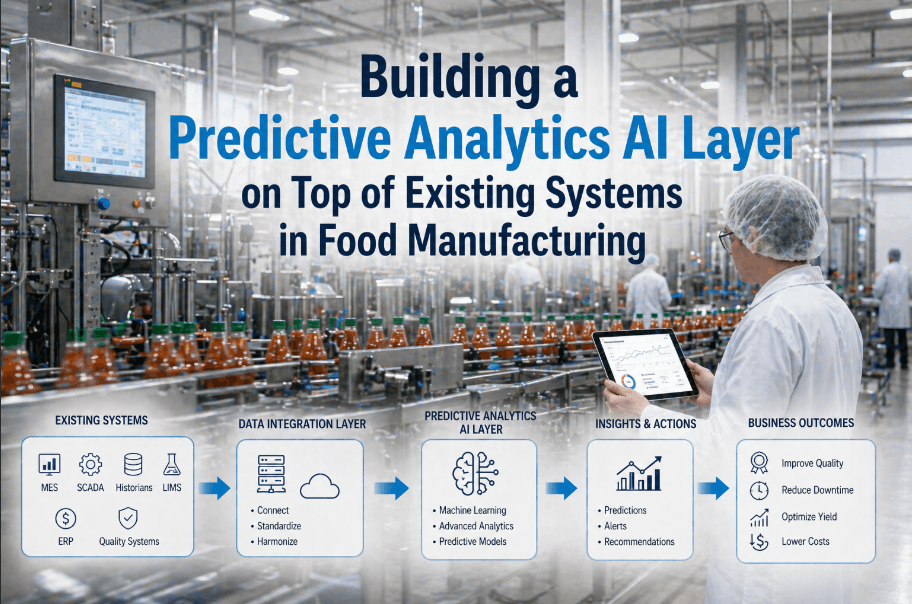
Yes. Modern FMCG digital factory platforms are designed with open integration architectures that connect with leading ERP systems (SAP, Oracle, Microsoft Dynamics), manufacturing execution systems, LIMS platforms, and quality management systems — consolidating operational data into a unified intelligence layer without requiring replacement of existing core systems.
What change management investment is required for FMCG digitalization success?
Successful FMCG digital transformation programs invest in change management from day one — including leadership alignment, frontline engagement in platform configuration, structured training programs, and defined adoption milestones. Organizations that treat change management as a parallel program rather than a post-deployment afterthought consistently achieve adoption rates and ROI outcomes significantly above industry averages.