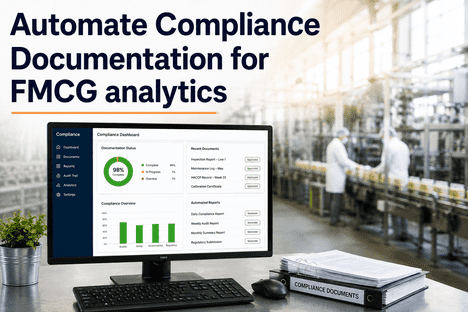
Automate Compliance Documentation for FMCG analytics

By Seren on June 3, 2026

automate-compliance-documentation-fmcg-analytics-url.png_optimized_300

FMCG manufacturing facilities operate under some of the most stringent regulatory frameworks in industrial production — FSMA, SQF, BRCGS, IFS, GFSI benchmarked schemes, and FDA 21 CFR Part 11 for electronic recordkeeping each require documented evidence of compliance that spans every stage of production. The documentation burden is enormous: quality inspection records, HACCP monitoring logs, sanitation verification records, supplier certification audits, corrective action reports, and traceability documentation must be maintained, cross-referenced, and made available for regulatory inspection on demand. Manual documentation processes — spreadsheets, paper logs, disconnected quality management systems — create compliance exposure that is entirely preventable. iFactory AI automates compliance documentation for FMCG manufacturing, converting fragmented data streams into structured, audit-ready records that satisfy regulatory requirements without engineering hours spent on manual data entry and document assembly. Book a Demo to see iFactory AI's compliance automation platform configured for your FMCG facility's specific regulatory obligations.


AI Compliance Automation · FMCG Documentation · Audit-Ready Records · Food Safety Intelligence

How AI Automates Compliance Documentation for FMCG Manufacturing

AI-driven quality inspection recordkeeping, HACCP log automation, supplier compliance tracking, FSMA traceability documentation, and FDA 21 CFR Part 11 compliant electronic records — built for FMCG facilities operating under SQF, BRCGS, IFS, and GFSI benchmarked food safety schemes.

Why Compliance Documentation Automation Is the Highest-ROI Digital Investment for FMCG Facilities

The cost of compliance documentation in FMCG manufacturing is not the software — it is the labor. Quality assurance teams at mid-size FMCG facilities spend 25 to 40 hours per week on manual documentation activities: transcribing inspection readings from paper forms into digital records, assembling HACCP monitoring logs from multiple data sources, compiling supplier certification documentation for annual audits, and preparing traceability exercise reports. At an average loaded cost of $45 to $65 per hour for QA documentation labor, a facility spending 35 hours per week on manual documentation incurs $82,000 to $118,000 annually in labor costs for activities that AI automation reduces to near-zero marginal effort.

The compliance exposure is more expensive than the labor. A single non-conformance finding during a GFSI-benchmarked certification audit — caused by incomplete documentation, missing HACCP log entries, or untraceable supplier records — can require a corrective action plan, a follow-up audit within 30 to 60 days, and in severe cases result in certification suspension that blocks shipment to retailers requiring BRCGS or SQF certification. The cost of a certification gap ranges from $15,000 for a minor finding to $250,000 or more for a suspension that interrupts customer shipments. Automated compliance documentation eliminates the documentation gaps that generate these findings. Book a Demo to see how iFactory AI documents your facility's compliance evidence automatically.

Manual Inspection Record Transcription

Quality inspectors record readings on paper forms during production runs. Those readings must be transcribed to digital records for audit documentation. Transcription errors, missing entries, and delayed digitization create documentation gaps that BRCGS and SQF auditors identify as non-conformances during certification audits.

Disconnected HACCP Monitoring Logs

HACCP critical control point data flows from multiple sources — temperature sensors, pH meters, metal detector outputs, chlorine analyzers — each with its own logging format and frequency. QA teams manually reconcile these data streams into unified HACCP logs, a process that introduces time lags and cross-referencing errors.

Supplier Compliance Documentation Gaps

FMCG facilities maintain approved supplier lists with certification records, COAs, and letters of guarantee. Managing supplier document renewal cycles across dozens or hundreds of suppliers manually means expired certificates inevitably slip through — creating a documented non-conformance during GFSI audits that requires formal corrective action.

Traceability Exercise Preparation Overhead

Annual mock traceability exercises — required under FSMA Traceability Rule and GFSI scheme requirements — demand pulling documentation from receiving records, production logs, inspection data, and shipping manifests. Manual traceability exercises consume 8 to 16 hours of QA engineering time and frequently expose data gaps that require remediation before the formal exercise.

Manual Audit Preparation Cycles

Preparing for BRCGS, SQF, or IFS certification audits requires assembling evidence across every clause of the standard — quality records, HACCP documentation, training records, supplier files, pest control logs, and equipment calibration records. Manual audit preparation consumes two to four weeks of QA team time per certification cycle.

No Automated Corrective Action Tracking

When audits or internal inspections identify non-conformances, corrective action plans are generated and tracked manually. Root cause analysis, action item assignment, due date management, and effectiveness verification documentation degrade without structured tracking — leading to recurring findings in subsequent audit cycles.

25–40 hrs
Weekly QA documentation labor hours at mid-size FMCG facilities that AI automation reduces to minutes
$82K–118K
Annual labor cost per facility for manual compliance documentation activities that AI can automate
60%
Reduction in audit non-conformance findings documented at FMCG facilities after deploying AI compliance automation
2–4 wks
Manual audit preparation time per certification cycle eliminated by automated documentation generation

Want to see iFactory AI's compliance automation platform demonstrated against your facility's specific regulatory obligations and quality documentation workflows? Book a Demo with iFactory's FMCG compliance team.

Five AI Capabilities That Automate FMCG Compliance Documentation

Not all compliance automation capabilities deliver equal value. The following five capabilities represent the highest-impact AI deployments for FMCG facilities — areas where replacing manual documentation workflows with AI-driven automation creates measurable, auditable compliance improvements that compound across successive certification audits as the system accumulates facility-specific quality and regulatory data.

Quality Layer
Automated Quality Inspection Recordkeeping with AI Data Capture
Quality inspection data is the foundation of FMCG compliance documentation. iFactory AI eliminates manual transcription by capturing inspection data at the source — directly from connected gauges, sensors, and vision inspection systems, and from operator-entered readings via mobile forms that validate data completeness at the point of entry. Inspection parameters, pass-fail determinations, and corrective actions are recorded to structured digital records automatically, timestamped, and linked to the production batch, line, and operator. The system validates that all required inspection points for each product SKU are documented before the batch is closed — eliminating the gap between what was inspected and what was recorded. For SQF and BRCGS facilities, this automated recordkeeping directly satisfies documentation requirements for product quality monitoring across all production stages.
Documentation Capabilities
Real-time inspection data capture Mobile operator forms with validation Connected gauge and sensor integration Batch-level record linking SKU-specific inspection requirement mapping Automated data completeness validation
Documentation Outcome
Inspection record accuracy moves from manual transcription with typical 3–5% error rates to 100% source-data accuracy. QA labor for inspection documentation reduces by 80–90%, and every batch's quality records are complete and audit-ready at the moment of batch closure rather than assembled days later.
Safety Layer
AI-Driven HACCP Monitoring Log Automation
HACCP critical control point monitoring is the most documentation-intensive activity in FMCG food safety compliance. iFactory AI's HACCP automation module aggregates CCP data from all monitoring sources — continuous temperature sensors, metal detector output logs, pH and water activity meters, chlorine analyzer readings — into unified HACCP monitoring logs that document every CCP reading, time stamp, operator ID, and any deviation occurrence. When a CCP reading falls outside the critical limit, the system automatically generates a deviation record, notifies the designated corrective action responder, and documents the corrective action taken — including rework, hold, or disposition decision. The complete HACCP log for each production day is finalized automatically at shift end, ready for QA review without manual log assembly. For facilities operating under 21 CFR Part 120 (HACCP for juice) or 21 CFR Part 123 (HACCP for seafood), the system supports regulatory-specific log formats and retention requirements.
HACCP Automation Capabilities
Unified CCP data aggregation Automatic deviation detection and logging Corrective action notification workflow Shift-end log finalization Regulatory-specific log format support Real-time CCP status dashboard
Compliance Outcome
HACCP log preparation time reduces from 3–5 hours per shift of QA manual reconciliation to fully automated generation with QA review only. Deviation documentation completeness reaches 100% — every out-of-spec reading is captured, every corrective action is recorded, and every log is audit-ready at shift close instead of days delayed.
Supplier Layer
Automated Supplier Compliance and Certification Tracking
Supplier compliance documentation is a persistent source of audit findings at FMCG facilities. iFactory AI's supplier compliance module maintains a structured repository of approved supplier records — certifications (SQF, BRCGS, organic, non-GMO, kosher, halal), certificates of analysis, letters of guarantee, and raw material specifications. The system tracks certification expiration dates automatically and alerts the procurement and QA teams 90, 60, and 30 days before expiry. Supplier document requests, receipt, and validation are managed through a structured workflow that logs every action. For BRCGS Global Standard for Food Safety Issue 9 compliance, the module maps documentation to specific clauses — supplier approval (3.5.1), raw material risk assessment (3.5.1.1), and incoming goods inspection (3.5.2) — generating clause-specific evidence packages for audit review.
Supplier Compliance Capabilities
Structured supplier document repository Automated certification expiry tracking Document request and validation workflow BRCGS clause-specific evidence mapping Multi-site supplier management Raw material specification version control
Compliance Outcome
Supplier certification expiry non-conformances — the most common supplier-related audit finding — are eliminated. QA time for supplier document management reduces from hours per week of file chasing to automated workflow management with periodic review. Supplier compliance is documented continuously rather than assembled reactively before audits.
Traceability Layer
FSMA Traceability Rule Documentation and Mock Trace Automation
The FSMA Traceability Rule (21 CFR Part 1 Subpart S) requires FMCG facilities on the Food Traceability List to maintain records at six Key Data Elements across the supply chain — from receiving through transformation through shipping. iFactory AI's traceability module captures KDEs automatically from production and logistics data: receiving lot numbers and supplier information, production batch transformation records, quantity and date data at each processing step, and outbound shipment lot assignments. The system can execute a mock traceability exercise — tracing a raw ingredient lot forward to all affected finished product shipments or tracing a finished product lot back to all ingredient lots — in minutes rather than the hours required for manual trace. The complete trace report, with all required FSMA KDEs documented, is generated automatically and available for audit review or regulatory submission on demand.
Traceability Capabilities
FSMA KDE automated capture Lot genealogy tracking Forward and backward trace execution Automated mock trace reports Receipt-to-shipment chain documentation Batch transformation record linking
Traceability Outcome
Mock trace exercise completion time drops from 8–16 hours of QA effort to under 5 minutes of system execution. FSMA Traceability Rule KDE documentation is continuous and complete at every production step. In the event of a recall, trace completion is available in minutes rather than hours, directly reducing recall scope and cost.
Audit Layer
AI-Powered Audit Preparation and Evidence Package Generation
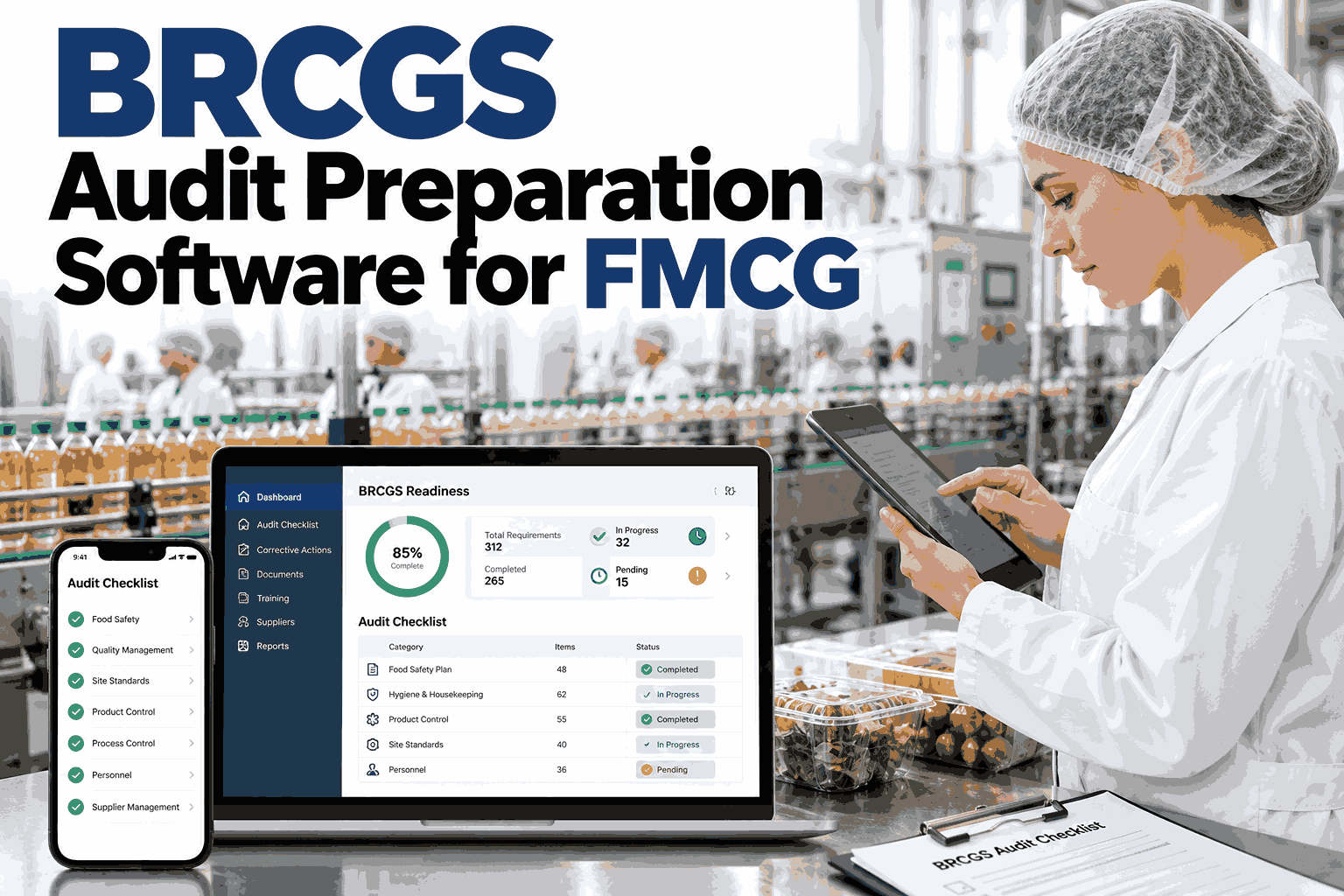
Preparing for BRCGS, SQF, IFS, or FSSC 22000 certification audits is the most concentrated documentation effort in the FMCG compliance calendar. iFactory AI's audit preparation module maps every facility document — quality records, HACCP logs, training files, pest control documentation, calibration records, supplier files — to the specific clauses of the applicable standard. When an audit is scheduled, the system generates a complete evidence package organized by clause, with each document linked to the standard requirement it satisfies. Pre-audit gap analysis identifies documentation weaknesses before the auditor arrives. During the audit, the evidence browser gives instant access to any clause's supporting documentation. Post-audit, corrective action documentation for any findings is tracked through closure with automated effectiveness verification scheduling.
Audit Preparation Capabilities
Standard-specific clause mapping Automated evidence package generation Pre-audit gap analysis Real-time evidence browser Corrective action tracking through closure Multi-standard support (BRCGS, SQF, IFS, FSSC)
Audit Outcome
Audit preparation time drops from 2–4 weeks of intensive QA effort to evidence package generation in hours. Non-conformance findings related to documentation completeness — the most common finding category across GFSI audits — are eliminated when every clause's required evidence is pre-mapped and automatically maintained.

Ready to see how iFactory AI maps your facility's existing documentation to audit clause requirements? Book a Demo for a live walkthrough of automated audit preparation specific to your certification standard.

Manual vs. Automated Compliance Documentation: A Performance Comparison

The table below compares manual compliance documentation approaches against iFactory AI's automated documentation platform across the key performance dimensions that determine FMCG compliance quality, labor cost, and audit readiness. Figures reflect documented outcomes across FMCG facilities using iFactory AI.

Documentation Area Manual Approach iFactory AI Automated Annual Value Impact
Inspection Records Paper forms → manual transcription → digital records — 3–5% error rate Source-data capture with completeness validation — 100% accuracy $35K–$55K labor recovered annually
HACCP Logs Manual reconciliation from multiple CCP data sources — 3–5 hrs/shift Automated CCP aggregation and shift-end log generation $28K–$45K labor recovered annually
Supplier Docs Email-based certification collection with manual expiry tracking — recurring gaps Automated expiry alerting and document request workflow Eliminate supplier certification non-conformances
Traceability Manual lot genealogy mapping — 8–16 hrs per mock trace exercise Automated KDE capture with instant forward/backward trace — 5 min $8K–$16K labor recovered per exercise
Audit Preparation Manual clause-by-clause evidence assembly — 2–4 weeks per cycle Automated evidence package generation organized by standard clause $15K–$30K engineering time recovered per certification cycle
Corrective Actions Spreadsheet-based tracking with manual follow-up — 30% overdue rate Structured workflow with automated escalation and closure verification Recurring audit findings eliminated
Regulatory Filing Manual FDA/FSMA documentation compilation — reactive to requests Continuous documentation with on-demand regulatory package generation Zero documentation-related regulatory findings

iFactory AI Deployment Workflow: From Legacy Documentation to Automated Compliance

iFactory AI's compliance documentation deployment follows a structured five-phase workflow that transitions an FMCG facility from manual, paper-dependent documentation processes to fully automated, AI-driven compliance records within 8 to 14 weeks. The methodology is sequenced to deliver measurable documentation improvement at each phase — beginning with inspection records and HACCP logs where data sources are most accessible, before layering in supplier compliance and traceability automation that require broader data integration.


01

Documentation Audit and Data Source Mapping

iFactory's implementation team conducts a comprehensive documentation audit — mapping every compliance record type the facility generates, the data sources that feed each record, the current documentation workflow (manual vs. digital), and the regulatory standard requirements each record must satisfy. Inspection points, HACCP CCPs, supplier documentation requirements, and traceability KDEs are catalogued. The audit identifies documentation gaps, data quality issues, and the highest-labor manual documentation processes that will deliver the fastest ROI when automated. A deployment roadmap is developed with phase-specific milestones and success metrics.

Output: Complete Documentation Mapping with Automation Roadmap
02

Inspection Record and HACCP Log Automation Go-Live

AI inspection recordkeeping is activated by connecting quality inspection devices — gauges, sensors, vision inspection systems — to the iFactory platform and deploying mobile forms for manual inspection points. Inspection records begin flowing automatically, with data completeness validation ensuring every required parameter is documented. HACCP CCP aggregation is activated simultaneously, pulling temperature, metal detector, pH, and other CCP data into unified monitoring logs. During the first 30 days, records are generated automatically and reviewed in parallel with existing manual documentation to validate completeness and accuracy before transitioning to automated documentation as the primary record.

Output: Live Inspection and HACCP Documentation with Parallel Validation
03

Supplier Compliance and Certification Tracking Activation

The supplier compliance module is populated with the facility's approved supplier list and existing certification documentation. Certification expiry dates are entered, and the automated alerting workflow is configured with configurable lead times for renewal notices. Supplier document request templates — for COAs, letters of guarantee, updated certifications — are set up and the structured document repository is organized by supplier and certification type. Procurement and QA teams receive training on the document request and validation workflow. After go-live, all incoming supplier documentation is managed through the platform, building a continuously maintained supplier compliance record.

Output: Automated Supplier Compliance Tracking with Document Repository
04

FSMA Traceability and Lot Genealogy Automation

The traceability module is integrated with receiving, production, and shipping data systems to capture FSMA Traceability Rule Key Data Elements automatically. Lot genealogy — linking raw material lots through production batch transformations to finished product shipments — is built continuously from production records. The mock trace capability is configured to execute forward and backward traces on demand. An initial mock trace exercise is conducted to validate KDE completeness and trace speed, with any data gaps identified and resolved before the system is activated for ongoing traceability documentation.

Output: Automated Traceability Documentation with Instant Mock Trace
05

Audit Preparation Mapping and Full Compliance Integration

The audit preparation module is configured by mapping every facility compliance document to the specific clauses of the applicable standard — BRCGS, SQF, IFS, or FSSC 22000. Standard-specific evidence package templates are created, and the gap analysis tool is run to identify any documentation requirements not yet addressed by automated records. The corrective action workflow is activated with root cause analysis templates, assignment routing, escalation rules, and effectiveness verification scheduling. A pre-audit evidence package is generated and reviewed by the QA team to validate completeness against all standard clauses. Post-validation, the facility operates with fully automated compliance documentation — producing audit-ready records continuously rather than assembling them reactively before certification cycles.

Output: Full Compliance Automation with Standard-Specific Audit Preparation

Want the deployment workflow mapped to your facility's specific regulatory obligations, quality documentation processes, and audit schedule? Book a Demo and review your facility-specific deployment plan with iFactory's FMCG compliance team.

Expert Review: What FMCG Quality Leaders Should Expect from Compliance Documentation Automation

Expert Perspective

Having managed quality and food safety systems across four FMCG facilities — two BRCGS-certified and two SQF-certified — over 17 years in the industry, the single most important insight I can offer is this: the facilities that perform best in certification audits are not the ones with the most QA staff. They are the ones with the best documentation systems. Manual documentation processes create systematic gaps — missing records, delayed log entries, disconnected data — that auditors identify as findings regardless of how thorough the underlying quality activities are. Compliance documentation automation eliminates the gap between what your facility actually does for quality and safety and what it can prove it does through documentation.

Start with HACCP log automation — it delivers the fastest audit-visible improvement. HACCP documentation is the single most scrutinized record set in every GFSI-benchmarked audit. When HACCP logs are assembled automatically from CCP data sources rather than manually reconciled from disconnected logs, the completeness improvement is immediately visible to auditors. I have seen facilities reduce their HACCP-related audit findings from three or four per cycle to zero within the first audit after automation go-live.
Mock trace automation pays for itself in the first exercise. The first time your QA manager runs a mock trace exercise in 5 minutes instead of 8 hours, you have recovered the deployment cost of the traceability module in a single afternoon. Beyond the direct labor savings, the ability to run mock traces on demand — quarterly instead of annually — builds a traceability evidence record that demonstrates continuous system effectiveness to FSMA and GFSI auditors in a way that annual exercises cannot.
Supplier compliance automation eliminates the most common recurring finding. Expired supplier certifications are the audit finding that should never happen — it is entirely preventable with automated tracking. Yet it remains one of the top three most frequently cited non-conformances in BRCGS and SQF audits because manual tracking systems inevitably miss renewal dates across dozens or hundreds of suppliers. Automating this single documentation area eliminates an entire category of recurring audit findings with minimal configuration effort.
Director of Quality and Food Safety, North American FMCG Manufacturer 17 Years in FMCG Quality Management — SQF Lead Auditor — iFactory AI Compliance Reference 2026

Conclusion

Compliance documentation automation is not a future capability for FMCG manufacturing — it is a present competitive necessity. Facilities that have deployed AI-driven documentation systems are entering certification audits with complete, clause-mapped evidence packages and zero documentation-related non-conformances. Their QA teams spend time on quality improvement and root cause analysis instead of manual log assembly and record transcription. Their traceability exercises take minutes instead of days. Their supplier compliance gaps are eliminated by automated tracking rather than discovered during audit preparation under time pressure.

Book a Demo today to see iFactory AI's compliance documentation platform applied to your facility's specific regulatory obligations, quality processes, and certification standard.

Bring Your Current Documentation Process. Leave With an Automation Roadmap.

In a 45-minute working session, iFactory AI's FMCG compliance specialists configure a live platform preview using your facility's quality documentation workflows, regulatory obligations, and certification schedule — covering inspection records, HACCP log automation, supplier compliance, FSMA traceability, and GFSI audit preparation.

Frequently Asked Questions

Yes. iFactory AI is designed to support FDA 21 CFR Part 11 compliance for electronic records and electronic signatures. The platform includes user authentication and access controls, audit trail logging for all record creation and modification events, secure electronic signature capture with user-specific credentials and signature meaning attribution, and data retention controls that meet regulatory recordkeeping periods. Validation documentation packages are available to support customer PQ/OQ protocols. For facilities exporting to EU markets, the platform also supports GDPR compliance requirements for production data management. Book a Demo to review the platform's Part 11 compliance documentation specific to your facility's quality system.
Yes. iFactory AI is designed as a documentation automation layer that integrates with existing quality management systems, ERP platforms (SAP, Oracle, Microsoft Dynamics), and production data infrastructure. The platform connects via API, file-based import/export, and direct database interfaces. For facilities using paper-based documentation, mobile forms and barcode scanning provide digital capture at the source without requiring upstream system changes. The platform can operate alongside existing QMS software — automating documentation generation while records remain accessible through the existing system interface. Integration timelines typically range from 2 to 6 weeks depending on the number of source systems and data mapping complexity.
iFactory AI includes pre-configured documentation mapping templates for BRCGS Global Standard for Food Safety Issue 9, SQF Code Edition 10, IFS Food Version 8, and FSSC 22000 Version 6. Each template maps facility documentation — quality records, HACCP logs, supplier files, training records, pest control documentation, equipment calibration records — to the specific clauses of the applicable standard. The platform supports facilities that maintain multiple certifications simultaneously, with documentation organized to satisfy each standard's unique clause structure from the same underlying data. Standard-specific evidence packages are generated with clause references, auditor notes, and document location links for each audit.
Historical documentation remains accessible through your existing systems. iFactory AI automates documentation going forward from the deployment date — the platform does not require migration of historical records into its data structure. For facilities that want consolidated documentation, iFactory can ingest historical records as reference documents in the audit preparation module, linking them to standard clauses alongside current automated documentation. This approach allows facilities to maintain their legacy documentation systems for historical reference while transitioning to automated documentation for all new production records — the audit evidence package includes both current automated records and linked historical documents in a single clause-organized view.
Evidence package generation for an upcoming audit is available immediately once the documentation mapping phase is complete — typically within 4 to 6 weeks of the deployment start date. The first evidence package will include documentation generated by the platform from the deployment date forward, linked to existing historical records from your legacy systems. For facilities that want a fully automated package covering all audit evidence before the next certification audit, we recommend deployment at least 12 weeks before the scheduled audit date to allow sufficient production documentation to accumulate in the automated system. However, even with shorter timelines, the platform significantly reduces manual evidence assembly effort by organizing existing records against standard clause requirements automatically. Book a Demo to discuss your facility's specific audit timeline and deployment schedule.

Replace Manual Documentation and Audit Scramble with Continuous AI Compliance.

iFactory AI delivers automated inspection records, HACCP log generation, supplier compliance tracking, FSMA traceability documentation, and GFSI audit preparation — inside a single integrated platform built for FMCG manufacturing quality and food safety compliance.
Share This Story, Choose Your Platform!