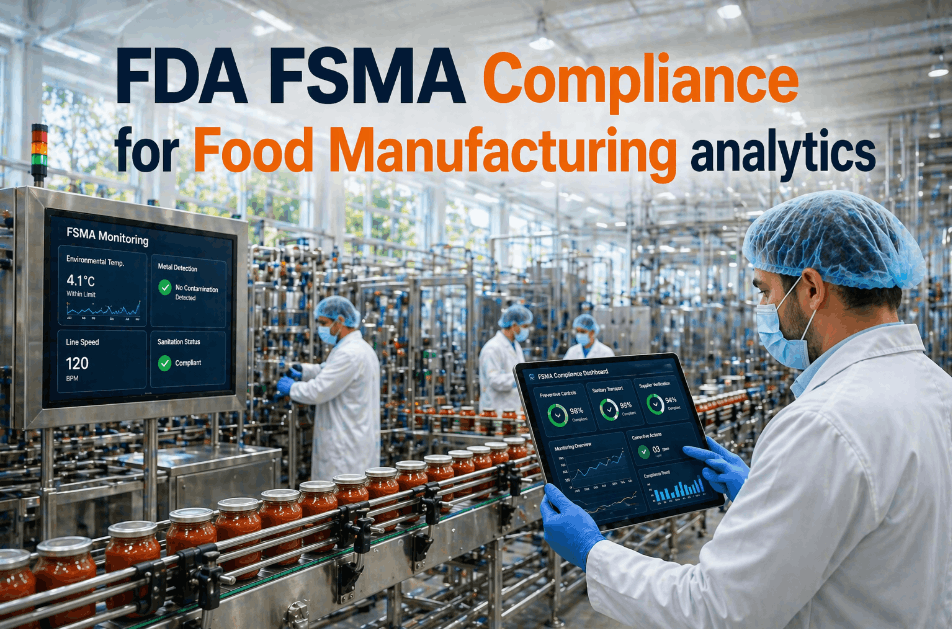
Implementing an AI-driven food safety compliance platform is one of the most consequential decisions a Preventive Controls Qualified Individual (PCQI) will make — because the platform you select becomes the backbone of your FDA FSMA compliance infrastructure. This guide provides a structured evaluation framework for selecting an AI-driven compliance platform that meets the regulatory demands of FDA FSMA Preventive Controls for Human Food (21 CFR Part 117) and the operational realities of food manufacturing facilities. Organizations that Book a demo receive a personalized compliance platform assessment mapped against their specific food safety plan requirements.
Why FSMA Compliance Requires a Fundamentally Different Approach to Food Safety Documentation
The food safety documentation requirements under FSMA are structurally different from conventional quality management record-keeping. Under the Preventive Controls for Human Food rule (21 CFR Part 117), food facilities must maintain a written food safety plan that includes hazard analysis, preventive controls, supply-chain programs, recall plans, and monitoring procedures — all of which must be reassessed at least every three years, or whenever significant changes occur. Conventional spreadsheet-based or paper-driven documentation systems collapse under this compliance burden because they lack the architectural features required for regulatory-grade food safety management. With iFactory's AI-driven platform, food safety managers Book a demo to see how automated hazard analysis and preventive control tracking transforms FSMA compliance from a documentation burden into a competitive advantage.
- Hazard analysis maintained in static documents — no version control or audit trail for revisions
- Preventive control monitoring data scattered across spreadsheets, logbooks, and paper forms
- Corrective action records disconnected from the hazard they reference — no traceability linkage
- FDA inspection preparation requires manual document compilation across multiple disconnected systems
- Supply-chain preventive controls tracked outside the food safety plan — gaps invisible until audit
- Reassessment deadlines managed manually — high risk of missed three-year or significant-change reassessments
- AI-driven hazard analysis with version-controlled documentation and complete revision history
- Real-time preventive control monitoring dashboards with automated data capture from production systems
- Corrective actions auto-linked to the specific hazard and preventive control they address — full traceability
- On-demand FDA inspection report generation organized by 21 CFR Part 117 subpart structure
- Supply-chain preventive control tracking integrated into the food safety plan with automated supplier document requests
- Automated reassessment calendar with regulatory deadline tracking and escalation alerts
The PCQI-Driven Hazard Analysis Process: Continuous Compliance Through AI-Powered Documentation
21 CFR 117.130 requires that the food safety plan be prepared by a Preventive Controls Qualified Individual (PCQI). The hazard analysis is the foundation of this plan — identifying known or reasonably foreseeable biological, chemical, and physical hazards, evaluating their severity and probability, and determining whether preventive controls are required. iFactory's AI-powered hazard analysis module supports the PCQI by automating hazard identification, risk scoring, and documentation generation while keeping the PCQI in full control of all analytical determinations. Plant quality teams that schedule a live walkthrough of the AI-assisted hazard analysis workflow receive a demonstration of regulatory documentation generation with their own facility data.
Key Capabilities for FSMA Compliance Management
Selecting an AI-driven platform for FSMA compliance requires evaluating specific technical capabilities that address the distinct regulatory requirements of 21 CFR Part 117. Each capability maps to a specific FSMA compliance obligation, and collectively they form the complete food safety intelligence layer required for FDA-regulated food manufacturing. Quality leadership teams that schedule a platform evaluation receive a detailed capability assessment mapped against their facility's specific food safety plan requirements and inspection history.
Platform Evaluation Matrix: FSMA Compliance Analytics
When evaluating AI-driven platforms for FSMA compliance, each criterion must be assessed against the specific requirements of 21 CFR Part 117 and the operational demands of food manufacturing facilities. The following comparison matrix provides a structured evaluation framework for assessing platform capabilities across the regulatory dimensions that matter most to food safety compliance.
| Evaluation Criterion | Essential Requirement | Advanced Capability | Regulatory Standard |
|---|---|---|---|
| Hazard Analysis Documentation | Static document with manual updates | AI-assisted hazard identification with live revision tracking | 21 CFR 117.130(a)(b)(c) |
| Preventive Control Monitoring | Manual log entries with periodic review | Real-time sensor integration with automated deviation alerts | 21 CFR 117.140, 117.145 |
| Corrective Action Records | Paper forms in separate filing system | AI-triggered corrective actions with hazard traceability linkage | 21 CFR 117.150 |
| Verification Activities | Checked manually against documentation | Automated verification scheduling with validation package generation | 21 CFR 117.160, 117.165 |
| Supply-Chain Controls | Supplier letters maintained in separate files | Integrated supplier verification platform with automated document requests | 21 CFR 117.136, 117.405 |
| Recall Plan Management | Static recall plan with annual review | AI-powered recall simulation with batch traceability integration | 21 CFR 117.139 |
Performance Benchmarks from FSMA Compliance Deployments
Food manufacturing facilities deploying AI-driven FSMA compliance platforms report measurable improvements across hazard analysis completeness, preventive control monitoring efficiency, and FDA inspection readiness. The following benchmarks represent aggregated results from iFactory deployments at FDA-regulated food processing facilities.
Expert Perspective: What AI Compliance Documentation Changes in Food Safety Operations
The food industry has been understandably cautious about AI-driven compliance documentation, and that caution is rooted in a proper respect for the regulatory framework. What I have seen change in the last three years is not a relaxation of those standards but the emergence of platforms that meet them. The critical distinction is between platforms that bolt FSMA documentation onto their quality management output and platforms like iFactory that treat food safety plan record generation as an intrinsic part of every analytical operation. When a preventive control monitoring point triggers, the corrective action record is created — not because someone remembered to file it, but because the platform's architecture requires it. That architectural commitment to compliance is what makes a platform suitable for FDA-regulated use, and it is also what makes it possible to deploy AI at food manufacturing facilities without creating an unsustainable administrative burden.Book a demo
Frequently Asked Questions: FSMA Compliance Analytics
The platform supports the PCQI by automating hazard identification, severity and probability assessment, and preventive control determination while maintaining the PCQI's full authority over all analytical decisions. The AI engine ingests ingredient specifications, process flow diagrams, supplier records, and historical quality data to identify known or reasonably foreseeable biological, chemical, and physical hazards at each process step. The PCQI reviews all AI-generated hazard identifications and risk assessments, and the platform records each PCQI determination as part of the permanent food safety plan documentation. The complete hazard analysis — including AI recommendations, PCQI determinations, and supporting evidence — is maintained with full version control and audit trail as required by 117.305.
Yes. iFactory's platform integrates with existing process control systems, temperature monitoring sensors, metal detectors, X-ray inspection systems, and other critical control point monitoring equipment through standard industrial protocols. The platform also supports manual data entry for facilities where automated sensor integration is not yet deployed. All monitoring data — whether captured automatically or entered manually — is linked to the applicable preventive control and hazard analysis record, creating a complete traceability chain from control point through corrective action to FDA inspection documentation.
The platform maintains an automated reassessment calendar that tracks the three-year reassessment deadline from the date of the last food safety plan validation. Ninety days before the reassessment deadline, the platform generates a notification to the PCQI and quality leadership team with a pre-populated reassessment package that includes the current hazard analysis, all preventive control monitoring summaries, corrective action histories, verification activity logs, and any changes to ingredients, processes, or suppliers that have occurred since the last reassessment. The PCQI reviews and updates the food safety plan through the platform, and all changes are automatically versioned and documented as part of the reassessment record.
A phased deployment typically spans 6 to 12 months, beginning with a food safety plan gap analysis that reviews existing hazard analysis documentation, preventive control monitoring procedures, and record-keeping systems. Phase one establishes core hazard analysis documentation and preventive control monitoring within 2 to 4 months. Phase two adds AI-driven deviation detection, corrective action workflow integration, and supply-chain control management. Phase three deploys the FDA inspector portal, automated reassessment tracking, and recall plan management capabilities. An accelerated deployment timeline is achievable for facilities that already have mature quality management systems and digital monitoring infrastructure.