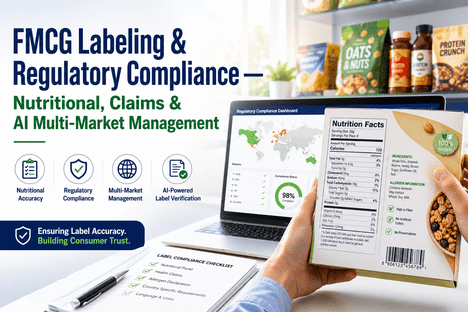
Most Quality & Compliance Directors managing FMCG product lines across multiple markets already understand the compliance challenge at an instinctive level: a nutritional panel layout that satisfies FDA 21 CFR 101.9 triggers a formatting rejection under EU Regulation 1169/2011. An allergen declaration correct for the U.S. "Big 9" omits the cereals containing gluten, lupin, and mollusks required in the EU's 14-allergen framework. A health claim that passed internal legal review in one jurisdiction exposes the business to regulatory action in another. The gap between market-compliant and recall-vulnerable is rarely intent. It is intelligence. AI-powered multi-market regulatory compliance gives you the tool to close that gap before the label reaches the production line.
Know Which Labels Are Compliant, Which Markets Are at Risk, and Exactly What Needs to Change — Across Every SKU in Your Portfolio.
iFactory delivers AI-powered regulatory compliance as a fully managed service — continuous label verification, market-specific rule enforcement, and recall-risk intelligence embedded directly into your production workflow.
Annual direct recall costs incurred by the food industry in 2024 — the overwhelming majority driven by preventable labeling errors at artwork stage
45.8%
Of all FDA food recalls in 2025 were caused by undeclared allergens — labeling errors, not manufacturing failures
4–8 hrs
Manual compliance review time per SKU — versus 2–3 minutes per SKU with AI-powered review, with 100% rule coverage
61%
Of FMCG teams in North America still rely primarily on manual checking — the primary reason label errors reach the production line undetected
Why Multi-Market Label Compliance Is the Risk Exposure Most Quality Directors Are Not Measuring
FMCG brands managing products across multiple jurisdictions have a structural vulnerability that most never fully quantify: a single SKU may require compliance with eight, twelve, or twenty distinct regulatory frameworks simultaneously. The nutritional panel formatted for the U.S. market must be redesigned for the UK post-Brexit FIC equivalent. The allergen call-out correct for Canada's 14 allergens plus triticale will not satisfy Mexico's NOM-051 warning seal thresholds or Brazil's ANVISA RDC 429/2020. The health claim approved under FDA's significant scientific agreement standard may not be authorised under EFSA's evaluation process. Each market gap is a recall waiting to happen — and the cost of a single recall event averages $10 million in direct expenses alone.
The barrier has historically been the volume. Multi-market label compliance requires tracking regulatory changes across 160+ jurisdictions simultaneously, applying rule variations to every active SKU, and verifying that each printed label matches the approved regulatory specification. Manual systems cannot sustain this. AI compliance engines process regulatory rule sets as machine-readable logic, audit every label against every applicable jurisdiction's requirements, and flag deviations before artwork is approved — reducing the compliance window from hours to minutes and eliminating the human-error vector that causes over 60% of allergen recalls.
What Label Compliance Without AI Looks Like
Manual checklist reviews per SKU, dependent on the individual reviewer's knowledge of current regulations across each target market
Regulatory monitoring distributed across emails, trade publications, and manual subscriptions — critical rule changes missed until a border detention surfaces them
Artwork approval workflows with multiple hand-offs and offline systems — 44% of teams report errors introduced at hand-off points that no single reviewer catches
Post-print corrections that trigger reprint costs (69% of brands), repacking costs (57%), and launch delays (43%) — all preventable at pre-print review stage
What AI-Powered Label Compliance Delivers
Automated multi-market auditing against 120+ regulatory checkpoints per SKU — every market's specific rules applied simultaneously, not sequentially
Continuous regulatory horizon scanning across 160+ jurisdictions — rule changes flagged and impact-assessed against your active SKU portfolio within 24 hours of publication
Centralised "living rulebook" where global regulations and brand standards are consolidated and instantly applied across every SKU and target market in the portfolio
Audit-ready documentation for every compliance check — every finding linked to the specific regulation and source reference, eliminating reliance on reviewer memory
The Four Pillars of Multi-Market FMCG Label Compliance
Effective multi-market label compliance requires a structured framework that translates regulatory requirements across jurisdictions into consistent, verifiable rules. These four pillars form the foundation that AI-powered compliance platforms use to deliver market-specific accuracy at portfolio scale.
01
Nutritional Panel Compliance — Format Accuracy Across Regulatory Frameworks
Regulatory Formatting
The nutritional panel is the most visually regulated element of any FMCG label. Under the FDA's 2016 Nutrition Facts update (fully enforceable since 2021), the panel must display mandatory nutrients in a specified layout with prescribed font sizes, bolding rules, and daily value percentages. The EU's Regulation 1169/2011 requires energy and nutrient declarations per 100g or 100ml in tabular format with a minimum x-height of 1.2 mm. Canada mandates bilingual English and French declarations with FOP nutrition symbols mandatory from January 1, 2026. China's new GB 28050-2025 standard, enforceable from March 16, 2027, introduces its own formatting and nutrient declaration requirements. AI compliance engines parse each jurisdiction's formatting rules as machine-readable specifications, enabling simultaneous verification of a single nutritional panel against all target markets — flagging the exact coordinate, font size, unit, or declaration element that fails each market's standard. This eliminates the most common source of multi-market nutritional panel errors: assuming that a panel correct for one jurisdiction will pass in another.
FDA Nutrition Facts format
EU FIC tabular alignment
Canada bilingual + FOP symbols
02
Health Claims Verification — Permissible Language by Jurisdiction
Claims Compliance
Health claims operate under fundamentally different regulatory philosophies across markets. The FDA recognises three tiers — authorised health claims (significant scientific agreement), qualified health claims (emerging evidence with disclaimer language), and structure-function claims — each with distinct evidentiary and labelling requirements. The FDA's updated "healthy" claim definition (effective February 25, 2025, with compliance due February 25, 2028) imposes nutrient-specific thresholds that disqualify products previously eligible. The EU operates under Regulation 1924/2006, where all health claims must receive pre-market EFSA authorisation and appear on the EU Register. The EU EmpCo Directive, effective September 27, 2026 with no transition period, bans unsubstantiated sustainability claims — "sustainable," "carbon neutral," "eco-friendly," "green" — across all consumer-facing marketing. AI claims verification checks every claim on the label against each target jurisdiction's permitted claims register, flagged claim language, and qualifying disclaimer requirements, producing a market-by-market compliance verdict for every claim on every SKU.
FDA authorised/qualified tiers
EFSA pre-market authorisation
EU EmpCo green claims ban
03
Allergen Declaration Accuracy — The #1 Cause of Recalls
Allergen Compliance
Undeclared allergens are the leading cause of FDA food recalls, accounting for 45.8% of all food recall events in 2025. Over 60% of these recalls are caused by labeling and packaging errors, not manufacturing cross-contamination. The allergen declaration framework itself varies by market: the U.S. mandates declaration of nine major allergens (the "Big 9" including sesame added January 2023 via the FASTER Act). The EU requires 14 allergens including cereals containing gluten, crustaceans, eggs, fish, peanuts, soy, milk, nuts, celery, mustard, sesame, sulphur dioxide, lupin, and molluscs. Canada requires 14 allergens plus triticale, with mandatory bilingual labelling. Japan specifies 8 designated allergens. Precautionary allergen labelling ("may contain" statements) is under increasing global scrutiny — the Codex Alimentarius Commission's July 2026 draft guidelines recommend that PAL be used only as a last resort, grounded in documented risk assessment. AI allergen verification checks every ingredient declaration against each target market's allergen list, format requirements, and PAL restrictions simultaneously — flagging missing allergens, incorrect species declarations, and non-compliant precautionary statements before the label goes to print.
Export compliance introduces a layer of regulatory complexity that domestic-only operations never encounter. U.S. food labeling requirements apply equally to imported products — no exceptions, no transition periods. A noncompliant label results in immediate detention at the port of entry. Each export destination imposes its own framework: China's new GB 7718-2025 standard requires all labels in Chinese with specific formatting and registration number markings; the EU Packaging and Packaging Waste Regulation (PPWR), effective August 12, 2026, requires a Declaration of Conformity for every packaging format placed on the EU market; Mexico's NOM-051 mandates black octagon warning seals for products exceeding nutrient thresholds and prohibits child-appeal elements on products bearing such seals. Differences in regulations across countries increase costs by 15–30% for producers and traders (UNCTAD, 2026). AI export compliance verification evaluates every label against each target export market's complete regulatory framework — not just the label content but also the supporting documentation requirements, registration obligations, and packaging material rules — producing a market-specific compliance verdict and a documented audit trail acceptable to customs authorities.
China GB 7718-2025 / GB 28050-2025
EU PPWR DoC + PFAS restrictions
Mexico NOM-051 warning octagons
How the Compliance Gap Compounds Across Markets Over Time
The regulatory gap between a label designed for one market and the requirements of another market does not stay constant — it widens. Each jurisdiction updates its regulatory framework on its own schedule, and a label that was fully compliant for export at the time of artwork approval can become noncompliant before the first production run if a rule change occurs in the intervening period. This is the compounding dynamic that makes continuous compliance monitoring essential and periodic manual review dangerous.
The Compliance Compounding Cycle — Why Multi-Market Risk Grows Without Continuous AI Monitoring
Phase 1
Label approved for primary market
Artwork passes internal review for the domestic market. Export market requirements are noted but not verified systematically. The label goes to print.
Phase 2
Regulatory change in target market
An export market updates its labeling regulation. The change is published in the local language. Without continuous monitoring, the brand remains unaware of the new requirement for weeks or months.
Phase 3
Noncompliant shipment detained at border
The first export shipment is detained at the port of entry. The $10M average recall cost is triggered. Product is held, returned, or destroyed. Retail relationships are damaged.
Phase 4
Corrective action costs multiply
Artwork redesign, reprinting, repacking, and regulatory remediation cost 3–5x what pre-print compliance verification would have. The total addressable market for the affected SKU contracts.
AI-powered continuous compliance monitoring interrupts this cycle at Phase 1 — verifying every label against every target market's current regulatory framework before artwork is approved, and flagging regulatory changes within 24 hours of publication so that existing labels are reassessed before noncompliance reaches a shipment. Brands using AI compliance platforms report 80%+ reduction in product-data errors and near-elimination of label-driven border detentions.
Your Labels Already Carry the Compliance Risk. What They Are Missing Is the AI Verification That Eliminates It.
iFactory's AI compliance service turns your existing artwork files, ingredient data, and target market list into a live multi-market compliance dashboard — without any internal regulatory data science or IT infrastructure investment.
Best Practice Replication — Turning Regulatory Intelligence Into Competitive Advantage
Identifying the compliance gap is the first output of AI-powered regulatory tracking. The second — and the one that drives operational improvement — is understanding where the highest-risk gaps exist across the portfolio and translating that intelligence into prescriptive action that prevents recalls before they occur.
Multi-Market Rule Gap Analysis
AI analysis of your active SKU portfolio against every target market's regulatory requirements identifies the specific gaps — the nutrients missing from a panel, the allergen incorrectly declared, the claim language not authorised — ranked by recall risk severity and the number of affected markets. The pattern is then surfaced as a prioritised remediation list for the compliance team.
Regulatory Horizon Scanning Impact
Continuous monitoring of regulatory changes across 160+ jurisdictions, with automated impact assessment against your active SKU portfolio. When the EU EmpCo Directive bans unsubstantiated sustainability claims effective September 27, 2026, or when China publishes GB 7718-2025, the AI platform identifies every SKU affected, quantifies the compliance gap, and estimates the remediation timeline.
Artwork Approval Workflow Integration
AI compliance checks embedded directly into the artwork approval workflow — every label is automatically audited against all target market rules before approval is granted. The compliance result is attached to the artwork record, creating an audit-ready trail that eliminates the hand-off errors and manual checking gaps that cause 48% of compliance failures.
"
We were exporting the same product to twelve markets and assumed our labels were compliant because we had reviewed them internally. The first we knew about a problem was when a shipment to the EU was detained because our precautionary allergen statement did not match the new guidance. That single shipment cost us over $350,000 in return freight, repacking, and lost shelf space. We implemented AI compliance verification across all twelve markets within six weeks. We have not had a single border detention since, and our compliance team now spends their time on strategic regulatory analysis instead of manual label checking.
How iFactory Delivers Multi-Market Label Compliance as a Managed Service
iFactory's AI compliance capability is not a standalone software module. It is embedded within the managed service delivery model — meaning the regulatory rule base, artwork integration, compliance auditing, and horizon scanning are maintained by iFactory, not by an internal regulatory team that the Quality Director has yet to hire.
iFactory Compliance Service — What Is Managed vs What the Quality Director Sees
Managed by iFactory — Behind the Service Layer
What the Quality Director Receives
Multi-jurisdiction regulatory rule base management — FDA, EU, UK, Canada, Mexico, Brazil, China, Japan, and 160+ additional jurisdictions continuously updated as regulations change
A single compliance dashboard showing every SKU's compliance status across all target markets — GO, FIX, or REVIEW — updated with every regulatory change, not on a quarterly audit cycle
Artwork ingestion and automated compliance audit across all four pillar domains — nutritional panels, health claims, allergen declarations, and export market rules — with every finding linked to the specific regulation
Automated identification of which SKUs and which markets carry the highest recall risk, prioritised by: severity of noncompliance, regulatory action likelihood, and commercial exposure per market
24/7 regulatory horizon scanning across all covered jurisdictions — with impact assessment that escalates only the changes requiring director-level attention rather than flooding the inbox with minor amendments
Regulatory change impact reports that identify the specific SKUs affected by a new rule, the compliance gap created, and the recommended remediation approach with timeline estimates
New market onboarding within service scope — adding a new export jurisdiction to the compliance view is a service request, not an internal regulatory research project
Export readiness reports per market showing the complete compliance status of every SKU destined for that jurisdiction, with documentation checklist and audit trail for customs verification
Conclusion
The gap between a compliant label and a recall-vulnerable label is not a quality control failure. It is an information gap. The labels that generate border detentions, recall events, and regulatory penalties are following predictable patterns — patterns that become visible the moment you have a continuous, multi-market compliance check running across every SKU in your portfolio.
AI-powered multi-market label compliance delivers that check as a live operational view — not as a periodic audit that reflects the regulatory landscape as it existed three months ago. For Quality & Compliance Directors managing FMCG portfolios where a single recall can cost $10 million and damage retail relationships that took years to build, the ability to identify a compliance gap before the label reaches the production line is not incremental improvement. It is the difference between preventive compliance management and reactive recall damage control.
iFactory's managed compliance service makes this capability available without the regulatory data science team, the rule-base development project, or the multi-year build timeline. The compliance intelligence goes live in weeks, updates continuously, and scales across every new SKU and target market you add to the portfolio. Book a demo to see how the multi-market compliance view maps to your current portfolio, or talk to an expert about your specific SKU count and target markets.
Frequently Asked Questions
iFactory's compliance rule base covers the full regulatory frameworks of the United States (FDA 21 CFR 101, 21 CFR 105, FALCPA, FASTER Act), European Union (Regulation 1169/2011, Regulation 1924/2006, EmpCo Directive, PPWR), United Kingdom (post-Brexit FIC equivalent), Canada (SOR/2014-204, SFCR, bilingual requirements, FOP nutrition symbols), Mexico (NOM-051, NOM-086), Brazil (ANVISA RDC 429/2020, RDC 727/2022), China (GB 7718-2025, GB 28050-2025, GACC Decree 248), Japan (Food Labeling Act, Health Promotion Act), and 160+ additional jurisdictions. The rule base is updated continuously as regulations change, typically within 24 hours of official publication. For portfolios requiring coverage of markets not yet in the rule base, new jurisdictions can be added as part of the service onboarding process. Talk to an expert to confirm coverage for your specific target market list.
iFactory's compliance service integrates with existing artwork management platforms through API-based artwork ingestion. When a new artwork file or label revision is submitted for approval, the AI compliance engine automatically ingests the artwork, extracts the label content, runs the multi-market compliance audit across all target jurisdictions, and appends the compliance result to the artwork record before it reaches the human approver. The compliance audit runs in under three minutes per SKU, covering 120+ regulatory checkpoints simultaneously. Artworks that fail compliance checks are flagged with the specific regulation violated, the jurisdiction affected, and the exact element of the label that requires correction. The integration requires no changes to the existing approval workflow — the compliance check becomes an automated step within the existing process rather than a separate manual review stage. For brands without a formal artwork management system, iFactory provides a web-based artwork submission portal with the same compliance audit capability. Book a demo to see how the integration maps to your current workflow.
iFactory's compliance service can go live across a 50+ SKU portfolio with multiple target markets within four to six weeks of service commencement. The onboarding process begins with ingestion of your existing artwork files, ingredient data, and target market list into the compliance platform. Initial audits run within the first week, producing the first compliance dashboard view showing which SKUs are compliant, which require correction, and which carry the highest recall risk. The full rule base for your target markets is activated during this period, and the horizon scanning engine begins monitoring regulatory changes relevant to your portfolio from day one. Portfolios with more than 200 SKUs or more than 20 target markets may require an additional two to three weeks for full onboarding, depending on data availability and artwork format complexity. The compliance dashboard provides a coverage confidence indicator alongside each SKU's compliance score so that the Quality Director has immediate visibility into which labels have been fully audited and which are awaiting data completion. Talk to an expert to map the onboarding approach to your current portfolio size and target market structure.
This is a common scenario in multi-market FMCG operations — a brand sells the same product concept across multiple markets but adjusts the formulation to meet local taste preferences, ingredient availability, or regulatory requirements. iFactory's compliance service treats each market-specific formulation as a distinct compliance profile linked to the same brand and product family. Each profile is audited against its specific target market's regulatory rules, and the compliance dashboard displays the results per market per SKU — allowing the Quality Director to see at a glance that the U.S. formulation passes FDA requirements while the EU formulation requires a different nutritional panel layout and allergen declaration format. The service also flags cross-market inconsistencies that may create brand risk — for example, if a health claim used in one market would be prohibited in another market where the same brand is visible on social media or e-commerce platforms. This cross-market brand consistency check is an optional service layer that many multi-national brands activate after the initial compliance baseline is established. Book a demo to see how the compliance service handles your specific brand and formulation structure across markets.
Stop Discovering Compliance Gaps at the Border. Start Verifying Every Label Against Every Market Before It Ships.
iFactory's AI compliance service delivers multi-market label verification, regulatory horizon scanning, and recall-risk intelligence — managed for you, live across your full SKU portfolio, updated continuously.