AI label verification for FMCG regulatory compliance is no longer a future-state technology — it is the operational baseline separating high-performing consumer goods manufacturers from those absorbing preventable recall costs, compliance penalties, and shelf-rejection losses. Every mislabeled product that exits your facility represents a convergence of regulatory exposure, consumer safety risk, and brand damage that automated label inspection systems are specifically engineered to eliminate. For FMCG manufacturers operating across multi-SKU product lines with evolving allergen disclosure requirements, nutritional panel mandates, and barcode accuracy standards, deploying AI-powered label compliance software is the highest-leverage quality control investment available today.
Automate Label Compliance Before Products Leave the Line
iFactory's AI label verification platform delivers real-time packaging inspection, allergen validation, barcode verification, and regulatory compliance documentation — purpose-built for FMCG production environments.
Why Manual Label Inspection Fails FMCG Regulatory Compliance
Traditional label verification relies on human visual inspection at speeds where accuracy degrades with throughput — a technician at 200 units per minute cannot catch font-size deviations, misregistered allergen declarations, or barcode errors that cause retail rejection. FDA, EU FIC, and FSMA regulations all mandate documented verification that label content matches the approved specification per batch. Plants that cannot demonstrate this trail face regulatory holds and recall liability that far exceeds the cost of the compliance infrastructure that would have prevented them. Operations teams that have booked a demo with iFactory consistently discover their inspection gap is wider than their quality records suggest.
How Machine Vision Label Inspection Systems Enforce Packaging Compliance in Real Time
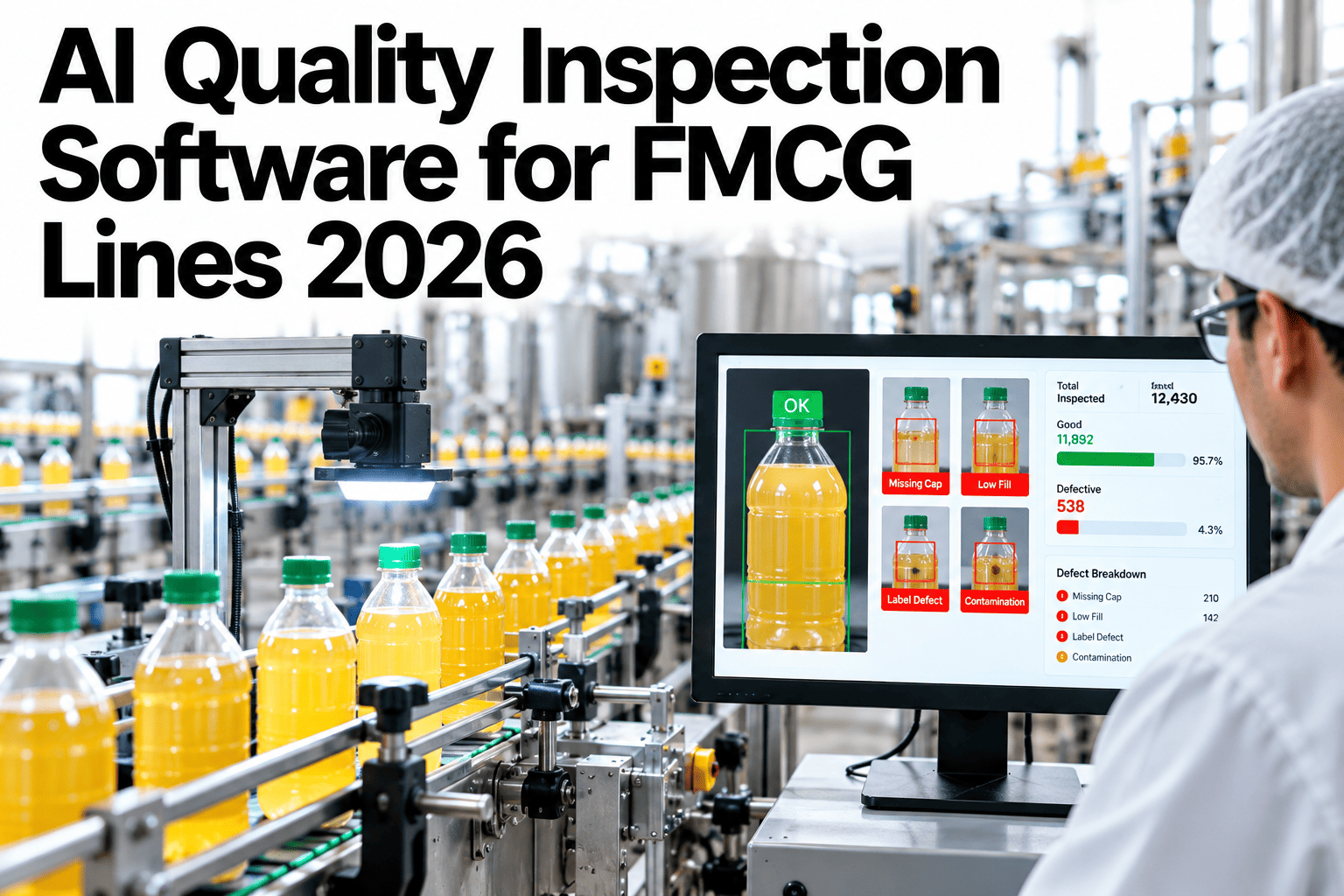
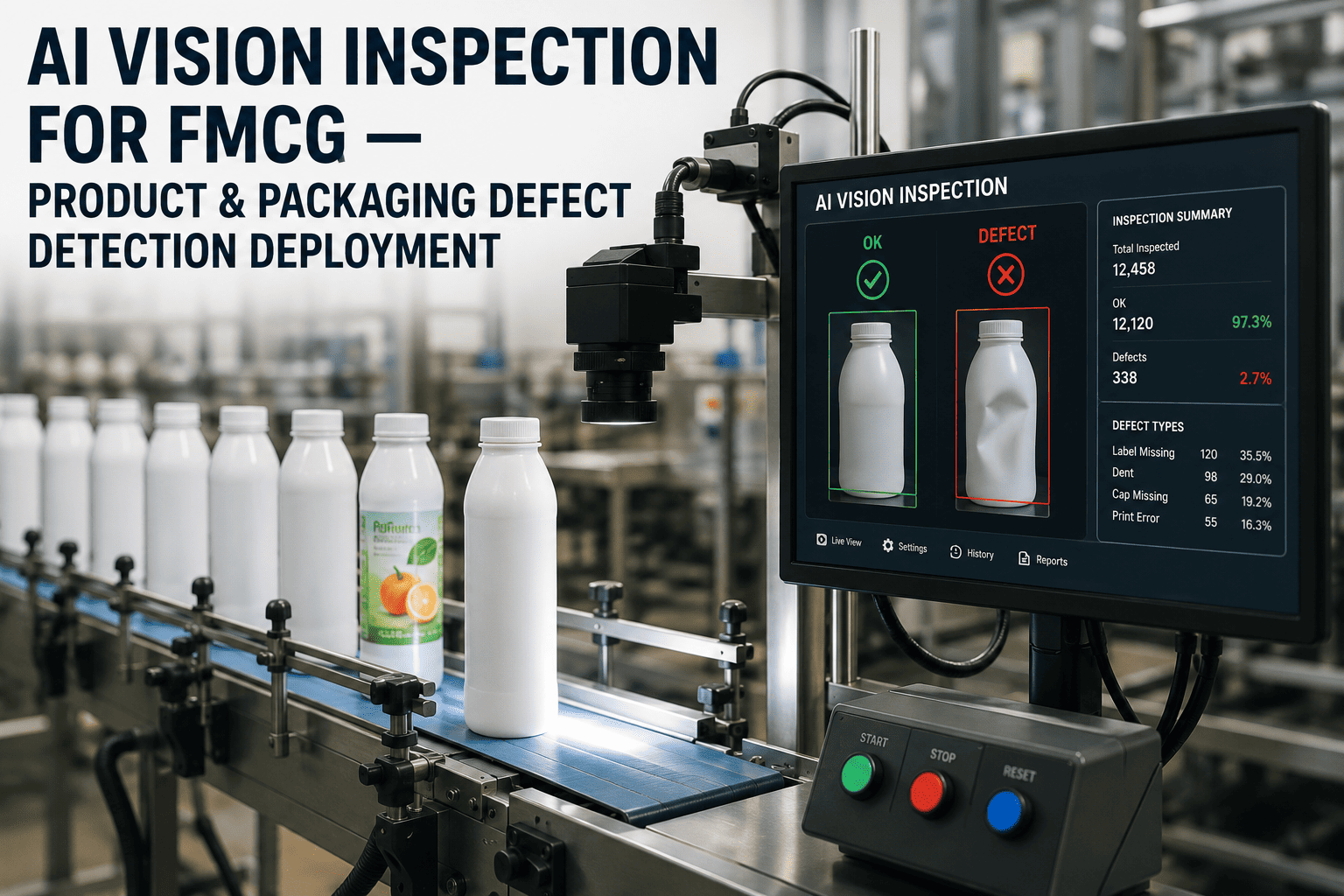
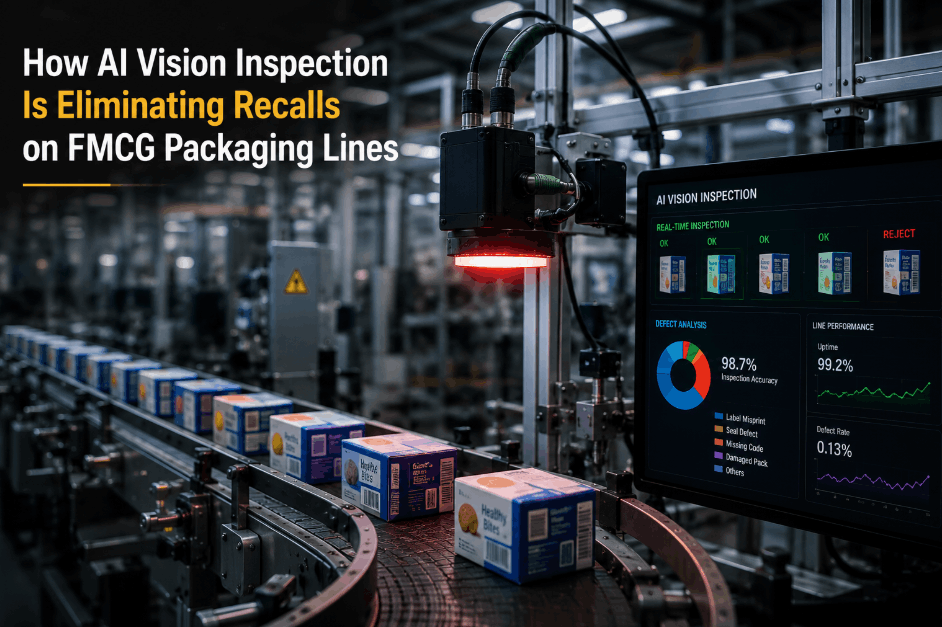
Modern AI label verification platforms operate across four simultaneous inspection dimensions: optical character verification, barcode and data matrix validation, color and print quality analysis, and regulatory content compliance checking. Each dimension feeds a central machine learning inference engine that cross-references detected label content against the approved digital artwork specification stored in the compliance database — flagging any deviation, however granular, before the product advances past the inspection gate. This architecture is what separates genuine computer vision compliance systems from simple threshold-based print inspection systems that miss the content-level errors responsible for most regulatory enforcement actions.
Optical Character Verification
AI-powered OCR reads and validates every text field — ingredient lists, allergen declarations, nutritional panels, and net weight claims — against the approved specification at 1200 dpi resolution, catching font errors and missing words human inspection misses at production speed.
Barcode Verification Software
ISO/IEC-compliant grading evaluates every GS1 barcode, QR code, and data matrix symbol for reflectance, decodability, and quiet zone conformance — preventing retailer chargebacks averaging $5,000–$40,000 per scan failure incident at major FMCG accounts.
Allergen Label Verification
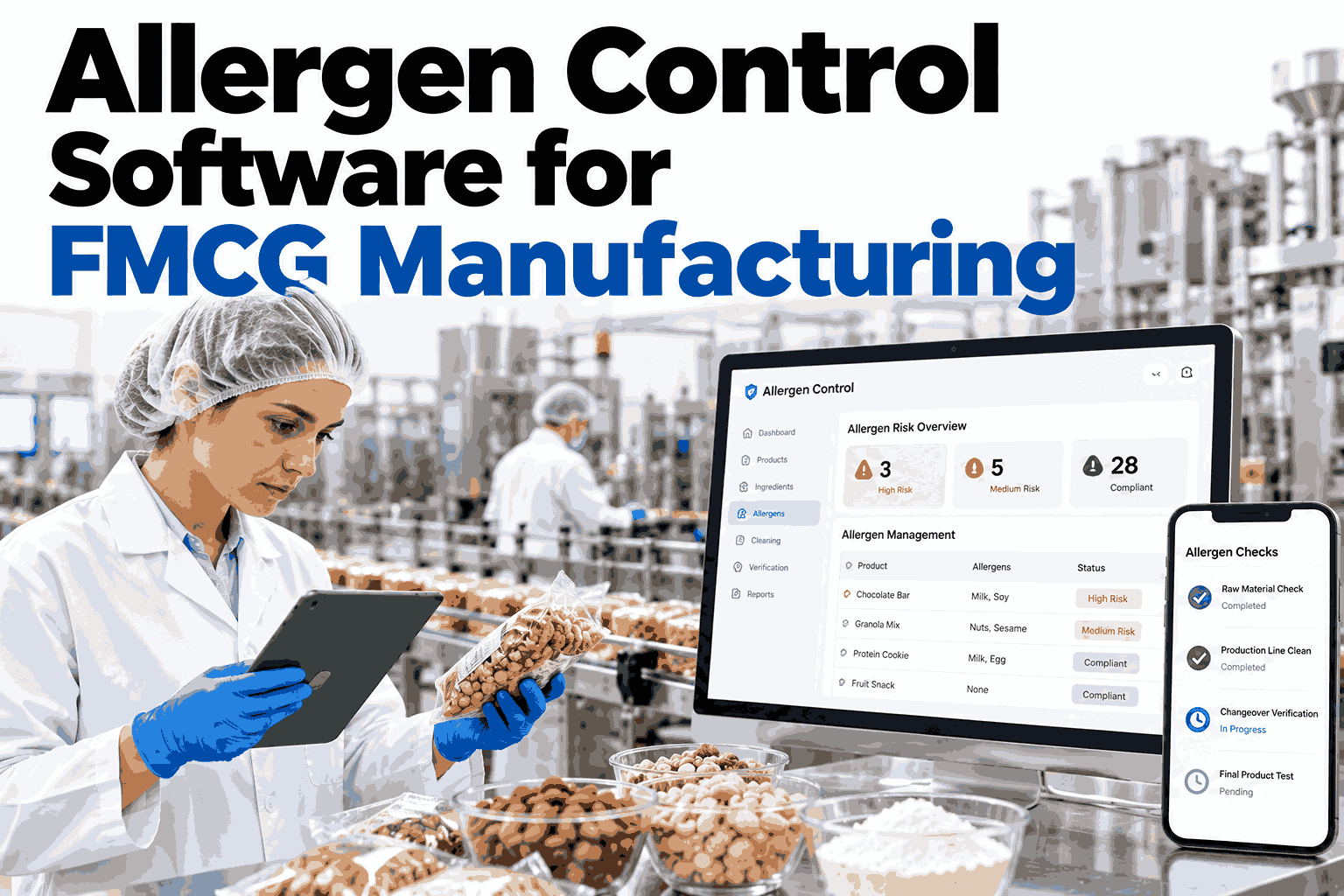
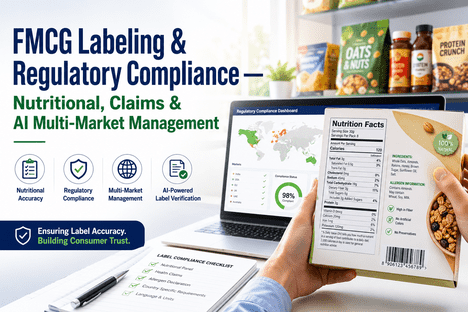
Dedicated inspection logic verifies all mandated allergen declarations — gluten, tree nuts, dairy, soy, shellfish, sesame — are present, correctly positioned, and formatted per FDA, EU FIC, and CODEX requirements simultaneously across every unit produced.
Print Quality Inspection
Spectrophotometric color analysis detects streak marks, voids, ink density shifts, and registration errors. Delta-E measurement against approved Pantone or CMYK specs flags deviations before consumer complaints or retail point-of-sale rejection occur.
AI Label Compliance Software: Multi-Jurisdiction Regulatory Coverage for Global FMCG Operations
A single SKU sold across the US, EU, and GCC must simultaneously satisfy FDA 21 CFR Part 101, EU FIC Regulation 1169/2011, and GCC GSO 9/2013 — each with different field sequencing, font minimums, and allergen highlight rules. AI packaging compliance software manages this by maintaining jurisdiction-specific rule sets in a centralized database that updates automatically as requirements change. Manufacturers managing seasonal label changes and reformulation updates find that scheduling a live demo with iFactory provides a jurisdiction-specific gap analysis within the session itself.
| Compliance Domain | Traditional Approach | AI Verification Approach | Risk Reduction |
|---|---|---|---|
| Allergen Declaration Accuracy | Manual review per batch | 100% automated OCR validation per unit | Up to 94% reduction in mislabeling events |
| Nutritional Label Inspection | Artwork sign-off only | Per-unit field-level value verification | Eliminates artwork-to-print discrepancy |
| Barcode Symbology Verification | Sample-based scan testing | ISO grade assigned per unit at line speed | Zero retailer chargebacks from scan failure |
| Ingredient List Validation | Periodic quality audit checks | Sequence and content verified per label | 88% reduction in sequence deviation events |
| Multi-Market Label Routing | Manual SKU-to-market matching | AI-driven label-to-destination verification | Eliminates wrong-market label application |
Automated Label Checking Architecture: From Inspection Gate to Compliance Record
The intelligence architecture of a production-grade automated label checking system extends well beyond the inspection camera. The full data pipeline — from image capture through defect classification, compliance decision, rejection actuation, and audit record generation — must complete in under 80 milliseconds per unit to maintain throughput on high-speed FMCG lines running 400–600 units per minute. This latency requirement drives the edge-computing architecture that distinguishes enterprise-grade machine vision label inspection from laboratory-grade systems that cannot operate at production speed without introducing line stoppages.
Layered Rejection and Alert Logic for Graduated Compliance Response
AI label verification generates graduated compliance responses matched to defect severity — a barcode grade-C issue triggers a maintenance alert without stopping the line, while a missing allergen declaration triggers an immediate hard rejection. Quality directors that have requested a demo session identify this graduated logic as the feature that most directly reduces false rejection rates.
Digital Compliance Documentation: Replacing Manual Records with Automated Audit Trails
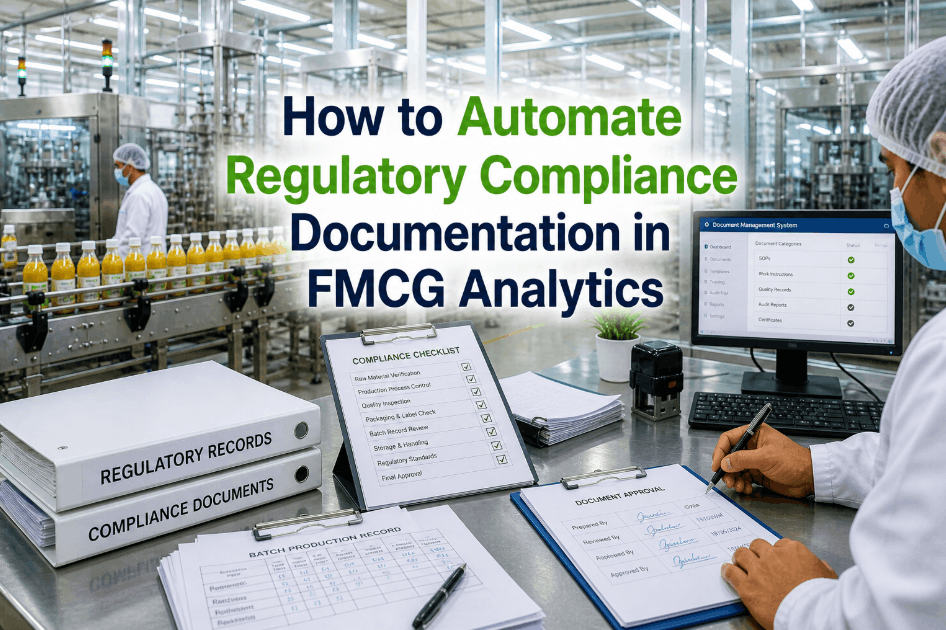
Every inspection event generates a timestamped digital record — image, detected content, compliance decision, and disposition action — satisfying FSMA preventive controls and GMP retention mandates with zero manual data entry. FDA audit preparation time drops from 3–5 days to under four hours using this automatically generated production history.
AI Label Verification Impact Across Key FMCG Quality Control KPIs
The operational and financial impact of deploying AI-powered label inspection systems spans every compliance dimension — from recall risk elimination and retailer chargeback prevention to audit labor reduction and consumer complaint rate improvement. The benchmarks below reflect iFactory customer performance data across beverage, packaged food, personal care, and household goods production environments within 12 months of full platform deployment.
Deploying AI Label Inspection Systems: A Practical Implementation Roadmap for FMCG Plants
Implementing an AI label verification platform in a live FMCG production environment follows a structured three-phase architecture that prioritizes camera system integration, compliance database build-out, and operational adoption in sequence. The temptation to compress this sequence to accelerate ROI consistently produces inspection systems with elevated false-rejection rates that erode operator trust — the most damaging outcome in any environment where human acceptance of automated inspection decisions is the critical adoption variable.
Camera Integration, Specification Database Build, and Baseline Inspection Activation
Install high-resolution line-scan cameras or area-scan arrays at critical inspection gates, integrate with existing conveyor and rejection systems, and build the approved specification database from current artwork masters for all active SKUs. Pre-deployment specification audits that reconcile digital artwork against physical label samples prevent downstream false-rejection events caused by artwork-to-print process variation tolerances not captured in the specification. Timeline: 4–10 weeks. CapEx: $35k–$120k depending on line count and camera configuration.
AI Model Calibration, Regulatory Rule Activation, and Alert Logic Configuration
Calibrate OCR and defect detection models against confirmed label samples across the full SKU range, activate jurisdiction-specific compliance rule sets for each target market, and configure graduated alert logic aligned to your quality management escalation hierarchy. This is the phase where the platform transitions from image capture to actionable compliance intelligence. Timeline: 4–8 weeks. Platform cost: $28k–$70k/year.
ERP and QMS Integration, Automated Compliance Reporting, and Continuous Model Improvement
Integrate AI verification outputs with SAP, Oracle, or Microsoft Dynamics quality management modules to enable automated non-conformance records, supplier deviation notifications, and compliance batch hold workflows. Ongoing model retraining against new label variants and confirmed defect events continuously improves inspection accuracy over time. Timeline: Ongoing. Incremental OpEx: $12k–$32k/year.
Quantifying the ROI of AI Label Verification for FMCG Regulatory Compliance
Direct Recall Risk and Penalty Avoidance
A mid-size FMCG manufacturer with $200M in annual revenue carries an estimated recall risk exposure of $2.8M–$6.4M. AI label verification systems eliminate allergen mislabeling events — the most common Class I recall trigger — reducing this exposure by 85–94% within the first operating year and delivering full platform payback in under 8 months.
Retailer Compliance and Chargeback Prevention
Walmart, Tesco, Carrefour, and Kroger enforce barcode grading requirements with chargeback schedules from $500 to $40,000 per failure event. AI barcode verification software grading every symbol to ISO/IEC 15416 standard eliminates this exposure entirely. FMCG teams find that a demo session with iFactory's engineers delivers a chargeback calculation specific to their retail portfolio.
Compliance Labor Elimination and Audit Readiness
FMCG quality teams at mid-size plants spend 18–24 labor hours per week maintaining label compliance records manually. iFactory's platform eliminates this overhead entirely through automated audit trail generation — improving record completeness beyond what any manual process can achieve, and closing the business case independently of any recall risk benefit.
AI Label Verification for FMCG Compliance — Frequently Asked Questions
How does AI label verification differ from standard print inspection systems?
Standard print inspection detects visual defects like streaks and voids but cannot read label content. AI label verification reads and validates actual text, allergen declarations, and nutritional values against the approved specification — catching content errors that print inspection systems cannot detect.
Can AI label inspection systems handle multiple label formats and SKUs on the same line?
Yes. AI platforms use automatic SKU recognition — reading the barcode on each unit — to retrieve the correct specification and apply the right inspection rule set in real time. This enables full compliance verification across unlimited SKU variants on a shared line with zero operator changeover intervention.
What regulatory frameworks does AI label compliance software support?
iFactory's platform supports FDA 21 CFR Part 101, EU FIC Regulation 1169/2011, Health Canada, Codex Alimentarius, GCC GSO, ANVISA Brazil, and FSSAI India. Regulatory rule sets update automatically as requirements change, eliminating the risk of operating on outdated compliance configurations.
How quickly can AI label verification systems be deployed in an existing FMCG production environment?
Initial system activation typically takes 4–6 weeks after camera installation. Full AI model calibration across all active SKUs is completed within 8–14 weeks. Plants with organized digital artwork libraries and existing MES or ERP systems achieve the fastest deployment timelines and earliest ROI.
What is the false rejection rate for AI label verification systems on high-speed FMCG lines?
Mature deployments on well-calibrated specification databases achieve false rejection rates below 0.08% — fewer than 8 correct labels per 10,000 inspected. Model calibration incorporates plant-specific print process variation tolerances, preventing cosmetic variation from triggering compliance holds intended for genuine content errors.
How does AI label verification support FSMA preventive controls documentation requirements?
The platform generates a continuous, tamper-evident digital record of every inspection event — image, detected content, compliance decision, and disposition — with timestamp and operator ID. This satisfies FSMA preventive controls documentation requirements and reduces FDA audit preparation from 3–5 days to under 4 hours.
Eliminate Label Compliance Risk with AI Verification Built for FMCG Production
iFactory's AI label verification platform delivers per-unit allergen validation, barcode grading, nutritional content inspection, and automated regulatory compliance documentation — purpose-built for FMCG manufacturers.