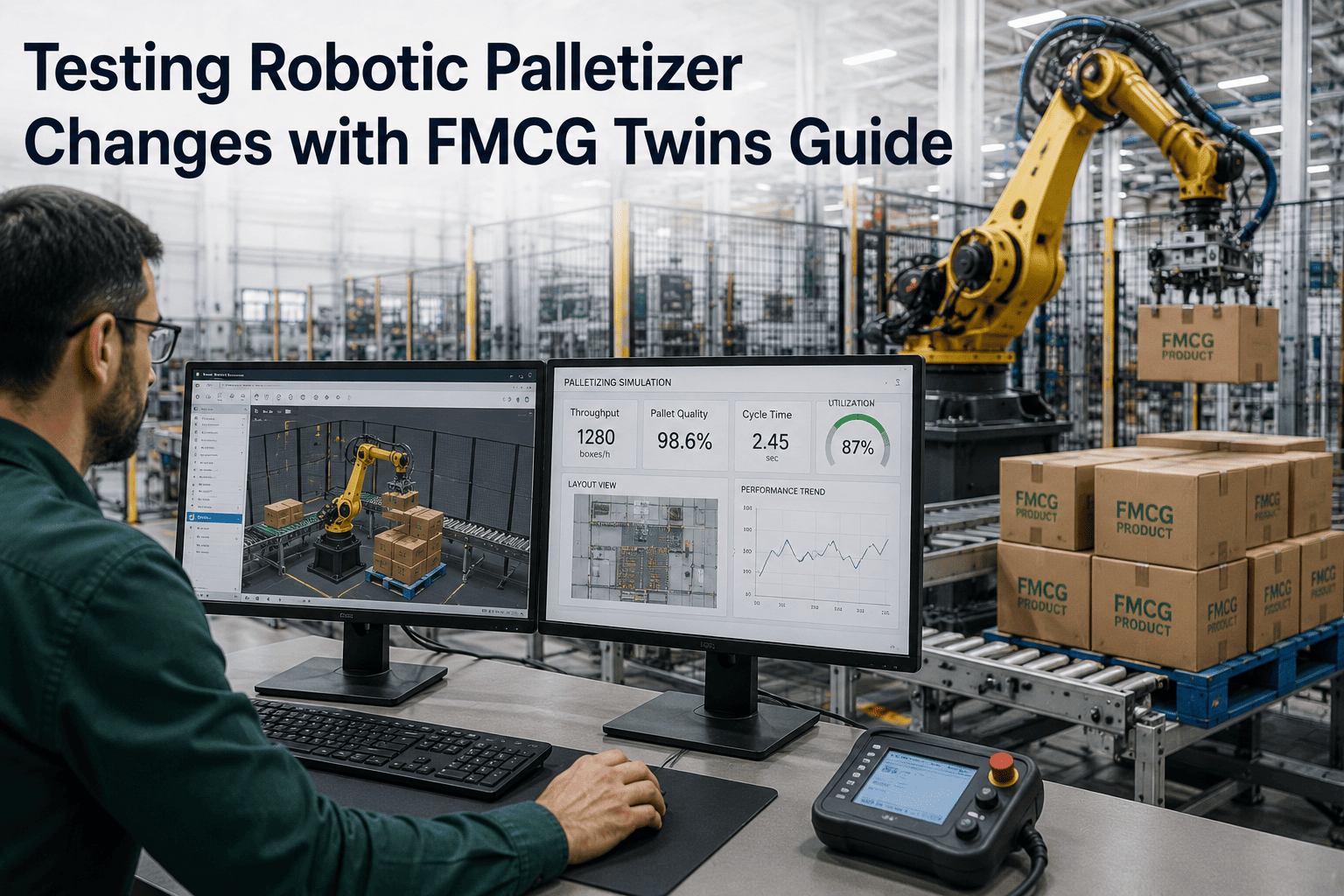
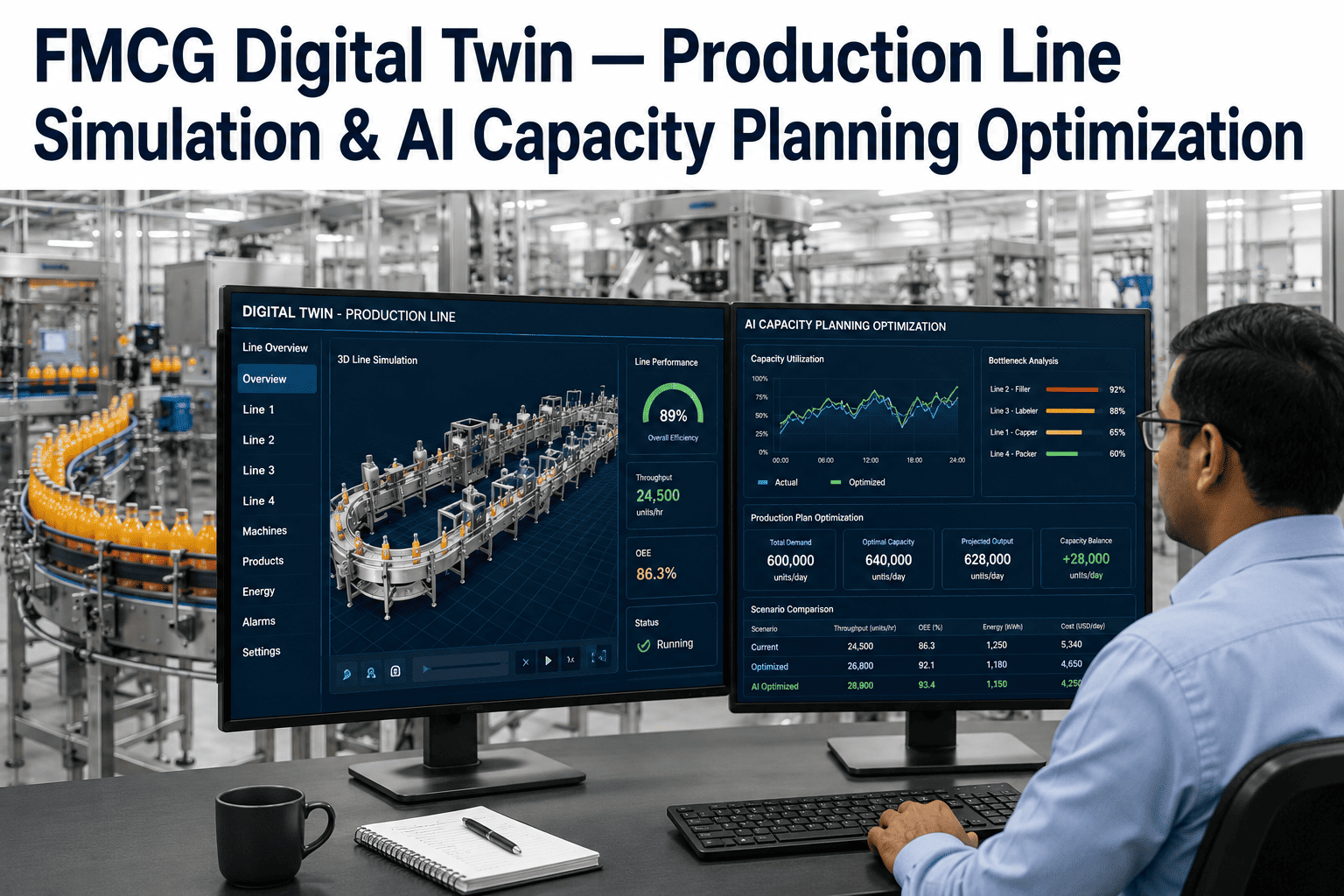
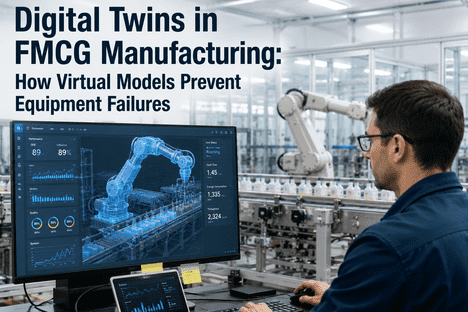
A palletizer running cleanly today does not stay untouched for long. A new SKU needs a new stacking pattern, a case size changes, a gripper gets swapped for a heavier product line, or a plant wants to squeeze another few cases per hour out of an existing cell. Every one of those changes is a small edit on paper and a real risk on the floor, because the palletizer never runs in isolation — it shares floor space with a case packer's reject conveyor, a stretch wrapper's infeed timing, and sometimes an AGV path that nobody re-checks before the change goes live. iFactory tests palletizer changes against a digital twin of the actual cell before they touch production, catching spatial conflicts and cycle-time mismatches in simulation instead of on a stopped line. To see a pending palletizer change tested against your own cell's digital twin, book a demo.
FMCG · DIGITAL TWIN · PALLETIZER CHANGE TESTING
Test the Change Before the Robot Ever Moves on the Real Line
iFactory builds a digital twin of your palletizer cell — reach envelopes, cycle timing, safety zones, and neighboring equipment — so a new pattern, SKU, or layout change gets validated in simulation before it ever risks a stopped line.
What a Missed Conflict Costs Versus What Catching It in Simulation Costs
$18K
Reported cost per day of lost output while a spatial or timing conflict gets debugged live on the floor
30 min
Time it typically takes the same conflict to surface when tested first in simulation
140mm
A real reported case: reject-conveyor overlap into a palletizer pick zone, invisible until commissioning
3+
Neighboring systems a single palletizer change can silently affect: packer, wrapper, AGV path
WHY A SMALL CHANGE ISN'T SMALL
What Actually Breaks When a Palletizer Change Goes Live Untested
A pattern change or a new SKU addition looks like a software update, but the palletizer's physical behavior — reach, timing, stop positions — interacts with everything physically near it. None of the failure modes below require a mistake on the programmer's part; they happen because a change that is correct in isolation still collides with something the original commissioning never anticipated.
SPATIAL CONFLICT
A New Reach Path Crosses Something It Shouldn't
A new stacking pattern extends the arm's travel envelope into a zone occupied by a conveyor, a guard rail, or a neighboring cell's own reach — invisible on paper, obvious the first time the arm actually swings there.
CYCLE-TIME MISMATCH
The New Pattern Doesn't Fit the Real Infeed Rate
A pattern calculated against a theoretical infeed rate runs fine on paper and falls behind the instant real product accumulation, line speed variance, or upstream stoppages enter the picture.
SAFETY-ZONE OVERLAP
A Changed Envelope Crosses a Safety Boundary
An updated reach pattern can push the arm's working envelope into a scanner zone or an AGV path that was configured for the cell's prior behavior, triggering unplanned stops or, worse, a safety gap nobody notices until an audit.
GRIPPER-LOAD INTERACTION
A New Product Weight Changes Cycle Dynamics
Swapping to a heavier or differently shaped case changes acceleration limits and settling time at each placement, which can silently degrade pattern accuracy even when the pick-and-place logic itself is unchanged.
Every one of these four failure modes is difficult to predict from a layout drawing or a PLC logic review alone, because they only emerge from the actual physical interaction between the change and everything around it — which is precisely what a digital twin is built to simulate before the change reaches the floor. It is worth being direct about why these conflicts survive a normal engineering review process: the engineer changing the pattern is reasoning correctly about the palletizer itself, and the conflict lives entirely in a system that engineer was never asked to re-verify.
WHAT GETS TESTED
The Specific Checks a Palletizer Change Should Pass Before Going Live
Testing a palletizer change in a digital twin is not a single pass or fail check, it is a defined set of validations that map directly to the failure modes above. A change that clears all four is one a plant can commission with real confidence rather than hope.
| Validation |
What It Confirms |
Failure Mode It Catches |
| Reach Envelope Simulation |
The arm's full range of motion under the new pattern stays clear of fixed and moving obstacles |
Spatial conflict |
| Cycle Time Against Real Infeed Data |
The new pattern's cycle time holds up against actual, not theoretical, upstream product accumulation |
Cycle-time mismatch |
| Safety Zone Boundary Check |
The updated working envelope stays inside the originally validated scanner and AGV exclusion zones |
Safety-zone overlap |
| Load and Acceleration Modeling |
Placement accuracy and settling time hold within tolerance under the new product weight and geometry |
Gripper-load interaction |
Running all four checks against the same digital twin, rather than validating each in isolation, is what surfaces the interaction effects — a pattern that passes reach and cycle time independently can still fail once both are tested together against the same simulated shift of real production variability. This combined-testing approach also reflects how a real production shift actually behaves: reach, timing, safety, and load are never independent variables on the physical floor, so testing them independently in simulation would simply recreate the same blind spot that live commissioning already has.
Get your next palletizer change validated before it goes live
iFactory builds the digital twin of your specific cell once, then reuses it for every future pattern, SKU, or layout change your plant needs to test.
THE WORKFLOW
From Proposed Change to Validated Go-Live in the Twin
Testing a change in simulation only works if the twin itself stays accurate to the real cell, and the workflow below is built around keeping that accuracy current every time a change is proposed, not just at initial commissioning.
1
Change Proposed and Modeled
A new pattern, SKU, or layout adjustment is entered into the twin exactly as it would be deployed to the real PLC, not a simplified approximation.
2
Full Validation Suite Runs
Reach envelope, cycle time, safety zone, and load dynamics are all tested together against a simulated production shift reflecting real infeed variability.
3
Conflicts Flagged With Specifics
Any failed check returns the exact conflict location, timing gap, or boundary violation, giving engineers a specific fix to make rather than a vague failure notice.
4
Revised and Re-Tested Virtually
Adjustments are made and re-validated in the twin as many times as needed, at zero production cost per iteration, before anything is scheduled for the floor.
5
Deployed to the Real Cell
Only a change that has cleared every simulated check gets pushed to the physical palletizer, with the validated parameters as the deployment reference.
The iteration step is where most of the value compounds. A change that needs three rounds of adjustment costs three thirty-minute simulation cycles instead of three separate live-line debugging sessions, each of which would have carried its own share of that reported $18,000-a-day cost.
KEEPING THE TWIN CURRENT
A Digital Twin Is Only Useful If It Matches the Real Cell
The entire premise of testing changes in simulation depends on the twin staying an accurate model of the physical cell, not a snapshot frozen at initial commissioning. This maintenance discipline is what separates a twin that stays trustworthy for years from one that quietly drifts and starts giving false confidence.
MECHANICAL WEAR
Bearing and Joint Wear Shift Real Accuracy
A palletizer with even sub-millimeter bearing wear can drift measurably in placement accuracy over time, and a twin that assumes factory-fresh tolerances stops matching what the real arm actually does.
LAYOUT CHANGES
Neighboring Equipment Moves Without Notice
A conveyor relocated, a guard rail adjusted, or a new AGV route added elsewhere on the floor can all change the constraints a palletizer twin needs to test against, even when nothing about the palletizer itself changed.
SENSOR CALIBRATION
Drift in the Sensors Feeding the Twin
Camera calibration, encoder accuracy, and safety scanner alignment all feed the twin's model of reality, and drift in any of them degrades the twin's fidelity just as much as physical wear on the robot itself.
A twin maintained on this discipline keeps earning its value on every subsequent change, while one left unmaintained after the initial build eventually produces a validation result that looks clean in simulation and still fails on the real floor, which is the worst possible outcome since it actively undermines confidence in the testing process itself.
WHICH CHANGES BENEFIT MOST
The Types of Palletizer Changes Where Twin Testing Pays Off Fastest
Not every change carries equal risk, and understanding which categories of change most commonly produce the failure modes above helps a plant prioritize where to apply twin testing first, especially while the practice is still new to a team.
HIGH RISK
New SKU or Case Geometry
A new product size or shape changes reach, load, and stacking pattern simultaneously, making it one of the highest-risk change categories for spatial and load-related conflicts.
HIGH RISK
Layout Adjustment Near the Cell
Moving a conveyor, adding a new AGV route, or relocating a guard rail anywhere near the palletizer directly threatens the spatial assumptions the original commissioning validated.
MODERATE RISK
Pattern Optimization for Throughput
Tightening cycle time to squeeze out additional cases per hour is exactly the change most likely to expose a cycle-time mismatch against real, rather than theoretical, infeed rates.
MODERATE RISK
Gripper or End-of-Arm Tooling Swap
A new gripper changes the arm's effective reach geometry and load dynamics together, carrying real risk even when the underlying pattern logic itself is untouched.
A plant introducing twin testing for the first time often starts with the two high-risk categories, since those are where a missed conflict is most likely to produce the kind of costly live-line debugging session the approach exists to prevent, then expands coverage to moderate-risk changes once the workflow is established.
TURNKEY DELIVERY
How iFactory Builds and Maintains Your Palletizer Twin
iFactory builds the digital twin once against your specific cell, then keeps it current so every future change gets tested against a model that actually reflects the real floor, not a static commissioning snapshot.
What Gets Built
Full digital twin of the palletizer cell and its immediate neighbors
Reach, cycle-time, safety-zone, and load validation suite
Real production infeed data feeding simulated cycle-time testing
Ongoing twin calibration against sensor and mechanical drift
Change-log tracking every simulation-to-commissioning deployment
Deployment Timeline
Weeks 1–4: Cell mapping, neighboring equipment audit, twin construction
Weeks 5–8: Validation suite calibration against real infeed and safety zone data
Weeks 9–12: First live change tested end to end, engineering team training
FREQUENTLY ASKED QUESTIONS
What FMCG Plants Ask Before Testing Palletizer Changes in a Twin
How accurate does the digital twin actually need to be to catch these conflicts reliably?
The twin needs to model the real cell's physical dimensions, reach envelope, and neighboring equipment layout precisely enough that a spatial conflict measured in tens of millimeters shows up in simulation, since that is the scale at which real reported conflicts like a reject-conveyor overlap actually occur. This requires the twin to be built from as-built measurements rather than original design drawings alone, since floor layouts commonly drift from the original plan through years of incremental changes.
Book a demo to review the measurement process used to build your specific cell's twin.
Do we need to rebuild the twin every time we want to test a new pattern or SKU?
No, this is the core efficiency of the approach — the twin of the physical cell and its neighbors is built once, and each new change is modeled as a variation tested against that same underlying twin, which is what makes repeated testing fast and inexpensive compared to the one-time cost of building the twin itself. The ongoing calibration work covered separately keeps that same twin accurate as the physical cell ages, rather than requiring a full rebuild for each new change.
Contact our support team to see how quickly a new pattern change can be tested against an existing twin.
Can simulation actually catch a cycle-time problem that depends on unpredictable upstream line variability?
Yes, provided the simulation is fed real production infeed data rather than a theoretical constant rate, which is exactly the distinction that separates a useful cycle-time validation from a misleading one. Testing against a full simulated shift that reflects actual accumulation patterns, line speed variance, and upstream stoppages is what surfaces a pattern that looks fine on paper but falls behind under real conditions, before that gap ever shows up as a bottleneck on the actual floor.
Book a demo to see cycle-time validation run against your own line's infeed data.
What happens if a change passes every simulated check but still has a problem once deployed?
This is uncommon when the twin is properly calibrated and maintained, but when it happens it is almost always traceable to a twin fidelity gap — a mechanical wear drift, a sensor calibration issue, or a neighboring equipment change that was not reflected in the twin at the time of testing, rather than a limitation of simulation as an approach. Every such gap becomes a direct input into tightening the twin's ongoing calibration discipline, closing that specific blind spot for every future change tested against it.
Contact our support team to review the twin calibration audit process.
Is this only worth it for major changes, or does it make sense for small pattern tweaks too?
Small tweaks are actually where the fast iteration loop pays off most, since a minor pattern adjustment tested in simulation costs a fraction of the time a major layout change would, and it is exactly the kind of change most likely to get pushed live without formal review because it seems too small to warrant one. The cases most likely to cause the $18,000-a-day scenario are often precisely these small changes that nobody thought needed testing, not the large, carefully planned rollouts that already get scrutiny by default.
Book a demo to see how quickly a minor pattern tweak can be validated in your twin.
TEST IT VIRTUALLY FIRST
Stop Debugging Palletizer Changes on a Stopped Line
iFactory builds a digital twin of your palletizer cell and validates every future pattern, SKU, or layout change against it, catching spatial conflicts and cycle-time mismatches before they cost a single hour of real production.