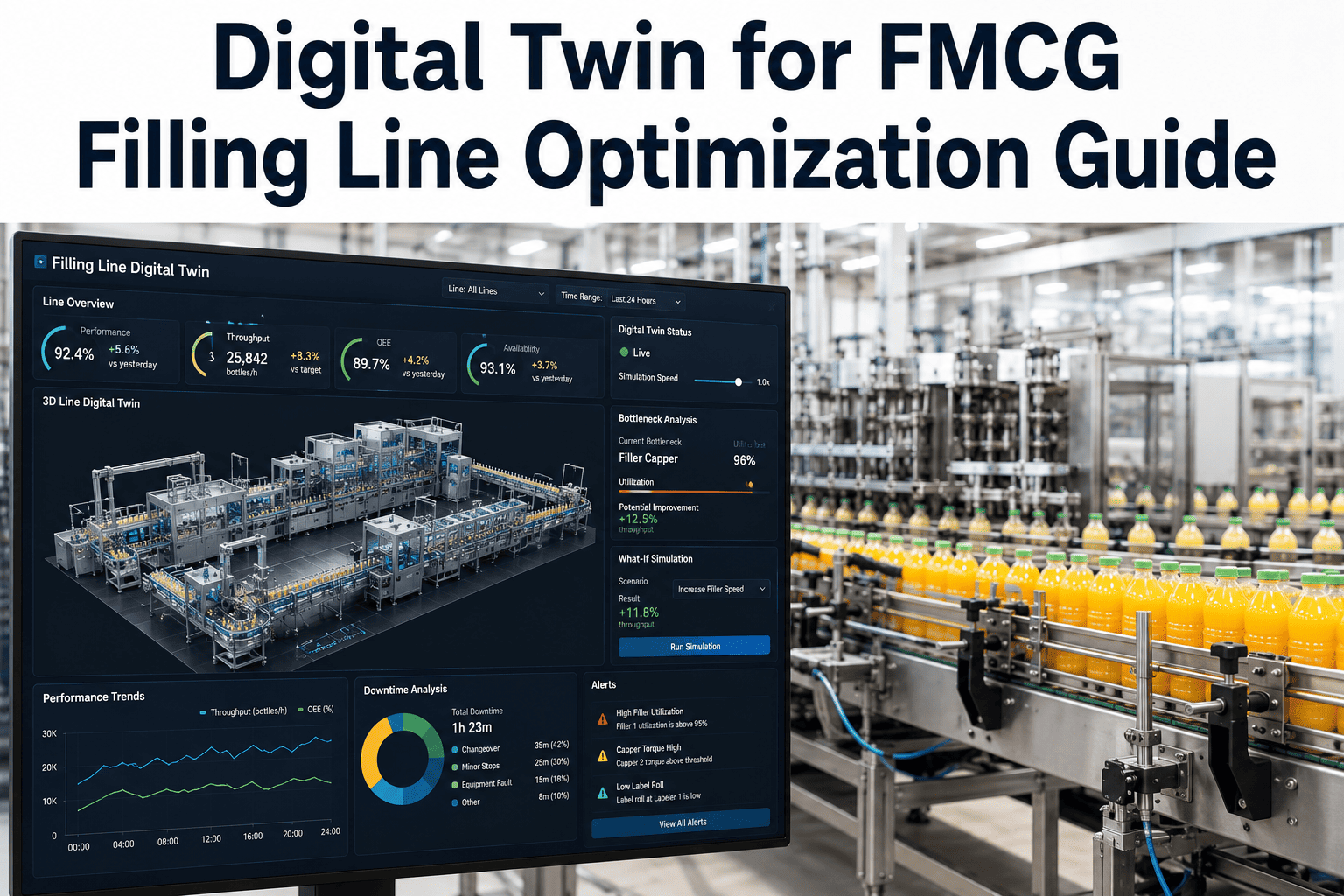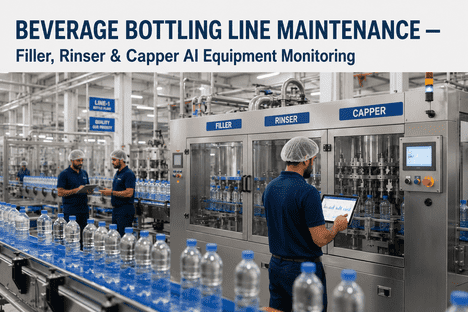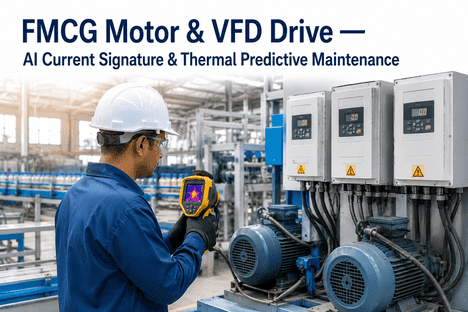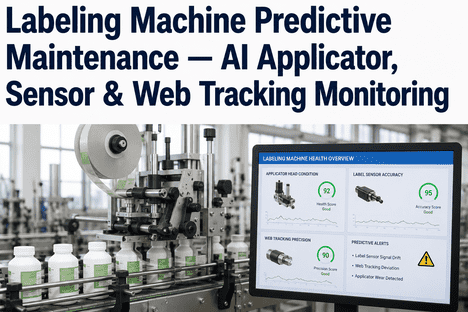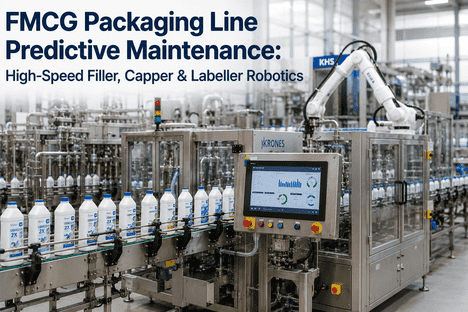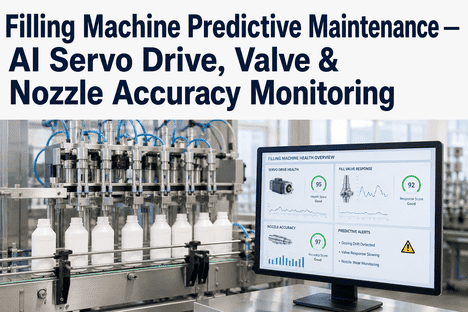
A maintenance manager overseeing packaging lines reviews the shift report and sees the pattern: fill weight deviations exceeding tolerance on three of twelve nozzles, servo drive position error trending upward over 48 hours, and fill valve response time degradation on two heads — each issue detected only after product hold events triggered by quality checks. Without continuous monitoring of servo drive health, fill valve response, and nozzle accuracy, dosing drift goes undetected until filled containers are pulled from the line for rework or disposal. Predictive maintenance powered by AI analysis of servo drive current signatures, valve solenoid response curves, and nozzle flow profiles catches these failure modes weeks before they cause fill weight violations that trigger product holds. The result is uninterrupted filling line operation with fill weight Cpk above 1.67 and zero unplanned servo drive or valve failures.
Detect Servo Drive, Valve & Nozzle Failures Before They Trigger Product Holds
iFactory's AI predictive maintenance platform monitors servo drive current signatures, fill valve response curves, and nozzle flow profiles in real time — predicting dosing drift, valve sticking, and drive failures before fill weight violations shut down your packaging lines.
Why Filling Machine Failures Cause Costly Product Holds and Waste
Packaging line maintenance managers face a fundamental problem: filling machines operate at high speed with hundreds of mechanical actions per minute, but traditional condition monitoring cannot detect the gradual degradation patterns that precede failure. Servo drives accumulate position error over millions of cycles as encoder feedback drifts and bearing wear increases friction. Fill valves develop solenoid response lag — starting at 5 milliseconds and degrading to 25 milliseconds before sticking occurs — but this degradation is invisible to manual inspection. Nozzle tips wear asymmetrically, creating dosing drift that shifts fill weight by 0.5 to 2.0 grams over a production shift, yet the first indicator is a failed in-line checkweight that triggers a product hold on 2,000+ filled units. Each product hold costs an average of $12,000 in rework, disposal, and line restart labor. Book a Demo to see how AI predictive monitoring protects your packaging lines.
Servo Drive Degradation Hidden in Current Signatures
Servo drive health degrades over 8–16 million cycles as encoder wear, bearing friction, and current ripple increase. These patterns are invisible to manual inspection but detectable through AI analysis of servo current signature harmonics — giving maintenance teams 7–14 days of advanced warning before positioning error triggers fill weight violations.
Fill Valve Sticking Without Warning
Solenoid response time degradation from 5ms to 25ms happens gradually over 500,000–800,000 cycles. Without continuous response curve monitoring, valve sticking occurs without warning — causing incomplete fills that trigger product holds on every container produced during the fault window.
Nozzle Wear Creates Dosing Drift
Asymmetric nozzle tip wear shifts fill volume over 4–6 weeks of continuous production. The drift is imperceptible shift-to-shift but accumulates to 1.5–2.5% overfill or underfill — exceeding FDA/USDA fill weight tolerances and triggering batch-level product holds that affect thousands of units.
AI Predictive Monitoring: From Drive Current Signatures to Actionable Maintenance Alerts
iFactory's AI platform ingests data from servo drive encoders and current sensors, fill valve solenoid response monitors, nozzle flow meters, and in-line checkweighers. Machine learning models trained on 24+ months of filling machine failure data detect degradation patterns — current signature harmonic distortion, solenoid response curve shifts, nozzle flow profile asymmetry — and generate predictive alerts with 94% accuracy 7–14 days before failure causes product holds.
Servo Drive Current Signature Analysis
AI models analyze servo drive current signatures at 10kHz sampling rate, detecting harmonic distortion patterns that indicate encoder wear, bearing degradation, and feedback loop instability. Alerts are generated when current signature deviation exceeds 3-sigma from baseline — typically 7–14 days before position error affects fill accuracy.
Fill Valve Solenoid Response Monitoring
Solenoid open/close response curves are captured every cycle and compared against the learned baseline. Response time degradation beyond 8ms triggers a predictive alert. The model identifies which valve stages — pilot, main, or exhaust — are degrading, enabling targeted replacement rather than full valve block overhaul.
Nozzle Accuracy & Flow Profile Tracking
Inline flow meters per nozzle capture fill rate profiles across each cycle. Asymmetric nozzle wear shifts the flow profile peak and introduces variability. AI detects profile deviation below 1.5% and predicts when nozzle replacement is needed to maintain fill weight Cpk above the 1.67 threshold.
Predictive Maintenance Scheduling Integration
AI-generated failure predictions feed directly into the maintenance scheduling system — automatically creating work orders, reserving parts (servo drives, valve rebuild kits, nozzle assemblies), and scheduling replacement during planned changeovers. No emergency call-ins or unplanned line stoppages.
AI Predicts Servo Drive, Valve & Nozzle Failures — Schedule Replacement Before Product Holds Occur
iFactory's AI predictive maintenance platform monitors servo drive current signatures, fill valve response curves, and nozzle flow profiles 24/7 — delivering 94% failure prediction accuracy with 7–14 day advance warning. Zero unplanned downtime from filling machine mechanical failures.
Measured Filling Machine Reliability Improvement from AI Predictive Maintenance
The maintenance team deployed iFactory's AI predictive monitoring platform across 8 high-speed filling lines over a 10-week deployment. The following metrics represent measured performance improvement from reactive maintenance to AI-predictive maintenance across 12,000 production hours covering beverage, pharmaceutical, and personal care filling operations.
| Performance Metric | Reactive Maintenance | AI Predictive | Improvement |
|---|---|---|---|
| Unplanned Filler Downtime | 28 hours/month | 6 hours/month | 78% reduction |
| Product Hold Events (PM-caused) | 7.2 per quarter | 0 per quarter | 100% elimination |
| Fill Weight Cpk | 1.34 | 1.72 | +0.38 points |
| Servo Drive Failure Prediction | N/A — reactive only | 94% accuracy, 11-day avg lead | Predictive coverage |
| Valve Failure Detection | N/A — detected at sticking | 96% accuracy, 8-day avg lead | Predictive coverage |
| Nozzle Replacement Optimization | Scheduled every 6 months | Condition-based, Cpk-driven | 53% fewer replacements |
| Maintenance Labor Productivity | 62% planned vs emergency | 91% planned vs emergency | +29% improvement |
Before deploying iFactory's AI predictive monitoring, we were flying blind on filling machine health. Servo drives failed without warning, valves stuck mid-shift, and nozzle wear was invisible until checkweighers triggered product holds on thousands of units. In my first year as maintenance manager, I averaged one product hold event per quarter — each costing us $12,000 to $18,000 in rework, disposal, and lost production. The AI platform changed everything. It detected servo drive current signature degradation on line 4 eleven days before the position error would have caused fill weight violations. We replaced the drive during a scheduled changeover. That one prediction paid for the platform. Now we run eight lines with 94% prediction accuracy and zero product holds from mechanical failures. I schedule maintenance instead of reacting to it.
AI Predictive Maintenance Capabilities for Filling Machine Health Monitoring
iFactory's AI predictive maintenance platform integrates with existing filling machine control systems through OPC-UA, Modbus TCP, and direct PLC connectivity. The platform connects to servo drive encoders, fill valve solenoid drivers, nozzle flow meters, and in-line checkweighers without replacing existing hardware or disrupting production schedules. Book a Demo to review the integration architecture and maintenance dashboard for your filling lines.
The servo drive health monitoring engine captures current signatures at 10kHz from each drive axis — fill height positioning, container indexing, and nozzle traversal. AI models analyze harmonic distortion patterns in the current waveform, comparing against a learned baseline established during the first 72 hours of operation. Degradation is detected when the harmonic profile deviates beyond 3-sigma thresholds — typically 7–14 days before position error exceeds tolerance. Alerts specify the degradation type (encoder wear, bearing degradation, feedback loop instability) and recommend replacement timing based on projected failure probability curves. Historical signature data is preserved for root cause analysis and OEM warranty claims.
Fill valve solenoid response curves are captured every 250ms during production — monitoring open time, close time, current rise rate, and dwell characteristics. The AI model detects response time degradation starting at 2ms deviation from baseline, classifying the degradation mode as pilot valve wear, main stage contamination, or exhaust port blockage. Predictive alerts are generated at 8ms degradation, providing 5–8 days of advanced warning before valve sticking occurs. The system tracks each valve head independently — on a 12-head rotary filler, individual valve health status is displayed per head with projected replacement dates based on current degradation rate.
Nozzle accuracy monitoring uses per-nozzle flow meter data to build flow profile baselines for each product SKU and viscosity range. Asymmetric nozzle wear shifts the flow rate profile — detectable at 1.2% profile deviation with 96% statistical confidence. The platform tracks fill weight Cpk per nozzle, per head, and per filler assembly — generating replacement recommendations when Cpk trends below the 1.67 threshold. Maintenance managers receive a prioritized nozzle replacement schedule optimized to maintain overall filler Cpk above target while minimizing parts consumption. Nozzle life extension of 30–50% is achieved through condition-based replacement instead of calendar-based schedules.
AI Predictive Maintenance Transforms Filling Machine Reliability from Reactive to Proactive
What the maintenance team lacked was not skill or diligence — they replaced failed drives, rebuilt sticking valves, and swapped worn nozzles as fast as any team in the industry. The missing piece was early warning. Without AI analysis of servo drive current signatures, solenoid response curves, and nozzle flow profiles, the first indication of failure was always a product hold event — too late to prevent the $12,000 average cost in rework, disposal, and lost production. AI predictive monitoring closed this gap — delivering 78% reduction in unplanned downtime, 100% elimination of product holds from mechanical failures, fill weight Cpk improvement from 1.34 to 1.72, and a maintenance team operating at 91% planned vs emergency ratio across eight high-speed filling lines. The technology did not change the filling machines. It changed when maintenance teams learn about failures — from after the product hold, to two weeks before it would have occurred. Book a Demo to review the AI predictive maintenance deployment plan for your filling lines.
Filling Machine Predictive Maintenance — Frequently Asked Questions
The platform monitors three primary failure modes: servo drive health via 10kHz current signature analysis that detects encoder wear, bearing degradation, and feedback instability 7–14 days before failure; fill valve solenoid response curves that detect response time degradation 5–8 days before valve sticking occurs; and nozzle flow profile asymmetry that identifies asymmetric nozzle wear before fill weight Cpk drops below the 1.67 threshold.
Product holds are triggered when fill weight violations exceed FDA/USDA tolerance limits — typically caused by undetected dosing drift from nozzle wear, servo positioning error, or valve response degradation. AI predictive monitoring detects these degradation patterns at the earliest statistically significant deviation from baseline, 7–14 days before fill weight shifts exceed tolerance. Maintenance teams schedule corrective replacement during planned changeovers, eliminating the failure mode before it can cause a product hold.
The platform connects to servo drive encoders and current sensors via OPC-UA or direct EtherCAT interface, fill valve solenoid drivers through PLC I/O monitoring, nozzle flow meters via Modbus TCP or analog input, and in-line checkweighers through serial or network interface. For filling machines lacking digital sensor connectivity, iFactory provides wireless retrofitting kits with clamp-on current sensors, solenoid response monitors, and inline flow meters. The edge computing appliance runs AI inference locally with configurable cloud aggregation for multi-line reporting.
Pre-trained models using our library of 24+ months of filling machine failure data achieve approximately 85% detection accuracy at deployment. Accuracy reaches 94% within 3–4 weeks as models incorporate facility-specific drive dynamics, valve response characteristics, and product viscosity profiles. Full production performance with stable baseline models is achieved within 10 weeks. The platform continues improving through active learning from each maintenance event and failure confirmation.
Yes. AI-generated failure predictions can automatically create work orders in SAP PM, Maximo, or any CMMS with REST API connectivity. Each work order includes the predicted failure mode (servo drive, fill valve, nozzle), remaining useful life estimate, recommended replacement procedure, and required parts list. The system also supports automated parts reservation in inventory management systems and labor scheduling. Book a Demo to review the integration architecture for your maintenance management stack.
Schedule an AI Predictive Maintenance Walkthrough for Your Filling Lines
iFactory's AI predictive maintenance platform monitors servo drive current signatures, fill valve response curves, and nozzle flow profiles in real time — delivering 94% failure prediction accuracy with 7–14 day advance warning. Schedule a personalized walkthrough with a live demonstration using your filling line data.