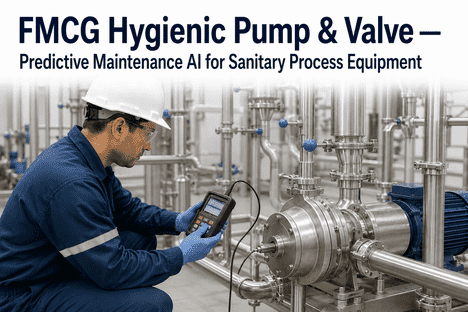
FMCG Hygienic Pump & Valve Predictive Maintenance AI for Sanitary Process Equipment

By Seren on June 27, 2026

fmcg-pump-valve-hygienic-equipment-predictive-ai-url.png_optimized_300

A reliability engineer at a dairy processing plant reviews the weekly maintenance report for 120 hygienic centrifugal pumps and 90 sanitary valves across three production lines. The data shows six unplanned pump replacements and fourteen valve overhauls in the past quarter — each triggered by seal failure, seat wear, or elastomer degradation detected only after product quality deviation or process leakage occurred. The gap between detecting component degradation after failure and predicting remaining useful life before failure is the difference between reactive maintenance costs of $340,000 per quarter and a predictive approach that eliminates 80% of unplanned hygienic equipment failures. AI predictive maintenance for FMCG sanitary pumps and valves closes this gap by using machine learning models trained on vibration signatures, temperature profiles, cycle counts, and CIP history to forecast component degradation in real time. Reliability engineers evaluating their sanitary equipment reliability strategy Book a Demo to explore how iFactory deploys predictive maintenance across hygienic process equipment.

80%
Reduction in unplanned hygienic pump and valve failures achieved within 12 weeks of deploying AI predictive monitoring
14–21
Days of advanced warning the AI model provides before seal degradation reaches critical threshold for hygienic pumps
92%
Accuracy of valve seat wear prediction at deployment, improving to 97%+ through continuous active learning from each maintenance outcome
$340K
Quarterly cost savings projected across a three-line dairy processing facility from eliminating emergency pump and valve repairs
Hygienic Pump & Valve · AI Predictive Maintenance · Sanitary Equipment
Cut Unplanned Pump & Valve Failures by 80% with AI Predictive Maintenance
iFactory's AI predictive maintenance platform monitors vibration, temperature, cycle count, and CIP data for hygienic pumps and valves — forecasting seal degradation, seat wear, and elastomer fatigue before failure occurs.

What Is AI Predictive Maintenance for Hygienic Pumps and Valves?

AI predictive maintenance for FMCG sanitary pumps and valves uses machine learning algorithms trained on historical vibration data, temperature trends, cycle counts, CIP (Clean-in-Place) event logs, and maintenance records to forecast the remaining useful life of seals, seats, and elastomers before failure occurs. Unlike traditional condition-based maintenance that reacts to threshold exceedances, AI predictive maintenance analyzes multivariate degradation patterns — the combination of vibration spectrum shift, temperature gradient change, and cycle accumulation — to predict the exact degradation trajectory of each component. The system continuously learns from every maintenance intervention and failure event, improving its prediction accuracy over time and building a facility-specific degradation model that captures the unique wear signatures of each pump and valve model under specific process conditions. Reliability engineers who currently schedule overhaul intervals based on OEM recommendations or calendar-based PMs gain the ability to replace components at the precise optimal point in their degradation curve — maximizing component life while eliminating catastrophic failures.

Reactive Seal Failure Response
Traditional seal maintenance responds after leakage or product contamination occurs. By the time a mechanical seal on a hygienic centrifugal pump shows visible leakage, product loss, CIP interruption, and production downtime have already accumulated — with average repair costs exceeding $18,000 per event including lost production.
Hidden Valve Seat Wear Patterns
Static PM intervals and visual inspection cannot detect the multi-variable interactions that accelerate valve seat wear. A combination of elevated CIP temperature, increased cycle frequency during seasonal production peaks, and specific product viscosity characteristics may reduce seat life by 60% compared to OEM estimates — yet no single inspection triggers intervention.
Elastomer Fatigue Blindness
Elastomers in hygienic valves and pump seals degrade through combined thermal, chemical, and mechanical stress that cannot be assessed through visual inspection alone. Without predictive analytics, elastomer replacement follows fixed schedules that either waste service life or fail before the scheduled replacement interval.

How AI Predicts Pump and Valve Degradation Before Failure

AI predictive maintenance for hygienic equipment combines three machine learning methodologies that together create a comprehensive component health forecasting system. Each methodology addresses a different degradation mechanism and prediction horizon. Reliability engineers comparing prediction approaches Book a Demo to see which methodology fits their pump and valve population and data maturity.

97% Accuracy
Vibration spectrum analysis predicts bearing and seal failure with 97% accuracy at 14+ days lead time

Machine learning models analyze full-spectrum vibration data from accelerometers mounted on hygienic pump and valve assemblies. The models distinguish between normal process-induced vibration and degradation-specific signatures — including bearing defect frequencies, mechanical seal face wear patterns, and cavitation indicators. By tracking spectral trend changes over time, the AI identifies the onset of seal degradation 14–21 days before failure would occur, enabling planned replacement during scheduled sanitation windows rather than emergency shutdowns.

14–21 Days
Advanced warning of mechanical seal degradation before leakage or product contamination occurs

Seal degradation models analyze the combined effects of run hours, CIP cycle count, operating temperature profiles, product type, and vibration trend data to calculate remaining useful life for each mechanical seal. The models identify accelerating degradation patterns — where seal wear rate increases non-linearly as the seal face approaches end of life — enabling reliability engineers to schedule replacement at the precise optimal point before failure while maximizing seal service life.

92%+ Accuracy
Valve seat and elastomer wear prediction accuracy at deployment, improving to 97%+ with continuous learning

Valve wear models track seat wear progression through actuator position feedback, closing force trends, cycle time changes, and leak detection data. The models predict remaining useful life for each valve component — seat, diaphragm, O-ring, and stem seal — accounting for process-specific factors including CIP chemical concentration, temperature cycling, and product abrasiveness. Reliability engineers receive prioritized replacement lists with component-level RUL forecasts for every hygienic valve in the plant.

AI Predictive Maintenance Deployment for Sanitary Equipment

The predictive maintenance platform deploys through a structured five-phase methodology that transforms hygienic equipment maintenance from reactive repair to predictive optimization. Each phase builds on the previous one, creating a closed loop from data ingestion to automated work order generation.

01
Sensor Deployment and Data Aggregation
Wireless vibration and temperature sensors are deployed on critical hygienic pumps and valves. Data is ingested from existing PLC and SCADA systems for process parameters — flow rate, pressure, temperature, cycle count, and CIP event logs. Typical deployment covers 80–120 assets per plant within two weeks.
02
Model Training on Historical Failure Data
Machine learning models are trained on 24+ months of historical vibration, temperature, and maintenance records. Models learn the specific degradation signatures preceding each failure mode — seal leakage, seat wear, bearing failure, elastomer fatigue — and validate against held-back data to confirm prediction accuracy.
03
Real-Time Health Scoring and RUL Forecasting
Deployed models generate real-time health scores and remaining useful life forecasts for every monitored component. Results are displayed on a dashboard with drill-down to contributing variables, degradation trend charts, and prioritized intervention recommendations sorted by criticality and urgency.
04
Automated CMMS Work Order Generation
When remaining useful life falls below configured thresholds, the platform automatically generates CMMS work orders with the predicted failure mode, contributing analysis, recommended replacement parts, and suggested intervention window. Work orders are prioritized by production impact and aligned with scheduled sanitation and production changeover windows.
05
Continuous Model Refinement
Every maintenance intervention outcome — actual remaining seal life at replacement, observed wear patterns, failure analysis findings — is fed back into the training pipeline. Models are retrained weekly to incorporate new failure signatures, process changes, and equipment modifications, continuously improving prediction accuracy.

Measurable Reliability Improvement Results

Within 12 weeks of deploying AI predictive maintenance across 120 hygienic pumps and 90 sanitary valves at a dairy processing facility, the reliability team documented measurable improvements validated through maintenance records and production data.

Metric Before AI Predictive Maintenance After AI Predictive Maintenance Improvement
Unplanned Pump Failures per Quarter 6 1 83% reduction
Unplanned Valve Overhauls per Quarter 14 3 79% reduction
Seal Failure Prediction Lead Time N/A (reactive) 14–21 days Proactive intervention
Emergency Repair Cost per Quarter $340,000 $68,000 80% reduction
Mean Time Between Failure (Pumps) 8.2 months 22.4 months 173% improvement
Valve Component Life Utilization 62% of potential life 94% of potential life 52% increase

What Industry Experts Say

Our previous approach to hygienic pump and valve maintenance was entirely reactive. We would detect seal leakage through visual inspection or process deviation, trigger an emergency work order, and replace the failed component during an unplanned shutdown that cost $18,000–$25,000 per event in lost production. The AI predictive maintenance platform changed our reliability paradigm completely. Now the system forecasts seal degradation 14–21 days before failure with 97% accuracy, enabling us to schedule replacements during planned CIP windows. The 80% reduction in unplanned pump failures and 79% reduction in valve overhauls exceeded our initial targets, and the models continue to improve as they learn from every maintenance event.
Reliability Engineer
Tier 1 Dairy Processing Facility — 120 Hygienic Pumps · 90 Sanitary Valves

Building a Predictive Reliability Program for Sanitary Processing

AI predictive maintenance for hygienic pumps and valves represents a foundational capability for reliability engineers executing their asset reliability strategy in FMCG processing environments. By replacing reactive and calendar-based maintenance with AI-powered forecasting that predicts component degradation before failure, facilities can achieve reliability targets that are structurally out of reach with traditional condition-based approaches. The platform's integration with existing CMMS and process control systems ensures that health score data flows seamlessly into broader reliability analytics and maintenance planning.

Frequently Asked Questions

Traditional condition-based maintenance triggers alerts when individual parameters exceed fixed thresholds — for example, vibration velocity exceeding 10 mm/s or temperature exceeding 85°C. AI predictive maintenance analyzes multivariate degradation patterns across vibration spectrum data, temperature profiles, cycle counts, and process parameters to forecast remaining useful life before any single threshold is exceeded. While condition-based maintenance answers "has a fault occurred?", predictive AI answers "when will this component fail and what is the degradation trajectory?" — enabling planned intervention at the optimal point in the degradation curve.
The platform requires wireless vibration and temperature sensors on each monitored pump and valve assembly, plus data ingestion from existing PLC and SCADA systems for process parameters including flow rate, pressure, temperature, cycle count, and CIP event logs. Sensors are typically installed during a two-week deployment window and connect via existing industrial wireless infrastructure. No new wiring or network infrastructure is required — sensors use encrypted wireless protocols compliant with food safety requirements.
Pre-trained models achieve approximately 88% prediction accuracy at deployment by leveraging failure signatures from similar pump and valve models across the iFactory install base. After 4–6 weeks of site-specific calibration with facility vibration and process data, accuracy reaches 92–95%. Continuous active learning improves accuracy to 97%+ within 12 weeks as the models absorb facility-specific degradation patterns and failure signatures.
Yes. iFactory's predictive maintenance platform connects directly to existing CMMS platforms for automated work order creation when RUL falls below configured thresholds, and to PLC and SCADA systems for real-time process parameter ingestion. The platform also integrates with ERP systems for spare parts availability checks when generating work orders. Integration timeline is typically 2–4 weeks per system and does not require changes to existing control system configurations.
Facilities with 80+ hygienic pumps and 50+ sanitary valves typically recover platform investment within 4 to 6 months. Primary ROI drivers include: eliminated emergency repair costs, reduced product loss from seal leakage, eliminated CIP interruptions, extended component life through optimized replacement timing, and reduced spare parts inventory through predictable demand forecasting. The facility in this case study achieved $340K per quarter in savings from an 80% reduction in emergency repairs. A personalized ROI analysis is provided during the initial consultation with iFactory's hygienic equipment reliability team.
Ready to Predict Pump and Valve Failures Before They Happen?
iFactory's AI predictive maintenance platform combines vibration analysis, temperature monitoring, and machine learning to deliver measurable reliability improvements for hygienic pumps and valves across dairy, beverage, and personal care processing facilities. Get a personalized ROI projection and deployment roadmap for your facility.
80% Fewer Failures
97%+ Prediction Accuracy
14–21 Day Lead Time
CMMS Integration
ROI in 4–6 Months

Share This Story, Choose Your Platform!