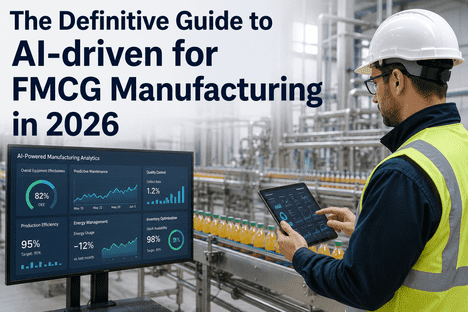
The Definitive Guide to AI-driven for FMCG Manufacturing in 2026
By Seren on June 17, 2026
Every FMCG production manager knows the pain of a packaging line that stops producing at 3:15 PM on a Friday. The line-side display shows 82% OEE. The shift report from the previous week shows 79%. The variance report from the plant manager's monthly review aggregates to 85%. None of these numbers is wrong. Each is calculated on a different basis — different availability definitions, different quality inclusion rules, different performance calculation methods — and none of them individually represents the operational reality that the line lost 47 minutes to a vacuum-pack seal failure, 22 minutes to a changeover that ran over by nine minutes, and 14 minutes to a upstream filler jam that never appeared on any equipment-level sensor log. The FMCG industry generates more operational data than any other discrete manufacturing vertical, and it uses less of it for operational decisions. This is the gap that AI-driven analytics exists to close, and this guide is built for the people who need to close it — plant managers, operations directors, and continuous improvement leads who are ready to move from fragmented data to a unified operational intelligence platform.
Your FMCG Plant Runs on Data You Are Not Using. AI-Driven Analytics Connects Every Signal to Every Decision.
iFactory's AI-driven platform unifies production monitoring, predictive maintenance, quality control, and energy analytics into a single operational intelligence layer purpose-built for FMCG manufacturing — from raw material intake to finished goods palletising.
Overall OEE improvement reported by FMCG plants deploying integrated AI-driven analytics — combining real-time production monitoring with predictive maintenance and quality integration across packaging, processing, and filling lines
30–45%
Reduction in unplanned downtime when AI predictive models are deployed on critical FMCG packaging and processing assets — catching bearing wear, seal degradation, and motor anomalies before they cause line stops
20–35%
Energy cost savings achieved through AI-driven energy monitoring and load optimisation — identifying peak demand patterns, idle consumption, and equipment-level energy waste across refrigeration, HVAC, and processing systems
40–60%
Faster root cause identification for quality deviations when AI-powered analytics links upstream process parameters to downstream quality outcomes — enabling HACCP-compliant corrective action within minutes instead of shifts
The FMCG Data Fragmentation Problem — Why Most Plants Cannot Answer the Questions That Matter Most
An FMCG plant operating three packaging lines, two processing trains, a warehouse, and a utilities block typically relies on six to eight separate data systems. The PLC and SCADA layer captures machine-level cycle times and fault codes. The MES tracks work orders and batch records. The CMMS holds maintenance history and work order completion data. The quality management system stores HACCP records, lab results, and nonconformance reports. The energy management system monitors power consumption at the meter level. The warehouse management system logs inventory movements. Each system produces data that is complete within its own domain and incomplete for every cross-domain question that a plant manager actually needs to ask. Why did OEE drop on Line 2 during the afternoon shift on Tuesday? The answer lives across the SCADA cycle time log, the CMMS fault history, the QMS nonconformance record for the seal integrity test, and the shift logbook entry about the raw material batch change. AI-driven analytics extracts the answer from all four simultaneously — without manual data assembly, without spreadsheet reconciliation, and without the delay that turns operational hindsight into a missed improvement opportunity.
The FMCG industry operates on thin margins, high throughput, and quality standards that carry both brand and regulatory consequences. A foreign material incident on a ready-to-eat product line requires traceability from supplier batch to finished good case code, and it must be producible within hours — not days. A packaging line running at 78% OEE when the threshold is 85% represents a margin erosion that compounds across every shift of every week of the year. AI-driven analytics platforms purpose-built for FMCG address both the traceability requirement and the performance improvement requirement with the same data architecture: one platform that ingests, normalises, and analyses operational data from every source across the plant and returns answers in the language of FMCG operations — OEE by line and shift, quality yield by product and batch, energy intensity by process step, and maintenance risk by asset class.
Six Data Silos That Every FMCG Plant Manager Needs Unified — but Few Have Integrated
01
Production Monitoring — PLC, SCADA, Line Sensors
Real-time cycle times, machine states, fault codes, and throughput data from packaging lines, fillers, cookers, conveyors, and palletisers. Each line generates thousands of data points per minute. Less than 5% is used for operational decisions. AI-driven analytics ingests the full stream and surfaces only the events, trends, and anomalies that drive throughput, quality, or cost outcomes.
Unified view: Real-time and historical OEE by line, shift, product, and recipe — calculated on consistent availability, performance, and quality definitions.
02
Maintenance Management — CMMS, Work Orders, Sensor Health
Maintenance history is the richest untapped dataset in FMCG plant operations. Every work order, every parts replacement, every technician note, and every vibration or temperature sensor reading is a signal about future failure risk. AI models trained on combined maintenance and production data identify the patterns that precede line-stopping failures — bearing temperature rising with line speed, seal wear accelerating after specific product changeovers, motor current profiles that precede drive faults.
Unified view: Predictive maintenance risk scores for every critical asset — maintenance scheduled by failure probability, not calendar interval.
HACCP records, lab test results, microbial swab data, seal integrity test results, and nonconformance reports represent the quality layer that determines whether production is shippable or quarantined. When these records are disconnected from production data, root cause analysis requires manual cross-referencing of timestamps across systems. AI-driven analytics links each quality outcome to the upstream process conditions — the filler temperature, the packaging film batch, the line speed at the time of production — that produced it, enabling root cause identification in minutes.
Unified view: Quality outcome traceable to upstream process parameters — root cause identified in minutes, not shifts.
04
Energy Monitoring — Power, Gas, Water, Refrigeration
Energy is the second-largest operating cost in most FMCG plants after raw materials. Refrigeration alone can account for 25–35% of total plant energy consumption in a cold-chain facility. When energy data is analysed in isolation, it identifies consumption patterns. When it is analysed alongside production data — which product was running, at what throughput, on which line — it reveals energy intensity by product SKU, by process step, and by operating condition. This is the dataset that makes energy reduction a production efficiency initiative rather than a facilities initiative.
Unified view: Energy intensity (kWh per unit produced) by SKU, line, and process step — consumption attributed to production, not just to the meter.
05
Shift Logbook and Operator Rounds Data
The shift logbook contains more operational insight than any automated system captures — the operator observation that a filler was running at slightly higher temperature than the setpoint, the supervisor note about a raw material batch that looked different, the handover comment about a conveyor that was making an unusual sound during the prior shift. When this unstructured data is digitised and analysed alongside structured machine data, it fills the informational gap between what sensors measure and what operators see.
Unified view: Operator observations correlated with machine data — the human signal integrated with the digital signal.
06
Warehouse and Inventory Management
Finished goods inventory, raw material stock, packaging materials, and WIP are managed in the WMS and ERP layers. When inventory data is disconnected from production data, the plant cannot answer the question: how much finished goods inventory did we generate per unit of raw material consumed, per line, per shift, per product variant? This is the data that connects production efficiency directly to working capital — and makes quality-related rework visible as both a cost and an inventory impact.
Unified view: Yield and inventory impact calculated per production run — quality rework cost visible in the production dashboard.
+
The Integration Multiplier — Why Six Silos Connected Exponentially Increase Value
A plant that connects production and maintenance data reduces unplanned downtime. A plant that connects production, maintenance, and quality data reduces both downtime and waste. A plant that connects production, maintenance, quality, energy, shift log, and inventory data transforms from a facility that tracks individual metrics to a facility that models operational outcomes — predicting which combination of line speed, product SKU, ambient temperature, and maintenance state will produce the highest quality yield at the lowest energy cost per unit. This is the operational intelligence that defines AI-driven FMCG manufacturing in 2026.
Full integration: Every data source connected — operational outcomes modelled, predicted, and optimised in real time.
→
The iFactory AI-Driven Platform Difference
iFactory's AI-driven analytics platform was purpose-built for FMCG manufacturing complexity. Rather than requiring plants to replace existing systems, iFactory connects to every data source through standard industrial protocols and APIs — OPC-UA, Modbus, REST, MQTT — and normalises the data into a unified operational data model. The platform then applies machine learning models trained on FMCG operational patterns: OEE anomaly detection, predictive failure models for packaging and processing assets, energy intensity regression by product and line, and quality deviation prediction that links upstream process parameters to downstream outcomes. The result is a single interface that answers the questions FMCG plant managers ask every day, without the data assembly work that currently prevents them from answering those questions before the opportunity to act has passed.
Start with a free demo configured for your plant's data environment and operational priorities.
Core Capabilities of AI-Driven FMCG Analytics Platforms — What to Evaluate Before You Select
The FMCG analytics software market has expanded rapidly, and the terminology used to describe platform capabilities varies significantly between vendors. Operations directors evaluating platforms need a consistent framework for comparing what each system actually delivers. The following capabilities represent the core functional areas that define a purpose-built AI-driven analytics platform for FMCG manufacturing, as distinct from general-purpose analytics tools or bolt-on dashboards layered over existing automation systems.
Core Capability Framework for AI-Driven FMCG Analytics Platform Evaluation
01
Universal Data Ingestion and Normalisation
The platform must connect to PLCs (Siemens, Rockwell, Mitsubishi, Omron), SCADA systems, CMMS databases (SAP PM, Maximo, Infor EAM), QMS platforms, WMS, ERP, energy management systems, and shift logbook data. Connection is table stakes. The differentiator is data normalisation — the ability to map disparate data models into a unified operational schema so that one line's OEE is calculated on the same basis as another line's OEE, one plant's quality yield definition matches another plant's, and cross-site comparisons are valid without manual reconciliation.
02
AI-Powered Predictive Maintenance for FMCG Assets
Predictive maintenance models must be trained on FMCG-specific failure patterns — not generic rotating equipment anomaly detection. The models that matter for an FMCG plant are those that predict vacuum-pack seal degradation before leak rates exceed specification, filler valve wear before fill weight variance triggers regulatory noncompliance, conveyor bearing failure before line stoppage, and compressor performance degradation before refrigeration temperature deviation. Each model must be retrainable on plant-specific data and must produce a clear risk score with the time window in which intervention is recommended.
03
Real-Time OEE with Consistent Definitions
OEE must be calculated in real time on consistent availability, performance, and quality definitions configurable by line, product family, shift pattern, and reporting period. The platform must support the OEE calculation methods used in FMCG — including the ability to exclude planned downtime for availability, define ideal cycle time per SKU and pack format, and calculate quality yield at the point of production rather than at the point of finished goods inspection. Historical OEE trends must be attributable to downtime category, product, shift, and operator team without manual data filtering.
04
Quality Traceability and HACCP-Compliant Analytics
The platform must link every quality outcome — lab test result, seal integrity test, microbial swab result, foreign material detection event — to the upstream process parameters that produced it: raw material batch identity, processing temperature and time profile, packaging material lot, line speed at time of production, operator team, and environmental conditions. This linkage enables root cause analysis to be performed in minutes rather than hours. For HACCP compliance, the platform must generate audit-ready documentation linking critical control point monitoring data to corrective action records automatically.
05
Energy Analytics with Production Attribution
Energy analytics must attribute consumption to production activity at the line, process step, and SKU level — not just at the facility or meter level. The platform must calculate energy intensity (kWh per unit, kWh per kg, or equivalent) for each product SKU, and must identify the operating conditions that drive energy intensity above target thresholds. Peak demand forecasting must be integrated with production scheduling so that high-energy production campaigns can be planned to avoid peak tariff periods when economically beneficial.
06
Shift Logbook Digitisation and Operator Intelligence
The shift logbook digitisation feature must go beyond a digital form that replaces a paper log. It must capture structured and unstructured operator observations, correlate them with machine data from the same time period, and surface patterns that would not be visible from either dataset alone. AI models should analyse shift log entries for recurring themes — a specific product that consistently generates operator comments about changeover difficulty, a particular line that generates more comments about waste in the minutes before shift handover, a time of day when seal integrity deviations are more frequent.
Universal Data Ingestion · Predictive Maintenance · Real-Time OEE · Quality Traceability · Energy Analytics
Six Capabilities That Define AI-Driven FMCG Analytics. One Platform That Delivers All Six.
iFactory's AI-driven platform is built for FMCG manufacturing — connecting every data source, predicting every failure pattern, tracing every quality outcome, and optimising every unit of energy consumed.
The Plant Manager's Dashboard — What AI-Driven Analytics Shows You Every Morning
The plant manager arriving at 6:45 AM needs a dashboard that answers the five questions that determine the day's operational priorities, before the morning production meeting starts. What did we produce last night across every line and product? Where is OEE trending relative to the weekly target and where are the losses concentrated? Are there any active quality holds or pending HACCP deviations that need escalation? Which assets are showing elevated failure risk and what is the maintenance plan for today's shift? How are we tracking on the monthly continuous improvement initiatives — changeover time reduction, waste reduction, energy intensity reduction? iFactory's AI-driven analytics dashboard is structured around these five questions, with drill-down paths that lead from the summary metric to the specific event, the root cause, and the corrective action record — all within the same interface, without opening a separate system.
Dashboard View 01
OEE by Line, Product, and Shift — Live and Trending
Every production line displays OEE calculated on consistent definitions — availability (actual run time vs. planned production time), performance (actual cycle time vs. ideal cycle time per SKU), and quality (good units produced vs. total units started). Traffic-light status indicators show which lines are above target (green), approaching threshold (amber), or below target (red). Drill-down from any line shows OEE by product SKU, by shift pattern, and by downtime category — mechanical, electrical, process, changeover, quality hold — so the plant manager knows not just that OEE is below target, but why.
Plant manager action: Drill into red-line OEE loss to identify dominant downtime category before the morning meeting.
Dashboard View 02
Predictive Maintenance Risk — Asset Health Scores by Criticality
Every critical asset — filler, sealer, cooker, compressor, conveyor drive — displays a health score calculated from vibration, temperature, current draw, and historical maintenance pattern data. Assets showing declining health scores appear in a prioritised list with the predicted remaining useful life window and the recommended intervention. The plant manager can see at a glance whether today's production plan is at risk from any asset requiring maintenance attention and can decide to adjust the schedule, approve a proactive maintenance intervention, or accept the risk with a documented justification.
Plant manager action: Approve proactive maintenance for declining-health assets before they fail during a high-priority production run.
Dashboard View 03
Quality Yield — Real-Time and Trended by Product Family
Quality yield is calculated at the point of production — the percentage of units produced that pass first-time quality inspection — trended by product family, line, and shift over configurable time windows. Quality events — seal integrity failures, fill weight deviations, foreign material detection, microbial test positives — appear as annotations on the yield trend line, linked to the upstream process conditions at the time of the event. The plant manager sees not only the yield percentage but the pattern of quality losses and the process context around each loss event.
Plant manager action: Identify quality loss patterns emerging in the most recent shifts — investigate before the trend becomes a systemic issue.
Dashboard View 04
Energy Intensity — kWh per Unit Produced by SKU and Line
Energy consumption attributed to production activity at the line, process step, and SKU level. The plant manager sees which products are the most energy-intensive to produce, which lines are operating above their expected energy intensity baseline, and whether there are correlating patterns between energy intensity and production throughput, ambient temperature, or time of day. Energy cost per unit is calculated in the same view, enabling the plant manager to make trade-off decisions between production speed and energy cost that are not visible when energy data is reviewed independently of production data.
Plant manager action: Identify SKUs running above expected energy intensity — investigate process conditions contributing to higher consumption.
Dashboard View 05
Continuous Improvement Tracking — Changeover, Waste, and Availability
Every continuous improvement initiative — changeover reduction, waste reduction, availability improvement, speed loss reduction, quality yield improvement — is tracked against its baseline and target in the CI dashboard. The plant manager can see which initiatives are on track, which are stalling, and which have reached their target and should have a new target set. Each initiative is linked to the operational data that measures its progress — changeover times calculated from actual line data rather than manually entered estimates, waste rates calculated from production reconciliation data, availability calculated from PLC uptime and downtime event logs.
Plant manager action: Review CI initiative progress from the same data that measures daily OEE — no separate tracking system required.
Dashboard View 06
HACCP and Food Safety Compliance Status
Critical control point monitoring data displayed in real time across every CCP in the facility — cooking temperatures, cooling rates, metal detector performance, X-ray inspection pass rates, and microbiological test results. Any deviation from the established critical limit generates an immediate alert with the corrective action record template pre-populated with the relevant process data. HACCP plan documentation, deviation records, and corrective action evidence are exportable on demand for audit or regulatory review. The plant manager responsible for food safety compliance sees the full CCP status landscape in the same dashboard as OEE and maintenance risk — because food safety is not a separate system, it is a dimension of every production decision.
Plant manager action: CCP deviations visible in the same dashboard as OEE — compliance status integrated with production status.
"
We were running a multi-line FMCG facility producing sauces, dressings, and ready meals across eight packaging lines with three processing trains operating around the clock. Our OEE was calculated in three different ways — one from the SCADA system, one from the MES, and one from a spreadsheet the plant manager had inherited five years earlier. Nobody could tell us what the real OEE was, and the continuous improvement programme was running on data that no two stakeholders agreed on. After deploying iFactory's platform, we had a single OEE number that everyone accepted, and the AI-driven analytics identified that 23% of our availability losses were coming from a single filler valve degradation pattern that no one had connected across the separate maintenance and production data streams. Fixing that pattern alone recovered 4% OEE across the facility within six weeks.
— Plant Manager, Major FMCG Sauces and Dressings Facility — Multi-Line Continuous Production, Multi-SKU High-Changeover Environment
ROI Framework for AI-Driven FMCG Analytics — Building the Business Case
The business case for AI-driven analytics in an FMCG plant rests on four quantifiable value drivers: OEE improvement through loss identification and reduction, maintenance cost reduction through predictive intervention, energy cost reduction through consumption attribution and optimisation, and quality waste reduction through early deviation detection. Each driver produces a measurable financial return, and the returns are additive because the data platform that enables one enables all four simultaneously. The following framework provides the basis for calculating expected returns from an AI-driven analytics deployment in a typical FMCG facility.
Four Value Drivers — Conservative ROI Calculation for a Mid-Size FMCG Facility
Value Driver 01
OEE Improvement
For a plant with 10 production lines at 80% OEE and 100,000 units per line per day at $0.50 contribution margin per unit, a 5% OEE improvement (from 80% to 85%) generates $250 per line per day in additional contribution — $912,500 per year across 10 lines. AI-driven analytics consistently delivers 5–12% OEE improvement across FMCG deployments.
Value Driver 02
Maintenance Cost Reduction
A mid-size FMCG facility spends $1.5–3M annually on maintenance (labour, parts, contractor services). Predictive maintenance reduces unplanned downtime by 30–45% and extends asset life by 15–25%. Conservative saving estimate: 20% of annual maintenance spend = $300,000–600,000 per year. The AI models that generate these savings also produce the data that justifies the transition from calendar-based to condition-based maintenance strategies.
Value Driver 03
Energy Cost Optimisation
A mid-size FMCG facility with $2–5M annual energy spend achieves 10–20% reduction through AI-driven analytics that attribute consumption to production activity, identify idle consumption patterns, and optimise production scheduling to avoid peak demand tariffs. Conservative saving: 12% of energy spend = $240,000–600,000 per year. These savings are sustainable because the analytics continuously identify new optimisation opportunities as production mix and conditions change.
Value Driver 04
Quality Waste Reduction
Quality waste (rework, downgrade, scrap, and write-off) in FMCG typically runs at 2–5% of production value. For a $50M annual production facility, that represents $1–2.5M in waste. AI-driven quality analytics reduces waste by 20–35% through early detection of deviation patterns and improved root cause identification. Conservative saving: 20% reduction = $200,000–500,000 per year. The same analytics platform generates the HACCP and regulatory compliance documentation linked to every waste-reduction decision.
Aggregate conservative annual benefit for a mid-size FMCG facility: $1.65–2.6M per year — with typical platform deployment costs recovered within 4–8 months.
Implementation Strategy — How to Deploy AI-Driven Analytics Without Disrupting Production
The most common concern that FMCG operations directors raise before deploying an AI-driven analytics platform is implementation risk. A food or beverage plant operating at high utilisation cannot afford a system deployment that disrupts production. The implementation approach that has proven most effective across iFactory FMCG deployments follows a staged, parallel-track model that begins with data connection and ends with closed-loop operational intelligence — without ever requiring a production line to stop for system installation.
Phase 1 — Data Connection and Normalisation
iFactory connects to existing PLC, SCADA, CMMS, QMS, and energy data sources via standard industrial protocols and APIs. No production system modification required. A typical mid-size FMCG facility with 6–10 production lines and 3–5 supporting systems completes data connection and normalisation in 2–4 weeks. The plant manager gains the first unified operational view — OEE, quality yield, and energy intensity calculated on consistent definitions across all lines and data sources.
Duration: 2–4 weeks. Production impact: None.
Phase 2 — AI Model Training and Shadow Mode Validation
Predictive maintenance, quality deviation, and energy optimisation models are trained on the plant's historical data and deployed in shadow mode — generating predictions and recommendations without taking automated action. The shadow mode period (typically 2–4 weeks) produces validation accuracy data against actual production outcomes. The plant manager and continuous improvement team review the model outputs, adjust thresholds and parameters, and authorise the models to move to advisory mode where predictions drive operator alerts and maintenance recommendations.
Duration: 4–6 weeks. Production impact: None — advisory only.
Phase 3 — Advisory Deployment and User Adoption
AI predictions drive operator alerts on line-side displays, maintenance recommendations in the CMMS workflow, quality deviation alerts in the QMS, and energy optimisation suggestions in the plant manager's dashboard. The iFactory platform includes role-based interfaces designed for each user group — operators see real-time line performance and alerts, maintenance technicians see asset health scores and recommended interventions, quality teams see deviation patterns and root cause analysis, plant managers see the full operational landscape in the morning dashboard.
Duration: 4–6 weeks. Production impact: Minimal — alerts drive awareness.
Phase 4 — Closed-Loop Optimisation and Continuous Model Improvement
AI models transition from advisory to closed-loop operation where appropriate — automated OEE loss classification, automated predictive maintenance work order generation for pre-approved interventions, automated quality hold placement for deviations matching established patterns, and automated energy consumption alerts for conditions exceeding configurable thresholds. Models are retrained quarterly on accumulating plant data and validated against actual outcomes. The continuous improvement programme moves from measuring improvement to modelling it — predicting the OEE, energy, and waste impact of each proposed operational change before the change is implemented.
Duration: Ongoing. Production impact: Positive — automated interventions prevent losses.
Conclusion — AI-Driven Analytics Is the Operational Baseline for FMCG Manufacturing in 2026
The FMCG manufacturing industry in 2026 operates under margin pressure, regulatory complexity, and consumer expectations that require a level of operational precision that fragmented data systems cannot deliver. Every plant manager knows that the data to make better decisions exists somewhere in the facility — in the PLC logs, the CMMS records, the QMS reports, the energy meters, the shift logbooks — but assembling that data into actionable intelligence requires time and effort that the operations team does not have and that the margin does not support. AI-driven analytics platforms purpose-built for FMCG close this gap not by replacing the systems that generate the data but by connecting them, normalising them, and analysing them as a unified operational dataset. The result is a plant manager who starts every day knowing exactly where OEE stands, which assets are at risk, what quality pattern is emerging, and which continuous improvement initiative is delivering — and who has the data to make the decisions that sustain the improvement trajectory.
The operations directors and plant managers achieving the strongest results from AI-driven analytics are the ones who treat it as an operational baseline rather than a technology project — a platform that every decision is made from, every meeting is informed by, and every continuous improvement initiative is measured against. The facilities that deploy AI-driven analytics in 2026 will establish the operational intelligence standard that the rest of the industry will need to meet by 2028. The gap between industry leaders and the rest is measured in months, not years.
iFactory's AI-driven platform is built specifically for FMCG manufacturing operations that need to move from fragmented data to unified operational intelligence — connecting every production line, every asset, every quality record, and every energy meter into a single analytics layer purpose-built for food, beverage, and CPG manufacturing. Book a Demo to see the platform configured for your plant's specific production lines, SKU portfolio, and operational priorities, or talk to an expert about a free OEE, energy, and quality analytics assessment for your FMCG facility.
Frequently Asked Questions
A typical deployment across a mid-size FMCG facility with 6–10 production lines and 3–5 supporting data systems (PLC/SCADA, CMMS, QMS, energy management, shift logbook) completes Phase 1 data connection and normalisation in 2–4 weeks. The full deployment through advisory mode typically takes 8–12 weeks from system connection to AI-driven alerts and recommendations visible in operator and plant manager dashboards. The timeline depends primarily on data system availability and the number of data sources being connected. iFactory provides dedicated integration engineering support throughout the deployment and trains the plant's operational technology team on platform administration during the process. Talk to an expert about a deployment timeline assessment for your specific plant environment.
iFactory integrates with existing systems. The platform connects to PLCs and SCADA systems through OPC-UA and Modbus protocols for real-time machine data, to CMMS platforms like SAP PM, Maximo, and Infor EAM through REST APIs for maintenance and work order data, to quality management systems and LIMS through standard API and flat-file import formats, to energy management systems through Modbus and API connections, and to ERP and WMS platforms through REST API integration. The platform ingests data from all connected sources, normalises it into a unified operational data model, and presents the integrated view in the analytics dashboard — without requiring any existing system to be replaced, modified, or operated differently. Book a Demo to see an FMCG plant's data environment configured in the platform with your specific systems already connected.
The data normalisation layer that iFactory deploys at each site maps the site-specific data model to a standardised operational schema — so that OEE, quality yield, energy intensity, and maintenance metrics are calculated on consistent definitions across every plant in the network, regardless of the underlying systems each plant uses. The corporate operations leadership dashboard aggregates data from every connected site on the same basis, enabling valid cross-site performance comparison. Each site retains its local data system configuration and operational autonomy. The centralised normalisation means that a plant using Rockwell PLCs with SAP PM and a plant using Siemens PLCs with Maximo report OEE on the same definitions in the corporate dashboard. Book a Demo to see a multi-site FMCG deployment configuration with cross-site OEE comparison.
Predictive maintenance models require a minimum of 3–6 months of paired production and maintenance history to establish baseline failure patterns. Quality deviation models require 6–12 months of paired process parameter and quality outcome data for primary quality characteristics like fill weight, seal integrity, and microbial test results. Energy optimisation models produce meaningful results with 6–12 months of production-attributed energy consumption data. Data security is handled through encrypted transmission (TLS 1.3), role-based access control at the user, role, and data source level, and deployment options that include cloud (AWS GovCloud or equivalent), on-premises (within the plant's existing IT infrastructure), or hybrid configurations. All data remains within the chosen deployment boundary. iFactory maintains SOC 2 Type II certification for data security and privacy. Talk to an expert about data security requirements for your specific FMCG operational environment.
Your Plant Has the Data. AI-Driven Analytics Turns It into Your Competitive Advantage.
iFactory's AI-driven platform for FMCG manufacturing — unified production monitoring, predictive maintenance, quality analytics, energy optimisation, and digitised shift logbook. Purpose-built for food, beverage, and CPG operations. Installed without production disruption. ROI measurable within the first quarter of deployment.