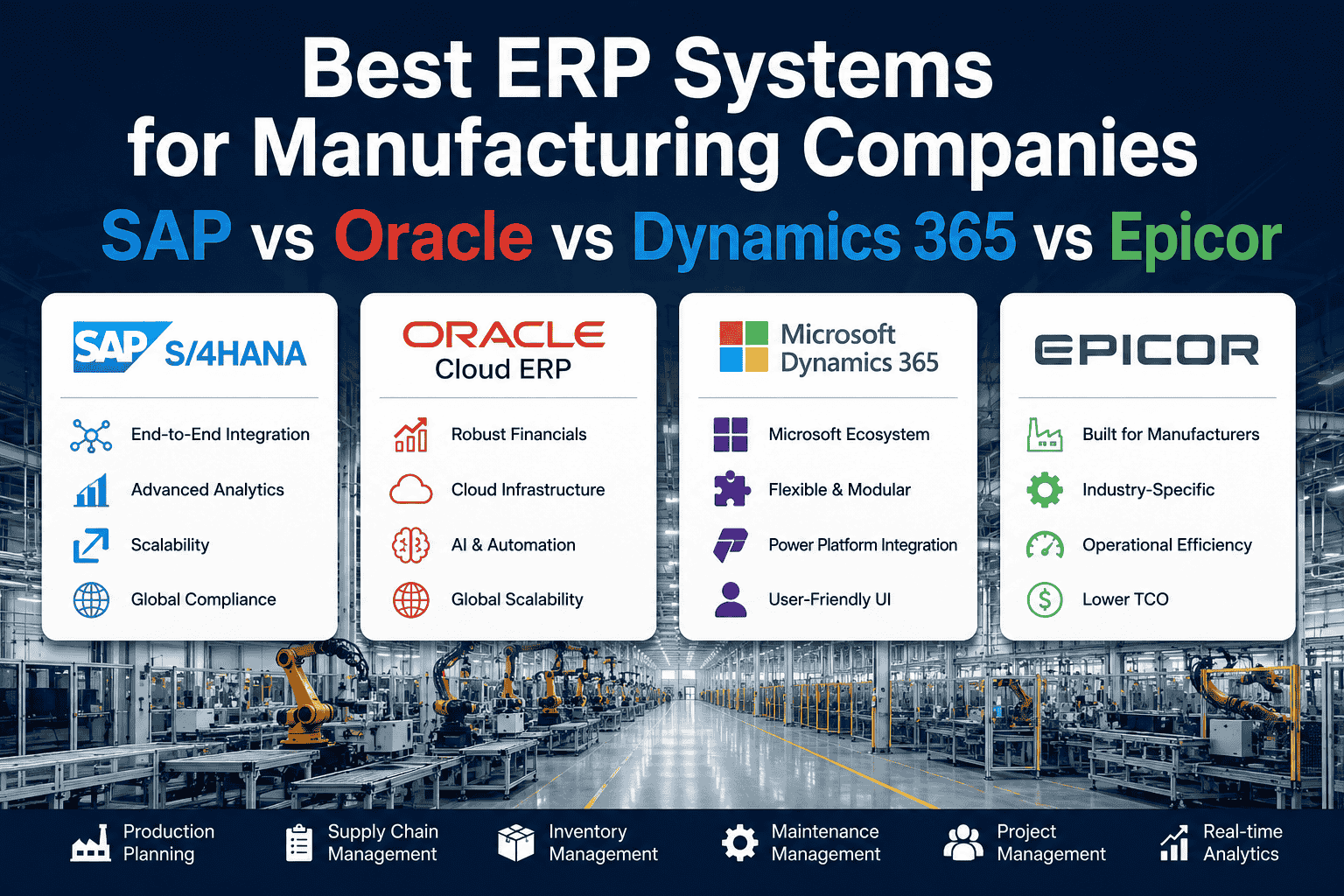
Choosing the wrong ERP costs manufacturers an average of $1.5M in failed implementation costs — before you count the operational chaos. SAP, Oracle, Microsoft, and Epicor all claim to be the best ERP for manufacturing, but the right answer depends on your size, complexity, industry, and tech ecosystem. This independent comparison breaks down the four leaders across cost, capability, implementation timeline, and fit. Book an ERP strategy consultation to map the right system for your manufacturing operation.
#1
SAP S/4HANA
Enterprise Champion
Best for 1,000+ user global manufacturers
#2
Oracle Cloud ERP
Finance-First Leader
Best for finance-led large enterprises
#3
Dynamics 365
Ecosystem Integrator
Best for Microsoft-stack mid-large companies
#4
Epicor Kinetic
Mid-Market Specialist
Best for mid-market discrete manufacturers
Comparison Snapshot — All 4 ERPs at a Glance
Before diving into individual vendor profiles, here's how the four manufacturing ERP leaders stack up across the metrics that matter most in a greenfield evaluation. Numbers reflect typical mid-to-large manufacturing deployments in 2026.
Metric
SAP S/4HANA
Oracle Cloud ERP
Dynamics 365
Epicor Kinetic
Per-user pricing
$180+/mo
$100-200/mo
$70-210/mo
$100-200/mo
Typical 3-yr TCO
$1M-$5M+
$500K-$2M
$300K-$1.5M
$250K-$800K
Implementation
6-18 mo
6-12 mo
6-14 mo
4-9 mo
Manufacturing depth
Excellent
Good
Good
Excellent
Cloud-native
Yes (Public/Private)
Yes
Yes
Yes (+ on-prem)
Sweet-spot users
1,000+
500+
250-5,000
50-2,000
Partner ecosystem
Largest
Large
Large
Specialized
How We Evaluated These ERPs
Independent ERP comparisons fail when they treat every criterion equally. Our scoring weights five evaluation dimensions to reflect what actually matters in manufacturing decisions — heavier emphasis on functional fit and TCO, lower weight on features that look good on RFPs but rarely get used.
Manufacturing Capabilities
30%
MRP, BOM, shop floor control, APS, MES integration, quality management depth
Total Cost of Ownership
25%
Licensing, implementation, integration, training, and 5-year operating costs
Time-to-value, partner availability, change management complexity, failure rates
Scalability & Global Fit
15%
Multi-plant, multi-entity, multi-currency, multi-GAAP support
Ecosystem & Future-Proofing
10%
AI/ML capabilities, IoT integration, partner network, roadmap clarity
Vendor Profiles · Strengths, Weaknesses, Best Fit
Each ERP earned its market position through different trade-offs. Here's what each gets right, what it gets wrong, and when to pick it.
The undisputed heavyweight for complex global manufacturers. In-memory HANA database delivers real-time analytics across multi-plant operations. Deepest functionality in process manufacturing (pharma, chemicals, food) and discrete enterprise manufacturing.
Strengths
Deepest manufacturing capabilities
Multi-GAAP, multi-entity, multi-plant
Largest implementation partner network
Real-time HANA analytics
Weaknesses
Highest TCO of the four
Steep learning curve
Overkill for SMB manufacturers
Long implementation timelines
Best for
Global manufacturers with 1,000+ users, complex regulatory environments, process industries, and budgets that prioritize functional depth over speed
Built around best-in-class financials with strong manufacturing modules layered on top. Cloud-native architecture, quarterly auto-updates, and tight integration with Oracle's database/cloud stack. Strong for finance-led organizations driving ERP from the CFO office.
Strengths
Best-in-class financials
Quarterly cloud updates
Strong AI/ML embedded
Excellent for public sector & finance
Weaknesses
Manufacturing depth below SAP
Vendor lock-in concerns
Customization more constrained
Smaller manufacturing partner pool
Best for
Large enterprises with sophisticated finance requirements, multi-subsidiary consolidation, and a preference for SaaS-only operations
Modular suite covering Finance, Supply Chain Management, Sales, and Service. Native Microsoft 365, Azure, and Power Platform integration makes it the natural pick for organizations already invested in the Microsoft stack. Excellent BI through Power BI.
Strengths
Tight Microsoft ecosystem fit
Power BI / Power Automate native
Modular — start small, grow
Strong partner network
Weaknesses
Less depth than SAP in process mfg
Module licensing gets complex
Heavy customization needs Power Platform
Less mature than legacy ERPs
Best for
Mid-to-large manufacturers already on Microsoft 365 or Azure, organizations valuing modular adoption, and companies that want CRM + ERP from one vendor
Purpose-built for discrete and mixed-mode manufacturing. Often beats SAP on manufacturing fit at a fraction of the cost for sub-2,000-user shops. Strong MES, APS, and quality modules natively integrated. New Epicor Prism agentic AI module accelerates shop-floor productivity.
Strengths
Manufacturing-first DNA
Native MES + APS integration
Faster implementation (4-9 mo)
Cloud + on-prem flexibility
Weaknesses
Weak finance/CRM vs Tier 1
Smaller global partner network
Steep learning curve
Not ideal for 5,000+ user enterprises
Best for
Mid-market discrete and ETO manufacturers (50-2,000 users) wanting deep manufacturing functionality without SAP-level cost or timeline
Get an Independent ERP Recommendation in Two Weeks
iFactory's ERP advisory team reviews your manufacturing operations, growth plans, and tech stack — then recommends the right platform with a defensible TCO model. Vendor-neutral. Implementation-focused. No commissions, no kickbacks.
Head-to-Head · Cost & Implementation Timeline
The four ERPs span a 4-5x cost range for comparable manufacturing deployments. Implementation timelines vary 2-3x. Use the visualization below to ground your budget conversation in reality before vendor demos start.
Oracle Cloud ERP
$500K – $2M
Dynamics 365
$300K – $1.5M
Epicor Kinetic
$250K – $800K
$0$1M$2.5M$5M+
Typical Implementation Timeline
SAP S/4HANA Public Cloud
3-6 mo
Dynamics 365 F&SCM
6-14 mo
SAP S/4HANA Private/Enterprise
12-18 mo
Need a defensible TCO model before you commit budget? Schedule a TCO modeling session with our ERP advisory team.
Head-to-Head · Manufacturing Capabilities
The pricing comparison tells half the story. The capability matrix tells the other half — and for greenfield manufacturers, this is where the real decision gets made. Each ERP scores across the seven manufacturing modules that actually drive production performance.
Capability
SAP
Oracle
D365
Epicor
MRP & production planning
Advanced planning & scheduling
Multi-plant, multi-currency, multi-GAAP
Need help interpreting the capability matrix for your specific manufacturing model? Connect with our ERP architects for a tailored walkthrough.
Best Fit by Company Size
The single biggest predictor of ERP success isn't features — it's match between platform complexity and operational scale. Here's where each ERP delivers its best value, and where it becomes either overkill or underpowered.
50
250
1,000
2,500
5,000
10,000+ users
Not sure which size bracket your factory falls into? Book a free fit assessment — we'll model the right tier for your operation.
Selection Decision Framework
Faced with four credible options? Walk this decision tree. Each branch reflects the trade-off that actually differentiates the four ERPs in real selection processes — not the ones vendors highlight in their demos.
Question 1
Are you 1,000+ users with global multi-plant operations?
Yes
SAP S/4HANA wins on depth and global compliance
No
Continue to Question 2
Question 2
Is finance/multi-entity consolidation your primary driver?
Yes
Oracle Cloud ERP wins on financial sophistication
No
Continue to Question 3
Question 3
Are you deeply invested in Microsoft 365 + Azure?
Yes
Dynamics 365 wins on ecosystem integration
No
Continue to Question 4
Question 4
Mid-market manufacturer needing deep shop-floor functionality?
Yes
Epicor Kinetic wins on manufacturing-first design
Other
Consider NetSuite, Infor, or QAD outside this comparison
Expert Perspective
Every failed ERP implementation we've reviewed has the same root cause: the company picked the platform their CIO knew, not the platform their factory needed. SAP isn't always best. Dynamics isn't always best. The best ERP for manufacturing is the one whose data model matches your products, whose scheduling engine matches your production complexity, and whose partner network is strong in your geography. Spec the platform to the factory, not the factory to the platform.
— Manufacturing ERP Selection Best Practice
75%
of ERP implementations exceed budget
$1.5M
avg cost of a failed implementation
5-15 yr
expected ERP lifecycle once committed
30%
budget contingency to plan for
Bottom Line · Pick the Platform Your Factory Needs
SAP wins on depth and global complexity. Oracle wins on financials. Dynamics wins on Microsoft ecosystem fit. Epicor wins on mid-market manufacturing focus. None of them is universally best — and any consultant who tells you otherwise has a commission to collect. The right answer comes from honest scoring against your specific manufacturing model, growth plan, and tech stack. Spend three weeks getting selection right; you'll save three years of regret.
Get the Right ERP Picked, Scoped, and Stood Up
iFactory's ERP advisory practice combines vendor-neutral selection with implementation-ready scoping. Walk away with a recommended platform, defensible TCO, implementation roadmap, and risk mitigation plan — in weeks, not months.
Frequently Asked Questions
What is the best ERP system for manufacturing companies in 2026?
There is no single best ERP for manufacturing — the right choice depends on company size, manufacturing complexity, geographic footprint, and existing tech stack. For large global manufacturers (1,000+ users) with complex multi-plant, multi-GAAP operations, SAP S/4HANA delivers the deepest manufacturing capabilities. For finance-led large enterprises prioritizing multi-subsidiary consolidation, Oracle Cloud ERP wins on financial sophistication. For mid-to-large manufacturers already invested in Microsoft 365 and Azure, Dynamics 365 Finance & Supply Chain Management offers the tightest ecosystem fit. For mid-market discrete or mixed-mode manufacturers (50-2,000 users) needing deep shop-floor functionality, Epicor Kinetic frequently beats Tier 1 systems on manufacturing fit at a fraction of the cost and timeline.
How much does manufacturing ERP software cost?
Manufacturing ERP costs vary 5-10x across the four leaders. Per-user subscription pricing ranges from $70/month (Dynamics 365 Business Central tier) to $180+/month (SAP S/4HANA Public Cloud). Three-year total cost of ownership for a mid-market manufacturer typically ranges from $250K-$800K for Epicor Kinetic, $300K-$1.5M for Dynamics 365 Finance & SCM, $500K-$2M for Oracle Cloud ERP, and $1M-$5M+ for SAP S/4HANA. TCO includes licensing, implementation services, data migration, integrations, training, change management, and ongoing maintenance. Plan for 30-50% budget contingency — 75% of ERP implementations exceed their original budgets, and the average cost of a failed implementation is approximately $1.5M.
How long does it take to implement a manufacturing ERP?
Implementation timelines vary significantly with platform choice and deployment complexity. SAP S/4HANA Public Cloud typically goes live in 3-6 months for standardized mid-market deployments, while Private Cloud or large enterprise rollouts take 12-18 months. Epicor Kinetic implementations average 4-9 months with its faster mid-market focus. Oracle Cloud ERP runs 6-12 months. Dynamics 365 Finance & SCM averages 6-14 months depending on module scope and customization. Key factors that extend timelines: complex legacy data migration, heavy customization, multi-plant rollouts, MES/SCADA integration, and weak internal change management. The fastest implementations have strong executive sponsorship, dedicated internal teams, and accept platform best practices instead of customizing to legacy workflows.
What is the difference between SAP S/4HANA and Epicor Kinetic for manufacturing?
SAP S/4HANA and Epicor Kinetic both deliver excellent manufacturing capabilities, but they target very different organizational scales. SAP S/4HANA is built for global enterprises (1,000+ users, often 10,000+) with complex regulatory requirements, multi-GAAP financial consolidation, and process manufacturing depth (pharma, chemicals, food). It costs $1M-$5M+ over three years and takes 6-18 months to implement. Epicor Kinetic is purpose-built for mid-market discrete and mixed-mode manufacturers (50-2,000 users) wanting deep MES, APS, and quality management capabilities natively integrated. It costs $250K-$800K over three years and goes live in 4-9 months. SAP wins on global complexity and process manufacturing depth. Epicor wins on manufacturing-first design and time-to-value for mid-market discrete manufacturers.
Should we pick our ERP before or after greenfield factory design?
Pick your ERP before — or in parallel with — greenfield factory design, never after. The ERP you choose determines integration architecture with MES, SCADA, IoT platforms, and shop-floor systems. Choosing the building's network architecture, edge compute capacity, and data infrastructure before knowing your ERP creates expensive retrofits when integration requirements surface. Best practice: select your ERP platform during the factory design phase, validate its API and integration capabilities with your shortlisted MES and IoT vendors, then design the network and compute infrastructure to support the chosen stack. This sequencing also lets you negotiate better licensing terms with the ERP vendor — most offer significant greenfield deployment discounts when committed early.
Book a greenfield ERP planning session to align your selection with your factory build timeline.