Shift Handover Best Practices for Manufacturing Plants

By Riley Quinn on June 24, 2026

manufacturing-shift-handover-system-ai-logbook

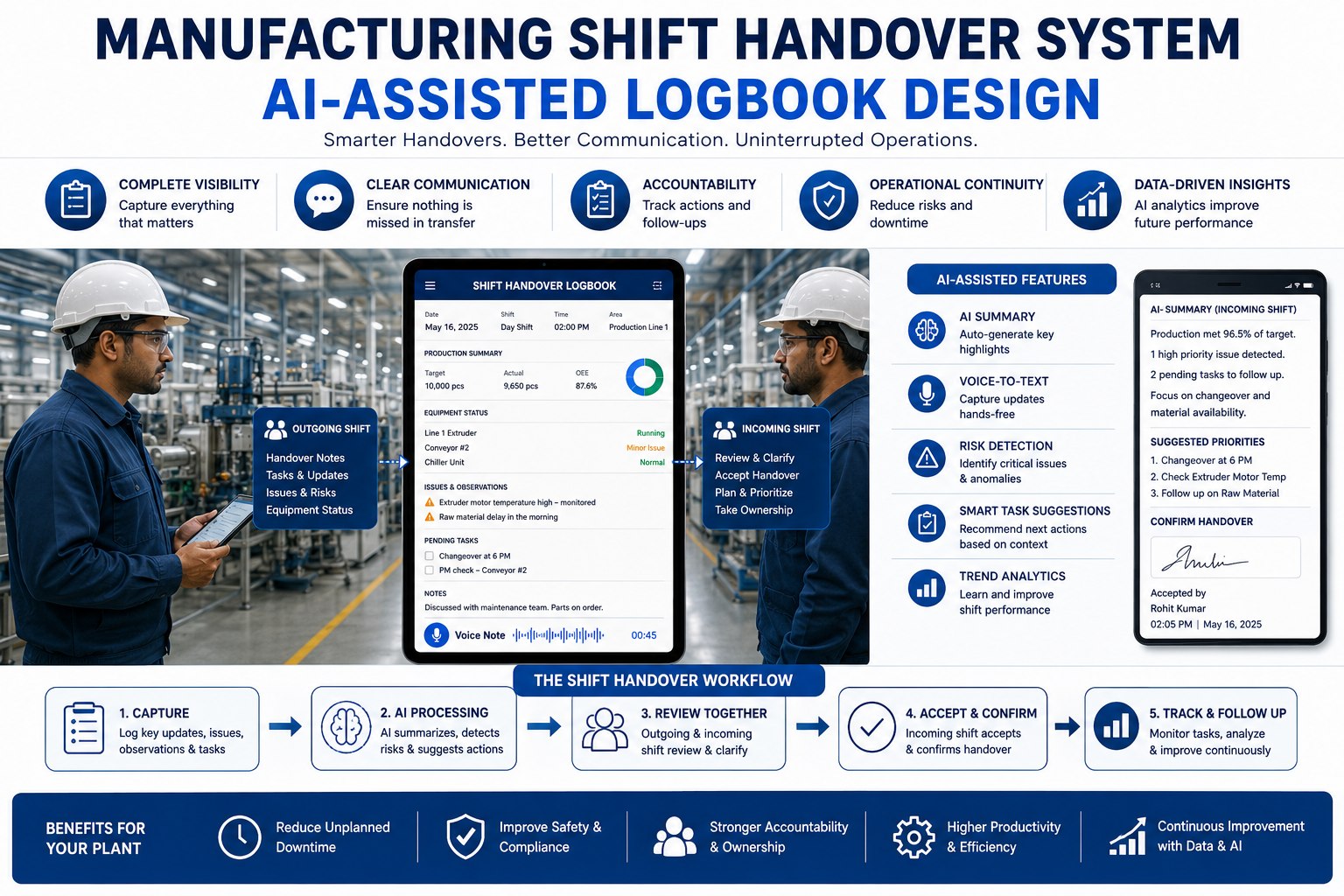
Shift handover covers less than 5% of operational time — yet 40% of all plant incidents happen during or immediately after it. Verbal handovers lose 40 to 60% of actionable information. Paper logs are illegible. Incoming operators arrive without context. Manufacturing plants moving to AI-assisted digital shift logbooks document 76% handover-time cuts, 80% audit prep savings, and 90%+ operator adoption when implemented with discipline. The wrong implementation wastes $470K+ and leaves operators copying paper logs into a digital tool 15 minutes before handover. Get the design right and the floor stops surprising the next shift. Book a shift logbook demo to see the design in action.

Manufacturing Shift Handover · AI-Assisted Logbook Design 2026
The Information Loss Cascade — Where 75% of Shift Knowledge Disappears
Stage 1
Outgoing operator knows
100%Complete shift knowledge in their head
Stage 2
After 12-hour fatigue
75%Memory degraded · key details slipping
Stage 3
Verbal handover (5–10 min)
55%Said aloud · 40–60% never makes it out
Stage 4
Incoming operator retains
40%Heard but not all absorbed under time pressure
Stage 5
Next shift acts on
25%What actually drives action on the floor
40%Of plant incidents happen during or immediately after shift handover
76%Handover-time cut documented in aerospace deployments
$1.4TFortune 500 annual unplanned downtime loss (Siemens)
2.1MUS manufacturing jobs unfilled by 2030 (Deloitte) · knowledge loss accelerating

The 6 Areas Every AI-Assisted Logbook Must Capture

A shift logbook is only as useful as the data it contains. High-performing manufacturing operations structure every shift entry around six core areas. Anything less leaves the incoming shift starting blind on what matters most.

Production Status

Lines running, throughput rate vs target, plan deviations with root cause. Incoming shift sees the running state, not just an end-of-shift number.

Downtime Events

Every stoppage with asset ID, start time, duration, fault code, and action taken. SCADA-auto-logged where possible; operator-annotated where context matters.

Quality & NCRs

Non-conformance reports, in-process inspection results, rework events. Photos and voice-to-text attached. Linked to lot/batch genealogy.

Safety Observations

Near-misses, hazard observations, PPE incidents, FOD finds. Mandatory acknowledgment by incoming shift lead. Routes to safety team automatically.

Open Work Orders

Live status: open, in-progress, on hold, completed. Direct CMMS linkage — shift log entries auto-create work orders, work orders auto-update the log.

Pending Tasks & Watch Items

Action items carried forward, watch-listed conditions, standing orders. Incoming shift sees what needs action in the next 2 hours before stepping on the floor.

Paper vs Spreadsheet vs Digital — The Capability Gap

Most manufacturers still operate on paper logbooks or shared Excel files. The capability gap to a proper AI-assisted digital logbook is far wider than most teams realize. Each row below maps a real operational requirement.

Capability
Paper
Spreadsheet
AI Digital Logbook
Voice-to-text capture
No
No
Yes · hands-free entry
Photo attachments
No
Limited
Yes · auto-timestamped
SCADA / PLC auto-logging
No
No
Yes · machine writes its own entries
AI-generated shift summary
No
No
Yes · top issues auto-ranked
Mandatory e-signature acknowledgment
No
No
Yes · audit-trail certified
CMMS work-order auto-creation
No
No
Yes · one tap from observation
Searchable history (any date, any asset)
No
Limited
Yes · sub-second query
FDA 21 CFR Part 11 / ALCOA+ compliance
No
No
Yes · immutable records

Want to see the AI digital logbook running on your shift workflow? Book a shift logbook demo — we will walk through your current handover process side-by-side with iFactory's Shift Logbook.

The 6-Phase Implementation That Hits 90%+ Adoption

A chemical plant in Louisiana spent eight months evaluating digital shift logbook platforms, picked the most feature-rich option, and deployed it across four production units in a single weekend. Within 90 days, operator adoption fell below 30%. 82% of paid features were never used. The failure cost over $470,000. The plants that hit 90%+ adoption follow a different sequence.

1

Assessment & Current-State Mapping

Walk every shift. Document what's actually captured today (paper, whiteboards, emails, WhatsApp). Identify the 3 highest-cost handover failures. Output: deployment readiness scorecard.

Duration: 1–2 weeks
2

Template Co-Design With Operators

Operators design the templates — not IT, not management. Sub-5-minute structured handover with conditional branches. Operators add detail only to flagged exceptions.

Duration: 2–3 weeks
3

Pilot Shift Deployment

Deploy to a single shift with champion operators. Daily feedback cadence. Template refinement. CMMS and asset register integration validated. No paper retirement yet.

Duration: 3–4 weeks
4

Phased Cross-Shift Rollout

Expand one shift at a time with a 2-week stabilization period between each. Each new shift gets the same champion support. Cross-shift visibility is the adoption lever.

Duration: 4–8 weeks
5

Paper Retirement Deadline

Hard deadline for paper logbook removal. Without this, operators write on paper and copy to digital — doubling work. The deadline is the moment digital becomes the system of record.

Duration: Week 12 cutover
6

Continuous Improvement & ROI Reporting

Monthly metrics: adoption (entries per shift), efficiency (handover time, completeness), impact (incident recurrence, response time). Quantified results sustain leadership investment.

Ongoing · monthly cadence
Hit 90%+ Adoption — Not the 30% That Costs $470K
iFactory's shift logbook deployment maps your shift structure, operator workflows, and existing CMMS/MES integrations against the 6-phase rollout — producing the deployment plan with template co-design, pilot scope, paper retirement deadline, and ROI cadence before any commitment is made.

Compliance Coverage — One Logbook, Every Standard

Manufacturing shift handover records are increasingly subject to regulatory scrutiny. The matrix below maps every major standard to the logbook capability that meets it. Paper systems fail multiple rows automatically.

Regulation / Standard
Requirement
Logbook Capability
FDA 21 CFR Part 11
Electronic records · e-signatures
Immutable e-sign with timestamp
FDA 2026 QMS Regulation
Electronic documentation for life sciences
Audit-ready records from day one
OSHA PSM (29 CFR 1910.119)
Process safety shift handover records
Standing orders + safety bypass log
EPA Risk Management Program
Documented chemical handling continuity
Cross-shift event timeline
ALCOA+ Data Integrity
Attributable · legible · contemporaneous · original · accurate
Every entry meets all 9 criteria
AS9100 Aerospace
Traceability · serial number tracking
NCR/CAPA linking · serial-level log
ISO 45001 Safety / ISO 55001 Asset Mgmt
Documented safety and asset records
Searchable audit trail by asset/event

Need to map this matrix against your specific regulatory exposure? Talk to our compliance team — we will produce the gap analysis against your current paper or hybrid system.

Expert Perspective: Why 77% of Shift Logbook Pilots Fail — and the 3 Things That Distinguish the 23% That Hit 90%

The pattern across failed shift logbook pilots is remarkably consistent. The Louisiana chemical plant that spent $470,000 on a feature-rich platform and saw adoption drop below 30% in 90 days. 82% of paid features unused. Operators writing on paper and copying to digital in the last 15 minutes before handover. The three things that distinguish the 23% of pilots that hit 90%+ adoption are not platform features — they are deployment discipline. First, operators design the templates, not IT — anyone who has ever seen a developer-built form for a control room knows why. Second, the digital tool must be faster than paper from the operator's perspective on day one — sub-5-minute structured handover with conditional branches, not a wall of mandatory fields. Third, a hard paper retirement deadline at week 12 — without it, operators continue dual-tracking forever. Get those three right and 90%+ adoption is the baseline outcome. Get any one wrong and you join the 77% writing $470K cheques to platforms operators don't use.

— iFactory Shift Logbook Practice, 2025 to 2026
$470K
Failed implementation cost · feature-rich, adoption-poor
82%
Of paid features unused in failed deployments
Higher log discipline when operators see cross-shift visibility
Replace Paper Logbooks in 1–2 Weeks — Hit 90%+ Operator Adoption
iFactory's Shift Logbook ships with pre-configured templates for your industry, integrates with your existing MES, CMMS, and ERP without rip-and-replace, and goes live on tablets across all shifts in 1–2 weeks. AI shift summaries, mandatory acknowledgments, full audit trail.

Frequently Asked Questions

Why do verbal shift handovers lose so much information?

Outgoing operators are tired after 8 to 12 hours. Memory degrades, key details slip. The 5-10 minute verbal handover window is too short to surface every issue. Studies show 40-60% of actionable information is lost in verbal handovers alone. The incoming shift then absorbs only a fraction of what is said under time pressure. By the time action is taken, the next shift acts on roughly 25% of what the outgoing operator originally knew.

What features matter most in an AI-assisted shift logbook?

Six capabilities define a usable digital logbook: voice-to-text for hands-free entry, photo attachments with auto-timestamp, SCADA/PLC auto-logging so machines write their own entries, AI-generated shift summaries that surface top issues, mandatory e-signature acknowledgment from incoming shift lead, and direct CMMS integration so observations auto-create work orders. The platform must also be faster than paper from day one — under 5-minute structured handover.

Why do so many digital shift logbook deployments fail?

Most failures share the same root causes: templates designed by IT rather than co-designed with operators, deployment without a pilot phase, no paper retirement deadline, and no champion operator network. A Louisiana chemical plant spent $470,000 on a feature-rich platform and saw adoption fall below 30%. 82% of paid features were unused. Operators end up dual-tracking — writing paper and copying to digital — doubling their work.

How does a digital shift logbook handle regulatory compliance?

A properly designed digital logbook meets FDA 21 CFR Part 11 (electronic records, e-signatures), the FDA 2026 QMS Regulation, OSHA PSM 29 CFR 1910.119 (process safety), ALCOA+ data integrity, AS9100 aerospace traceability, and ISO 45001/55001 safety and asset management. Records are timestamped, attributable, immutable, and electronically signed. Audit responses that took weeks on paper take seconds in digital.

How does iFactory's shift logbook deployment work?

iFactory's shift logbook ships with pre-configured templates for your industry (aerospace, F&B, pharma, chemical, mining, power, automotive), integrates with your existing MES, CMMS, ERP, and SCADA without rip-and-replace, and goes live on tablets across all shifts in 1-2 weeks. The deployment follows the 6-phase methodology that consistently delivers 90%+ operator adoption. Book your shift logbook demo here.

Share This Story, Choose Your Platform!