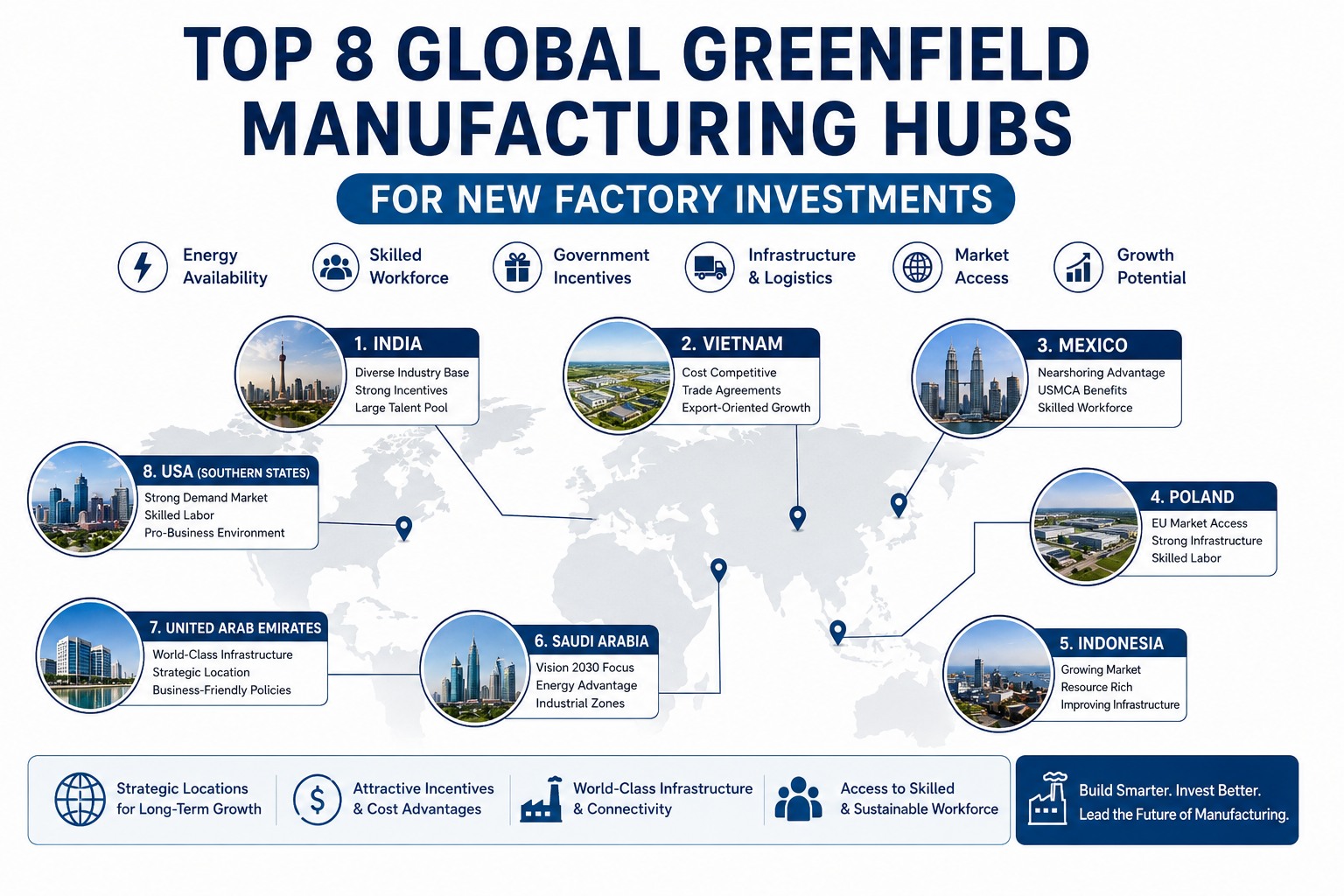
Global manufacturing investment is undergoing a structural realignment in 2026. The United States has announced $1.765 trillion in committed manufacturing investment since 2025. India captured $114 billion in greenfield capex while China's FDI dropped 29% for a second year. ASEAN hit a record $225 billion. The traditional formula — cheap labor and tax breaks — no longer applies. Capital now flows to hubs that combine power availability, AI-ready digital infrastructure, supply chain proximity, and geopolitical alignment. The eight hubs ranked below capture the lion's share of factory commitments. Book a site selection consultation to evaluate your project.
United States (Texas, Southeast, Arizona)
India (Maharashtra · Tamil Nadu · Gujarat)
Mexico (Chihuahua · Nuevo León · Jalisco)
Vietnam (Bac Ninh · Binh Duong)
Malaysia (Penang · Selangor · Johor)
UAE & Saudi Arabia (Dubai · NEOM)
France (Hauts-de-France · Île-de-France)
Thailand (Eastern Economic Corridor)
What Actually Drives Hub Selection in 2026 — The 4 Decisive Factors
The investment calculus has fundamentally changed. Cheap labor and tax breaks no longer win site selection. Four factors now dominate the decision — and hubs that can't deliver them are watching investment pipelines dry up regardless of traditional advantages.
Power Availability
Surpassed proximity to markets as the dominant factor — especially for AI-intensive manufacturing and data centers. Grid reliability and renewable mix matter as much as raw capacity.
Digital Infrastructure
Sub-10ms latency to hyperscaler cloud, robust fiber connectivity, edge compute readiness. Greenfield builders now treat digital infrastructure as table stakes — not differentiator.
Geopolitical Alignment
Since 2017, the average geopolitical distance of greenfield FDI has shrunk about 2× faster than trade. Friendshoring and nearshoring are reshaping where companies build.
Workforce Availability
Skilled labor is the #1 reshoring constraint. The US has 500,000 unfilled manufacturing jobs. Hubs with active workforce development programs (Germany, Vietnam, India) win projects others lose.
The Top 4 Hubs in Detail — Capital, Sectors, and Strategic Fit
The top four hubs capture the majority of 2025–2026 greenfield commitments. Each has a distinct strategic profile — geographic positioning, sector concentration, and incentive structure that determines which manufacturers belong where.
Texas · Southeast · Arizona · New York
Federal CHIPS Act + IRA incentives + state property tax abatements drive the largest concentration of advanced manufacturing globally. Apple ($600B), Micron ($200B), TSMC ($100B), TI ($60B) anchor semiconductors. Texas alone absorbed 25% of US industrial space in 2025.
Maharashtra · Tamil Nadu · Gujarat · Karnataka
PLI scheme + state-level incentives + 4-of-10 largest semiconductor announcements. Maharashtra alone captured 39% of FY25 FDI equity. India's FDI grew 14% in 2024 while China's fell 29%. Pune, Sriperumbudur, Sanand, Hyderabad anchor the practical project universe.
Chihuahua · Nuevo León · Jalisco · Querétaro
Foxconn Chihuahua + Guadalajara (NVIDIA GB200 superchip site) + Quanta Monterrey define the AI-server nearshoring wave. Geographic structural advantage: proximity to US market, USMCA tariff-free access, shorter transit. Mexico's natural answer for US-bound automotive, electronics, AI servers.
Bac Ninh · Binh Duong · Ho Chi Minh City
Taiwan FDI accumulated $40B+. Samsung, Intel, Foxconn anchor electronics ecosystem. Trade-weighted tariff of 18% versus China's 41% drives high-volume electronics relocation. Vietnam targets 100 chip design firms by 2030.
Want a hub-by-hub comparison against your specific product, capital, and timeline? Book a site selection consultation — we will produce the location ranking with incentive stack analysis.
Hubs #5–#8 — Emerging Specialists Taking Market Share
The next four hubs capture specialized investment flows — semiconductor packaging, sovereign-capital-backed AI, European reindustrialization, and Southeast Asian EV/battery production. Each one wins specific sectors that the top four don't dominate.
Penang · Selangor · Johor (KL-Singapore corridor)
National Semiconductor Strategy active. Established E&E ecosystem. 11% trade-weighted tariff — lowest in ASEAN. Mature packaging and testing base. Watch: power infrastructure gaps in tier-2 cities.
Dubai · Abu Dhabi · Riyadh · NEOM
AI partnerships multiplying (Microsoft-G42 etc.). Sovereign Wealth Funds deploying capital aggressively. Energy cost advantages. Asia-Middle East corridor projected $270B flows. Watch: localization requirements and limited manufacturing base depth.
Hauts-de-France · Île-de-France · Grand Est
Emerged as Europe's leader with 4× increase in greenfield value. Hosts Europe's largest AI data center. France 2030 plan + Choose France summit + nuclear-backed grid + skilled workforce. Strong EV battery cluster forming in the north.
Eastern Economic Corridor (Rayong · Chonburi)
Long-established regional auto hub now pivoting to EV and battery production. Chinese OEMs expanding regionally. EEC corporate tax holidays up to 13 years. Strong supplier ecosystem and skilled automotive workforce.
Which Hub Fits Your Sector — The Decision Matrix
Different sectors favor different hubs. Semiconductor builders gravitate to US, India, and Malaysia. EV battery makers cluster in Mexico, Thailand, and France. AI server manufacturers prefer Mexico and UAE for cost reasons. The matrix below maps the highest-ROI hub per sector.
Want this matrix re-ranked against your specific product, target market, and capital structure? Talk to our site selection team — we will run the analysis against your project parameters.
Expert Perspective: Why Site Selection in 2026 Is Nothing Like 2020
The site selection conversation in 2026 looks nothing like 2020. Five years ago, the optimization was labor cost and tax incentive. Today, the binding constraints are power availability, AI-ready digital infrastructure, geopolitical alignment, and skilled workforce. Hubs that historically won on cheap labor and tax breaks alone — including some traditional Asian destinations — are losing project announcements to higher-cost locations that can deliver gigawatt-scale power and supply-chain proximity to friendly trading partners. The most consequential shift is power. Data centers and AI-intensive manufacturing now demand 2 to 3× the electrical capacity of traditional plants. Grid-constrained sites lose projects even when every other factor favors them. The disciplined greenfield builders rank hubs across all four factors simultaneously rather than optimizing on one — and they negotiate state-level and local incentive stacks aggressively, because federal-level numbers tell only part of the story.
— iFactory Greenfield Consulting, Site Selection Practice 2025 to 2026