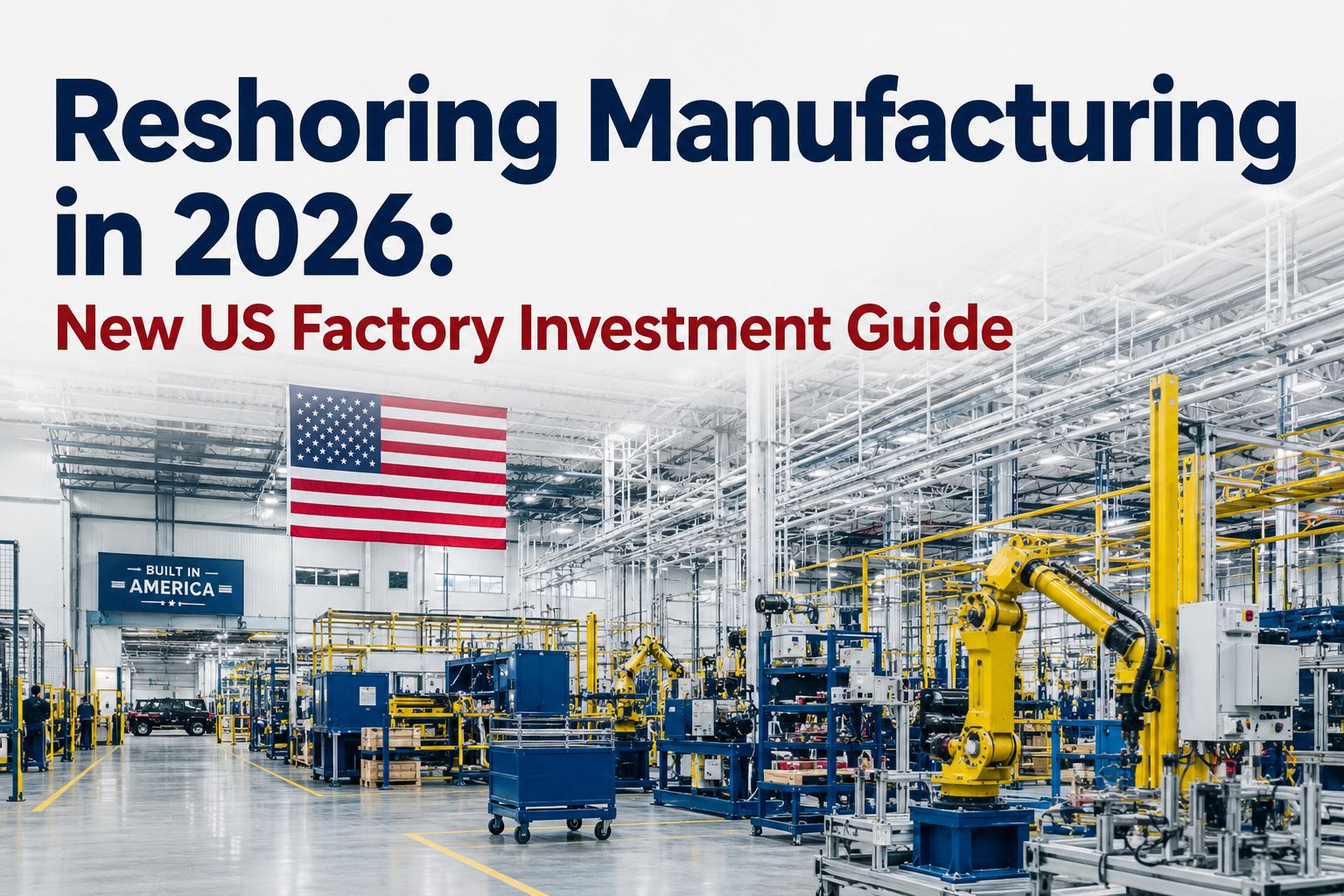
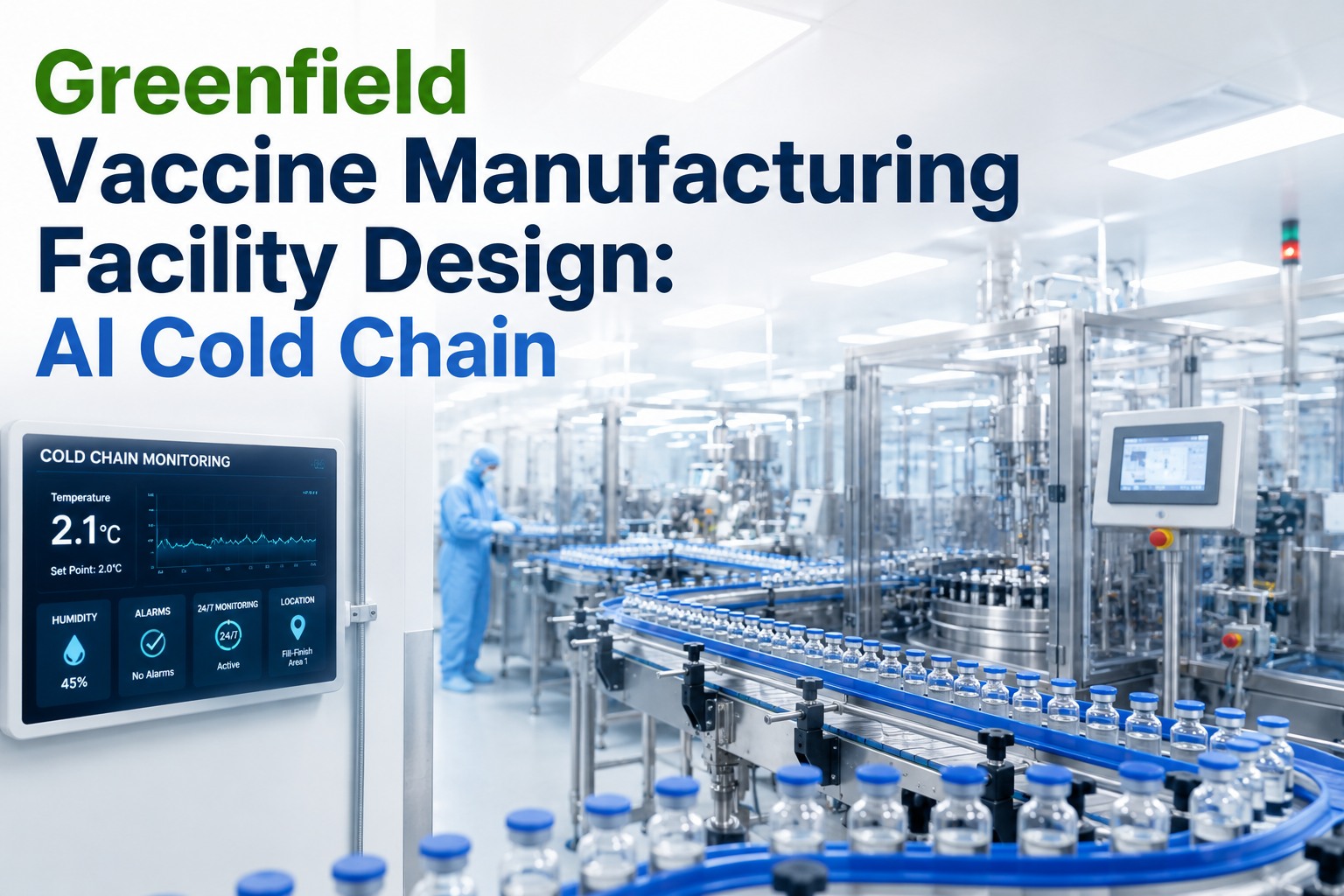
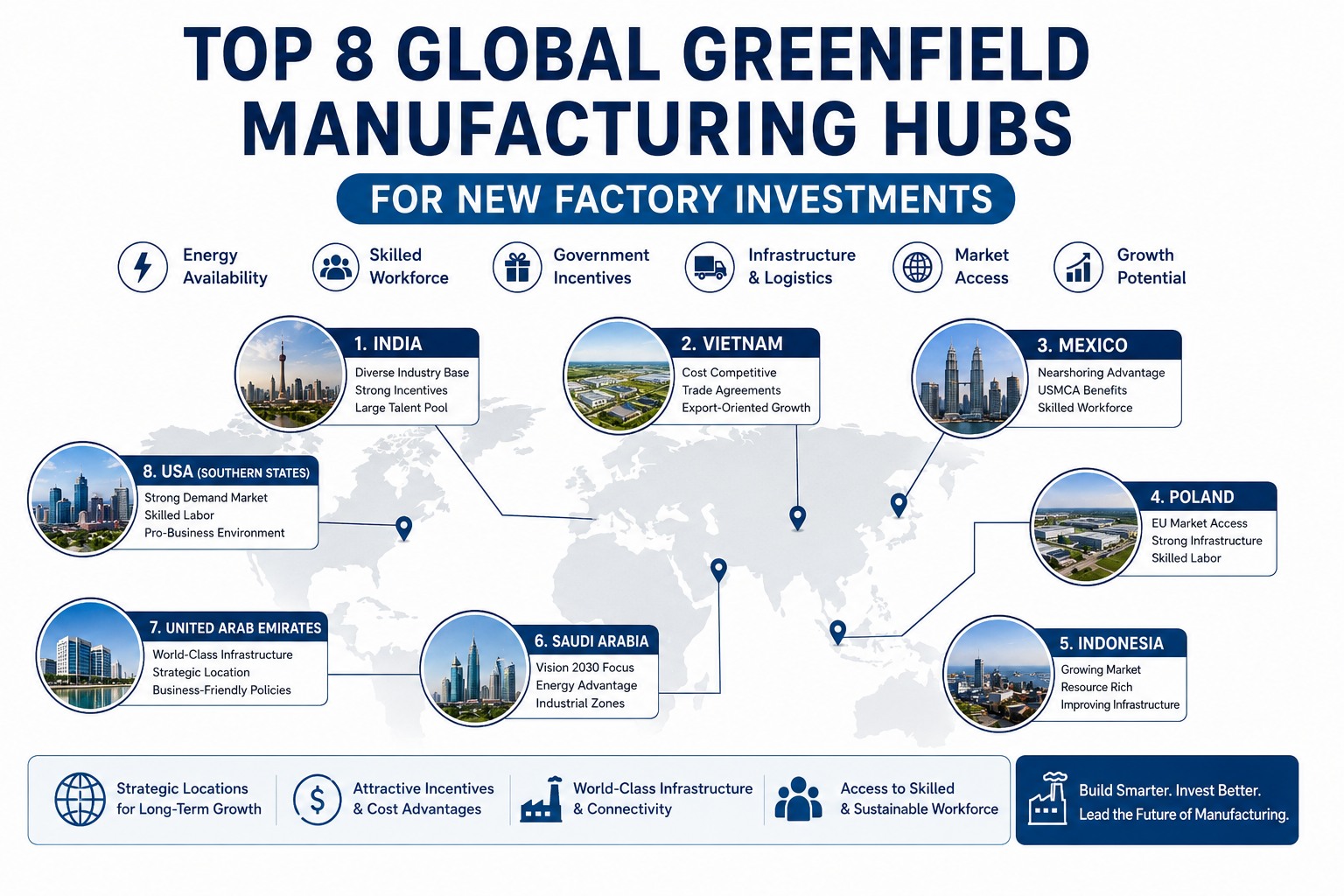
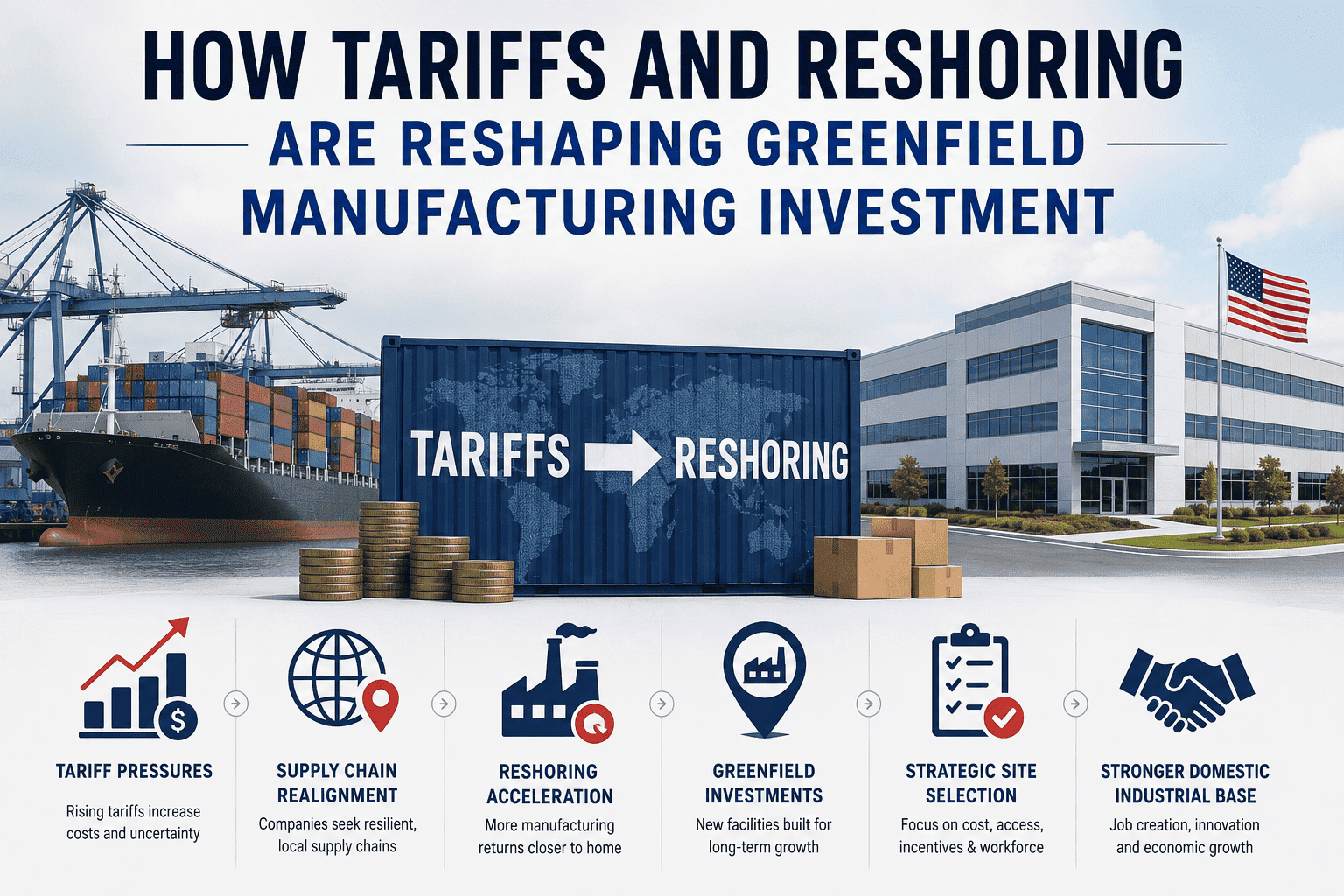
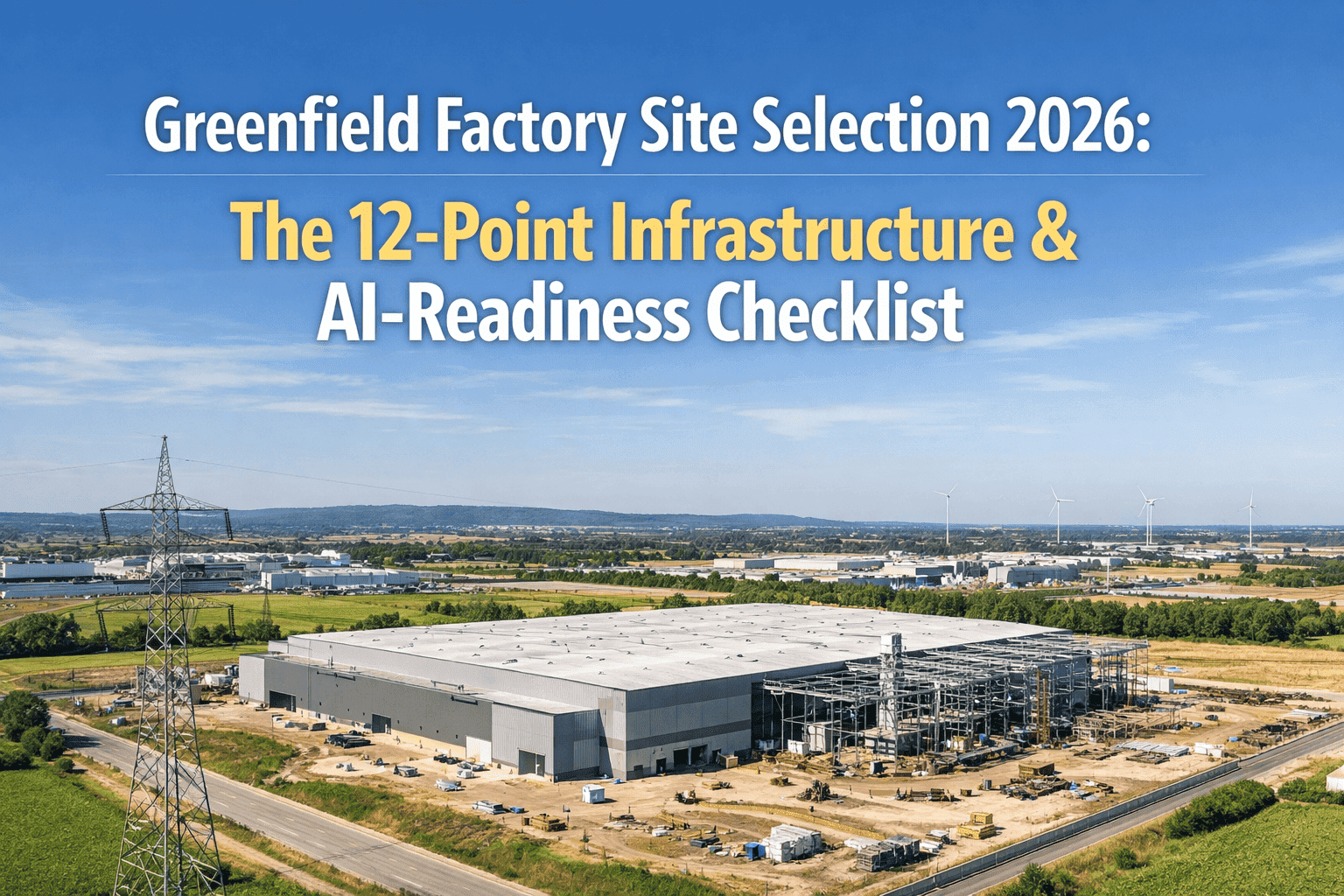
US manufacturing construction spending more than doubled between 2020 and 2024 — hitting $223B annualized — and the wave is still building. The CHIPS Act, the IRA, 2025 tariffs, and a hardening China decoupling have collapsed three decades of offshoring logic in 36 months. Semiconductors, EV batteries, automotive, defense, and pharma are all coming home — but labor scarcity, energy constraints, and site selection complexity will separate winners from also-rans. This guide breaks down the macro forces, sector winners, site selection criteria, workforce strategy and AI-era factory design that define a successful 2026 reshoring project. Book a greenfield strategy session to scope your reshoring program.
$223B
Annualized Mfg Construction
More than 2x Feb 2020 levels · Real inflation-adjusted dollars
↑ 53%
Reshoring Job Announcements
Driven by CHIPS Act + IRA post-2022
$272B
CHIPS Act Project Pipeline
Semiconductor fabs · multi-year build-out
77%
OEMs Worried About Geopolitics
Taiwan crisis · China decoupling · supply risk
Sectors Leading the Reshoring Wave · Share of 2024 Announced Jobs
16%
Aero · Pharma · Other
5 Forces Driving Reshoring in 2026
Reshoring isn't one trend — it's five reinforcing forces that have collapsed the offshoring economics decades took to build. Understanding which ones apply to your industry determines whether your reshoring case is bulletproof or speculative.
01
Federal Industrial Policy
CHIPS Act ($52B+ semiconductor funding), Inflation Reduction Act (clean energy, EV credits), 100% bonus depreciation, and refundable tax credits make domestic CAPEX dramatically cheaper than 5 years ago.
$272B+ committed
02
Tariff & Trade Pressure
Section 232 tariffs, expanded country-of-origin rules, and 2025 auto tariffs have shifted import math. Companies producing in the market they sell to bypass tariff exposure entirely.
+139% auto jobs
03
Supply Chain Resilience
COVID, Suez, Taiwan, Red Sea — every major OEM has lived through a supply shock since 2020. Single-source Asian dependencies are now board-level risks, not operational decisions.
77% OEM concern
04
TCO Re-Math
Total Cost of Ownership analysis shows logistics, IP risk, and inventory carrying costs eat 15-20% of the apparent offshore mfg savings. Reshoring becomes obvious once TCO replaces piece-price thinking.
20-30% reshoreable
05
AI & Automation
Robotics, AI-driven QC, and predictive maintenance close the labor cost gap. A US plant running modern automation often beats an Asian plant on cost-to-produce — without the geopolitical risk.
86.7% adopting
Sectors Leading the Reshoring Wave
Not every industry is reshoring at the same pace. Six sectors account for the vast majority of new US factory announcements — and each has its own catalysts, leading states, and bottleneck risks.
35%
Semiconductors
Intel, TSMC, Samsung, Micron, GlobalFoundries building US fabs. Backed by $52B+ CHIPS Act funding.
Hot states: Arizona · Texas · Ohio · New York
31%
EV Batteries & Solar
GM, Ford, Stellantis, LG, Panasonic, SK On building battery gigafactories. IRA credits drive economics.
Hot states: Georgia · Kentucky · Tennessee · Michigan
+139%
Automotive Assembly
2025 tariff regime triggered reshoring of full assembly operations. Expected job announcements jump 139% YoY.
Hot states: South Carolina · Alabama · Tennessee · Ohio
$19B
Aerospace & Defense
$19B in federal R&D funding (2023) accelerated US production capacity. Critical mineral supply security focus.
Hot states: California · Florida · Texas · Washington
High
Pharmaceuticals & Biotech
API reshoring after India/China dependency exposed during COVID. Biologics manufacturing centered on domestic biotech hubs.
Hot states: North Carolina · Massachusetts · Indiana · NJ
Medium
Food & Beverage
Steady reshoring as buyer-near production reduces logistics + cold chain risk. Less policy-driven, more market-driven.
Hot states: Texas · Pennsylvania · California · Iowa
Site Selection Framework
Site selection for a 2026 reshoring project requires weighing seven criteria that didn't all matter equally in past decades. Energy availability has moved from "check the box" to "deal-breaker for AI-era and semiconductor facilities." Workforce depth now beats incentive packages. Use the framework below to score candidate states and sites.
Criterion
Weight
What to Evaluate
Workforce Availability
25%
Skilled labor pool, technical college pipeline, existing mfg cluster density
Energy Infrastructure
20%
Grid capacity, renewable mix, water availability (critical for fabs), backup options
Incentives Package
15%
State/local tax credits, training grants, infrastructure investment, abatement period
Logistics & Market Access
15%
Interstate access, port/rail proximity, customer concentration, supplier network
Permitting Timeline
10%
Environmental review duration, water/air permits, NEPA process, local zoning
Construction Cost & Climate
10%
$/sf construction, weather risk, hurricane/seismic exposure, labor cost
Risk & Resilience
5%
Political stability, regulatory predictability, climate resilience over 30-year horizon
Make Your Reshoring CAPEX Decision Defensible
iFactory's greenfield practice runs full site selection, incentive negotiation, and architecture design for US reshoring projects — built on TCO models that survive board scrutiny and IRA/CHIPS Act qualification reviews.
Labor & Workforce Reality
The single biggest risk to every reshoring project in 2026 isn't financing — it's finding people. With ~601K open manufacturing jobs and ~449K open construction jobs nationally, your factory's commissioning timeline is now constrained by workforce supply. Three strategies separate plants that staff successfully from those that don't.
Strategy 1
Co-locate With Talent Pools
Site near existing manufacturing clusters or 4-year engineering schools. Greenfield plants in workforce deserts spend 18-24 months chasing labor — and lose key roles to nearby competitors.
Tactic: Map within 30-min commute radius of skilled labor concentrations before signing land
Strategy 2
Build Training Pipelines Early
Partner with community colleges and trade schools 18-24 months before commissioning. CHIPS Act funding requires workforce development plans — most companies treat this as compliance instead of competitive advantage.
Tactic: Co-fund custom curriculum + paid apprenticeships starting at site selection
Strategy 3
Automate Where Labor Is Tightest
AI-driven QC, cobots, autonomous mobile robots, and predictive maintenance reduce dependence on roles you can't reliably hire. Modern automation closes the labor cost gap with offshore production.
Tactic: Design for 30-40% fewer direct labor roles than equivalent 2015-era factory
Need a labor and automation strategy for your specific site? Schedule a workforce planning session with our greenfield team.
Factory Design for the AI Era
A reshored US factory in 2026 isn't a 2010-era plant on US soil — it's an AI-ready, energy-resilient, modular facility designed for 30 years of evolution. Four design principles separate factories that age well from those that need expensive retrofits within 5 years.
AI-Ready Data Infrastructure
Sensor density 5-10x higher than 2010 factories. Edge compute, OT/IT convergence, OPC UA + MQTT, and time-series databases architected at greenfield — not bolted on later.
Modular & Reconfigurable Layout
Production lines designed for change. Standardized utility drops, mobile equipment, drop-in cell footprints. Adding capacity should take weeks, not months.
Energy & Water Resilience
Backup power, behind-the-meter renewables, water recycling, and demand response — critical given grid constraints and net-zero corporate goals.
Robotics-Native Architecture
AMR/AGV paths, robot cell guarding, vision systems, private cellular networks — designed in from concept rather than retrofit after operations start.
Designing an AI-ready greenfield plant? Connect with our digital infrastructure team for an architecture review.
5 Reshoring Mistakes to Avoid
The reshoring boom is creating opportunity — and also creating predictable failure patterns. The five mistakes below appear in nearly every project we've seen stall, slip, or under-deliver.
01
Picking a Site Before Building the TCO Model
Incentives shouldn't drive site selection — workforce, energy, and logistics should. Multi-year TCO modeling reveals the real winner, often a different state than the highest-incentive offer.
02
Underestimating Permitting Timelines
NEPA reviews, water permits, and air permits can take 12-24 months in some states. Start permitting in parallel with concept design — not after design is locked.
03
Treating Workforce as a Hiring Problem
Workforce is an architecture problem. Plants designed for 800 workers in a 200-worker labor market fail. Design for the workforce reality, then automate the gap.
04
Building 2010-Era Factories on US Soil
Replicating the offshore plant in Tennessee misses the entire point of reshoring. Modern AI-ready design closes the labor cost gap and futureproofs the asset.
05
Ignoring Energy & Water Constraints
Arizona water rationing for fabs, Texas grid concerns, transmission interconnect queues. Energy infrastructure now decides whether a site is buildable at all.
Avoid these mistakes by starting with a structured reshoring strategy. Book a reshoring scoping session with our greenfield team.
Expert Perspective
Every reshoring case I've seen succeed shares one trait: the team made the workforce and energy decisions before the incentive negotiation. They figured out where the skilled labor was, where the grid had capacity, and where the water would still be there in 2050. Then they negotiated incentives in those locations. The teams that lose come at it the other way — they take the biggest incentive package, then spend three years discovering they can't hire welders or get a 200MW interconnect. Site selection is workforce and infrastructure first, incentives second. Get that order wrong and CHIPS Act money becomes the most expensive financing you'll ever take.
— US Greenfield Reshoring Best Practice
$2.65
Economic impact per $1 mfg spend (NAM)
4.8
Supported jobs per mfg job
601K
Open US mfg jobs · workforce squeeze
3.7%
US unemployment · tightest in 50 years
Bottom Line · The Window Won't Stay Open Forever
The 2022-2026 reshoring wave is the largest US manufacturing investment cycle since the post-war buildout. CHIPS Act funding, IRA credits, tariff protection, and the geopolitical risk premium combine to make domestic CAPEX dramatically cheaper than it was 5 years ago. But the incentives won't last forever, the labor pool won't get easier, and the best sites are getting claimed. The companies winning at reshoring are the ones who started TCO modeling in 2023, locked sites in 2024, and broke ground in 2025. The window is still open — but it's narrowing every quarter.
Build Your Reshoring Strategy Before the Window Closes
iFactory's US greenfield team designs reshoring strategies that survive board scrutiny — site selection, TCO modeling, incentive negotiation, AI-ready factory architecture. Built for the 2026 regulatory environment with the workforce and automation strategy to back it.
Frequently Asked Questions
Why are manufacturers reshoring to the US in 2026?
Five compounding forces: CHIPS Act + IRA ($272B+ committed), 2025 tariffs closing the offshore cost gap, supply chain resilience after COVID and Taiwan risk (77% OEMs concerned), TCO re-math (logistics + IP costs eat 15-20% of offshore savings), and AI/automation closing the labor cost differential.
Which sectors are leading the US reshoring wave?
Top sectors by 2024 announced jobs: Semiconductors (35%, $272B pipeline), EV batteries & solar (31%, IRA-driven), Automotive assembly (+139% YoY post-tariffs), plus growing aerospace/defense ($19B R&D), pharmaceuticals (API reshoring), and food & beverage (market-near production).
What are the top US states for reshoring projects?
Sector-dependent. Semiconductors: Arizona, Texas, Ohio, New York. EV/battery: Georgia, Kentucky, Tennessee, Michigan. Auto assembly: South Carolina, Alabama, Tennessee. Pharma/biotech: North Carolina, Massachusetts, Indiana. Site selection should prioritize workforce + energy over incentive packages.
What is the biggest risk to US reshoring projects?
Workforce availability. ~601K open US manufacturing jobs and ~449K open construction jobs with unemployment at 3.7% mean labor is the binding constraint. Plants designed for workforce realities that don't exist will miss commissioning dates and underperform. Co-locate with talent pools, build training pipelines 18-24 months early, and automate where labor is tightest.
How should I design a new US factory for the AI era?
Four principles:
AI-ready data infrastructure (5-10x sensor density, edge compute, OPC UA/MQTT from day one),
modular layout (standardized utility drops, drop-in cells),
energy & water resilience (renewables, recycling, demand response), and
robotics-native architecture (AMR paths, vision systems, private cellular networks designed in).
Book a factory architecture review to scope for your specific industry.