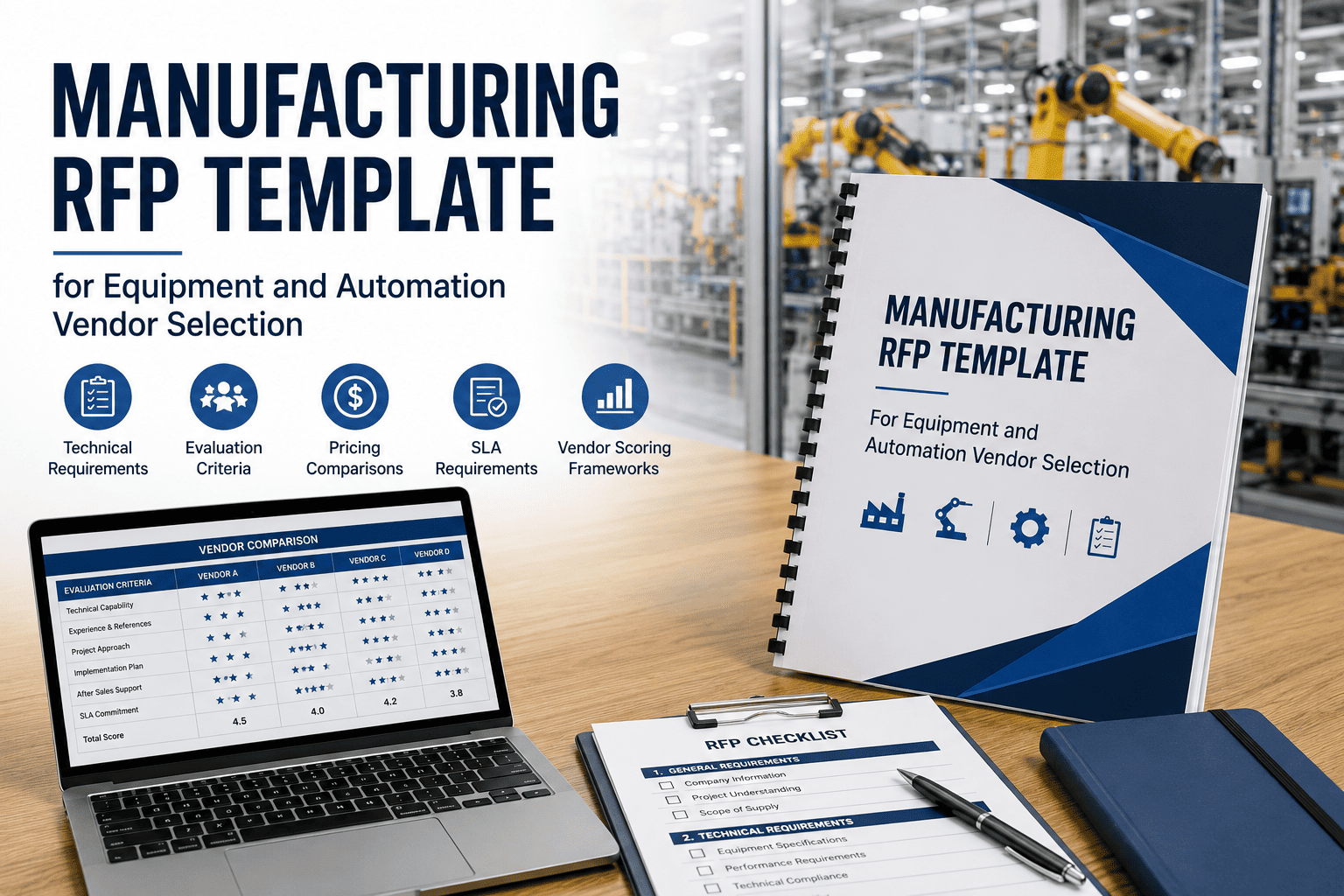
Most manufacturing RFPs fail before vendor responses arrive. Vague scope produces vague proposals, undefined scoring weights produce post-hoc rationalization, and "must-haves" that aren't actually mandatory let unqualified vendors hide in the pile. This template breaks the manufacturing equipment and automation RFP into 8 mandatory sections with a weighted scoring framework, a working vendor scorecard, 5-year TCO normalization, and SLA requirements that hold up under negotiation. Book a vendor selection consultation before you send your next RFP.
01
Long List Identification
20-50 vendors
Market scan, analyst reports, peer references, trade show research
02
RFI & Qualification
10-15 vendors
Capability questionnaire, financial health, capacity, references
03
RFP Distribution & Response
5-7 vendors
Full RFP package, Q&A period, structured proposal submission
04
Shortlist Demos & Site Visits
2-3 vendors
Demos with YOUR data, reference site visits, technical deep-dives
05
Award & Contract Negotiation
1 winner
Best-and-final pricing, SLA finalization, contract execution
12-20 wks
Typical end-to-end RFP timeline
30%
Recommended technical weight in scoring
25%
Recommended TCO weight in scoring
The 8 Mandatory RFP Sections
Every manufacturing equipment and automation RFP — whether you're buying a packaging line, an MES platform, or a robot cell — should contain these 8 sections in this order. Skip any one and either responses become uncomparable or you set yourself up for scope disputes after award.
01
Executive Summary & Project Background
Project context, business drivers, key dates, primary contacts. Vendors need to understand WHY before they propose HOW.
Include: company profile · strategic context · stated objectives
02
Detailed Scope & Deliverables
Concrete deliverables list. Production volumes, footprint constraints, integration points, exclusions. Vague scope = useless proposals.
Include: capacity targets · physical constraints · scope boundaries
03
Technical Requirements
Performance, integration, compliance, cybersecurity. Separate must-have from should-have. Demand specific specs, not "industry-standard."
Include: performance specs · protocols · compliance standards
04
Commercial Terms & Pricing Structure
Mandatory line-item pricing format. No bundling allowed. Capital, install, training, support, spares — separately quoted.
Include: pricing template · payment terms · escalation clauses
05
SLA & Support Requirements
Uptime targets, response/resolution times, parts availability, training. Define ENFORCEABLE SLAs with credits — not aspirational promises.
Include: uptime % · response SLAs · credit schedule
06
Implementation Plan & Timeline
Phased schedule, milestone payments, acceptance criteria, FAT/SAT requirements, change-order process.
Include: milestone gates · acceptance criteria · FAT/SAT specs
07
Vendor Qualifications & References
3+ references in identical industry, financial statements, certifications, team CVs. Skip this and you'll discover vendor red flags after signing.
Include: 3+ references · D&B report · key personnel
08
Evaluation Criteria & Submission
PUBLISH your scoring weights, format requirements, submission deadlines. Transparency forces vendors to address what matters most.
Include: scoring rubric · format spec · Q&A process
Weighted Scoring Framework
RFPs without explicit scoring frameworks produce post-hoc rationalization of the decision the team wanted to make anyway. Define weights BEFORE proposals arrive. The framework below works for most manufacturing equipment and automation procurements — adjust the weights to match your specific priorities, but keep the structure.
Recommended Weighted Scoring · Manufacturing Equipment & Automation
25%
Total Cost of Ownership
15%
Implementation & Support
15%
Vendor Stability & References
30%
Technical Fit
Performance specs met, integration compatibility, scalability, cybersecurity posture, compliance with required standards (ISA-95, ISA-99/IEC 62443, OPC UA, etc.)
25%
Total Cost of Ownership
5-year TCO including CapEx, install, training, maintenance, spares, and end-of-life costs. Lowest bid rarely wins; lowest TCO usually does.
15%
Implementation & Support
Realistic timeline, dedicated implementation team, FAT/SAT protocols, training depth, knowledge transfer, post-go-live support model.
15%
Vendor Stability & References
Financial health, time in market, customer churn, reference quality (≥ 3 in identical industry with ≥ 24 months production), executive sponsorship.
10%
SLA Commitments
Uptime guarantees, response/resolution time, parts availability, credit schedule for missed SLAs. Enforceable commitments, not aspirational language.
5%
Innovation & Roadmap
Published product roadmap, R&D investment, AI/ML capabilities, willingness to co-develop, modernization path for legacy customers.
Build a Defensible Vendor Selection Process
iFactory's procurement advisory team runs the full RFP cycle — scope definition, vendor long-listing, RFP authoring, response evaluation, contract negotiation. Built to find the right vendor, not the loudest one.
Sample Vendor Scorecard
Here's what an evaluated scorecard looks like in practice — three shortlisted automation vendors scored across six weighted criteria on a 1-5 scale, with weighted totals revealing the actual winner. Notice how Vendor B has the lowest sticker price but the highest weighted score: technical fit and reference quality compound favorably.
Evaluation Criterion
Weight
Vendor A
Vendor B
Vendor C
Technical Fit
30%
4 (1.20)
5 (1.50)
3 (0.90)
Total Cost of Ownership
25%
3 (0.75)
4 (1.00)
5 (1.25)
Implementation & Support
15%
3 (0.45)
5 (0.75)
3 (0.45)
Vendor Stability & References
15%
4 (0.60)
5 (0.75)
2 (0.30)
SLA Commitments
10%
4 (0.40)
4 (0.40)
5 (0.50)
Innovation & Roadmap
5%
3 (0.15)
5 (0.25)
4 (0.20)
Weighted Total
100%
3.55
4.65 · Winner
3.60
Need a customized scorecard for your specific procurement? Book a scoring framework session with our advisory team.
5-Year TCO Pricing Normalization
Vendors will quote in incomparable formats unless you mandate normalization. One bundles training into capital cost. Another quotes hardware low but charges $200/hour for required commissioning. A third uses subscription pricing that looks small annually but compounds. Force every vendor into the framework below so comparisons are apples-to-apples.
Cost Category
Year 0
Year 1
Year 2
Year 3
Year 4
Year 5
Hardware / Equipment CapEx
●
—
—
—
—
—
Software Licenses (perpetual or Y1)
●
—
—
—
—
—
Installation & Integration Services
●
—
—
—
—
—
Training & Knowledge Transfer
●
●
—
—
—
—
Annual Maintenance / Support
—
●
●
●
●
●
Spare Parts & Consumables
●
●
●
●
●
●
Subscription / SaaS Fees
—
●
●
●
●
●
Upgrade & Modernization Costs
—
—
—
●
●
●
5-Year TCO Total
Sum across all categories · the number that actually decides the RFP
Need a TCO model that exposes hidden vendor costs? Connect with our procurement team for a vendor-neutral TCO assessment.
SLA Requirements by Category
SLAs separate vendors who'll show up at 2 AM from those who'll route your ticket to L1 in a different time zone. Mandate enforceable SLAs with credit schedules for missed targets — not aspirational language. Six SLA categories belong in every manufacturing equipment RFP.
Uptime & Availability
≥ 99.5% measured monthly
Excludes scheduled maintenance windows defined in advance. Credit applies for each 0.1% miss below target.
Incident Response Time
P1: 15 min · P2: 1 hr · P3: 4 hrs
P1 = production stopped. Time-to-acknowledge, not time-to-resolve. 24/7 coverage for P1 mandatory.
Incident Resolution Time
P1: 4 hrs · P2: 24 hrs · P3: 5 days
Workaround acceptable for P1 resolution if fully documented. Permanent fix tracked separately with target dates.
Spare Parts Availability
Critical: 24 hrs · Non-critical: 5 days
Critical spares stocked at vendor depot within 4-hour drive. Vendor maintains agreed minimum inventory.
Training Commitments
≥ 40 hrs included · refresh year 2
Onsite + virtual. Operator, maintenance, admin tracks separately. Training-the-trainer included.
Warranty Period
≥ 12 months from SAT
Includes parts + labor. Extended warranty pricing in proposal. Coverage starts from Site Acceptance Test, not shipment.
5 RFP Mistakes That Tank Vendor Selection
The same handful of mistakes show up in failed RFP processes year after year. Avoid these five and your selection becomes evidence-based instead of political — and the post-award honeymoon doesn't end in scope disputes by month three.
01
No Scoring Framework Before Proposals Arrive
Defining weights after seeing responses produces post-hoc rationalization of the decision the team wanted anyway. Set scoring weights, criteria, and decision authority BEFORE the RFP goes out.
02
Too Many "Must-Have" Requirements
If everything is must-have, nothing differentiates. Reserve "must" for genuine deal-breakers. Use "should" and "nice-to-have" for everything else. Most RFPs have 3-7 actual must-haves.
03
Demos with Vendor's Data, Not Yours
Every vendor looks brilliant with their demo data. Require shortlisted vendors to demonstrate with YOUR work orders, production data, and constraints. If they can't handle your complexity, you need to know before signing.
04
Overweighting Cost vs Functional Fit
The cheapest equipment that doesn't solve your problem costs infinitely more than a moderately priced one that does. Weight technical fit and TCO higher than sticker price. Total cost of ownership wins, not lowest bid.
05
Skipping Reference Calls
Call every reference. Ask: How was implementation? What surprised you? Would you buy again? What do you wish you'd known? References sanitized in proposals always have unwritten lessons you only get by calling.
Avoiding these mistakes requires experienced procurement facilitation. Book an RFP scoping session to plan yours right.
Expert Perspective
The RFPs we audit that produce post-award disputes share one symptom: nobody in the procurement team can describe in 10 seconds WHY the winner won. They can list features. They can recite the scorecard total. But they can't articulate the decision in a sentence. That's because the scorecard came after the decision, not before. Real procurement discipline means writing your scoring weights, must-haves, and decision rights on a whiteboard BEFORE you publish the RFP — then defending them when vendor pressure tactics show up at week 8. The vendors who try to undermine your scoring framework are telling you something important about how the relationship will go post-contract.
— Manufacturing Procurement Best Practice
12-20 wks
Typical RFP cycle for capital equipment
3-7
Real must-have requirements per RFP
5-7
Vendors invited to formal RFP stage
2-3
Shortlisted for demos & site visits
Bottom Line · Discipline Beats Documents
A great RFP template doesn't produce a great vendor selection — disciplined process does. Define your scoring weights before responses arrive. Reserve "must-have" for deal-breakers only. Demand normalized 5-year TCO comparisons. Mandate enforceable SLAs with credit schedules. Run demos with YOUR data. Call every reference. And document your decision rationale in writing before the contract is signed. Get this right and your factory's equipment vendors become 10-year partners. Get it wrong and you'll be running a replacement RFP in 18 months.
Run a Vendor Selection That Holds Up Post-Award
iFactory's procurement practice runs full RFP cycles for greenfield and brownfield manufacturing projects — vendor-neutral, scoring-disciplined, and built to find the right partner instead of the loudest one. From scope definition through contract execution.
Frequently Asked Questions
What is a manufacturing RFP template and what should it include?
A manufacturing RFP (Request for Proposal) template is a structured document used to solicit competitive proposals from equipment and automation vendors for capital projects. A complete template contains 8 mandatory sections: Executive Summary & Project Background, Detailed Scope & Deliverables, Technical Requirements, Commercial Terms & Pricing Structure (with mandatory line-item format), SLA & Support Requirements, Implementation Plan & Timeline, Vendor Qualifications & References (≥3 in identical industry), and Evaluation Criteria & Submission Process. The template should publish your scoring weights upfront so vendors can address what matters most — typically 30% Technical Fit, 25% TCO, 15% Implementation & Support, 15% Vendor Stability, 10% SLA Commitments, 5% Innovation. Generic templates need adaptation for industry-specific requirements (food & beverage, pharmaceutical, automotive, electronics) but the 8-section structure remains constant.
How do you score and evaluate vendor proposals objectively?
Objective vendor scoring requires defining the weighted scoring framework BEFORE proposals arrive. Standard methodology: define 5-7 evaluation criteria, assign percentage weights totaling 100%, define explicit scoring criteria for each level on a 1-5 scale (where 5 = exceeds requirements with evidence, 1 = does not meet requirements), have 3-5 stakeholders score independently, then meet to reconcile differences and produce weighted totals. Each raw score multiplied by criterion weight produces a weighted score; sum across all criteria for the final ranking. Example: Vendor scoring 4 on Technical Fit (weighted 30%) earns 1.20 weighted points; scoring 5 on TCO (weighted 25%) earns 1.25 weighted points. Total weighted scores typically range 1.00 to 5.00 — anything above 4.0 represents strong fit. Defining scoring rubrics in advance forces defensible comparison and prevents post-hoc rationalization of decisions the team wanted to make anyway.
What's the difference between RFI, RFP, and RFQ?
RFI (Request for Information) is the initial market scan — sent to 10-20 vendors to gather capability information, financial health, and reference data. Used to narrow a long list (20-50 vendors) down to a qualified candidate pool. RFP (Request for Proposal) is the detailed solicitation sent to 5-7 qualified vendors requesting comprehensive technical and commercial proposals against specific requirements, with vendor-specific solutions and pricing. Used for complex purchases where the right solution isn't obvious. RFQ (Request for Quotation) is the most transactional — used when specifications are completely defined and the only variable is price. Typically sent to pre-qualified vendors for commodity equipment or standardized services. The typical manufacturing procurement progression: long list → RFI → qualified candidates → RFP → shortlist → demos & site visits → final negotiation. End-to-end cycle for capital equipment runs 12-20 weeks.
What SLA requirements should be mandatory in a manufacturing RFP?
Six SLA categories belong in every manufacturing equipment RFP with enforceable targets and credit schedules for misses. Uptime & Availability: ≥99.5% measured monthly excluding scheduled maintenance, with credits for each 0.1% miss. Incident Response Time: P1 (production stopped) acknowledged within 15 min, P2 within 1 hour, P3 within 4 hours, with 24/7 coverage for P1. Incident Resolution Time: P1 within 4 hours (workaround acceptable), P2 within 24 hours, P3 within 5 business days. Spare Parts Availability: critical spares within 24 hours stocked at vendor depot within 4-hour drive, non-critical within 5 days, with vendor maintaining agreed minimum inventory. Training Commitments: ≥40 hours included with refresh in year 2, separate tracks for operator/maintenance/admin, train-the-trainer included. Warranty Period: ≥12 months from Site Acceptance Test (not shipment), parts and labor included, with extended warranty pricing in the original proposal. All SLAs need credit schedules — aspirational language without financial consequences is unenforceable.
How do you compare vendor pricing fairly when they quote differently?
Mandate a 5-year Total Cost of Ownership (TCO) framework that forces every vendor to normalize their pricing. The template should require pricing across 8 categories with year-by-year breakdowns: Hardware/Equipment CapEx (Year 0), Software Licenses (perpetual or Year 1), Installation & Integration Services (Year 0), Training & Knowledge Transfer (Years 0-1), Annual Maintenance/Support (Years 1-5), Spare Parts & Consumables (Years 0-5), Subscription/SaaS Fees (Years 1-5 if applicable), and Upgrade/Modernization Costs (Years 3-5). Mandatory line-item format — no bundling allowed. Sum across all categories produces the 5-year TCO, which is the actual decision number. Lowest sticker price rarely wins; lowest TCO usually does. The vendor with a 30% lower CapEx but 2x the annual subscription often loses on TCO.
Book a TCO modeling session to build a defensible 5-year cost model for your specific procurement.