Factory Expansion Planning: Designing Manufacturing Plants for Future Growth
By Riley Quinn on June 13, 2026
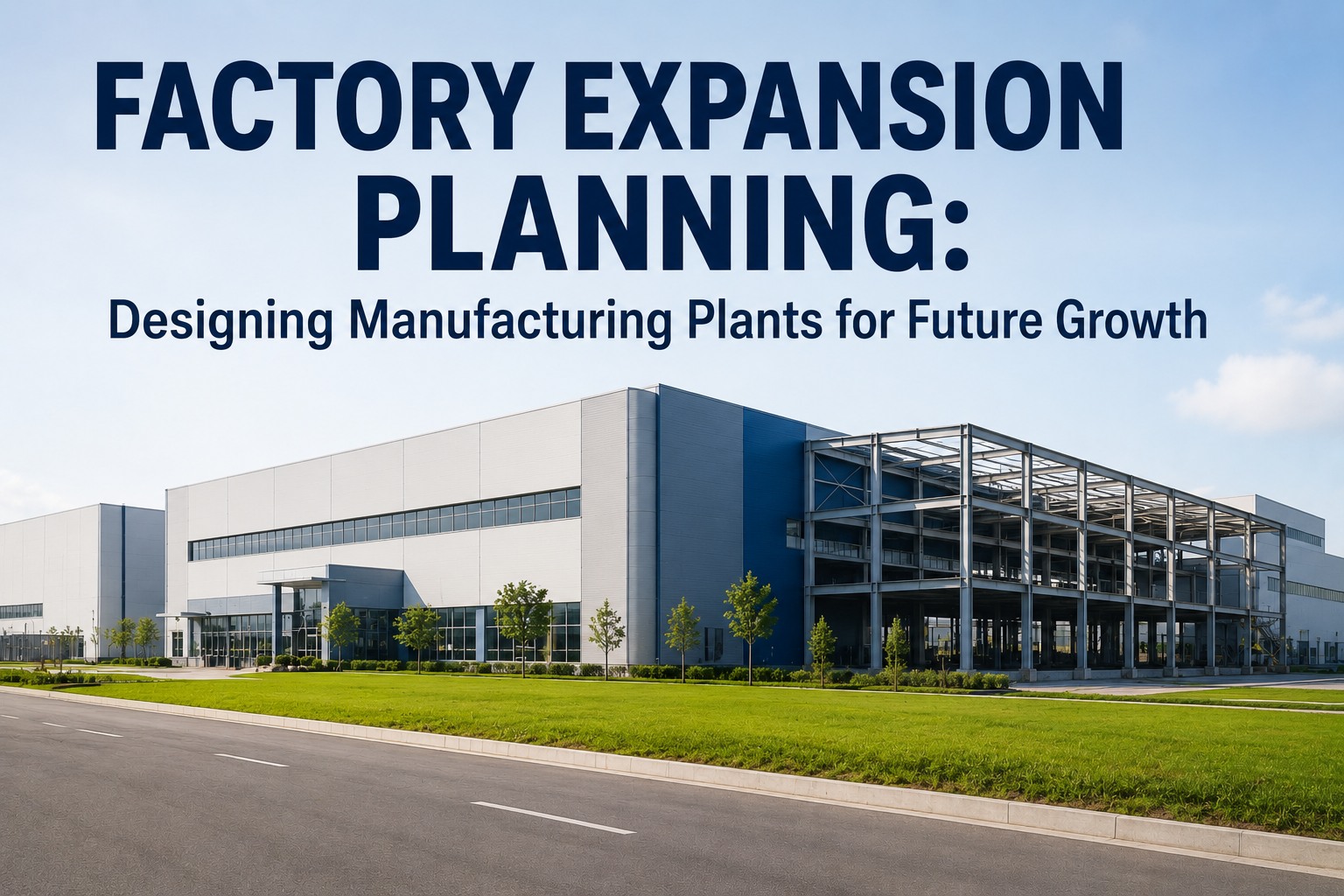
The most expensive mistake in greenfield manufacturing isn't underbuilding — it's not planning for Phase 3 capacity when designing Phase 1. Micron is building 4 phased fabs in New York. Texas Instruments dropped a new $11B fab next to its existing Lehi facility. Rivian's 9M sq ft Georgia site scales to 400K vehicles by 2028. Every one of these projects works because the master plan was set before the first wall went up. Skip expansion planning at concept design and you'll pay 2-3x more to retrofit later — or hit walls you can't move at all. This guide breaks down the master planning, utility headroom, modular layout, and phased build strategies that make future-proof factories possible. Book a master planning session to apply this to your project.
Future-Proof Factory Design · Master Plan Thinking
Plan Phase 1 for Phase 3 Capacity
The footprint, utilities, and layout you design today determine the capacity you can reach in 5, 10, and 15 years
Phase 1 · Today
Footprint100K sq ft
Lines1 line
Capacity50K units/yr
Investment$45M
→
Phase 2 · +3 Years
Footprint200K sq ft
Lines2 lines
Capacity120K units/yr
Investment+$30M
→
Phase 3 · +7 Years
Footprint350K sq ft
Lines4 lines
Capacity250K units/yr
Investment+$55M
Critical insight: Phase 2 and Phase 3 only work if Phase 1 was designed with the land, utilities, structural capacity, and regulatory permits to support them. Skip this and Phase 2 costs 2-3x more as a retrofit.
Why Factories Hit Capacity Walls (Even New Ones)
Three years after commissioning, a new factory should be hitting its stride. Instead, many find themselves blocked from expansion by decisions baked into the original concept design. Five reasons new factories outgrow themselves faster than expected — and how each can be avoided at master planning stage.
01
Land Footprint Maxed Out
The site was sized to fit Phase 1, not the master plan. Adjacent land is now developed, expensive, or zoned differently. Expansion means buying a second site.
02
Utility Capacity at the Ceiling
Power transformer sized for current load. Water service at 80% of allocation. HVAC running at peak. Doubling capacity requires utility upgrades that take 12-18 months and seven figures.
03
Structural Limits on Vertical/Horizontal Growth
Ceiling height blocks vertical storage. Column spacing prevents AMR routing. Roof load can't accept new HVAC. The building physically can't support the new operation.
04
Regulatory Approvals Are Per-Phase
Environmental, fire, zoning, and air permits were obtained for Phase 1 only. Each expansion phase triggers fresh permitting — adding 6-18 months of regulatory risk.
05
Process Flow Locks the Layout
Receiving, production, and shipping were sized for current volume. Expanding any one creates bottlenecks in the others. The floor plate becomes a constraint, not an enabler.
The 5 Pillars of Future-Proof Factory Design
Every factory designed for future growth shares five architectural pillars. None of them is expensive at greenfield concept stage. All of them are nearly impossible to retrofit later. Build all five into your master plan or accept that Phase 2 will be painful.
Pillar 1
Master Planning
Design for the ultimate Phase 3 footprint at day one. Pre-allocate space for future buildings, additional bays, expanded utilities, and parking growth.
Day-1 Cost~2-5% of CAPEX · Saves 50-70% in Phase 2/3
Pillar 2
Utility Headroom
Oversize power, water, HVAC, IT, and compressed air for 2x current load. Spec transformers, pumps, and risers that can accept additional capacity without replacement.
Pre-define "drop-in" zones for future lines. Standardize utility drops, column grids, and ceiling heights so new equipment fits without rework.
Day-1 CostNegligible · Cuts new-line install time 40-60%
Pillar 4
Land Banking
Acquire 2-3x the land your Phase 1 footprint needs. Land is the one thing you can't manufacture later — and adjacent parcels appreciate faster than expansion budgets.
Day-1 Cost1-3% of CAPEX · Locks future expansion path
Pillar 5
Regulatory Pre-Approval
Secure environmental, zoning, fire, and air permits for the full Phase 3 master plan at the outset. Each phase then becomes a notification, not a fresh approval.
Day-1 CostModest · Cuts 6-18 months from each expansion
Design Your Next Factory for the Capacity It Will Need
iFactory's greenfield team builds master plans that pre-allocate land, utilities, structural capacity, and regulatory approvals for the full 10-15 year horizon — so Phase 2 and Phase 3 become drop-in expansions instead of expensive retrofits.
Master Planning · Design for the Final State First
Master planning means designing for Phase 3 before building Phase 1. The framework below shows what to plan, over what horizon, and what each planning decision unlocks for future expansion.
Master Plan Element
Planning Horizon
What It Unlocks
Site Layout & Building Footprint
15-20 years
Full Phase 3 floor plate, expansion bays, parking, logistics yard
Utility Infrastructure Sizing
10-15 years
Power, water, gas, HVAC, IT backbone for 2x current load
Process Flow & Material Handling
10 years
Receiving, production, shipping zones sized for Phase 3 throughput
Modular Line Zones
5-10 years
Pre-allocated bays with utility drops for 2-3 future lines
Land Banking & Acquisition
15-20 years
Adjacent parcels for future buildings, parking, utility yards
Regulatory Master Permits
10-15 years
Environmental, zoning, fire, air consents for full Phase 3 footprint
Utility infrastructure is the single most expensive system to retrofit later. The "30-50% headroom rule" means specifying utilities with 30-50% capacity above current load — and routing them so additional capacity can be added without trenching, switchgear replacement, or shutdown. Five utility categories with specific headroom recommendations.
Electrical Power
+50%
Spec transformers and main switchgear at 1.5x current load. Route service entry so a second transformer can be added in parallel. Pre-stub conduit for future panels.
Water & Wastewater
+40%
Service line sized for Phase 3 demand. ETP and storage tanks sized modular. Pre-allocated effluent permit volume covers future expansion.
HVAC & Cooling
+30%
Chiller plant sized with N+1 redundancy that also serves as Phase 2 capacity. Roof structural load supports additional AHUs without reinforcement.
Compressed Air & Gas
+40%
Compressor room sized for additional units. Header piping run at larger diameter than Phase 1 needs. Drop points pre-installed in modular zones.
IT & Network Backbone
+100%
Cable trays, conduit, fiber backbone, and data closets sized for 2x current. Power-over-Ethernet infrastructure for sensors and cameras across the full master plan footprint.
Modular layout design means treating future lines as predictable expansions, not surprises. Four design patterns that turn factory expansion from a construction project into an equipment install.
Pattern 1
Standardized Bay Modules
Divide the building into uniform 50-60ft bays with identical column spacing, ceiling height, and utility drops. Any bay can house any production line — eliminating retrofit cost when product mix changes.
Pattern 2
Pre-Stubbed Utility Drops
Capped utility connections (power, compressed air, water, network) installed in unbuilt zones at construction. Future equipment connects in days instead of months.
Pattern 3
Mobile Equipment Strategy
Mobile workbenches, portable racking, casters on subassembly carts, and modular partition walls. Reconfigure production cells in days as product mix evolves.
Pattern 4
Expansion-Ready Building Envelope
Knock-out wall panels at end of building. Roof trusses sized to extend. Foundation pads pre-poured for adjacent expansion. New bay becomes a tilt-up addition, not a teardown.
Most factories that struggle to expand share the same root causes — and they're all preventable at concept design. Five mistakes we see in expansion-blocked plants over and over.
01
Sizing for Today's Demand
Capacity forecasts that look 3 years out instead of 10. Build to the demand curve's 90th percentile, not the median. Underbuilding costs more than overbuilding.
02
Buying Just Enough Land
Land you don't buy today is land you can't buy later — or land you pay 3-5x more for. The single biggest expansion blocker is adjacent parcels that aren't yours.
03
Locking the Layout to Current Process
Fixed walls, custom utility drops, and bespoke column spacing make every future change a renovation. Modular bays cost almost nothing extra at greenfield stage.
04
Single-Phase Regulatory Approvals
Permits secured for Phase 1 only. Each expansion triggers fresh environmental review, public hearings, and 6-18 months of regulatory risk. Pre-approve the master plan.
05
Ignoring Logistics Scaling
Truck dock count, parking, and yard space sized for Phase 1 volumes. Doubling production but with the same gate creates traffic, queuing, and safety incidents.
Expert Perspective
Every factory I've seen hit a capacity wall could have avoided it. Not by spending more — by deciding more. The teams that get expansion right make six decisions at concept design that the teams that don't make never make at all: how much land to acquire, how oversized the transformer should be, how the building should be modularized, what the regulatory master permit looks like, where the second receiving dock will go, and how the utility risers route. Six decisions, $2-5M in additional Phase 1 cost, and the factory expands in months instead of years for the next two decades. Skip those decisions and the same expansion costs $20M and 30 months. The math is brutal, and it always favors planning.
— Greenfield Master Planning Best Practice
2-3x
Retrofit cost vs greenfield master plan
+10-15%
Utility CAPEX for full headroom
6-18 mo
Saved per phase with master permits
40-60%
Faster line install in modular layout
Bottom Line · Plan Phase 3, Build Phase 1
Factory expansion planning isn't about overbuilding — it's about preserving options. The master plan defines the maximum capacity the site can ever reach. The utility headroom defines whether you can grow without trenching. The modular layout defines whether new lines are installs or renovations. The regulatory pre-approval defines whether expansion takes months or years. Build all four into Phase 1 and you've turned every future expansion into a drop-in. Skip them and your competitors will out-scale you by simply having factories that can grow. The companies winning the next decade aren't the ones with the biggest plants today — they're the ones with the most expandable plants.
Future-Proof Your Next Factory From Day One
iFactory's greenfield team designs master plans that preserve expansion options across a 15-year horizon — land banking, utility headroom, modular layouts, regulatory pre-approval, and capacity forecasting built into concept design.
Designing a manufacturing facility's Phase 1 build with the land, utilities, structural capacity, layout, and regulatory approvals needed to support future Phase 2 and Phase 3 expansions over a 10-15 year horizon. The goal: make future expansions drop-in installs instead of expensive retrofits.
What are the 5 pillars of future-proof factory design?
1) Master planning (design for ultimate footprint), 2) Utility headroom (30-50% oversizing on power, water, HVAC, IT), 3) Modular layouts (standardized bay modules with pre-stubbed utility drops), 4) Land banking (2-3x current footprint acquired upfront), 5) Regulatory pre-approval (master permits for full Phase 3 plan).
How much utility headroom should new factories design in?
Utility-specific recommendations: Electrical: +50% (transformer + switchgear). Water/wastewater: +40%. HVAC: +30% with N+1 redundancy. Compressed air: +40%. IT/Network: +100% (cheapest to oversize, most expensive to retrofit). Total utility CAPEX premium: roughly +10-15% for full headroom.
Why does Phase 1 design determine Phase 3 capacity?
Five constraints lock in during Phase 1: land footprint (can't buy adjacent parcels later), structural capacity (ceiling height, column spacing, roof load), utility infrastructure (transformer size, water service, ETP capacity), process flow (receiving and shipping sizing), and regulatory permits (per-phase approvals add 6-18 months each).
What does modular factory layout actually mean?
Treating the building as standardized bay modules rather than custom rooms. Each bay has identical column spacing, ceiling height, and pre-stubbed utility drops (power, water, compressed air, network). Future lines drop into vacant bays in days instead of months. Combined with mobile equipment and expansion-ready building envelopes, the factory becomes reconfigurable as product mix evolves. Book a modular layout session to apply this to your plant.