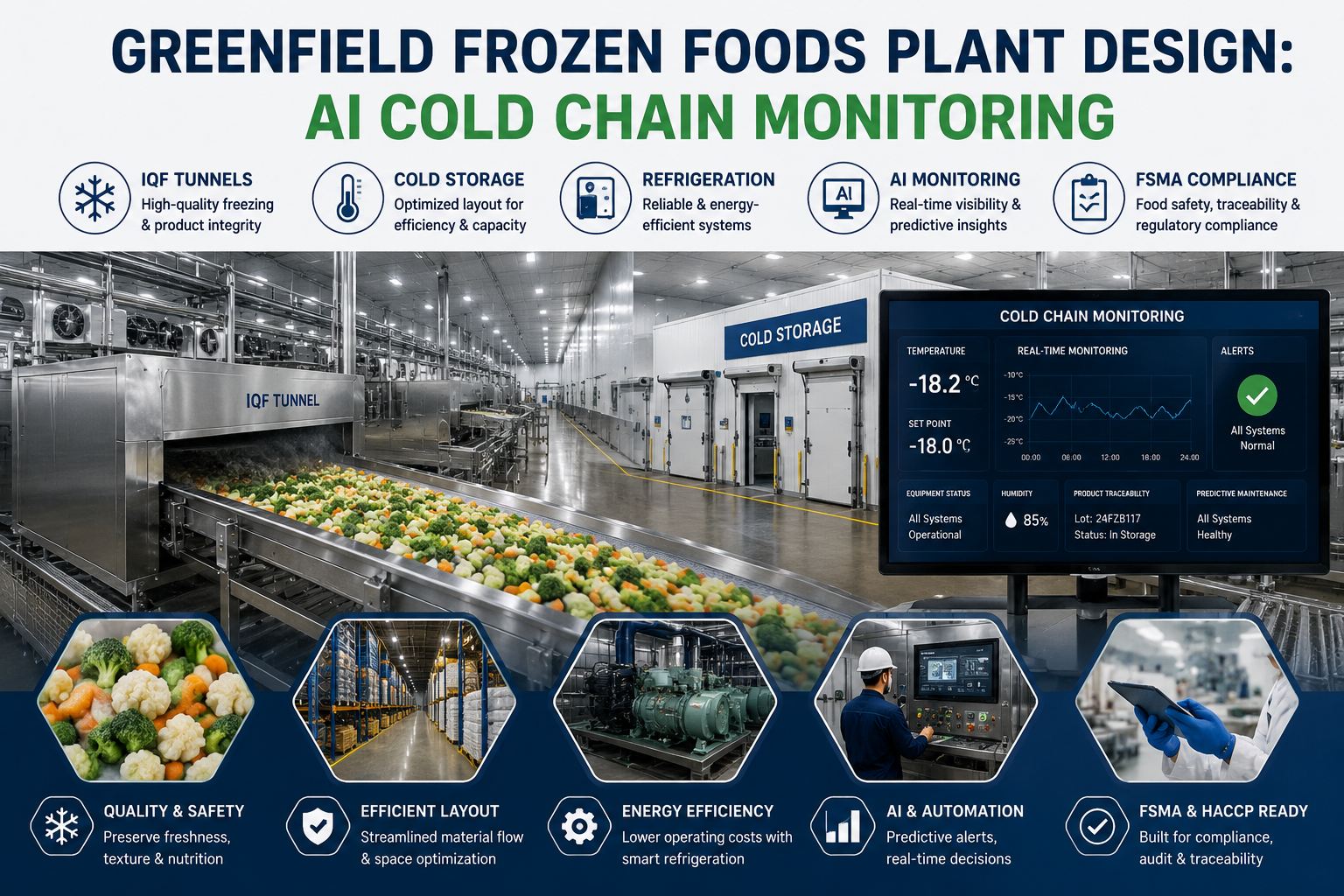
A single 4-hour temperature excursion in cold storage can destroy $180,000 of perishable inventory — and if no one was monitoring, the loss is only discovered when product arrives discolored or unsafe. FSMA 204 traceability took effect January 20, 2026, demanding batch-level digital records retrievable within 24 hours of an FDA request. Manual logs can no longer meet this bar. A greenfield frozen foods plant designed around AI cold chain monitoring locks in continuous temperature tracking, IQF tunnel optimization, predictive refrigeration maintenance, and FSMA-compliant traceability from day one. Book a frozen foods plant consultation to map your facility design.
The AI-Monitored Cold Chain — From Dock to Dock in 6 Temperature Zones
$180KInventory destroyed by a single 4-hour temperature excursion
Jan 20, 2026FSMA 204 compliance date now in effect
24 hrFDA audit response window for traceability records
0.3% → 100%Package inspection coverage with AI vision
The 4 IQF Tunnel Types — Ranked by Freezing Speed
IQF tunnel selection drives 30–40% of plant CapEx and locks in product quality for the next 15 years. Different products demand different freezing methods. The visual below ranks all four by speed — fastest at the top, with product-fit mapped to each.
Best for: Patties · fish fillets · burgers · meat portions
10–20 min
Simple
Where Cold Chain Failures Actually Happen — The Risk Heatmap
Not all zones fail equally. The risk heatmap below shows where failures concentrate, what causes them, and what they cost. AI monitoring eliminates the highest-cost risks first.
Frozen Storage
Critical
Compressor failure during off-shift · undetected door breach · $180K excursion
IQF Tunnel
Critical
Belt speed drift · uneven freezing rate · large ice crystals · quality loss
Shipping Dock
High
Reefer pre-cool gap · loading door open too long · trailer handoff failure
Receiving
High
Supplier excursion in transit · undetected on receipt · downstream contamination
Packaging
Medium
Seal integrity failure · misprint lot code · FSMA 204 traceability gap
Prep & Blanch
Medium
Blanch time variance · CIP cycle skip · cross-contamination risk
Ready to map this risk heatmap against your specific facility? Book a frozen foods plant consultation — we will produce the risk-prioritized AI deployment plan before construction documents close.
FSMA 204 in 3 Steps — From Event to Audit-Ready Response
FSMA 204 effective January 20, 2026 demands batch-level traceability with sub-24-hour FDA audit response. AI cold chain monitoring closes the loop automatically — from event capture through retrieval.
01
Capture KDE at CTE
Every Critical Tracking Event (receiving, transforming, creating, shipping) auto-captures Key Data Elements — lot codes, timestamps, locations, batch genealogy.
Continuous · real-time
02
Index & Store
Records stored in audit-ready format with batch genealogy linkages. Searchable by lot, date, supplier, processing event. Retention exceeds FDA minimum.
Indexed in seconds
03
Retrieve on Demand
FDA request triggers sub-minute traceability query across the full batch genealogy. Audit-ready report generated automatically with full supporting evidence.
Sub-minute query · 24 hr SLA met with hours to spare
4 AI Cold Chain Use Cases — Ranked by Payback Speed
AI cold chain monitoring is a stack of distinct use cases each with its own ROI. The four below pay back within 6–14 months in a greenfield deployment. Greenfield delivery runs 4–6× cheaper than retrofitting the same systems later.
6–9 mo
Continuous Temperature Tracking
IoT sensors at every rack, aisle, freezer, dock. Deviation alerts in <60 seconds. Prevents the $180K excursion event before it lands on the books.
Every zone · every minute
8–12 mo
AI Vision Quality Inspection
Lifts seal-integrity inspection from current 0.3% sampling to 100% of output. Catches package defects, smeared lot codes, fill-level errors before shipping.
100% of packages · 0% sampled
9–12 mo
Predictive Refrigeration Maintenance
Compressor vibration, current draw, head pressure monitored. Predicts failures 14–21 days ahead. Converts emergencies into planned PM windows.
14–21 day failure lead time
10–14 mo
FSMA 204 Traceability Automation
Auto-captures all KDEs at every CTE. Generates audit-ready reports in seconds. Eliminates the $50K–$200K manual compliance team overhead.
Sub-minute audit response
Ready to sequence these 4 use cases into your construction schedule? Talk to our cold chain AI team — we will produce the deployment plan against your build timeline.
Design AI Cold Chain Into the Plant — Not After Commissioning
iFactory's frozen foods consultation maps your product mix, IQF tunnel selection, cold chain zone temperatures, FSMA 204 KDE-CTE architecture, predictive refrigeration scope, and AI vision quality inspection — producing the full deployment plan before construction documents close.
Expert Perspective: Why Cold Chain AI Belongs in the Construction Schedule
Two factors compress every greenfield frozen foods CapEx decision in 2026. First, FSMA 204 took effect January 2026 — there is no longer a path to "we'll add traceability later." Paper systems will not survive an FDA for-cause inspection. Second, a single temperature excursion event now costs more than an entire year of AI monitoring — $180K of destroyed inventory in 4 hours. The plants that win the next decade are the ones whose IQF tunnel, refrigeration architecture, sensor density, and FSMA traceability layer were designed together in the construction schedule. The retrofit penalty is brutal: running new conduit through finished freezer panels costs 4 to 6 times more than designing it in.
— iFactory Greenfield Consulting, Cold Chain Practice 2025 to 2026
4–6×
Cost of retrofit vs greenfield AI cold chain
$180K
Single excursion cost = annual AI monitoring budget
8–14 mo
Typical greenfield AI cold chain payback window
FSMA 204 Is Live — Build the Compliance Layer Into the Plant
iFactory's frozen foods plant consultation maps cold chain zones, IQF tunnel selection, predictive refrigeration scope, AI vision quality inspection, and FSMA 204 KDE-CTE architecture — producing the deployment plan with 8–14 month ROI projection before construction commits.
What is FSMA 204 and how does it affect frozen foods plant design?
FSMA 204 is the FDA Food Safety Modernization Act traceability rule effective January 20, 2026. It requires entities handling Food Traceability List items to capture Key Data Elements at every Critical Tracking Event. Records must be retrievable within 24 hours of an FDA request. Manual logs cannot meet this standard. Greenfield plants must design KDE-CTE traceability into the digital infrastructure from day one.
Which IQF tunnel type is best for a greenfield frozen foods plant?
The right tunnel depends on product mix. Cryogenic immersion (1-4 min) delivers fastest freezing for premium seafood. Fluidized bed (3-8 min) suits berries, peas, fries. Spiral freezers (8-25 min) handle versatile product mix including poultry, meals, pizzas. Linear belt (10-20 min) fits patties and large pieces. IQF tunnel selection drives 30-40% of plant CapEx.
How does AI cold chain monitoring prevent temperature excursions?
AI cold chain monitoring places IoT sensors at every rack, aisle, freezer, and dock — capturing continuous readings rather than periodic spot-checks. Deviation alerts trigger within 60 seconds of trend detection. Predictive refrigeration models forecast compressor failures 14-21 days ahead, allowing planned maintenance instead of emergency response. A single 4-hour excursion would otherwise destroy $180,000 of inventory.
What is the typical ROI window for AI cold chain monitoring in a greenfield plant?
Greenfield AI cold chain payback runs 6 to 14 months across the use case stack. Continuous temperature tracking pays back in 6-9 months from excursion prevention. AI vision quality inspection in 8-12 months. Predictive refrigeration maintenance in 9-12 months. FSMA 204 traceability automation in 10-14 months. Greenfield deployment runs 4-6× cheaper than retrofitting the same systems later.
How does iFactory's frozen foods plant consultation work?
iFactory's consultation maps your product mix to IQF tunnel selection, designs the 6-zone cold chain architecture, scopes the sensor density and edge inference layer, models the FSMA 204 KDE-CTE capture architecture, integrates predictive refrigeration maintenance, and produces the 8-14 month ROI projection. All delivered before construction documents close. Book your frozen foods plant consultation here.