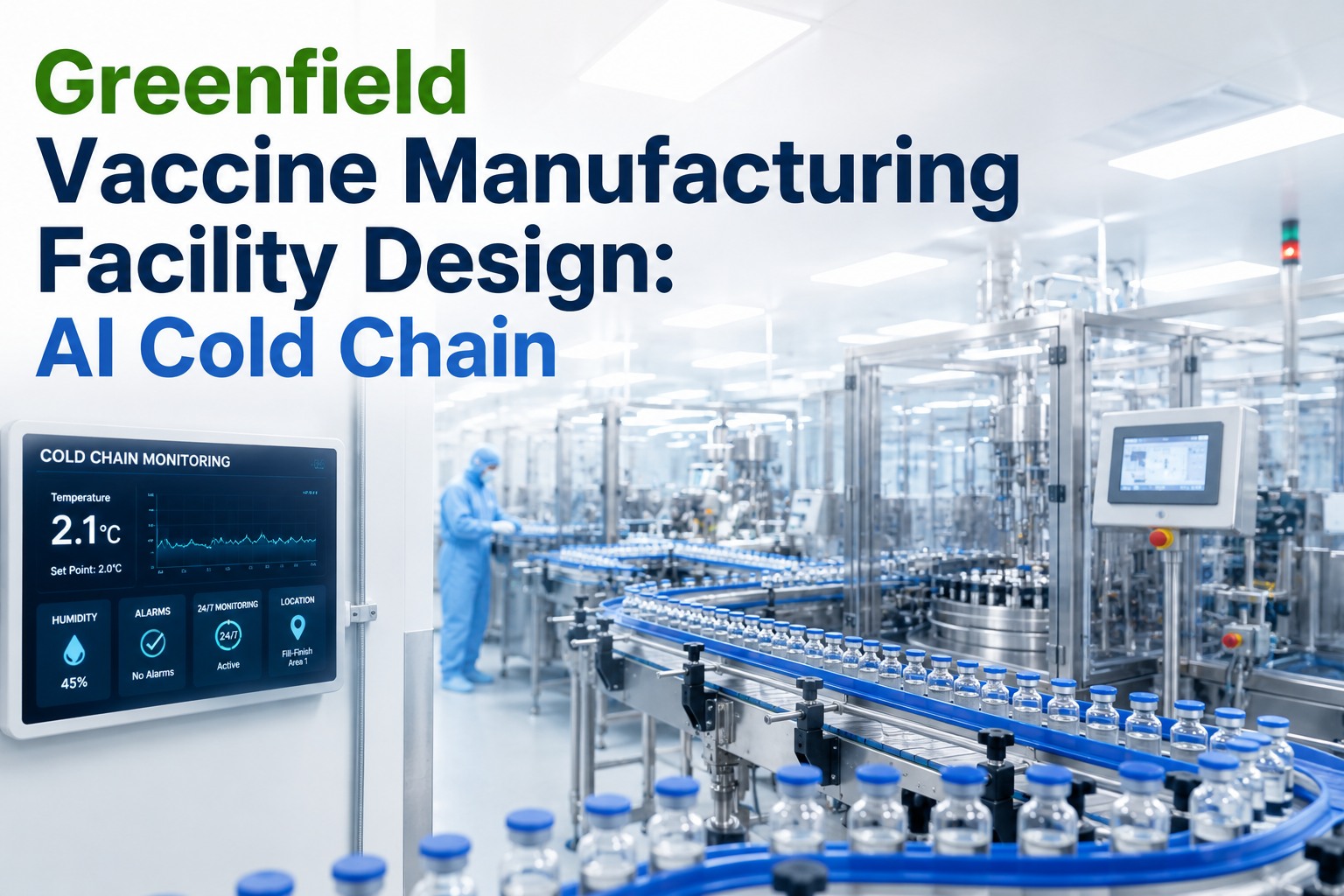
A vaccine is only as good as the last degree it was kept at. A single temperature excursion, or one contamination event in the fill room, can scrap a batch worth millions and doses that cannot simply be remade next week. That is why a greenfield vaccine facility is built around two unforgiving disciplines — sterility and the cold chain — both governed by some of the strictest regulations in manufacturing. The plants that succeed design continuous monitoring into both, so problems surface as alerts rather than as ruined product. This guide walks through designing a modern vaccine facility around AI cold chain monitoring, aseptic fill-finish, and GMP from the ground up.
Designing a vaccine facility? Book a 30-minute facility design consultation to build cold chain and contamination monitoring in from the layout.
Every Vaccine Lives Inside a Temperature Band
Drift outside the band, even briefly, and a vaccine starts losing the potency that makes it work. The cold chain has to hold unbroken from the fill line all the way to the patient.
Why Vaccine Manufacturing Is Unforgiving
Two things make vaccines harder to make than almost anything else. They are biological, so they must be produced and filled under sterile conditions that leave no room for contamination; and they are fragile, so they must stay within a narrow temperature band from the moment they are filled. A ruined batch cannot be remade on demand, so the value of catching a drift early is enormous — which is exactly what continuous monitoring is for. If you want it scoped for your modality and layout, you can map it with a pharma manufacturing specialist.
of vaccines are wasted globally each year, much of it from cold-chain failures
ultra-cold tier some mRNA vaccines must be stored at
ISO 5 cleanroom class the aseptic fill point must hold continuously
Inside the Facility: From Bioreactor to Vial
A vaccine plant runs in two halves — making the bulk drug substance, then turning it into the finished, filled product. The handoff between them, aseptic fill-finish, is the most tightly controlled step in all of pharmaceutical manufacturing.
Upstream
Antigen or mRNA is produced in bioreactors or by in-vitro transcription.
Downstream
Chromatography and filtration purify the bulk drug substance.
Formulation
Adjuvants, stabilizers, or lipid nanoparticles are blended to recipe.
Aseptic Fill-Finish
Sterile filling of vials and syringes in the Grade A core.
Most critical stepLyophilization
Freeze-drying for vaccines shipped and stored as a powder.
Inspect & Cold Store
Automated inspection, then straight into the cold chain.
Mapping a fill-finish line into your layout? Book a process design review and we will plan the aseptic core and monitoring around your modality.
Sterility and the Cleanroom: GMP by Design
Aseptic processing is governed by GMP cleanroom grades, set out in EU GMP Annex 1 and the FDA's aseptic guidance. The grades define how clean the air must be where each operation happens, and they cascade outward from the fill point. Annex 1 ties them together under a facility-wide Contamination Control Strategy, backed by continuous environmental monitoring of viable and non-viable particles.
Grade A demands continuous particle monitoring; Grade B and below are monitored often enough to catch contamination trends before they reach the product.
Planning the cleanroom grades and environmental monitoring? Book a GMP design session and we will plan the aseptic core and EM around your process.
The Smart Vaccine Plant: Cold Chain, MES, and Predictive Maintenance
The technologies that protect a vaccine plant all share one trait: they watch continuously, so a problem becomes a timestamped alert instead of a discovery at release testing. Four of them belong in the design from the start.
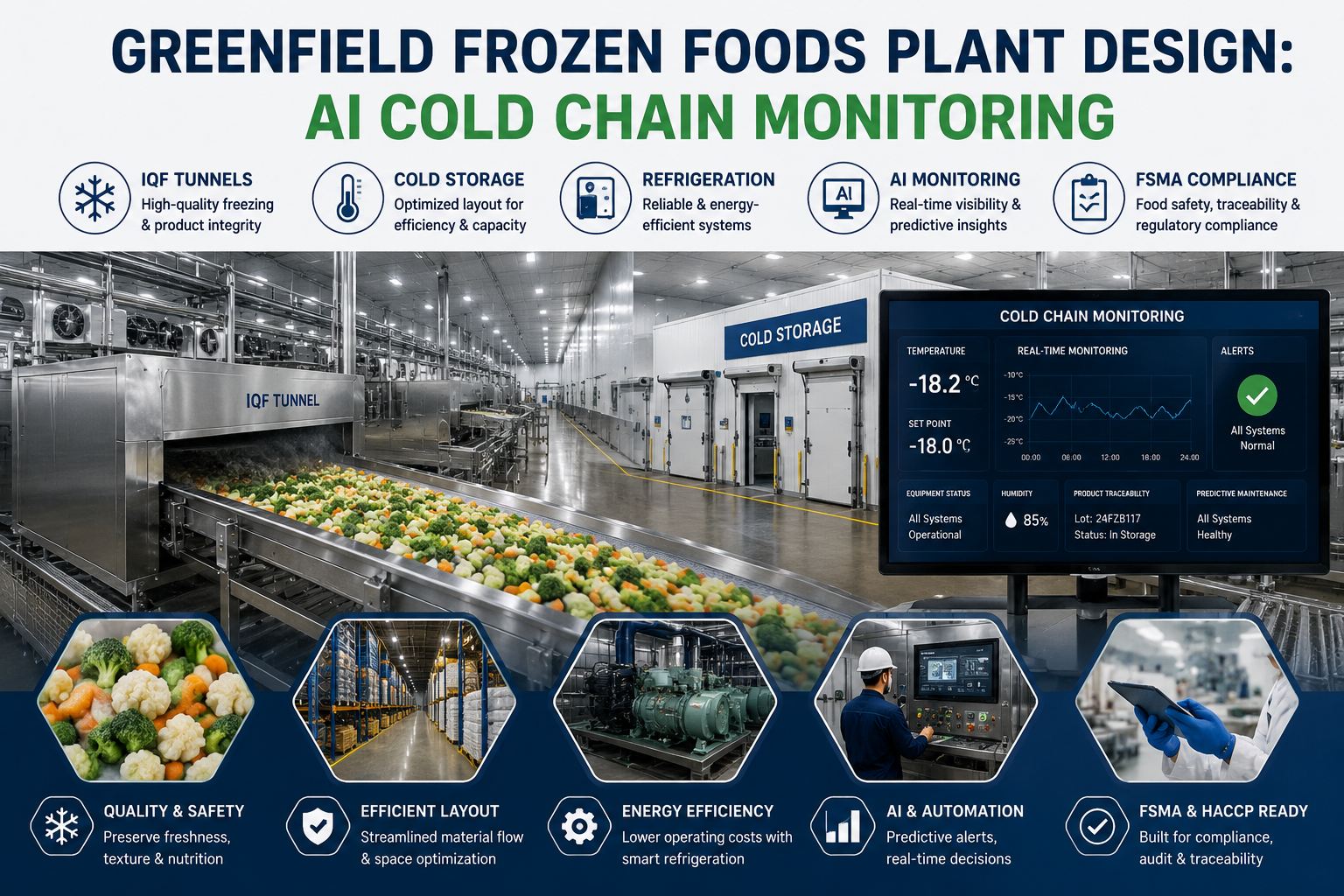
AI Cold Chain Monitoring
Continuous temperature logging with excursion prediction and shelf-life modeling, so a brief drift doesn't scrap a batch that is still usable.
Environmental Monitoring
Continuous viable and non-viable particle monitoring across the cleanrooms, with anomaly detection feeding the contamination control strategy.
MES & Electronic Batch Records
Paperless records, recipe control, and review-by-exception, with full lot genealogy and serialization for end-to-end traceability.
Predictive Maintenance
Protect freezers, HVAC, lyophilizers, and fill lines, where a single equipment failure can cost a multi-million-dollar batch.
Catch the Drift Before It Costs a Batch
iFactory brings AI cold chain monitoring, environmental monitoring, electronic batch records, and predictive maintenance onto one platform for vaccine manufacturing — so sterility and temperature stay visible, provable, and under control from fill to release.
Expert Perspective
In vaccine manufacturing, the expensive failures are almost always invisible until it is too late. A freezer drifts overnight, an air handler in the fill suite loses pressure for twenty minutes, a record gets transcribed wrong — and you find out at release testing, weeks later, with a batch you can no longer sell and doses you cannot quickly remake. The whole point of designing monitoring in from the start is to convert those silent failures into alerts you can act on in the moment. On a greenfield facility you can lay out the cleanroom grades, instrument the cold chain, and connect the batch record so that sterility and temperature are continuously proven rather than periodically checked. That is what keeps both the product and the license intact.
— Pharmaceutical Manufacturing Practice, iFactory Engineering Team
shelf life drop when one mRNA vaccine moves from frozen to refrigerated
particle class the fill point holds continuously (Grade A)
alert-and-backup standard expected on vaccine cold storage
The Bottom Line
A vaccine facility succeeds or fails on two things it can design in from the start: a sterile process that never lets contamination reach the product, and a cold chain that never lets temperature wander outside the band. Lay out the cleanroom grades around the fill point, instrument the cold chain end to end, connect the batch record, and protect the critical equipment with predictive maintenance. Do it as a greenfield design, and sterility and temperature become things the plant proves continuously rather than checks occasionally — which is the difference between a facility that ships doses and one that scraps them.
Design a Vaccine Plant That Proves It Stays in Spec
From cleanroom and fill-finish design to AI cold chain monitoring, environmental monitoring, electronic batch records, and predictive maintenance, iFactory helps greenfield pharma teams build a facility that is sterile, compliant, and continuously monitored from the first batch.
Frequently Asked Questions
What temperatures do vaccines need to be stored at?
Most conventional vaccines are kept refrigerated at 2 to 8°C. Some mRNA vaccines are stored frozen at around -20°C, and the most thermally fragile, such as the Pfizer-type mRNA vaccine, require ultra-cold storage near -70°C. Both heat and unintended freezing reduce potency, so each product has a defined band that must be maintained continuously from the fill line to the point of administration.
What is aseptic fill-finish?
Fill-finish is the step where the finished vaccine is filled into vials or syringes and sealed. Because the product cannot usually be sterilized afterward, the filling is done aseptically in a Grade A critical zone, often inside an isolator or restricted-access barrier system, with a cleaner Grade B background. It is widely regarded as the most stringently controlled operation in pharmaceutical manufacturing, since any contamination here reaches the patient directly.
What are GMP cleanroom grades A to D?
They are the air-cleanliness classes defined in EU GMP Annex 1 for sterile manufacturing. Grade A is the cleanest, equivalent to ISO 5, used at the fill point; Grade B is its background for aseptic work; Grade C and Grade D cover progressively less critical activities like solution preparation and gowning. Each grade carries its own particle limits and environmental monitoring requirements, all organized under a facility-wide contamination control strategy.
How does AI improve vaccine cold chain monitoring?
Beyond logging temperatures continuously and alerting on excursions, AI models can estimate how much usable shelf life remains after a temperature deviation. That means a brief, minor excursion no longer automatically condemns a batch — the system quantifies the impact so genuinely compromised product is rejected while still-good product is released. The result is less waste and faster, better-informed disposition decisions.
How does iFactory help design a vaccine facility?
iFactory's greenfield advisory helps lay out the cleanroom grades and fill-finish flow, then delivers AI cold chain monitoring, environmental monitoring, electronic batch records, and predictive maintenance on one platform so sterility and temperature stay continuously proven. The same data supports GMP compliance, traceability, and faster batch release. You can book a consultation to plan it for your facility.