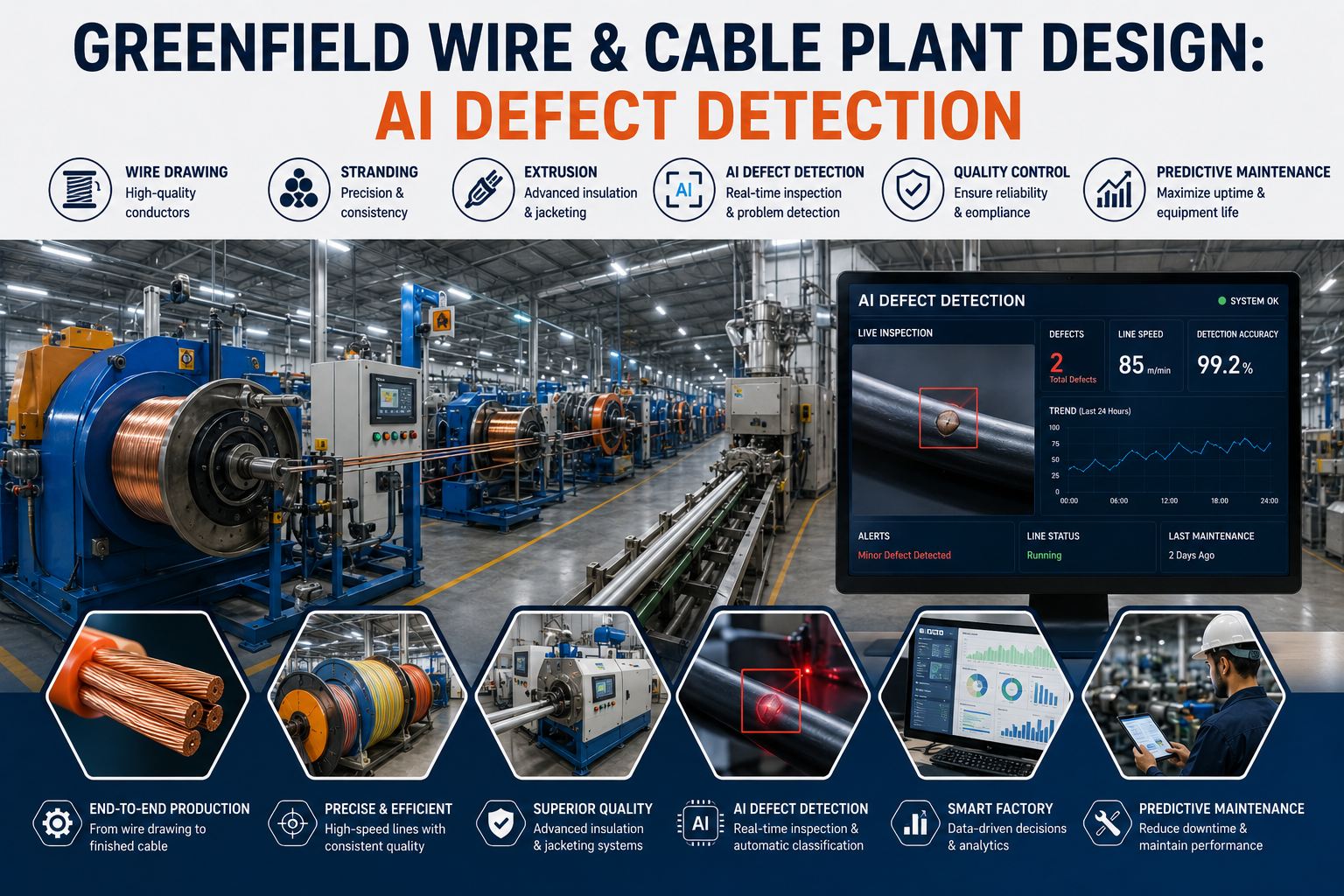
Wire and cable manufacturing has the longest continuous production line in industrial manufacturing — copper rod enters at one end, finished cable reels exit hundreds of meters later. A single uncaught defect at the drawing stage compounds through stranding, extrusion, sheathing, and reeling — by the time manual inspection spots it, an entire reel is scrap. AI defect detection changes the math: laser sensors at 20,000 measurements per second, machine vision inspecting every meter of cable, predictive maintenance forecasting failure 14–21 days ahead. Greenfield plants designed around AI cut insulation defects 75% and overall scrap 40%. Book a wire and cable plant consultation to map your line.
The 7 Production Stages — Equipment, AI Role, and Defect Capture
Every stage of the cable production line generates a distinct family of defects. AI inspection deployed at each stage catches defects within meters of where they're created — preventing the cascade that turns a single early defect into an entire scrap reel downstream.
Wire Drawing
Plastic deformation through hardened tungsten-carbide dies under controlled lubrication and annealing. Drives final conductor properties.
Stranding
Multiple drawn wires twisted into stranded conductor. Pitch (lay length) and twist direction determine cable flexibility and impedance.
Insulation Extrusion
Molten insulation extruded uniformly around conductor through crosshead die. Wall thickness and concentricity drive electrical performance.
Color Coding & Marking
Color stripes and printed text identify conductor function, voltage rating, manufacturer, lot code. Critical for traceability and field installation.
Cable Assembly
Multiple insulated conductors combined into a cable core with fillers and binder tape. Determines mechanical integrity and conductor count.
Outer Sheath Extrusion
Protective outer jacket extruded over assembled cable core. Spark test detects insulation pinholes and sheath integrity defects.
Cooling & Take-Up
Cooling stabilizes finished cable. Take-up reels wound with consistent tension and accurate length measurement.
Want this 7-stage AI inspection sequence designed against your specific cable product mix? Book a wire and cable plant consultation — we will produce the production line architecture before procurement.
The 8 Cable Defect Categories AI Vision Catches at Line Speed
Cable defects fall into eight predictable categories. Each maps to a production stage and a specific inspection technology. AI vision systems catch all eight simultaneously without sampling — every meter of cable inspected at full line speed.
Diameter Drift
Conductor or insulation OD drift outside spec. Laser projection sensors measure on 3 axes at 20,000 samples per second.
Lumps & Neckdowns
Sudden bulges (lumps) or thin spots (neckdowns) in extruded insulation. Fast defects requiring high-rate sensors.
Insulation Voids
Bubbles, air pockets, inclusions within insulation walls. Detected via X-ray or ultrasonic inspection. Critical for HV/EHV cables.
Surface Scratches
Marks, gouges, irregularities on outer sheath. 3D surface scanner detects features down to 50 microns.
Stranding Pitch Error
Wrong twist direction, incorrect lay length, broken strand. Machine vision verifies every revolution.
Color & Print Errors
Wrong color, missing stripe, misprinted lot code, illegible voltage rating. OCR + color vision verification.
Wrong Conductor Count
Missing core (e.g., 2 instead of 3 insulated wires). Catches the "deviation from spec" defect cited by the AI cable Triad study.
Sheath Integrity
Pinholes, cracks, gaps detected by inline spark tester at the standard high voltage. Critical for safety-rated cables.
The AI Inspection Hardware Stack — What Actually Sits on the Line
AI defect detection isn't a single camera — it's a sensor stack deployed at strategic line positions. Understanding the hardware layer reveals where greenfield design wins: cameras and sensors mount best when the production line is being built around them.
Laser Projection (LPS)
Detects diameter drift, ovality, lumps, neckdowns at full extrusion speed. The single most important sensor on the line.
3D Surface Scanner
Non-contact distance sensors detect surface scratches, gouges, marks. Mounted between extrusion and take-up.
High-Speed Industrial Cameras
Catches color coding, print accuracy, conductor count, stranding pitch. Multiple cameras at coding and assembly stations.
Inline Spark / HV Tester
Detects pinholes, cracks, sheath integrity defects through dielectric breakdown sensing. Required for safety-rated cables.
NVIDIA Jetson Edge Inference
Runs AI vision models at line speed. Defect classification per frame. Operator alerts within seconds of detection.
Vibration & Current Sensors
Strander bearings, extruder drives, water pumps monitored continuously. Predicts equipment failure before it scraps a reel.
Ready to size the AI sensor stack against your specific line speed and cable mix? Talk to our cable plant AI team — we will produce the hardware specification with sensor placement diagram.
Cable Type → Insulation → Inspection Priority Matrix
Greenfield builders need to match their target cable products to the right insulation compound and AI inspection priority. The matrix below covers the five most common cable categories deployed in new factories.
Expert Perspective: Why Greenfield Cable Plants Build AI Inspection Into the Line, Not Onto It
A cable production line has the longest continuous flow in industrial manufacturing — sometimes 300 to 500 meters from copper rod payoff to finished take-up reel. The defect economics are brutal because of that length. A diameter drift at Stage 1 that goes undetected through Stages 2, 3, 4, 5, 6, and 7 doesn't just scrap a few meters — it scraps the entire reel, sometimes thousands of meters of finished cable. The greenfield plants that win the next decade build AI inspection into every stage of the line from the start — sensor mounting designed into the line frame, edge inference servers integrated into the panel layout, predictive maintenance instrumentation built into every motor and bearing. Retrofitting AI onto an existing line costs 3 to 4 times more and rarely achieves the same coverage because the sensors get bolted into whatever positions are physically accessible — not the positions that catch defects earliest. The math gets clearer every quarter — 75% insulation defect reduction and 40% overall scrap reduction are the documented numbers from disciplined deployments.
— iFactory Greenfield Consulting, Cable Plant AI Practice 2025 to 2026