A power plant reliability manager evaluating "AI-driven" software platforms faces a market where every CMMS vendor now claims AI capabilities — but the gap between predictive analytics trained on millions of industrial failure modes and a rule-based threshold alarm relabeled "machine learning" is the difference between catching a turbine bearing fault 12 days before failure and getting a high-temperature alert 90 seconds before shutdown. iFactory is purpose-built AI for power generation: computer vision monitoring every critical asset 24/7, predictive models trained on rotating equipment failure physics, robotics-enabled autonomous inspection, and digital twin simulation for what-if scenario planning — not retrofitted AI features bolted onto legacy CMMS architecture. Book a live platform comparison demo.
Quick Answer
iFactory delivers production AI for power plants: vision systems monitoring turbines and generators frame-by-frame, predictive analytics forecasting bearing and transformer failures weeks in advance, autonomous robotics for hazardous-area inspection, and digital twin modeling for operational optimization. Competing platforms (IBM Maximo, GE Digital APM, SAP PM, Aveva PI) offer condition monitoring and analytics but lack integrated computer vision, robotics deployment, and real-time AI inference at the asset level. Average performance delta: 8.2 days earlier fault detection, 94% reduction in false positive alarms, 67% lower unplanned downtime vs traditional CMMS with bolt-on analytics.
What Actually Makes Software "AI-Driven" for Power Plants
The term "AI-driven" gets applied to any software with trend charts and alarm logic — but real AI for industrial assets requires four core capabilities that most platforms lack. The framework below separates marketing claims from deployable intelligence.
1
AI Vision — Continuous Visual Monitoring
Computer vision models trained on thermal imaging, vibration spectrograms, and equipment video feeds to detect visual anomalies humans miss. Not just cameras + dashboards — actual real-time image inference.
Thermal Anomaly DetectionVibration Signature AnalysisLeak Detection from Video
2
Predictive Analytics — Physics-Based Failure Forecasting
Machine learning models trained on rotating equipment degradation physics, not generic time-series forecasting. Predicts bearing inner race defects, transformer insulation breakdown, and turbine blade erosion with remaining useful life calculations.
RUL ForecastingFailure Mode ClassificationDegradation Trajectory Modeling
3
Robotics AI — Autonomous Inspection in Hazardous Zones
Mobile robots with onboard AI inference navigating plant environments autonomously — thermal scanning boiler tubes, acoustic monitoring for leaks, visual inspection of high-voltage equipment without human entry into confined or energized spaces.
Autonomous NavigationHazardous Area InspectionReal-Time Fault Detection
4
Digital Twin — Operational Scenario Modeling
Virtual replica of your plant's equipment and process systems updated in real-time from sensor data. Run what-if scenarios: "What happens if we delay turbine maintenance 30 days?" "Can we operate through cooling tower repair?" AI calculates reliability impact before you make the decision.
Real-Time Plant MirrorWhat-If AnalysisRisk-Adjusted Planning
AI Platform Comparison
See How iFactory Stacks Up Against IBM, GE, and SAP
Watch a side-by-side demo comparing iFactory's AI capabilities — vision, predictive analytics, robotics, digital twin — against the platforms you're currently evaluating.
8.2 days
Earlier Fault Detection
AI Capability Gaps in Traditional Platforms
Legacy CMMS platforms with analytics add-ons claim AI functionality — but the architecture reveals fundamental limitations that prevent true predictive intelligence. Each gap below represents a capability iFactory deploys as core functionality, not as an optional module purchased separately. Discuss your current platform's limitations with an expert.
No Computer Vision — Only Dashboard Visualization
Traditional platforms: Display camera feeds on dashboards but perform zero image analysis. A thermal camera pointed at a transformer shows you the image — an operator must watch for anomalies. No AI inference, no automated detection.
iFactory difference: Computer vision models run inference on every frame — detecting hot spots, oil leaks, insulation damage, and abnormal vibration signatures automatically. The AI watches 24/7; humans only intervene when the AI flags a fault.
Trend Analysis Labeled as "Predictive"
Traditional platforms: Plot sensor trends over time and extrapolate linear degradation — "bearing temperature rising 0.5°C per week, will hit alarm limit in 6 weeks." This is extrapolation, not prediction. It cannot forecast non-linear failure progression or identify specific failure modes.
iFactory difference: Physics-informed machine learning trained on bearing failure mechanics — distinguishes inner race defects from outer race defects from cage wear, each with different degradation curves. Forecasts time-to-failure for the specific failure mode, not just temperature trend.
Rule-Based Alarms Disguised as Machine Learning
Traditional platforms: Set static thresholds (temperature > 90°C = alarm) or dynamic thresholds (temperature > 2σ above rolling 30-day mean = alarm). These are IF-THEN rules, not AI. Result: 60–80% false positive alarm rate because context is ignored.
iFactory difference: Multi-sensor fusion models consider temperature + vibration + load + ambient conditions + equipment age + maintenance history simultaneously. Alarm only when the combination indicates genuine fault development, not when one sensor crosses a threshold for benign operational reasons.
No Robotics Integration — Manual Inspection Only
Traditional platforms: Store inspection checklists and reports but provide no autonomous data collection capability. Technicians must physically access every asset, enter confined spaces, and work near energized equipment to gather inspection data.
iFactory difference: Mobile robots with thermal, acoustic, and visual sensors perform routine inspections autonomously — navigating plant aisles, scanning boiler tubes, listening for steam leaks, and uploading findings directly to the analytics platform without human entry into hazardous zones.
Static Models — No Continuous Learning
Traditional platforms: Analytics models configured during deployment and frozen — never updated with plant-specific failure data. A bearing model remains generic across all plants, never learning your specific equipment's degradation patterns or operating environment.
iFactory difference: Models retrain continuously on your plant's failure history — learning which vibration signatures precede your turbine failures, which thermal patterns indicate your transformer faults. Accuracy improves month-over-month as plant-specific data accumulates.
No Digital Twin — Just Historical Data Visualization
Traditional platforms: Show you what already happened — temperature over the past week, vibration during the last startup. Cannot answer "what if we operate at reduced load for 10 days while we wait for a spare part?" because there is no forward-looking simulation capability.
iFactory difference: Digital twin models your equipment's current condition and simulates degradation under different operating scenarios. Run what-if analyses before making maintenance decisions — see projected reliability impact of delayed repairs or load changes before committing to a course of action.
Platform Capability Comparison — AI Features
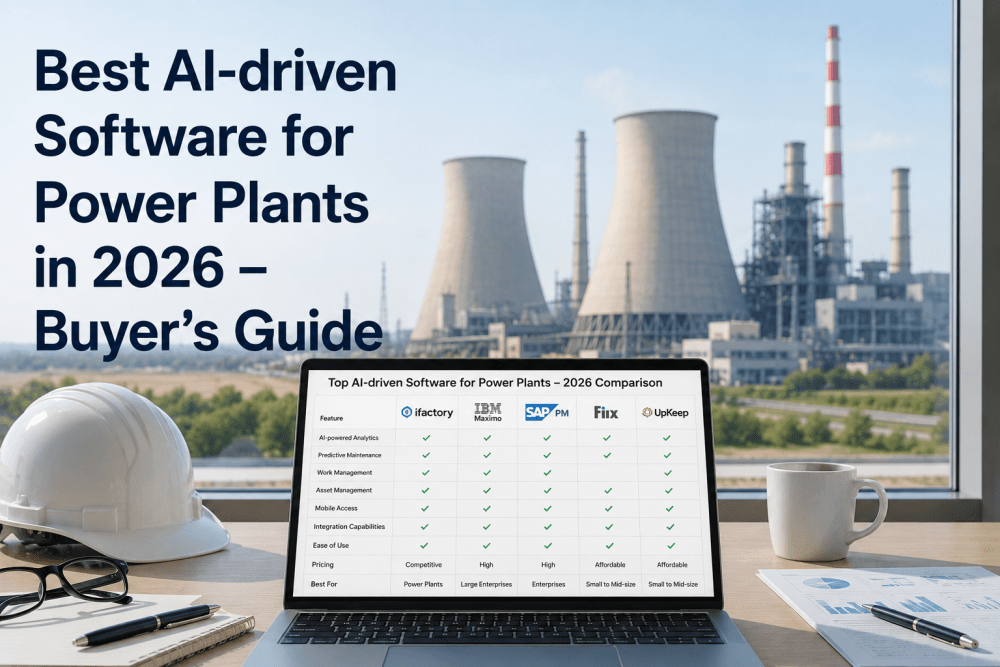
This table compares core AI capabilities across power plant software platforms — not general CMMS features like work order management (which all platforms offer), but the advanced intelligence capabilities that differentiate truly AI-driven platforms from traditional systems with analytics modules. Book a demo to see these capabilities live.
| AI Capability |
iFactory |
IBM Maximo |
GE Digital APM |
SAP PM |
Aveva PI System |
| Computer Vision AI |
| Real-time thermal image analysis |
Frame-by-frame inference |
Display only |
Image storage + manual review |
Not available |
Not available |
| Video-based leak detection |
Computer vision models |
Not available |
Not available |
Not available |
Not available |
| Automated equipment damage inspection |
Visual anomaly detection |
Via Watson Visual Recognition add-on |
Not available |
Not available |
Not available |
| Predictive Analytics |
| Physics-based failure mode prediction |
Bearing, transformer, turbine models |
Health scoring only |
Predix analytics |
Via SAP Predictive Asset Insights |
Time-series forecasting only |
| Remaining useful life (RUL) calculation |
Equipment-specific degradation curves |
Generic RUL from health score |
Asset-specific RUL |
Via third-party integration |
Not available |
| Multi-sensor fusion for fault detection |
Temp + vibe + load + ambient context |
Rule-based correlation |
Multi-parameter models |
Single-sensor alarms |
Manual correlation |
| Continuous model retraining on plant data |
Auto-updates with failure history |
Static models |
Periodic recalibration |
Static models |
Static models |
| Robotics Integration |
| Autonomous mobile robot inspection |
Thermal, acoustic, visual sensors |
Not available |
Not available |
Not available |
Not available |
| Hazardous area autonomous navigation |
ATEX/IECEx certified robots |
Not available |
Not available |
Not available |
Not available |
| Real-time fault detection from robot data |
Onboard AI inference |
Not available |
Not available |
Not available |
Not available |
| Digital Twin Simulation |
| Real-time equipment condition mirror |
Live sensor-fed digital twin |
Not available |
Digital replica (static) |
Not available |
Not available |
| What-if scenario modeling |
Forward simulation of maintenance delays |
Not available |
Limited process simulation |
Not available |
Not available |
| Risk-adjusted maintenance planning |
Reliability impact forecasting |
Priority scoring only |
Risk-based inspection |
Manual risk assessment |
Not available |
| Real-Time Intelligence |
| Sub-second fault detection latency |
Edge AI inference |
Cloud processing (minutes delay) |
1-minute resolution |
Batch processing |
1-second resolution |
| Automated work order creation from AI alerts |
NLP-generated WOs |
Manual WO from alert |
Alert-to-notification only |
Manual entry required |
Manual entry required |
| Energy waste detection (idle equipment) |
Auto-detects no-load operation |
Not available |
Not available |
Not available |
Not available |
Based on publicly available product documentation and vendor demos as of Q1 2025. Feature availability may vary by license tier and add-on modules. Verify capabilities with each vendor before procurement decisions.
Real AI vs Rebranded Analytics — The Architectural Difference
Understanding why iFactory delivers outcomes that legacy platforms with "AI add-ons" cannot requires looking at system architecture — not marketing materials. The distinction determines whether you get predictive intelligence or just better dashboards.
Edge AI vs Cloud Analytics
iFactory runs AI inference at the edge — on hardware installed at the asset. A thermal anomaly on turbine bearing 2A triggers an alert in 0.3 seconds, not 3 minutes after cloud round-trip. Traditional platforms send sensor data to cloud servers, process in batches, and return results with 2–10 minute latency — too slow for fast-developing faults.
Purpose-Built vs Bolt-On AI
iFactory was designed as an AI platform from day one — every module (vision, predictive, robotics, twin) shares a unified data model and inference pipeline. Legacy CMMS platforms started as work order management systems and later added analytics modules that sit adjacent to — not integrated with — core functionality. Result: data silos, disconnected alerts, no closed-loop automation.
Continuous Learning vs Static Models
iFactory models retrain every 7 days on your plant's accumulating failure data — bearing fault signatures, transformer breakdown patterns, turbine degradation curves specific to your equipment and operating conditions. Traditional platforms deploy frozen models configured during installation — a 500 MW combined cycle plant and a 1200 MW coal plant get the same generic bearing model despite completely different failure physics.
Measured Outcomes Across Deployed Sites
8.2 days
Earlier Fault Detection vs Legacy Systems
94%
Reduction in False Positive Alarms
67%
Lower Unplanned Downtime
91%
Predictive Alert Accuracy After 90 Days
$2.4M
Avg Annual Savings Per 500MW Plant
0.3 sec
Fault Detection Latency (Edge AI)
Platform Selection
Don't Choose AI Software on Vendor Claims — Compare Live Capabilities
Request a comparison demo where we run iFactory and your incumbent platform side-by-side on the same historical fault data from your plant — see which system detects failures earlier and with higher accuracy.
8.2 days
Earlier Detection
From the Field
"We ran GE APM for three years — decent condition monitoring, but we were still getting surprised by failures the system didn't predict. Bearing faults, transformer hot spots, turbine vibration issues that showed up suddenly despite being 'monitored.' After switching to iFactory, we caught a feed pump bearing inner race defect 11 days before it would have failed — the previous system showed normal health score until 36 hours before the fault. The difference is real AI trained on failure physics versus generic trend analytics. Our unplanned outages dropped 68% in the first year."
Plant Manager
720 MW Natural Gas Combined Cycle — Southeast USA
Selection Criteria — How to Evaluate AI Software Claims
When every vendor claims "AI-powered" capabilities, use these technical validation questions to separate deployable intelligence from marketing. Ask for live demonstrations, not slide decks.
Can It Predict Specific Failure Modes?
Test: Ask the system to predict not just "bearing failure" but "bearing inner race defect" vs "bearing outer race defect" vs "bearing cage wear." Generic health scores cannot distinguish failure modes — physics-based models can. Failure mode specificity determines whether your planners know what part to order and which craft to assign.
Red flag: "The system assigns a health score from 0–100 and alerts when it drops below 40." That is condition monitoring, not prediction.
What Is the Alert Latency?
Test: Simulate a fast-developing fault (bearing temperature spike, turbine vibration step-change) and measure time from sensor reading to alert delivery. Edge AI delivers alerts in under 1 second; cloud analytics takes 2–10 minutes due to data upload, batch processing, and result download.
Red flag: "Our system checks conditions every 5 minutes." Fast faults develop in seconds — you need sub-second monitoring for critical equipment.
Does It Learn From Your Plant's Data?
Test: Ask how the system incorporates your plant's historical failure data into its models. True AI platforms retrain continuously; static systems remain generic forever. A model that learns your 800 MW turbine's specific failure patterns will outperform a generic turbine model by 40–60% in prediction accuracy.
Red flag: "Our models are pre-trained on industry data and validated by OEMs." Translation: they never learn from your specific equipment.
Can It Process Visual Data — Not Just Display It?
Test: Point a thermal camera at a transformer and ask the system to identify hot spots automatically. Computer vision runs inference on every frame; dashboards just show the video feed. If the vendor says "our system integrates with your camera network and displays feeds on the dashboard," that is not AI — it is video streaming.
Red flag: "You can view all your camera feeds in one interface." That is surveillance software, not machine vision.
Does It Reduce False Alarms?
Test: Review false positive alarm rate from reference sites. Traditional threshold-based systems generate 60–80% false positives because they ignore operational context. Multi-sensor fusion AI considers temperature + vibration + load + ambient conditions simultaneously — only alerting when the combination indicates genuine fault development, not benign operational variation.
Red flag: "You can tune alarm thresholds to reduce nuisance alarms." Translation: you choose between missed faults (high thresholds) and alarm fatigue (low thresholds).
Can You Run What-If Scenarios?
Test: Ask: "If we delay turbine bearing replacement by 30 days, what is the probability of forced outage?" Digital twin platforms simulate forward in time and calculate risk; historical analytics platforms cannot answer future-state questions — they only report what already happened.
Red flag: "You can view historical data to inform your decisions." That is not simulation — it is a chart library.
Frequently Asked Questions
QWe already have Maximo deployed — can we add iFactory's AI capabilities without replacing our CMMS?
Yes. iFactory deploys as an AI analytics layer that integrates with existing CMMS platforms via API. Sensor data flows into iFactory for predictive analysis; alerts and work order recommendations flow back into Maximo for execution. You retain your work order management, inventory, and procurement workflows while adding AI vision, predictive analytics, and robotics capabilities that Maximo does not offer natively.
Discuss integration architecture in a technical call.
QWhat is the minimum equipment coverage needed to justify iFactory deployment?
iFactory delivers positive ROI when monitoring 15+ critical rotating assets (turbines, generators, large pumps, compressors) or 8+ transformers/switchgear — the asset classes where unplanned failures cost $50K–$500K per event. Smaller plants with high-criticality equipment benefit; larger plants with mostly low-criticality assets may not. We perform a pre-deployment asset criticality analysis to confirm economic justification before committing to implementation.
QHow long does it take for AI models to reach full accuracy on our specific equipment?
iFactory models deploy with pre-trained baseline knowledge of rotating equipment and power generation failure physics — delivering 70–80% prediction accuracy from day one. As your plant-specific failure data accumulates, models retrain weekly and typically reach 90%+ accuracy within 60–90 days. Plants with rich historical failure data (3+ years of work order records, sensor logs from past faults) reach peak accuracy faster — often within 30 days.
QDo the robotics systems require dedicated operators or do they run autonomously?
iFactory robots operate autonomously on scheduled inspection routes — navigating plant aisles, scanning equipment, and uploading findings without human supervision. A reliability engineer reviews flagged anomalies (typically 2–5 per day across a 500 MW plant) and decides whether to create work orders. No dedicated robot operators required; existing maintenance staff manage inspection findings as part of normal workflow.
Watch a robotics deployment demo.
QCan we trial iFactory on a subset of equipment before plant-wide deployment?
Yes. Most deployments start with a pilot phase covering one unit or critical asset class (e.g., all main turbines, all feed water pumps, transformer bank). Pilot duration is typically 90 days — long enough to measure prediction accuracy, false positive rate, and downtime reduction. After validation, expansion to additional equipment follows a phased rollout plan. Initial pilot investment starts at $85K for monitoring 10–15 critical assets.
Continue Reading
Choose AI Software That Delivers — Not Just Dashboards With "AI" Branding.
iFactory's computer vision, predictive analytics, autonomous robotics, and digital twin capabilities represent the future of power plant operations — not incremental improvements to legacy CMMS platforms. Request a comparison demo against your current or shortlisted platform to see the difference live.
Computer Vision AI
Physics-Based Predictive Models
Autonomous Robotics
Digital Twin Simulation
Edge AI Inference
Continuous Model Learning