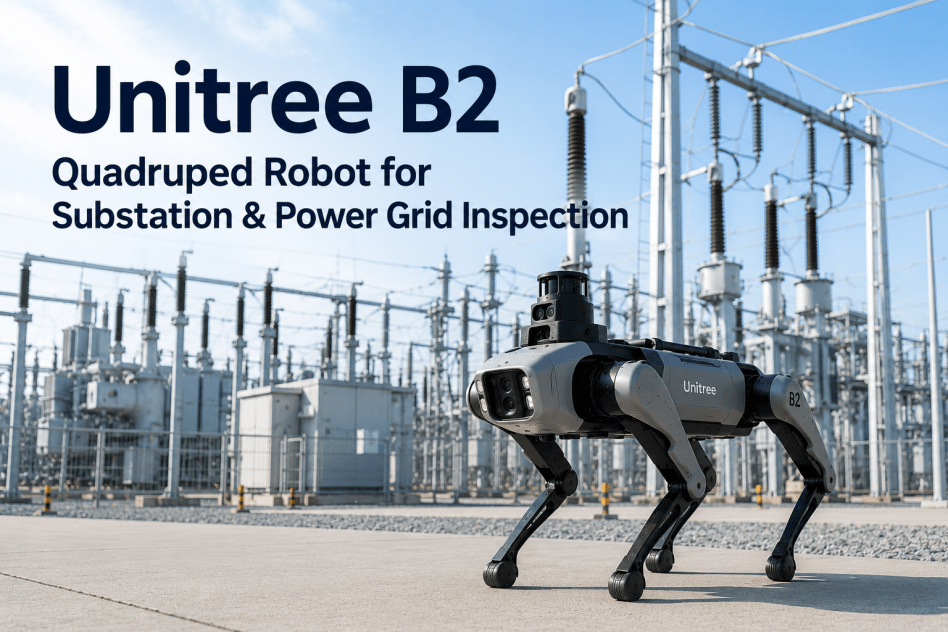
The night shift operator at a 500 MW combined-cycle plant glances at the SCADA summary and sees no alarms — yet the unit is down 12 MW from rated output. Two miles away, inside the 230 kV switchyard, a bushing on the main step-up transformer is 18°C hotter than its sister phase. The thermal camera on the autonomous patrol robot caught it 90 minutes ago, but the alert was routed to a log that nobody reads until morning. By dawn, the dissolved gas analysis will show acetylene. The repair: $1.2 million and 11 days of forced outage. This is the gap between "no alarm" and "no risk" — and it's a gap that costs North American utilities an estimated $4 billion annually in unplanned substation failures.
Autonomous Thermal & Partial Discharge Robotics for HV/MV Substations — From 69 kV to 765 kV
iFactory deploys a single robot platform that performs IR scans, partial discharge detection, visual inspection, and dissolved-gas-equivalent thermal monitoring across every transformer, breaker, and switchgear cubicle in your substation — with results delivered to your operations team in real time, not a morning-after report.
Why Substation Robotics Must Cover Thermal, PD & Visual — Simultaneously
A single transformer failure at a 345 kV substation costs between $2 million and $8 million when you factor in replacement transformer lead times (18–24 months for a large GSU), outage penalties, and emergency mobilization. Yet most substations still rely on quarterly handheld IR scans and annual PD surveys. The gap between those snapshots is where failures happen. iFactory's autonomous robot performs continuous thermal scanning of every bushing, every tap changer, every MV switchgear cubicle, and every SF6 breaker — while simultaneously collecting partial discharge data via UHF and HFCT sensors. The same patrol that catches a 12°C rise on a 230 kV bushing also flags a 150 pC PD signal on a 13.8 kV feeder breaker. The operations team sees both anomalies on the same dashboard, within the same shift.
Six Inspection Modalities in a Single Autonomous Platform
Each robot carries a sensor payload that replaces four separate inspection crews. Below are the six core capabilities, grouped by the failure mode they detect.
High-Resolution IR Scanning — All HV Bushings & Connections
640 x 480 radiometric thermal camera captures every bushing, disconnect switch, and bus splice in the substation. The onboard AI detects temperature differentials as small as 2°C against IEEE C57.91 loading curves and flags any asset exceeding its expected thermal profile. Patrol frequency: every 4 hours or on-demand via operator dispatch.
MV Switchgear & Breaker Cabinet IR Patrol
For indoor and outdoor metal-clad switchgear, the robot positions a micro-bolometer at each cubicle viewing window to measure internal connection temperatures. Detects loose bus connections, failing vacuum interrupters, and overloaded feeder cables — the leading cause of switchgear failures in plants over 20 years old.
UHF & HFCT Partial Discharge Detection — Live Assets
Onboard UHF antenna and high-frequency current transformer (HFCT) clamps detect PD activity from 1 picoCoulomb sensitivity. The robot docks at each test point — transformer bushing tap, cable termination, GIS compartment — and captures a 10-second PD spectrum. Results are correlated with thermal data to distinguish "hot and quiet" from "hot and sparking."
High-Resolution Visual & Thermal Fusion Imaging
4K visual camera with 30x optical zoom captures oil leaks, corroded hardware, wildlife intrusion, and insulator damage. Thermal and visual images are fused into a single overlay so operators can see both the temperature gradient and the physical condition of the asset in one frame.
Ultrasonic & SF6 Leak Detection
An ultrasonic microphone array detects high-frequency acoustic emissions from corona discharge, arcing, and gas leaks. The robot also carries a tunable diode laser absorption spectroscopy (TDLAS) sensor for SF6 leak quantification. Detects leaks as small as 1 gram per hour — far below the 10 g/hr threshold that triggers mandatory reporting under EPA's SF6 regulations.
Ambient & Load Correlation for IEEE C57 Compliance
The robot logs ambient temperature, humidity, and wind speed at each patrol point. This data is used to normalize thermal readings against IEEE C57.91 loading tables, so a 15°C rise on a 100 MVA transformer is correctly interpreted as "within limits at 80% load" or "dangerous at 40% load." Eliminates false alarms from ambient shifts.
One robot. Six inspection modalities. Zero infrastructure changes. Book a 30-min walkthrough and we'll show you live patrol footage from an operating 345 kV substation.
From Substation Entry to Operations Dashboard — Four Steps
The iFactory robot deploys in existing substations with zero infrastructure changes. No fiber runs. No new sensors. No downtime.
Site Survey & Waypoint Mapping
Our deployment team walks the substation once, mapping every transformer, breaker, switchgear row, and PD test point into the robot's navigation system. The robot learns the gravel paths, the gate positions, and the exclusion zones around live equipment.
Autonomous Patrol Execution
The robot navigates autonomously through the substation, stopping at each waypoint to capture thermal, visual, PD, and acoustic data. A full 20-acre substation with 15 transformers and 40 switchgear cubicles takes 90 minutes. The robot recharges at its docking station and begins the next patrol automatically.
Real-Time AI Analysis & Alerting
Onboard edge AI processes every thermal image, PD spectrum, and ultrasonic recording within seconds. Anomalies are compared against the asset's historical baseline and IEEE/NERC thresholds. Any reading exceeding the alert threshold is pushed to the plant's operations console, SCADA historian, and mobile notification system within 60 seconds of detection.
Trend, Report & Compliance Dashboard
All patrol data is stored in a time-series database that generates NERC-compliant inspection reports, thermal trend charts, and PD progression curves. The operations team can review the last 12 months of any asset's thermal profile in three clicks. Reports are exportable for NERC PRC-005 and IEEE C57 audit documentation.
Three Failure Modes That Quarterly Handheld Inspections Miss
The average North American substation receives a full thermal scan every 90 days. Between those scans, thousands of hours of operating time pass without any condition monitoring. Here are three real failure sequences that occur in that gap.
Bushing Thermal Runaway — Missed by 72 Hours
A 230 kV bushing with a 12°C rise at the oil-to-paper interface will escalate to catastrophic failure in 3 to 7 days. A quarterly handheld IR scan has a 98.7% chance of missing this window. The replacement cost for a single 230 kV bushing is $80,000 to $150,000, plus the forced outage cost of $500,000 per day for a baseload unit.
Partial Discharge on MV Switchgear — 150 pC to Flashover in 30 Days
A 150 pC PD signal on a 13.8 kV feeder breaker will progress to a phase-to-ground flashover in 30 to 60 days under normal load. PD surveys are typically performed annually. The resulting arc flash event destroys the switchgear cubicle, requires a 2-week outage, and costs $1.2 million in repairs and lost generation.
SF6 Leak — Undetected Until Annual Refill
A 5 g/hr SF6 leak from a 345 kV breaker will deplete the gas charge by 43 kg per year — enough to trigger mandatory EPA reporting and a $40,000 penalty. Without continuous monitoring, the leak is detected only during annual gas top-up or when the breaker fails to operate due to low pressure. The robot's TDLAS sensor catches the leak on the first patrol.
One robot. Six inspection modalities. Zero infrastructure changes. Book a 30-min walkthrough and we'll show you live patrol footage from an operating 345 kV substation.
What Operators Achieve with Continuous Robotics Patrol
Results from iFactory deployments across 14 substations in the US and Canada, ranging from 69 kV distribution to 765 kV EHV.
One robot. Six inspection modalities. Zero infrastructure changes. Book a 30-min walkthrough and we'll show you live patrol footage from an operating 345 kV substation.
What Substation & Plant Operators Ask About Robotics Inspection
Your Substation's Next Failure Is Already Heating Up. See It Before the Alarm.
One robot. Six sensors. Every transformer, breaker, and switchgear cubicle — inspected every shift, not every quarter. We'll deploy a pilot in your substation within six weeks of your data access handover.


.png)