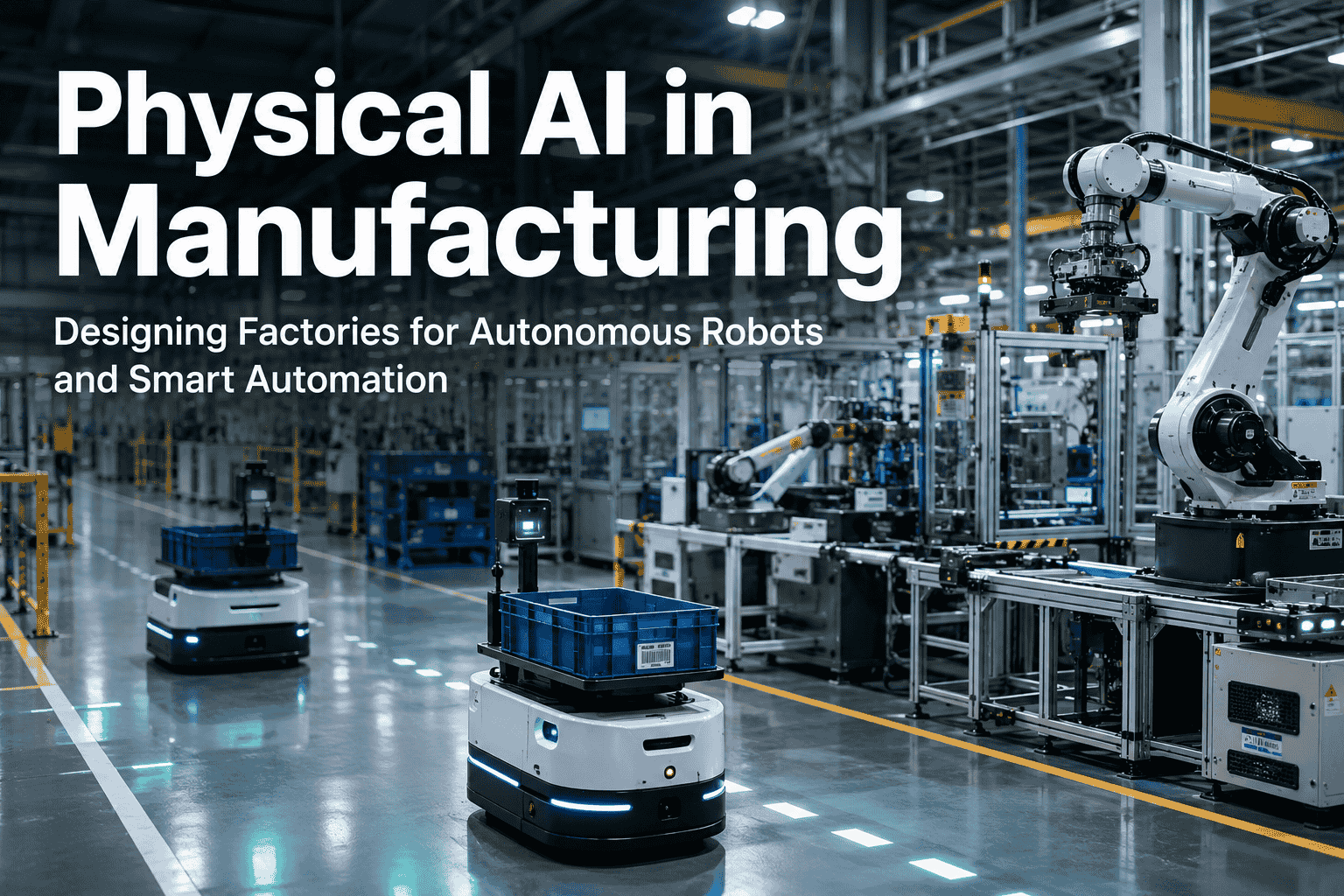
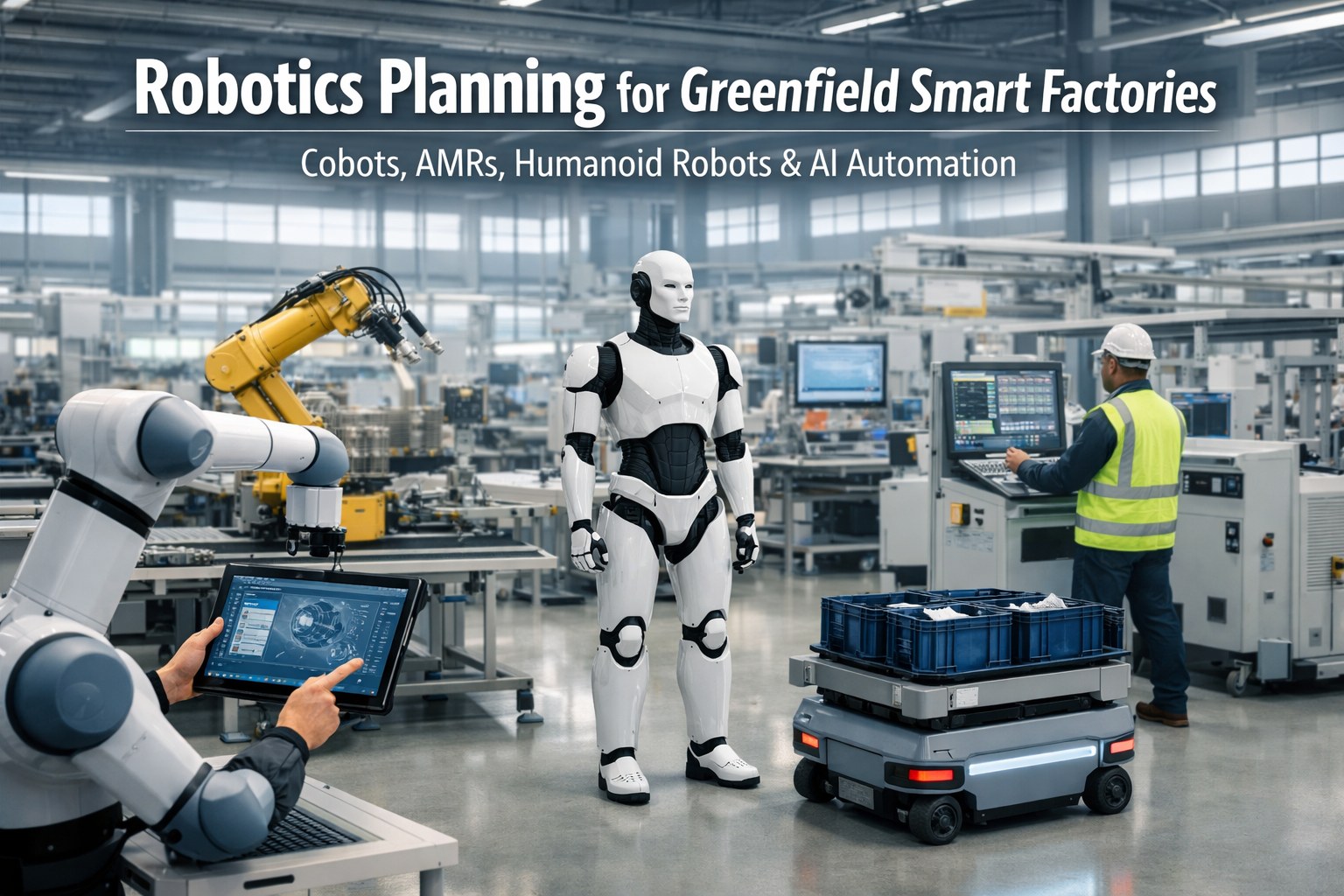
Physical AI in Manufacturing: Designing Factories for Autonomous Robots and Smart Automation
By Riley Quinn on June 11, 2026
Physical AI is the next inflection point in manufacturing — AI no longer trapped in dashboards, but embodied in robots that see, decide, and act on factory floors. Autonomous mobile robots, cobots, and humanoids running on foundation models like NVIDIA GR00T are turning sci-fi factory visions into commissioning timelines. Greenfield builders who design for physical AI today inherit a 10-year operational advantage. Request a smart factory automation assessment to map the right physical AI strategy for your facility.
Embodied Intelligence in Action
Perception → Cognition → Action
The closed loop that defines physical AI in manufacturing
Perception
Cameras · LiDAR · Force sensors · IMUs
AI Brain
Foundation models · Planning · Reasoning
Action
Robots · Manipulators · AMRs · Cobots
Continuous feedback loop · learning every cycle
110+
Robot brain developers in the NVIDIA ecosystem
7 mo
From concept to factory (vs. 2 yr traditional)
2026
Humanoid robots in production factories
What Is Physical AI?
Physical AI — sometimes called embodied AI — is artificial intelligence that perceives the physical world through sensors, reasons about it using foundation models, and acts on it through robotic bodies. Where traditional AI lives in dashboards and recommendations, physical AI moves boxes, assembles components, inspects welds, and navigates around forklifts. The shift is as fundamental as the move from mainframes to PCs: AI is leaving the data center and walking onto the factory floor.
Traditional AI
Lives in Software
Where it runsCloud, dashboards, MES
OutputPredictions, alerts, reports
InteractionOperator reads & reacts
ExamplesPredictive maintenance, vision inspection
vs
Physical AI
Lives in Hardware
Where it runsEdge compute on robot bodies
OutputPhysical actions in real world
InteractionRobot acts autonomously
ExamplesAMRs, cobots, humanoid manipulators
The 5 Categories of Physical AI Agents
Not every robot on the factory floor is physical AI. The distinguishing feature is autonomy — the ability to perceive, decide, and act without rigid pre-programming. Here are the five categories you'll encounter when designing a greenfield smart factory, ranked by autonomy level.
01
Industrial Robotic Arms
Fixed · Pre-programmed · 5-6 DOF
Traditional 6-axis manipulators for welding, painting, palletizing. Pre-programmed paths. AI vision now retrofits them for adaptive picking and bin selection.
Autonomy
L1
FANUC · ABB · KUKA · YASKAWA
02
Cobots (Collaborative Robots)
Stationary · Force-aware · Human-safe
Lightweight robotic arms designed to work alongside humans without safety cages. Force/torque sensors stop on contact. Used for assembly, machine tending, and quality checks.
Autonomy
L2
Universal Robots · Franka · Doosan
03
Automated Guided Vehicles (AGVs)
Mobile · Fixed paths · Magnetic/optical guidance
Follow predefined routes via wires, magnets, or QR codes. Reliable but inflexible — any layout change requires re-engineering the guidance infrastructure.
Autonomy
L3
Daifuku · Dematic · JBT
04
Autonomous Mobile Robots (AMRs)
Mobile · Free navigation · SLAM-based
Dynamic navigation using LiDAR, cameras, and SLAM algorithms. Adapt to layout changes, avoid obstacles, re-route on the fly. The workhorses of modern smart factories.
Autonomy
L4
Locus · Mobile Industrial Robots · 6 River
Frontier
05
Humanoid & Mobile Manipulators
Mobile + Manipulating · Foundation-model driven
General-purpose robots that combine mobility with dexterous manipulation. Running on foundation models like NVIDIA GR00T, they execute multi-step tasks from natural-language instructions.
Autonomy
L5
Figure · Agility · Boston Dynamics · NEURA
Pick the Right Physical AI Agents for Your Factory
iFactory's smart automation team helps greenfield builders match the right mix of cobots, AMRs, and humanoid manipulators to specific production workflows — and design the factory layout that makes them productive from day one.
Behind every autonomous robot is a five-layer software stack. Understanding it is essential for greenfield procurement — buy hardware that can't host modern foundation models, and your robots are stuck at yesterday's autonomy level forever.
On-robot GPUs, LiDAR, depth cameras, force sensors, IMUs, manipulators
Jetson ThorRealsenseLiDAR
Building a physical AI stack from the ground up? Schedule a strategy session to architect your robotics infrastructure.
Designing a Greenfield Factory for Physical AI
Physical AI doesn't fit into legacy factory layouts. The aisles, charging stations, network coverage, and safety zones a 1990s factory was built for actively constrain modern autonomous systems. Greenfield is your one chance to design the building around the robots — not retrofit robots into the building.
Layout
Floor Plan & Traffic Design
Aisles minimum 1.8m wide for two-way AMR traffic
Flat, level floors (≤2mm/m gradient) for stable navigation
Designated docking and charging zones at zone perimeters
Clear sight-lines for LiDAR/camera localization
No reflective surfaces in robot lanes (mirrors confuse sensors)
Network
Connectivity & Edge Compute
Wi-Fi 6E or Wi-Fi 7 coverage with seamless roaming
Private 5G for sub-1ms latency robotic control zones
Edge compute nodes (≥1 per production cell)
Redundant fiber backhaul to cloud platforms
QoS prioritization for robot control traffic
Safety
Human-Robot Coexistence
ISO 10218 / ISO/TS 15066 compliance for cobot zones
Safety scanners and emergency stops in shared spaces
The "factory of the future" isn't a concept anymore. Major manufacturers are running physical AI in production today — and reporting the kind of step-change improvements that traditional automation can't deliver.
Amazon Robotics
BlueJay multi-arm manipulator on Jetson platform
Used NVIDIA Omniverse and Isaac Sim to compress development cycles. The BlueJay system for picking, stowing, and consolidating moved from concept to production in just over a year.
~1 yr
Concept to production deployment
Siemens · Erlangen Plant
Humanoid HMND 01 wheeled robot · Jetson Thor
First proof of concept for autonomous humanoid logistics inside Siemens' blueprint autonomous electronics factory. Simulation-first development on Isaac Sim and Isaac Lab.
7 mo
Hardware development time (vs. 24 mo traditional)
Boston Dynamics
Atlas humanoid · Cross-embodied training
Training cross-embodied robot brains using Isaac Lab for reinforcement learning and Cosmos world models for generating synthetic training datasets at scale.
100x
Synthetic training data generation rate
Figure AI
Figure 02 humanoid · BMW manufacturing
Production deployment in BMW's South Carolina plant for body shop tasks. End-to-end neural network controls all manipulation, learning from real factory data.
2026
Year humanoid robots entered live BMW production
Ready to follow Siemens, Amazon, and BMW into physical AI deployment? Book a demo of iFactory's smart factory platform.
The Physical AI Adoption Roadmap
Most factories won't jump from zero to humanoids overnight. The realistic path is a four-phase journey, with each phase building data, infrastructure, and operational confidence for the next. Skip phases at your peril.
Phase 1
Fixed Automation
Year 0-1
Industrial robotic arms for repetitive welding, painting, palletizing. Pre-programmed paths.
Deploy AMR fleets for intralogistics. Build fleet management, charging, and orchestration platforms.
Autonomous material flow at scale
Phase 4
Embodied Foundation Models
Year 3+
Mobile manipulators and humanoids running foundation models. Natural-language task assignment. Self-improving fleet.
General-purpose autonomous factory
Expert Perspective
The transition from automation to physical AI isn't about replacing humans with robots. It's about giving every robot the ability to learn, generalize, and improve from real-world experience. The factories designed around this principle today will operate with capabilities the rest of the industry won't have for a decade. Physical AI is the next moat — and greenfield is your only window to build it deep.
— Industrial Robotics Strategy Best Practice
$24B
Humanoid robotics market by 2030
12x
Development cycle compression via simulation-first
L1-L5
Autonomy levels from fixed to foundation-model robots
4 phases
Standard adoption roadmap to embodied AI
Bottom Line · Design Your Factory for the Robots You Don't Have Yet
Physical AI isn't coming — it's here. NVIDIA's foundation models, Figure's humanoids in BMW plants, Amazon's AMR fleets, Siemens' autonomous electronics factory. The greenfield decision isn't whether to embrace embodied intelligence; it's whether your floor plan, network, charging infrastructure, and safety zones will accommodate the robots arriving over the next 5-10 years. Design for L1 today, but build the bones for L5 tomorrow. The factories that get this right will compound autonomy advantages every year. The ones that don't will spend the next decade retrofitting buildings that fight their robots at every turn.
Design Your Factory for the Physical AI Era
iFactory's greenfield consulting team helps manufacturers architect buildings, networks, and operations for autonomous robots from day one — combining AI-driven planning with deep robotics expertise. Build a factory ready for what's coming, not what's already here.
Physical AI — also called embodied AI — is artificial intelligence that perceives the physical world through sensors, reasons about it using foundation models, and acts on it through robotic bodies. Where traditional AI runs in dashboards producing predictions and alerts, physical AI runs on edge compute inside robots, taking direct physical action — moving materials, assembling components, inspecting welds, navigating around forklifts. Examples include autonomous mobile robots (AMRs), collaborative robots (cobots), and humanoid robots from companies like Figure, Agility, and Boston Dynamics. The shift from traditional AI to physical AI is as fundamental as the move from mainframes to PCs — AI is leaving the data center and walking onto the factory floor.
What is the difference between AMRs, AGVs, and cobots?
AMRs (Autonomous Mobile Robots) navigate freely using LiDAR, cameras, and SLAM algorithms — they adapt to layout changes and avoid obstacles dynamically. AGVs (Automated Guided Vehicles) follow predefined paths via magnetic strips, wires, or QR codes — reliable but inflexible, requiring infrastructure changes for any layout modification. Cobots (Collaborative Robots) are stationary robotic arms designed to work alongside humans without safety cages, using force/torque sensors to stop on contact. AMRs handle dynamic intralogistics, AGVs handle predictable repetitive transport, and cobots handle assembly, machine tending, and quality checks at fixed workstations. Most modern smart factories deploy a mix of all three, plus traditional industrial arms and increasingly humanoid manipulators for general-purpose tasks.
What is NVIDIA Isaac and how does it relate to physical AI in factories?
NVIDIA Isaac is a complete physical AI platform combining simulation (Isaac Sim, Isaac Lab), foundation models (Isaac GR00T), edge compute hardware (Jetson Thor), and perception libraries (Isaac Perceptor). It enables manufacturers and robot builders to develop, train, and deploy autonomous robots using simulation-first workflows that compress development cycles by 10x or more. Major manufacturers and robot OEMs use Isaac to accelerate deployment: Amazon Robotics compressed development of its BlueJay manipulator to about a year, Siemens reduced humanoid hardware development from 24 months to 7 months, and Boston Dynamics uses Isaac Lab to train cross-embodied robot brains. NVIDIA also released Cosmos world models for generating synthetic training data at scale, dramatically reducing the cost of teaching robots new tasks.
How do I design a greenfield factory for physical AI?
Greenfield factory design for physical AI requires attention across four domains. Layout: aisles minimum 1.8m wide for two-way AMR traffic, flat floors with ≤2mm/m gradient, no reflective surfaces in robot lanes, clear sight-lines for sensor localization. Network: Wi-Fi 6E or Wi-Fi 7 with seamless roaming, Private 5G for sub-1ms latency robotic control, edge compute nodes per production cell, redundant fiber backhaul. Safety: ISO 10218 and ISO/TS 15066 compliance for cobot zones, color-coded zones (human-only, robot-only, collaborative), safety scanners and emergency stops, speed limits in mixed-traffic areas. Power: opportunity charging stations every 30-50m, sized for fleet size plus 20% growth headroom, UPS backup for edge compute, battery swap stations for 24/7 fleets. Retrofitting any of these post-commissioning costs 5-10x more than including them in original design.
When should manufacturers adopt humanoid robots in factories?
Humanoid robots are entering live manufacturing today — Figure AI is deployed in BMW's South Carolina plant, Siemens runs Humanoid's HMND 01 in Erlangen, Amazon is piloting Agility's Digit. But humanoids sit at Phase 4 of the physical AI adoption roadmap. Most manufacturers should move sequentially: Phase 1 fixed industrial arms (Year 0-1), Phase 2 cobot integration (Year 1-2), Phase 3 AMR fleet operations (Year 2-3), Phase 4 embodied foundation models and humanoids (Year 3+). Skipping phases creates organizational and infrastructure debt — workforces that aren't trained for human-robot interaction, networks that can't handle robot control traffic, charging infrastructure sized for the wrong fleet, MES systems that can't orchestrate autonomous tasks. For greenfield builders specifically, design the building for Phase 4 even if you'll start at Phase 2 — the bones must support the future. Book a physical AI roadmap session to map your phased adoption.