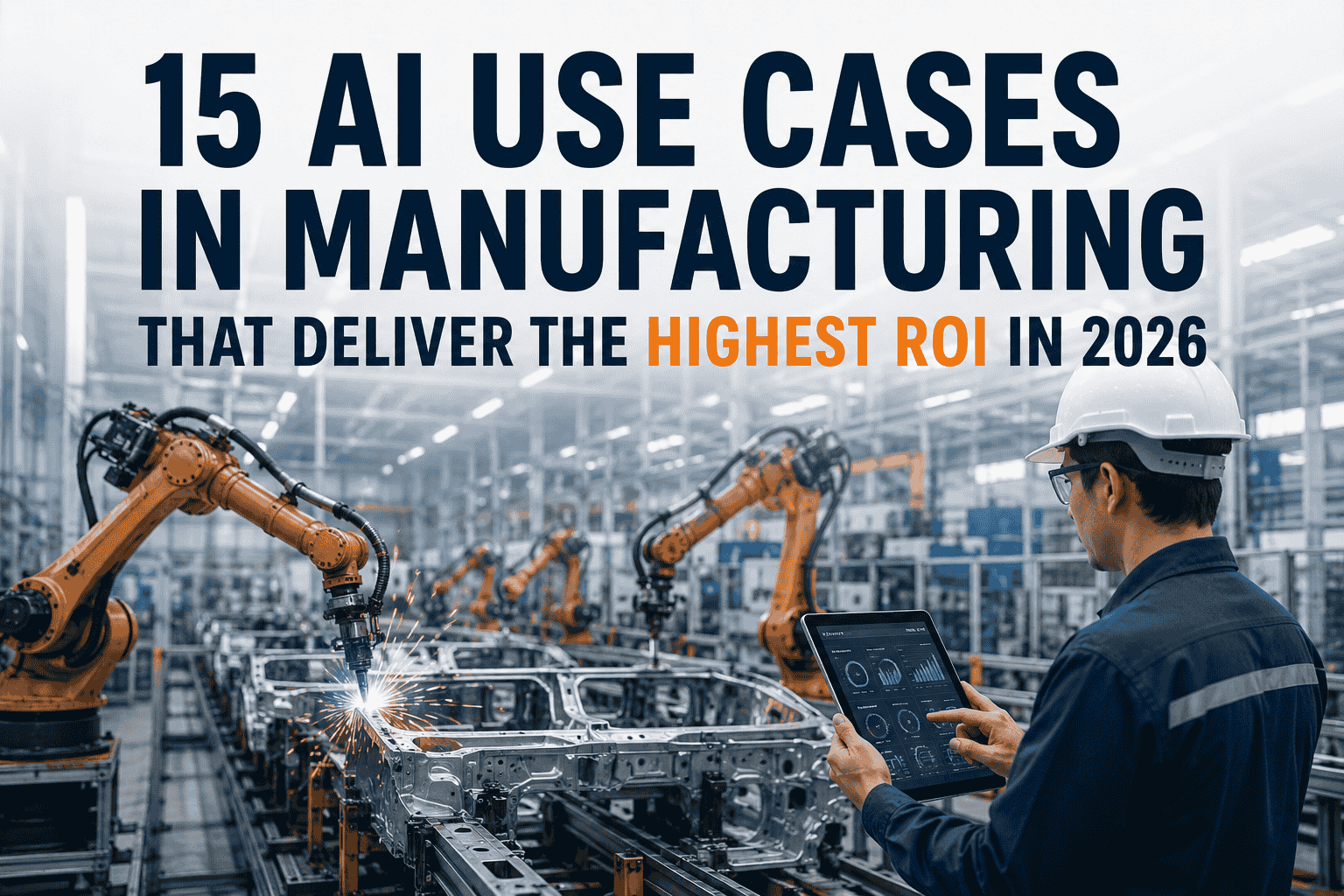
15 AI Use Cases in Manufacturing That Deliver the Highest ROI
By Riley Quinn on June 10, 2026
AI in manufacturing has crossed the threshold from "interesting experiment" to "measurable ROI". Manufacturers report an average 200% return on AI investments — the highest of any sector — and the gap between leaders and laggards is widening fast. The question isn't whether to deploy AI; it's which use cases pay back first. Book an AI readiness assessment to map the highest-ROI use cases for your factory.
AI Manufacturing ROI Dashboard · 2026
Average ROI
200%
Highest of any sector globally
0%100%200%300%
$47.9B
AI manufacturing market by 2030
42%
Manufacturers using AI today
3-6 mo
Payback for Tier 1 use cases
15
Proven ROI use cases (this list)
The 15 Use Cases at a Glance — Ranked by ROI
Before the deep dive: here's the full ranking. Top 5 deliver fastest payback. Next 5 unlock structural gains. Final 5 are strategic transformation bets. Bar width reflects relative ROI magnitude.
01
Predictive Maintenance
400% ROI
3-6 mo
02
Computer Vision Quality Inspection
350% ROI
3-6 mo
03
Energy Consumption Optimization
280% ROI
3-6 mo
04
AI Anomaly Detection
250% ROI
3-6 mo
05
Demand Forecasting
240% ROI
3-6 mo
06
AI Production Scheduling
220% ROI
6-12 mo
07
Quality Prediction
210% ROI
6-12 mo
08
Inventory Optimization
200% ROI
9-15 mo
09
Yield Optimization
190% ROI
12-18 mo
10
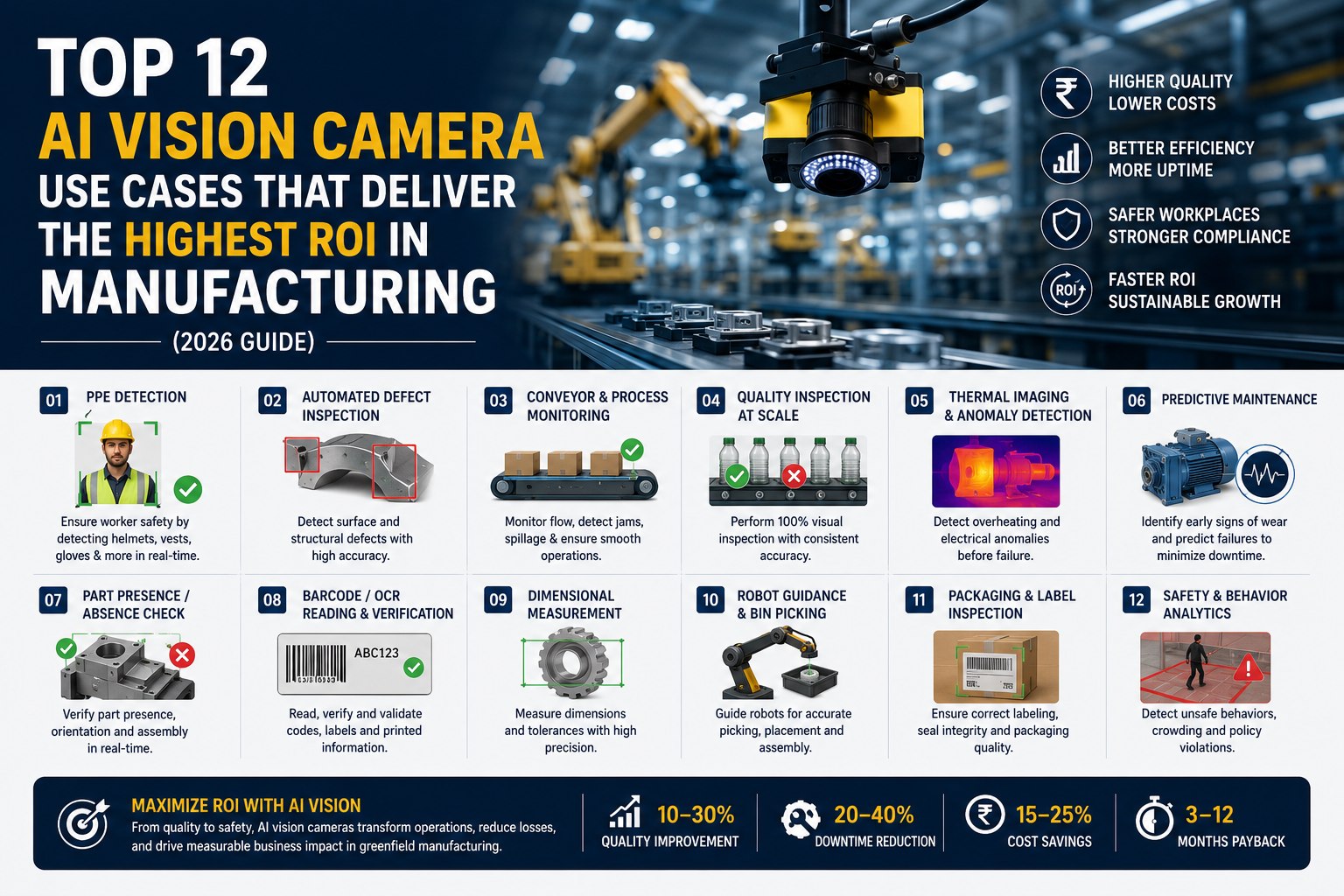
Worker Safety & PPE Monitoring
170% ROI
9-18 mo
11
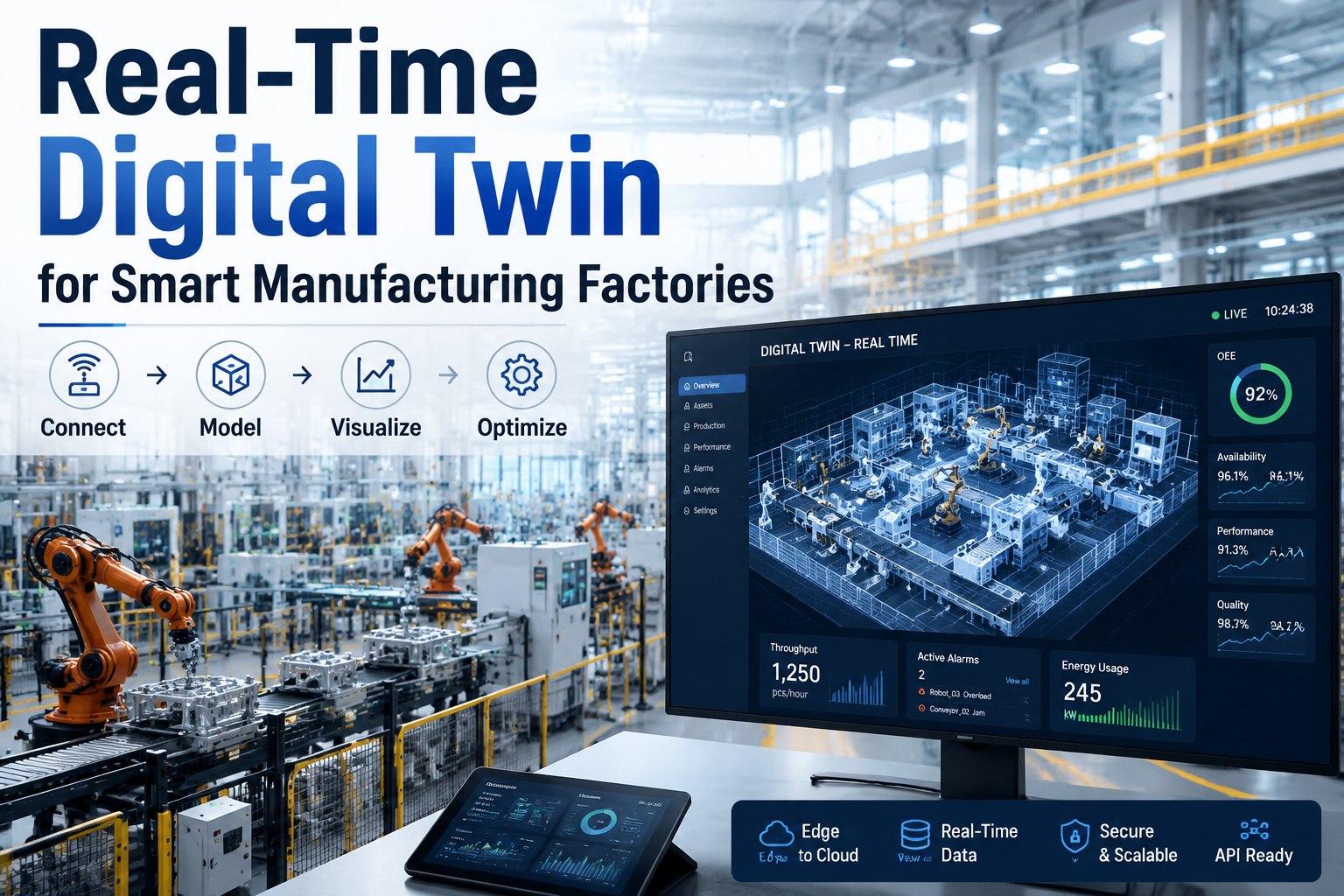
Digital Twin for Production
160% ROI
18-24 mo
12
Supply Chain Risk Prediction
150% ROI
18-24 mo
13
Generative Design (AI CAD)
140% ROI
18+ mo
14
AI Root Cause Analysis
125% ROI
18+ mo
15
Autonomous Process Control
110% ROI
24+ mo
Tier 1: Quick Wins (3-6 mo)
Tier 2: High Impact (6-18 mo)
Tier 3: Transformational (18+ mo)
How We Scored the 15 Use Cases
Not every AI use case in manufacturing deserves equal weight. The four-criterion framework below filters vendor hype from deployable reality. Each use case had to score on all four dimensions before earning a spot.
Data Availability
25%
Use case must run on data factories already generate — not data they'd need to collect from scratch.
Time to Value
30%
Pilot must show measurable impact within 18 months. Five-year payback projects don't survive budget cycles.
Measurable Baseline
25%
Operations must already track the KPI being improved — downtime, scrap rate, energy use — so ROI is provable.
Integration Feasibility
20%
Use case must integrate with existing MES, SCADA, ERP — not require ripping out core OT systems.
Tier 1 · The Quick Wins (Use Cases 1-5)
These five deliver the fastest, most provable ROI. They use data factories already collect, plug into existing systems, and produce results operators validate against their own experience. Start here — every successful AI program does.
01
Predictive Maintenance
Payback: 3-6 months
AI analyzes vibration, temperature, current, and acoustic signals to predict equipment failures days or weeks before they happen. Replaces reactive "fix-when-broken" with planned interventions during scheduled downtime.
ROI
400%
↓ 30-50% downtime
↓ 25-40% maintenance cost
↑ 20-40% asset life
02
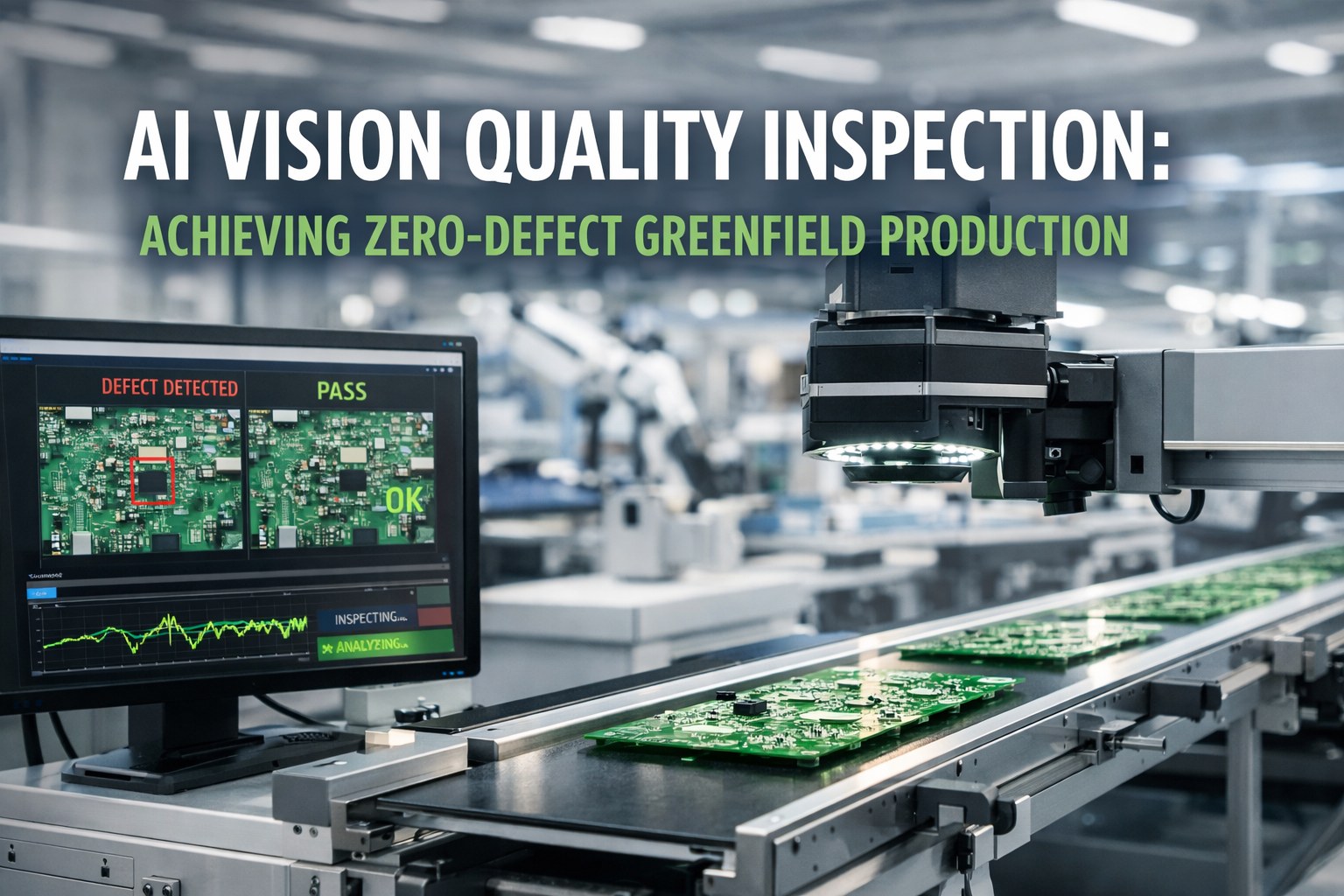
Computer Vision Quality Inspection
Payback: 3-6 months
Deep learning models inspect every unit at line speed, catching surface defects, assembly errors, and dimensional deviations with accuracy exceeding human inspection — and running 24/7 without fatigue.
ROI
350%
99%+ accuracy
↓ 60-90% inspection cost
100% coverage
03
Energy Consumption Optimization
Payback: 3-6 months
AI continuously tunes HVAC, compressed air, lighting, and motor loads against real-time production demand and time-of-use rates. Cuts utility bills without process changes or capital equipment.
ROI
280%
↓ 10-20% energy use
12% avg savings
ESG-aligned
04
AI Anomaly Detection
Payback: 3-6 months
Unsupervised models flag unusual process behavior — drifting setpoints, abnormal cycle times, unexpected sensor patterns — minutes after onset, before they cascade into defects, scrap, or downtime.
ROI
250%
5x faster detection
↓ 40% upset events
Always-on
05
Demand Forecasting
Payback: 3-6 months
ML models combine historical sales, market signals, weather, and promotions to predict SKU-level demand with 10-30% lower error than statistical methods. Drives production planning accuracy.
ROI
240%
↑ 10-20% forecast accuracy
↓ 20% inventory cost
SKU-level
Pilot a Tier 1 AI Use Case in 90 Days
iFactory partners with operations teams to deploy predictive maintenance, vision inspection, and energy optimization pilots that prove ROI within the first quarter. No long discovery phase. No vendor lock-in.
These five require deeper integration but unlock structural gains — touching scheduling logic, quality systems, inventory policies, and workforce safety. Most pay back within 12-18 months once data foundations from Tier 1 are in place.
06
AI Production Scheduling
AI solvers optimize schedules against machine availability, material lead times, workforce capacity, and changeover costs — finding solutions human planners take weeks to identify.
Without AI
Baseline throughput
With AI
↑ 10-15% throughput
07
Quality Prediction
Instead of inspecting after the fact, AI predicts defect probability from live process parameters. Operators adjust before scrap is produced.
Without AI
Baseline scrap rate
With AI
↓ 30-50% scrap
08
Inventory Optimization
ML balances holding costs, stockout risk, and lead-time variability to set dynamic reorder points across raw materials, WIP, and finished goods — replacing static safety stock rules.
Without AI
Baseline FG inventory
With AI
↓ 20-22% inventory
09
Yield Optimization
AI identifies process parameter combinations that maximize first-pass yield. Particularly powerful in process industries — semiconductors, chemicals, food, pharma — where variability compounds.
Without AI
Baseline yield
With AI
↑ 3-8% first-pass yield
10
Worker Safety & PPE Monitoring
Computer vision verifies PPE compliance, detects unsafe behavior, and triggers real-time alerts — replacing periodic safety audits with continuous monitoring on every shift.
Without AI
Baseline incident rate
With AI
↓ 40-70% incidents
Moving beyond pilots into integrated AI operations? Schedule a strategy session to scope your Tier 2 deployment roadmap.
Tier 3 · Transformational Use Cases (Use Cases 11-15)
These five reshape how manufacturing decisions get made. ROI takes longer to materialize — 18+ months minimum — but the strategic payoff separates AI leaders from followers. Real companies running these today, real numbers.
11
Strategic Play
18-24 months
Digital Twin for Production
Virtual replica of the factory floor lets teams simulate process changes, line balancing, or new product introductions before touching real equipment. Used by 50%+ of large industrial facilities.
Siemens · Boeing · GE
$1.2M-$3.5M annual savings · 65% changeover time reduction
12
Strategic Play
18-24 months
Supply Chain Risk Prediction
ML monitors supplier performance, geopolitical signals, logistics data, and raw material markets — flagging disruption risks 2-4 weeks before impact. Buys time to rebalance sourcing.
Procter & Gamble · Unilever · BMW
↓ 40-60% disruption severity · 2-4 week early warning lead time
13
Strategic Play
18+ months
Generative Design (AI CAD)
AI generates thousands of design alternatives meeting strength, weight, and cost constraints — finding solutions humans wouldn't propose. Cuts product development cycles dramatically.
Airbus · General Motors · Autodesk
↓ 40-60% design cycle time · ↓ 15-25% material costs
14
Strategic Play
18+ months
AI Root Cause Analysis
When defects, yield drops, or downtime events happen, AI correlates across hundreds of variables to find the actual cause — collapsing investigations from days of expert analysis to minutes.
Pfizer · Intel · Continental
↓ 70-90% investigation time · ↓ 50% defect recurrence
15
Strategic Play
24+ months
Autonomous Process Control
Reinforcement learning closes the loop — automatically adjusting process setpoints in real time to hold quality, yield, and throughput targets without operator intervention.
DeepMind · Google · ExxonMobil
↓ 40-50% process variability · ↓ 30% operator load
Planning a transformational AI deployment? Connect with our AI consulting team to architect a multi-year roadmap aligned to your factory's maturity.
AI Maturity Roadmap — Climb the Ladder
The biggest mistake in manufacturing AI is starting in the wrong tier. A factory at "Exploring" maturity jumping to digital twin deployment usually fails — not because the technology is wrong, but because the data, integration, and change-management foundations aren't in place. Find your rung; pick use cases that match.
Stage 1
Exploring
No AI in production · Manual reporting dominates · Data silos
Start withPredictive maintenance on one critical asset
Stage 2
Piloting
1-2 AI use cases live in pilot · MES/SCADA data accessible · Still siloed
Expand withVision inspection + energy optimization
Stage 3
Scaling
Multiple AI use cases in operation · Cross-system data integration mature
AddScheduling AI + quality prediction + yield optimization
Stage 4
Operating
AI embedded across operations · Closed-loop optimization · AI-native culture
UnlockDigital twin + autonomous control + generative design
Reality check: 42% of manufacturers have deployed some AI, but only 12% have scaled beyond single-use-case pilots. Most are stuck at Stage 2. The gap between Stage 2 and Stage 3 is where AI ROI compounds — and where most factories fail.
The factories winning with AI in 2026 aren't the ones with the biggest models or splashiest pilots. They're the ones that picked two or three high-ROI use cases, instrumented their data infrastructure properly, and scaled what worked. Pilots that don't connect to operational decisions are slide decks. Use cases that compound — predictive maintenance feeding scheduling, quality prediction informing process control — are how AI stops being a cost center and becomes a margin engine.
— Manufacturing AI Best Practice
200%
Average ROI from manufacturing AI investments
42%
Of manufacturers have deployed AI in some form
12%
Have scaled beyond single-use-case pilots
$47.9B
AI manufacturing market by 2030
Bottom Line · Build Your Roadmap Around ROI, Not Hype
The 15 use cases above represent the practical, deployable AI applications driving real ROI in manufacturing today. The winners aren't the factories that adopted everything — they're the ones that sequenced wisely. Start in Tier 1 with predictive maintenance and vision inspection. Use early wins to build data infrastructure. Layer in Tier 2 scheduling and quality prediction as integration matures. Save Tier 3 transformational use cases for when foundations are solid. The goal isn't to be on the bleeding edge — it's to be on the value edge.
Map Your Highest-ROI AI Use Cases
iFactory's AI manufacturing platform combines predictive maintenance, vision inspection, energy optimization, and scheduling AI in one integrated system. Skip the multi-vendor stitching. Get production-ready AI in months, not years.
What are the highest-ROI AI use cases in manufacturing in 2026?
The highest-ROI AI use cases in manufacturing are predictive maintenance, computer vision quality inspection, and energy consumption optimization — all delivering 200-400% ROI with 3-6 month payback periods. These work because they use data factories already generate (sensor streams, line images, utility meters), integrate easily with existing MES and SCADA, and produce results operators can validate immediately. Predictive maintenance alone reduces unplanned downtime by 30-50% and maintenance costs by 25-40%. Computer vision quality inspection achieves 99%+ defect detection accuracy at line speed. Energy optimization typically cuts utility bills 10-20% with no process changes. Manufacturers should start here before moving to Tier 2 and Tier 3 use cases.
How long does it take to see ROI from AI in manufacturing?
AI ROI timelines in manufacturing fall into three tiers. Quick-win use cases — predictive maintenance, vision inspection, energy optimization, anomaly detection, demand forecasting — pay back in 3-6 months. High-impact use cases like AI-driven scheduling, quality prediction, inventory optimization, yield improvement, and worker safety monitoring typically pay back in 6-18 months as data foundations are established. Transformational use cases — digital twins, supply chain risk AI, generative design, root cause analysis, autonomous process control — require 18+ months but unlock the largest strategic value. The average across all manufacturing AI investments is 200% ROI, the highest of any sector.
What is the difference between AI and traditional automation in manufacturing?
Traditional automation follows fixed rules — if X happens, do Y. It works well for stable, repetitive processes but breaks when conditions change. AI in manufacturing learns from data, recognizes new patterns, and adapts. A traditional vision system can only catch pre-programmed defect types; an AI vision system can recognize new defects it has never seen before, classify them, and improve over time. A traditional PLC follows hardcoded setpoints; an AI control system adjusts setpoints based on real-time conditions, raw material variability, and downstream demand. The result is automation that improves continuously without engineers reprogramming it — which is why AI delivers higher ROI than the previous generation of factory automation.
Which AI use case should manufacturers start with?
Manufacturers should start with predictive maintenance on a single critical asset or computer vision inspection on one production line. These two use cases consistently deliver the fastest, most measurable ROI because they solve universal pain points (unplanned downtime costs manufacturers an estimated $50 billion annually worldwide) and operate on data factories already collect. Successful pilots in these areas create internal momentum, build the data infrastructure needed for Tier 2 use cases, and prove out the change-management approach. Avoid starting with digital twins, generative design, or supply chain AI — these require mature data foundations early-stage factories don't have yet.
Why do most manufacturing AI projects fail to scale beyond pilots?
Roughly 42% of manufacturers have deployed AI in some form, but only 12% have scaled beyond single-use-case pilots. The most common failure pattern is treating AI as a technology project rather than an operations transformation — buying a platform without defining what "success" looks like in week two, then shutting the pilot down when nobody can answer that question. Other common failures: training models on clean lab data that doesn't survive contact with real factory conditions, no integration with MES/SCADA so insights don't drive operational decisions, and no change management so operators ignore AI recommendations. The factories that scale successfully start with a clear KPI, pick a use case where the data already exists, and connect predictions directly to operational actions. See how iFactory helps manufacturers scale AI beyond the pilot stage.