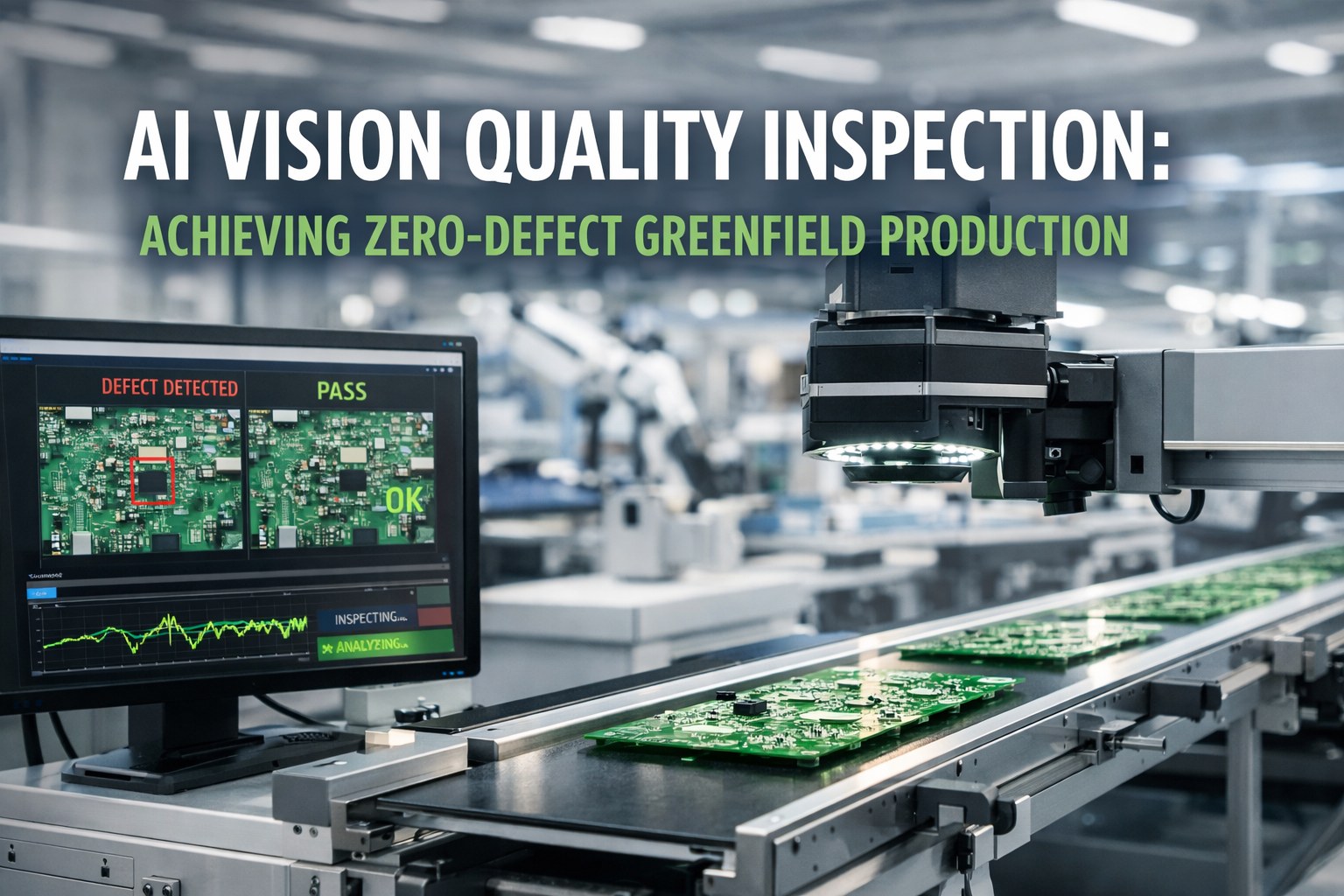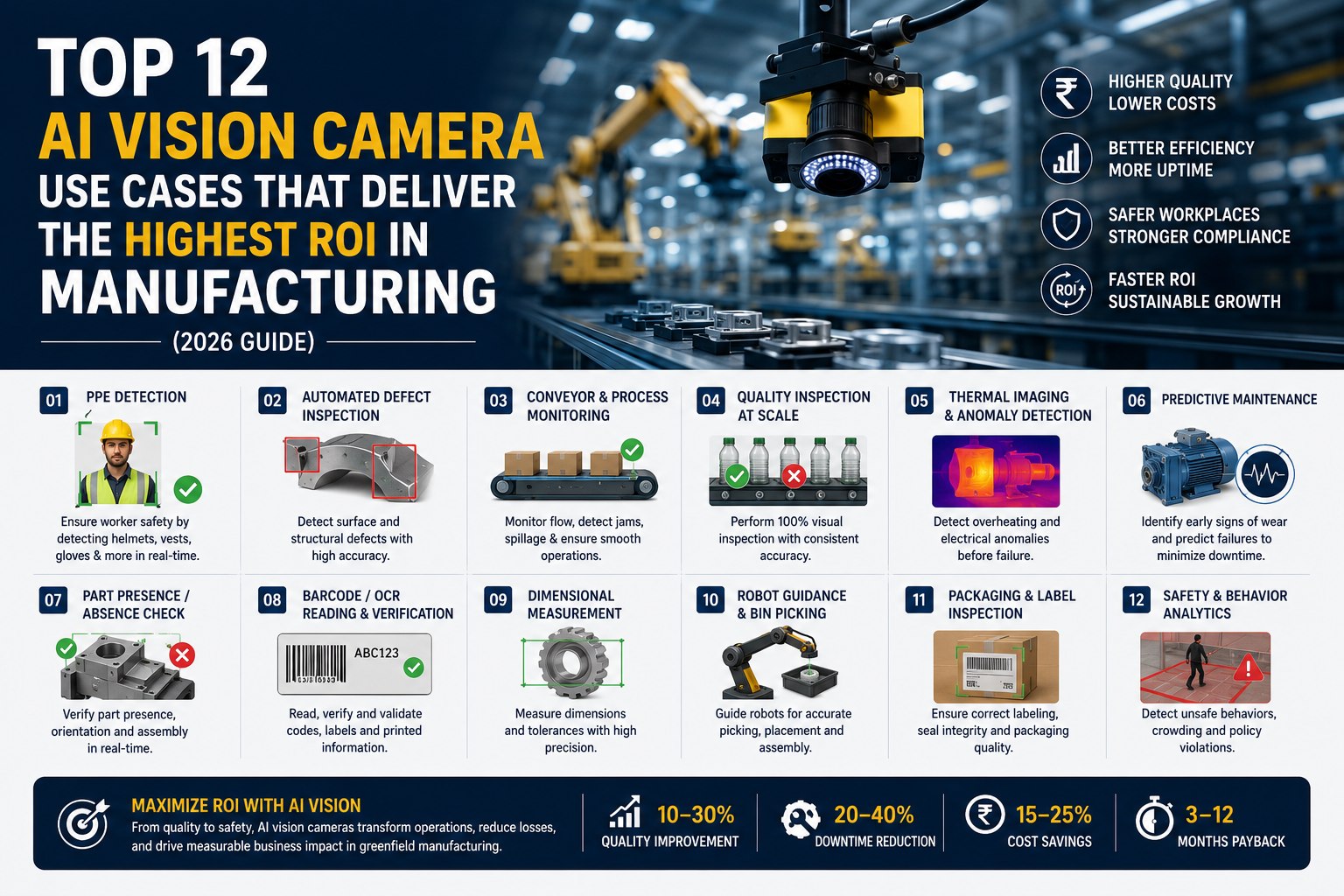
AI vision cameras have quietly become one of the fastest-paying investments a manufacturer can make — but not every use case pays back equally. The same camera and edge hardware can run defect detection, PPE monitoring, and thermal analysis at once, yet the smartest plants sequence their rollout by return, not by novelty. For a greenfield facility designing its camera strategy from scratch, knowing which applications deliver value first is the difference between a quick win and a stalled pilot. This guide ranks the top 12 AI vision camera use cases by ROI, so you can deploy the highest-impact ones first and let them fund the rest.
Planning your plant's AI vision strategy? Book a 30-minute greenfield AI vision consultation to map the highest-ROI use cases to your specific lines.
The Three Highest-ROI Use Cases
Why AI Vision Pays Back So Fast
The economics are unusually clean for an emerging technology. The cost of poor quality runs around 20% of revenue at a typical manufacturer, and a defect caught at an inspection station costs roughly $100 to fix versus $10,000 or more once it reaches a customer. AI vision flips that math by inspecting 100% of output instead of a sample, at speeds no human can match. Crucially, the returns compound: once an edge device is mounted, adding a second and third model — PPE, thermal, conveyor — on the same hardware carries near-zero marginal cost. If you want that math run against your own defect and downtime numbers, you can walk through it with an AI vision specialist.
average three-year ROI documented on AI visual inspection
defect detection accuracy versus roughly 80% for manual checks
reduction in defect rates after deployment
cut in scrap costs from catching issues earlier
The Top 12 AI Vision Camera Use Cases, Ranked by ROI
The list below runs from fastest payback to high-value operational wins. The bars show relative ROI strength, and payback figures are typical ranges drawn from industry deployments — your numbers depend on volume, defect cost, and downtime exposure.
Automated Defect & Surface Inspection
6–9 mo paybackCatches scratches, cracks, color drift, and burrs down to 0.1 mm at line speed — the most proven, highest-ROI vision application in manufacturing.
Predictive Maintenance via Vision
6–12 mo paybackTracks wear, alignment drift, and leak development on motors and drives — flagging failures weeks early and cutting unplanned downtime by up to 50%.
Thermal Hotspot & Electrical Anomaly Detection
<12 mo paybackRadiometric cameras spot temperature deviations as small as 0.1°C on panels, bearings, and gearboxes — preventing fires and catastrophic failures.
Assembly Verification & Completeness
6–10 mo paybackConfirms every component, fastener, and connector is present and correctly placed before a unit moves downstream — eliminating expensive rework.
PPE & Worker Safety Compliance
<12 mo paybackVerifies hardhats, vests, gloves, and goggles at 95–99% accuracy and logs every violation as auditable, OSHA-ready evidence — driving real behavior change.
Conveyor & Production Line Monitoring
<12 mo paybackDetects belt misalignment, spillage, jams, and hot material 8–24 hours before they would surface in a manual walkdown — preventing fires and stoppages.
Dimensional & Gauging Inspection
8–14 mo paybackPerforms sub-millimeter metrology on castings, machined parts, and stampings — replacing slow manual gauging with continuous, traceable measurement.
Label, Barcode & OCR Verification
9–14 mo paybackReads and validates labels, lot codes, and date stamps to stop mislabeled product and protect traceability across the line.
Packaging & Fill-Level Inspection
9–14 mo paybackChecks seal integrity, fill levels, cap presence, and count — catching packaging faults that trigger returns and customer complaints.
Zone Intrusion & Forklift-Pedestrian Safety
<12 mo paybackTracks vehicle-worker proximity, flags near-misses in blind spots, and enforces restricted-zone rules — a leading source of preventable injuries.
Foreign Object & Contamination Detection
10–16 mo paybackSpots foreign material and contamination in food and beverage lines — where a single missed event can mean a costly recall.
Inventory Counting & Material Tracking
6–12 mo paybackAutomates cycle counts and material tracking that used to tie up labor — an unglamorous use case that often delivers a surprisingly fast return.
Want these use cases prioritized for your facility and product mix? Book an AI vision ROI workshop and we will rank them against your real defect and downtime costs.
Where to Start: The Single-Station ROI Pattern
The plants that succeed with AI vision do not try to wire up fifty cameras at once. They prove the return on one high-impact station, then scale onto adjacent use cases using the same hardware. This is the four-step pattern iFactory uses to reach 99%+ accuracy in production.
-
1
Pick your highest-impact point
Start with a single station or two to three cameras at your costliest defect or downtime risk — not a plant-wide rollout.
-
2
Stand it up fast
Mount on existing IP cameras over ONVIF or RTSP, roughly 30 minutes per camera, and capture baseline images across good and defective parts.
-
3
Prove ROI in weeks
Shadow-run the model beside manual inspection for a week, resolve edge cases, and target 99%+ recall before full handover.
-
4
Scale onto adjacent use cases
Add PPE, thermal, and conveyor models on the same edge device — and route every detection straight into your CMMS as a work order.
Ready to prove ROI on your first station? Book a single-station AI vision demo and see detection running on your line in weeks, not months.
Turn One Camera Into a Plant-Wide ROI Engine
iFactory runs defect detection, PPE monitoring, thermal analysis, and predictive maintenance on the same edge hardware — and turns every detection into a tracked CMMS work order, so your highest-ROI use cases fund the next ones.
Expert Perspective
The mistake we see most often is teams treating AI vision as one big capital project instead of a sequence of fast wins. The right move is to pick the single use case with the clearest dollar cost — usually defect escape or unplanned downtime — prove it on one station, and let that return pay for the next model on the same camera. Once the hardware is in, the second and third use cases are almost free. ROI ranking is not academic; it is the deployment order.
— AI Vision Deployment Practice, iFactory Engineering Team
cost of a defect reaching the customer, versus ~$100 at the station
average annual unplanned downtime AI vision helps prevent
runs defect, PPE, and thermal models on the same hardware
The Bottom Line
AI vision stopped being experimental years ago — the case studies now show concrete dollar savings and payback measured in months. The winning strategy is not to chase every use case at once, but to rank them by return, start with the one that has the clearest cost attached, and scale onto adjacent applications on the same hardware. For a greenfield plant, building that ranking into your camera strategy from day one means each station you add is already justified before it is installed.
Build Your AI Vision Roadmap by ROI
From your first high-impact station to a plant-wide vision network, iFactory helps greenfield teams sequence AI vision use cases by return — so every camera earns its place before it goes live.
Frequently Asked Questions
What is an AI vision camera use case in manufacturing?
It is a specific task an AI-powered camera performs on the plant floor, such as detecting defects, verifying PPE, reading labels, or spotting thermal hotspots. A deep learning model analyzes the camera feed in real time and flags issues automatically. One camera can run several of these tasks at once on the same edge hardware.
Which AI vision use case has the highest ROI?
Automated defect and surface inspection is consistently the highest-ROI application, with documented three-year ROI around 374% and payback near 7 to 8 months. It pays back fastest because the cost of poor quality is large and easy to quantify, and AI inspects 100% of output rather than a sample.
How fast do AI vision cameras pay for themselves?
Most deployments pay back within 6 to 14 months, and high-volume defect inspection can break even in under 6. The return comes from reduced scrap, fewer customer returns and warranty claims, less manual inspection labor, and avoided downtime. A single inspection station often covers its cost inside the first year.
Can one AI vision camera handle multiple use cases?
Yes. On GPU-based edge hardware, a single camera can run defect detection, PPE compliance, and thermal anomaly models in parallel. Because the hardware is already in place, the second and third use cases carry almost no marginal cost, which is why compounding ROI is one of the biggest advantages of AI vision.
How do I start with AI vision in a greenfield plant?
Begin with one high-impact station rather than a plant-wide rollout. Mount on existing IP cameras, capture baseline images, shadow-run the model against manual inspection, and target 99%+ recall before handover, then scale onto adjacent use cases. You can book a greenfield AI vision consultation to plan the rollout.