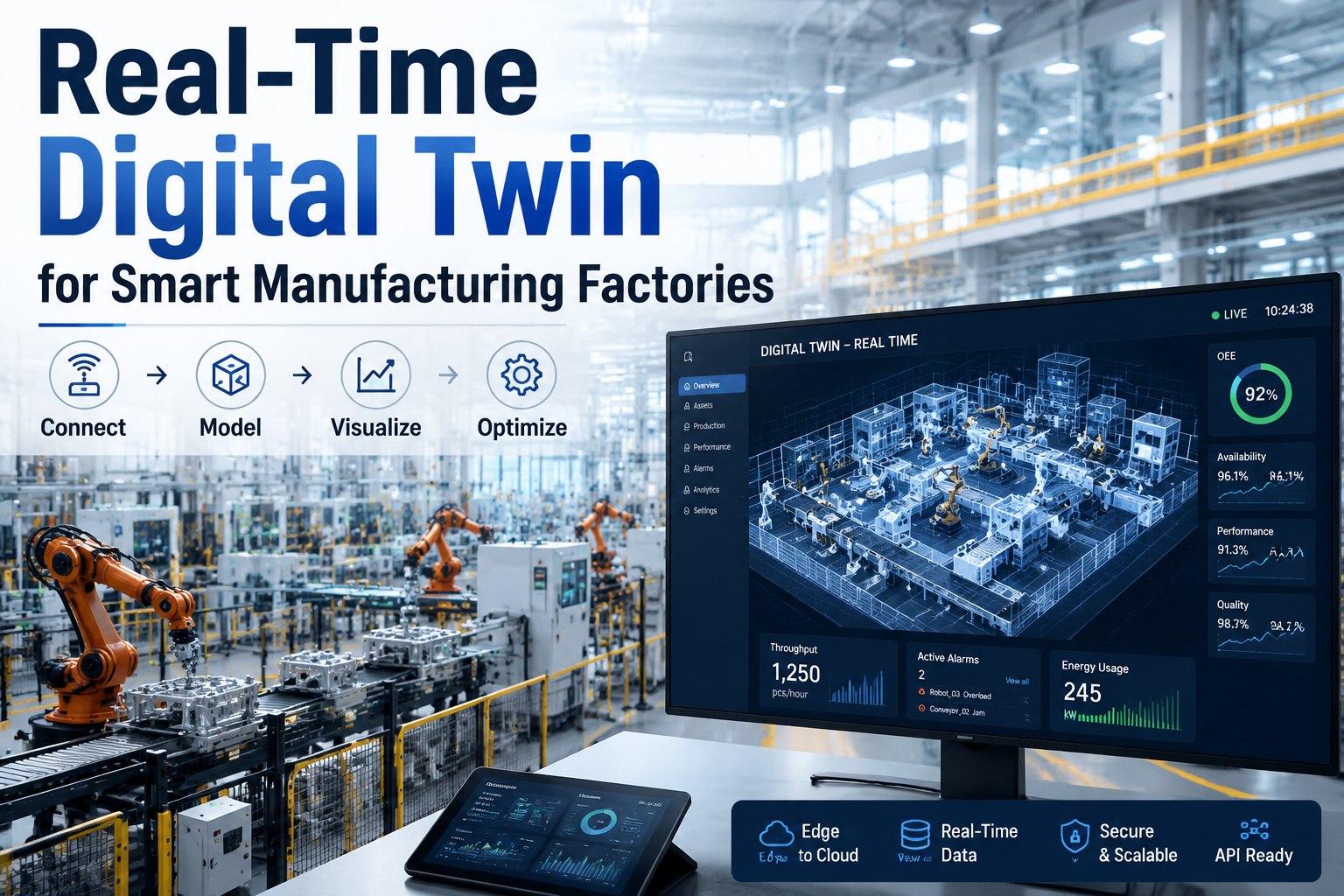
A real-time digital twin is not a 3D model sitting in a simulation tool. It is a live data layer — continuously fed by PLCs, sensors, SCADA systems, and OT networks — that mirrors your physical factory's behavior in virtual space with millisecond latency. When your factory twin is genuinely live, it predicts failures before they cascade, runs what-if scenarios without touching production, and turns every shift's operational data into permanent institutional intelligence. For greenfield plants, the competitive advantage is decisive: your twin is built before a single machine is commissioned, so every control sequence, material flow, and integration handshake is validated in virtual space first. The plants that get this right don't just launch on time — they launch already optimized.
See iFactory's real-time digital twin platform in action — 30-minute architecture walkthrough with a greenfield digital twin specialist.
Why Real-Time Is the Only Digital Twin Worth Building
There are two kinds of digital twins in manufacturing. The first is a simulation model — valuable for design and commissioning, but disconnected from live operations the moment the plant starts running. The second is a real-time twin: permanently synchronized to physical plant state via live data streams, continuously updating its model as conditions change, and capable of predicting problems before they manifest physically. For greenfield manufacturers, building the second kind from day one is what separates a smart factory from a smart-sounding factory.
reduction in development and commissioning time with digital twin virtual validation
reduction in unplanned downtime documented in production digital twin deployments
OEE increase at GM's Spring Hill plant after stamping-press digital twin deployment
annual savings achieved by Unilever across eight factories with AI-driven digital twins
Want to see what these results look like for your specific facility? Book a digital twin ROI assessment — iFactory models your operational data and projects twin value before you commit to infrastructure.
The Three Types of Manufacturing Digital Twin — and When You Need Each
McKinsey defines three scopes of manufacturing digital twin, each with distinct data requirements, integration depth, and ROI profile. For greenfield plants, the architectural decision is which twin type to build first — and how to design the data infrastructure so all three can be deployed progressively without rearchitecting from scratch.
Mirrors one physical asset — motor, CNC machine, press, or conveyor — in real time using PLC states, vibration, temperature, and power draw. Enables predictive maintenance, anomaly detection, and remaining useful life prediction at asset level.
Models entire production lines with live feeds from all assets, MES, ERP, and HMI. Enables dynamic scheduling, production optimization, bottleneck analysis, and what-if scenario simulation across the full line.
Extends the factory twin across the full supply chain — from supplier inventory through production and into distribution. Enables advanced planning, demand-driven scheduling, and supply risk prediction at enterprise scope.
Building the Data Architecture: What Goes Where and Why
Fifty-eight percent of digital twin project delays trace directly to OT/IT integration failures — not software limitations, not model complexity, not budget overruns. The data architecture is the project. Getting it right means understanding exactly which protocols handle which data types, where edge compute sits relative to the OT network, and how to structure the data platform so your twin can ingest millions of events per second without losing context.
OPC-UA on the Factory Floor
OPC-UA handles the factory floor's data complexity — self-describing objects, rich semantic metadata, alarm hierarchies, and bidirectional PLC communication. All major PLC manufacturers (Siemens, Rockwell, Beckhoff, ABB, Schneider) embed OPC-UA servers natively. Your twin subscribes to OPC-UA nodes for every variable that matters: motor speed, torque, temperature, position, cycle count, alarm state.
Edge Gateway: Protocol Translation + AI
The edge gateway sits between the OT network and the cloud data platform. It subscribes to OPC-UA servers, applies Sparkplug B structure to MQTT payloads, runs on-device AI inference (anomaly detection, quality classification), buffers data during connectivity outages, and reduces cloud bandwidth by filtering redundant data — typically cutting raw data volume by 60% before transmission.
Time-Series + Asset Model Database
The data platform layer ingests MQTT event streams into a time-series database (InfluxDB, TimescaleDB, or equivalent) paired with an asset model registry that maps every data point to its physical asset context. The registry defines the digital twin's semantic structure — asset hierarchy, parent-child relationships, attribute schemas — so raw sensor readings are always contextualized against the asset that generated them.
The Live Twin Model & AI Engine
The twin model layer consumes the contextualized data stream and maintains a continuously updated virtual representation of the factory. Physics-based simulation runs alongside live data — confirming expected vs. actual behavior and flagging deviations before they become failures. The AI engine generates predictive maintenance alerts, OEE optimization recommendations, and scenario simulations against the live model state.
Need help designing the data architecture for your facility? Talk to iFactory's digital twin architects — we design the full OT integration stack before your first sensor is installed.
Your Digital Twin Should Be Live from Commissioning Day One
iFactory's real-time digital twin platform integrates with your PLCs, sensors, and OT systems via OPC-UA and MQTT — delivering a live factory model that predicts failures, optimizes OEE, and validates every process change in virtual space before it touches production. Greenfield plants using iFactory launch with their twin already synchronized.
The Greenfield Advantage: Building Your Twin Before the Factory Runs
Greenfield plants have an architectural advantage that brownfield retrofits can never replicate: the digital twin can be built before the physical plant exists. Sensor placement, PLC program structure, network topology, and data model design can all be optimized for twin fidelity from the start — eliminating the retrofit costs and compromise architectures that plague brownfield deployments. More importantly, the twin enables virtual commissioning: validating every control sequence, interlocking logic, and process flow in simulation before physical equipment is powered up.
FEED Stage — Model Foundation
Asset hierarchy, sensor placement strategy, data model schema, and network topology are designed in tandem with the facility engineering. The twin model is built from CAD and P&IDs before any physical equipment arrives. Virtual sensors are placed at every measurement point, defining what the physical sensor network must deliver.
Construction — PLC Logic Validation
PLC code is written and validated against the digital twin model — testing interlocks, sequence logic, alarm configurations, and protocol handshakes in simulation. Virtual commissioning validates up to 90% of PLC code before any physical hardware is powered. Edge gateway hardware is installed and tested during construction, ready to connect from day one.
Commissioning — Live Data Synchronization
As equipment is powered up, the twin connects to live OPC-UA data streams for the first time. The simulation model transitions from virtual to hybrid — comparing live sensor data against the pre-validated simulation baseline. Deviations surface immediately as commissioning punch-list items. The twin is live before first production.
Production Ramp-Up — Continuous Optimization
During ramp-up, the twin's AI engine ingests real production data and begins generating predictive insights. OEE baselines are established from the first shift. Predictive maintenance models start training immediately. The what-if simulator allows process engineers to test parameter changes against the live twin model — reaching optimal operating conditions weeks faster than trial-and-error on the physical line.
Expert Perspective
When a greenfield process engineer told me they were planning to deploy a digital twin after production stabilized, I asked them to model the cost of that decision. Six months of production without a live twin — with trial-and-error optimization instead of simulation-guided parameter tuning, with reactive maintenance instead of predictive, with no what-if capability to test process changes safely — is the most expensive thing a modern factory can do. The twin that gets built before commissioning pays for itself before the factory reaches its first production milestone. The one that gets built afterward just accelerates an already-running machine.
— iFactory Digital Twin Architecture Team, Greenfield Manufacturing Practice
of PLC logic validated before physical commissioning via virtual twin
commissioning schedule saved vs. plants without virtual validation
average payback period in documented digital twin manufacturing deployments
Launch Your Greenfield Plant with a Live Digital Twin from Day One
iFactory's digital twin platform connects to your PLCs and sensors via OPC-UA and MQTT, runs AI-powered predictive maintenance and OEE optimization from first production, and gives your engineering team a what-if simulator to test every process change safely before it touches the line. The twin that launches with your factory — not after it.
Frequently Asked Questions
What makes a digital twin "real-time" vs. a standard simulation model?
A real-time digital twin is continuously synchronized to live plant state via persistent data streams — typically OPC-UA on the factory floor feeding through an edge gateway to the twin model at sub-second latency. A standard simulation model is a static snapshot: accurate at the moment it was built, but diverging from physical reality the moment conditions change. The critical difference is that a real-time twin detects anomalies and generates predictions based on current operating conditions, not historical averages. When a bearing temperature rises unusually at 2 a.m. on a Tuesday, the real-time twin notices and generates a maintenance alert. The simulation model does not know that Tuesday happened.
What protocols connect a digital twin to factory PLCs and sensors?
The standard architecture uses OPC-UA on the factory floor network (natively supported by Siemens, Rockwell, Beckhoff, ABB, and Schneider Electric PLCs) paired with MQTT using the Sparkplug B payload standard for cloud connectivity. An edge gateway subscribes to OPC-UA servers, applies filtering and compression, and publishes structured event streams to MQTT brokers. This architecture reduces cloud bandwidth by up to 60% versus raw data streaming while preserving the semantic richness of the OPC-UA data model. For older equipment without native OPC-UA, protocol adapters and IoT gateways bridge legacy protocols including Modbus, PROFINET, and EtherNet/IP.
How long does it take to build a real-time digital twin for a greenfield manufacturing plant?
For a greenfield plant, the digital twin model is built in parallel with facility design — beginning at the FEED stage from CAD drawings and P&IDs. This means the model foundation is complete before physical equipment arrives. Edge gateway hardware is installed during construction. By commissioning, the data connections are ready, and the twin goes live with the plant's first powered-up equipment. The total timeline from FEED to live twin is 4–8 months for a typical mid-complexity manufacturing facility. For brownfield retrofits without pre-built data infrastructure, the same scope typically takes 12–18 months due to sensor installation, protocol bridging, and data quality remediation.
What is virtual commissioning and how does a digital twin enable it?
Virtual commissioning uses the digital twin model to test PLC control logic, interlocking sequences, and operator workflows in a simulated environment before physical equipment is powered up. Engineers run the actual PLC code against the virtual plant model — catching logic errors, timing conflicts, and integration failures in simulation where corrections cost hours, not days of physical downtime. Industry benchmarks show virtual commissioning validates up to 90% of PLC code before go-live, saving 6–8 weeks of commissioning schedule per project. The same twin model that runs virtual commissioning becomes the real-time operational twin the moment the physical plant starts up — there is no separate deployment or transition step.
What ROI can a manufacturing digital twin deliver, and over what timeframe?
Documented manufacturing digital twin deployments show payback periods of 12–24 months for targeted asset twin pilots, with 15–30% ROI within the first two to three years. Key value drivers are predictive maintenance (18–25% reduction in maintenance costs), OEE improvement (15–25% increase), reduced unplanned downtime (20–42% reduction), and commissioning schedule savings (6–8 weeks per project). McKinsey research shows digital twins can cut development times by 50%, reduce labor costs by 10%, and deliver 5% revenue increase through optimized production. Unilever's deployment across eight factories generated $52 million in annual savings. The ROI case is strongest when the twin is built from day one of a greenfield plant rather than retrofitted after operations are established. Contact the iFactory team at ifactoryapp.com to model specific digital twin value for your facility.