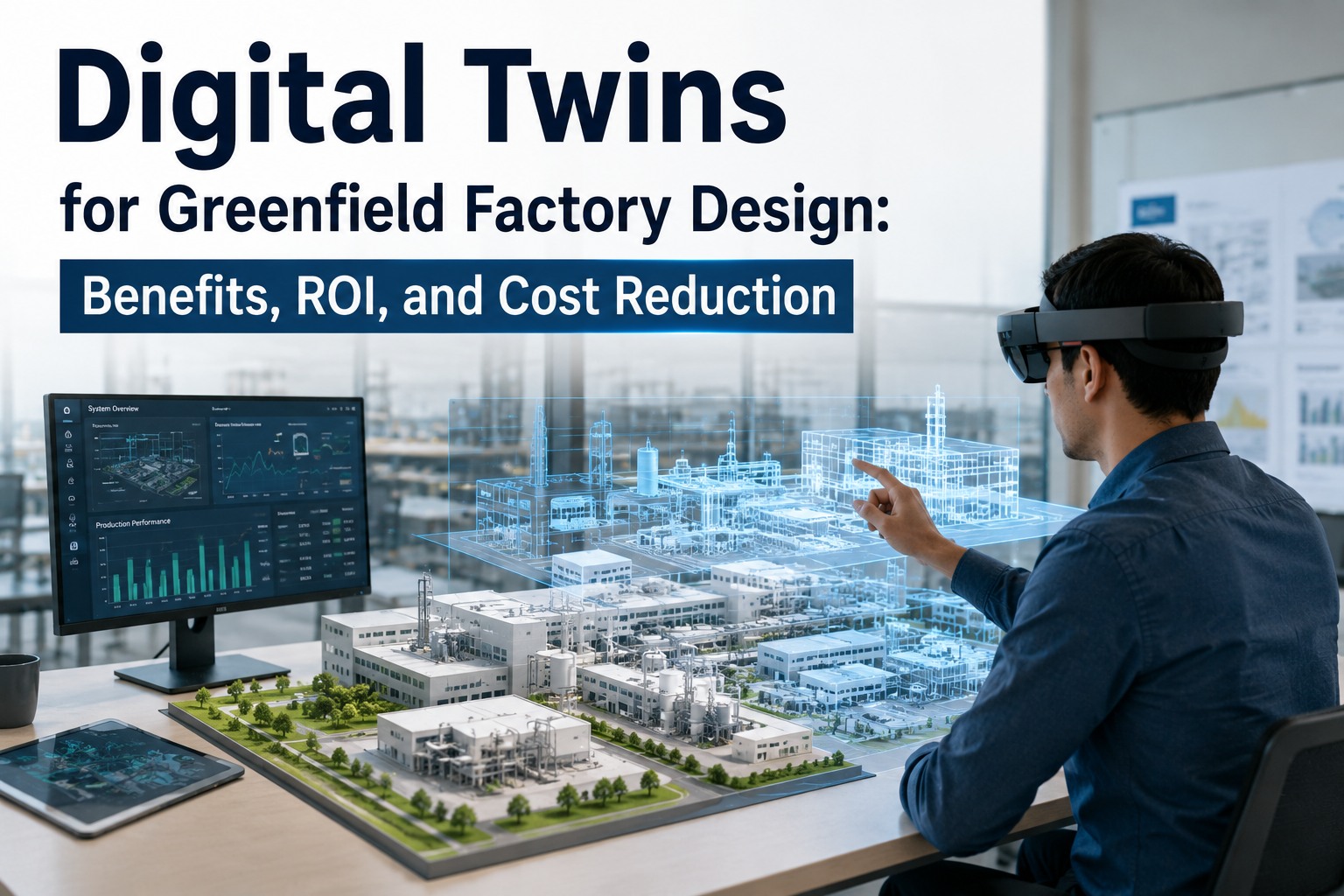
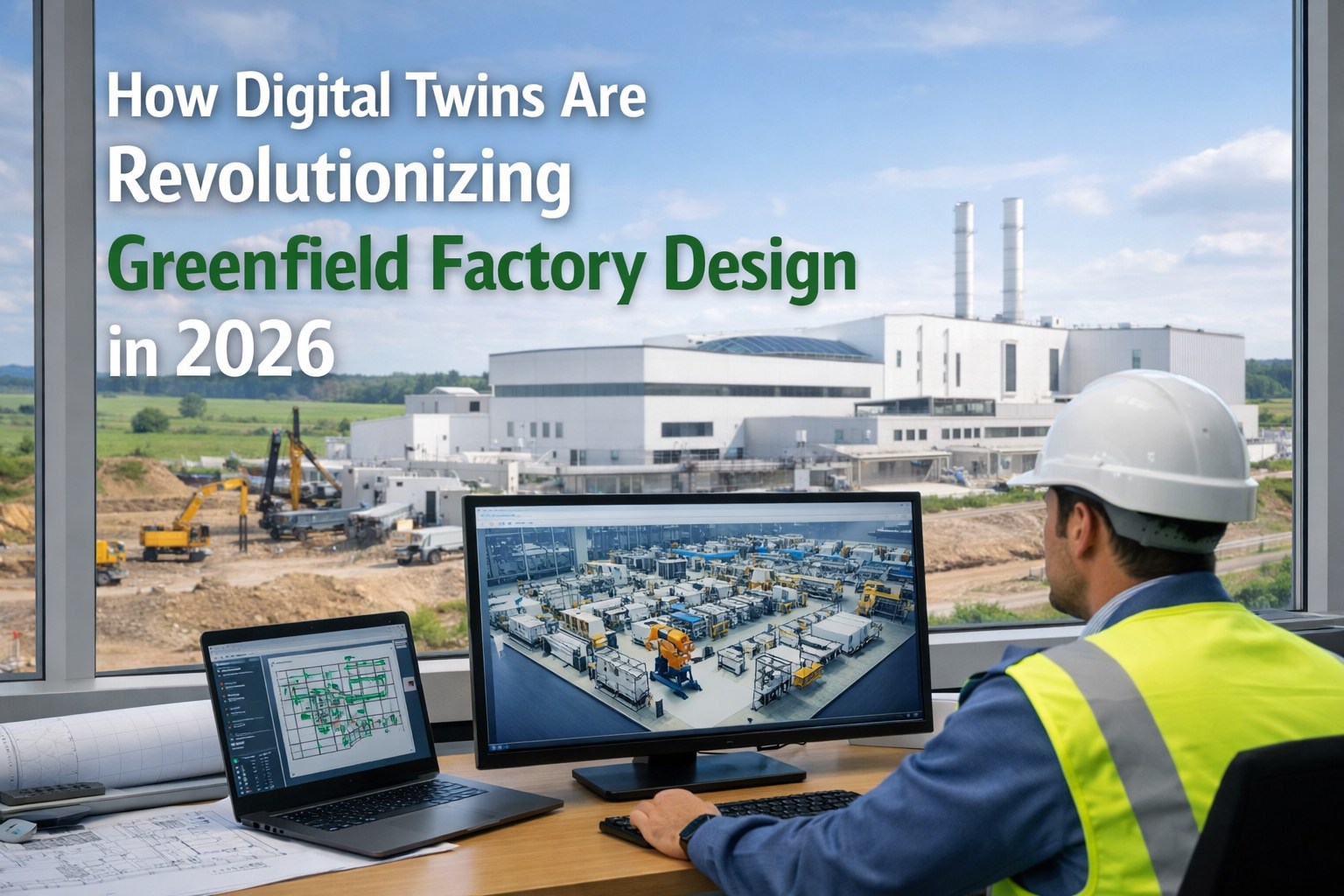
You are about to commit $150 million to a factory that does not exist yet. Every decision — floor layout, production line configuration, material flow, robot placement, utility routing — gets locked in during the design phase. Change orders after construction begins cost 10x more. Mistakes discovered during commissioning cost 50x more. What if you could build the entire factory virtually first — simulate every production scenario, test every layout option, identify every bottleneck — before a single foundation is poured? That is exactly what digital twin technology enables for greenfield factory planning. The global digital twin market reached $24 billion in 2025 and is growing at 35%+ annually because the ROI is undeniable: companies report 50% faster development times, 20% reduction in unplanned downtime, and 20–30% faster commissioning. For greenfield projects, the value is even higher — you eliminate the costliest mistakes before they become concrete and steel. iFactory uses digital twin simulation to design, optimize, and validate greenfield factories before construction begins — book a 30-minute consultation to see how virtual planning can de-risk your next facility investment.
Design Your Factory Before You Build It
Digital Twin-Driven Greenfield Planning, Simulation, and Virtual Validation
$34B
Global Digital Twin Market Size in 2026
86%
Of Manufacturers Say Digital Twins Apply to Their Organization
50%
Reduction in Development Time with Digital Twin Planning
What a Factory Digital Twin Actually Is — and Is Not
A factory digital twin is not a 3D model. It is not a static CAD rendering of a building layout. It is a dynamic, data-driven virtual replica of your entire production system — continuously updated, simulation-capable, and connected to the real world through sensors, IoT, and AI.
✗ A static 3D CAD model
✗ A visualization-only dashboard
✗ A one-time design deliverable
✗ Disconnected from operational data
✗ A replacement for physical commissioning
✓ A physics-accurate simulation of your production system
✓ Capable of running what-if scenarios in real time
✓ A living model that evolves from design through operations
✓ Connected to MES, ERP, IoT, and sensor data
✓ An AI-powered decision engine for continuous optimization
A McKinsey survey found that 86% of manufacturers say digital twins are applicable to their organization, and 44% have already implemented one. For greenfield projects specifically, the digital twin validates layout design, optimizes the facility footprint, and estimates inventory sizing — all before the first shovel hits the ground.
The 5 Simulation Layers of a Greenfield Factory Digital Twin
A comprehensive factory digital twin is not one model — it is five interconnected simulation layers, each answering different questions at different stages of the greenfield planning process.
Layer 1
Layout & Spatial Simulation
Does the floor plan actually work?
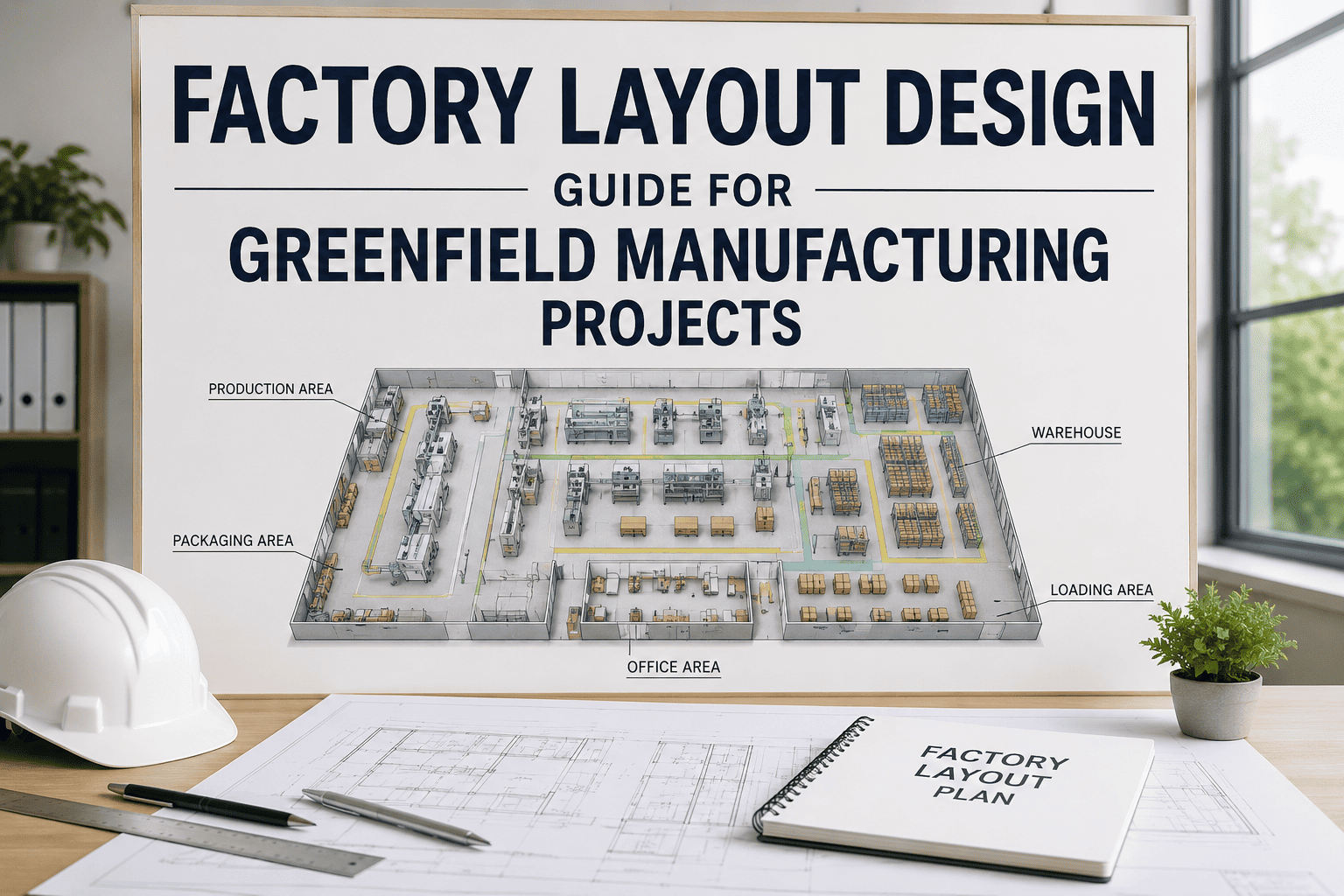
3D modeling of the entire facility — column spacing, aisle widths, equipment footprints, utility routing, and human ergonomic zones. Simulates robot reach envelopes, crane coverage, and AMR traffic patterns. Tests multiple layout configurations to find the optimal material flow before construction drawings are finalized.
Layer 2
Discrete Event Simulation (DES)
Can we hit target throughput?
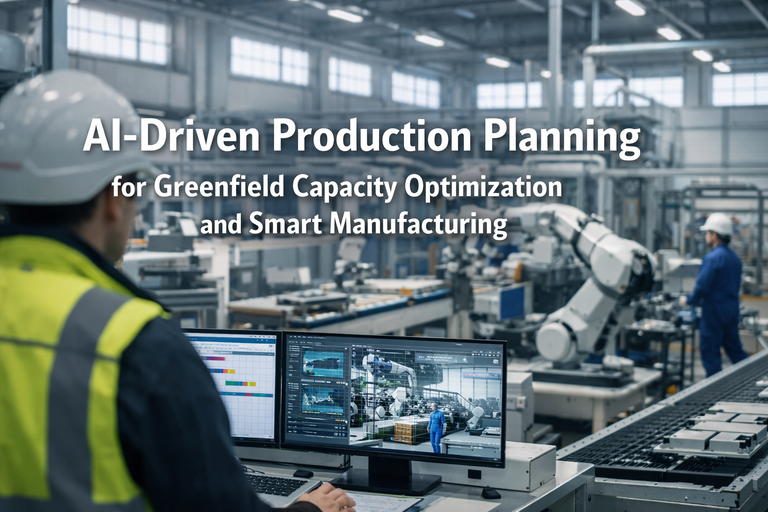
Models every production step as a sequence of events — machine cycle times, queue lengths, buffer capacities, changeover durations, and failure probabilities. Runs thousands of scenarios to identify bottlenecks, optimize batch sizes, and validate takt time adherence. This is where most hidden capacity constraints are discovered and eliminated.
Layer 3
Material Flow & Logistics Simulation
Will materials arrive at the right station at the right time?
Simulates the movement of raw materials, WIP, and finished goods across the entire plant — conveyor speeds, AGV/AMR routes, warehouse-to-line delivery cycles, and staging area capacity. Identifies congestion points, optimizes buffer locations, and validates that intra-logistics can sustain peak production without creating starvation or overflows.
Layer 4
Energy & Utility Simulation
How much power, water, air, and gas does this factory actually need?
Models WAGES (Water, Air, Gas, Electricity, Steam) consumption across every production scenario. Simulates peak demand vs. average load, identifies energy waste patterns, and right-sizes utility infrastructure from day one — avoiding both over-provisioning (wasted CAPEX) and under-provisioning (production constraints).
Layer 5
Virtual Commissioning & Control Validation
Will the automation systems work when we flip the switch?
Tests and debugs PLC logic, robot programs, SCADA configurations, and MES workflows in the virtual environment before physical installation. Catches logic errors, sequence conflicts, and safety interlock failures that would otherwise surface during physical commissioning — saving weeks of delays and significant startup costs.
Greenfield Planning Timeline: When Each Digital Twin Layer Activates
The power of digital twin-driven planning is that it front-loads decisions into the cheapest phase of the project — the virtual one. Here is how the five layers map to a typical greenfield factory timeline.
Concept & Layout Design
Layout Simulation
DES (Initial)
Build the first virtual factory model. Test 3–5 layout configurations against throughput targets, material flow efficiency, and expansion requirements. Eliminate non-viable options before engaging architects and structural engineers.
Detailed Engineering & Optimization
DES (Full)
Material Flow
Energy Sim
Refine production line configurations, validate conveyor and robot placements, optimize buffer sizes and batch sequences. Model WAGES consumption and right-size utility infrastructure. This is where the largest CAPEX savings are captured.
Virtual Commissioning (Parallel to Construction)
Virtual Commissioning
Control Validation
While concrete is being poured, test PLC programs, robot sequences, and MES integrations in the digital twin. Validate safety interlocks, fault recovery procedures, and production scheduling logic. Catch 60–80% of integration issues before physical startup.
Physical Startup & Continuous Optimization
Live Twin
AI Optimization
The digital twin transitions from planning tool to operations tool. Connected to real-time sensor data, it enables predictive maintenance, production scheduling optimization, and continuous improvement — the same model that designed the factory now runs it.
Simulate Today. Build Smarter Tomorrow.
iFactory builds digital twins that follow your greenfield project from concept through commissioning to operations — a single virtual model that de-risks every phase and keeps optimizing after day one.
The ROI of Digital Twin-Driven Greenfield Planning
Digital twins are not a cost — they are a risk reduction multiplier. Every dollar spent on virtual validation avoids multiples in physical rework, delayed commissioning, and suboptimal production capacity.
50%
Faster Development Time
Manufacturing companies using digital twins reduce development timelines by up to half. For a greenfield project, that can mean 6–12 months of accelerated time-to-production — worth millions in earlier revenue generation.
20–30%
Faster Commissioning
Virtual commissioning identifies logic, layout, and sequencing issues before machines go live. Teams report 20–30% reduction in commissioning time — avoiding the most expensive phase of any greenfield project from dragging on.
20%
Reduction in Unplanned Downtime
Once operational, the digital twin transitions to predictive maintenance — monitoring equipment health, detecting anomalies, and scheduling interventions before breakdowns occur. General Motors reported 25% reduction in unplanned downtime using digital twin integration.
5–7%
Monthly Cost Savings
McKinsey documented a factory digital twin that compressed overtime requirements and uncovered hidden production bottlenecks, resulting in 5–7% monthly cost savings by optimizing production sequencing within existing physical constraints.
Early digital twin adopters achieve approximately 15% cost reduction and over 25% operational efficiency gains within the first year. Unilever deployed digital twins across eight factories and reported 65% less downtime, 20% energy reduction, and 15% scrap reduction — totaling $52 million in annual savings.
What-If Scenario Planning: The Real Superpower
The most valuable capability of a factory digital twin is not monitoring what is happening — it is simulating what could happen. Before committing capital, greenfield planners can test scenarios that would be impossible, dangerous, or prohibitively expensive in the physical world.
What if demand doubles in 3 years?
Simulate adding a second production line, test whether existing utility infrastructure can handle the load, and verify that material flow does not create new bottlenecks — all before finalizing building dimensions.
What if a key supplier is delayed 2 weeks?
Model the impact on production schedules, test alternative sequencing strategies, measure buffer requirements, and calculate the revenue impact — in minutes, not after the disruption hits.
What if we switch to a new product line?
Test changeover procedures, validate that cobot cells can be reprogrammed for new tasks, simulate new material flow patterns, and estimate the ramp-up timeline — before signing the product development contract.
What if energy costs increase 40%?
Model the impact on per-unit production costs, test shift schedule adjustments to exploit off-peak energy pricing, and evaluate renewable energy or on-site generation investments against updated projections.
Industry Applications: From Cement to Automotive
Digital twin-driven greenfield planning is not industry-specific — it applies wherever complex manufacturing systems need to be designed, validated, and optimized before construction.
Steel & Metals
Blast furnace, rolling mill, casting
Thermal, energy, material flow
12–15% energy reduction
Cement
Kiln operations, grinding circuits
WAGES optimization, emissions
10–20% fuel savings
Automotive
Assembly lines, body shop, paint
Robot coordination, takt time
25% less unplanned downtime
Pharmaceuticals
Clean rooms, batch processing
Compliance validation, airflow
30% faster commissioning
FMCG / Food
Packaging lines, cold chain
Changeover, sanitation scheduling
15% throughput increase
Heavy Engineering
Fabrication, assembly, test cells
Crane coverage, material staging
5–7% monthly cost savings
Frequently Asked Questions
How much does a factory digital twin cost to build?
A basic digital twin for a single production line typically takes 4–8 weeks and costs $100K–$300K. A full plant-level twin for a greenfield facility ranges from $500K–$2M depending on complexity, number of production lines, and depth of simulation required. However, the payback is typically captured before physical commissioning begins — through eliminated design errors, optimized equipment sizing, and faster startup.
What software platforms are used for factory digital twins?
Leading platforms include Siemens Tecnomatix and Digital Twin Composer (launched at CES 2026), Dassault Systemes 3DEXPERIENCE with DELMIA, PTC ThingWorx, NVIDIA Omniverse for immersive visualization, and AVEVA for process industries. The choice depends on your industry, existing automation vendors, and integration requirements. iFactory works across platforms to ensure the best fit for your specific greenfield project.
Can a digital twin integrate with our MES and ERP systems?
Yes. Most modern digital twin platforms support integration with MES, ERP, SCADA, and IoT platforms through standard protocols like OPC-UA, MQTT, and REST APIs. This integration is what allows the twin to transition from a planning tool to an operational optimization tool — receiving real-time production data and feeding back scheduling and maintenance recommendations.
Do we need perfect data to start a digital twin project?
No. A common misconception is that data must be perfect before starting. In reality, the digital twin itself acts as a diagnostic tool that exposes missing signals, data quality issues, and sensor gaps. For greenfield planning specifically, the twin begins with design data and equipment specifications — real-time sensor data is added only when the physical plant becomes operational.
Build Virtually. Launch Confidently. Optimize Continuously.
iFactory delivers end-to-end digital twin solutions for greenfield factories — from 3D layout simulation and discrete event modeling to virtual commissioning and live operational optimization. Every simulation de-risks your investment. Every insight accelerates your launch.