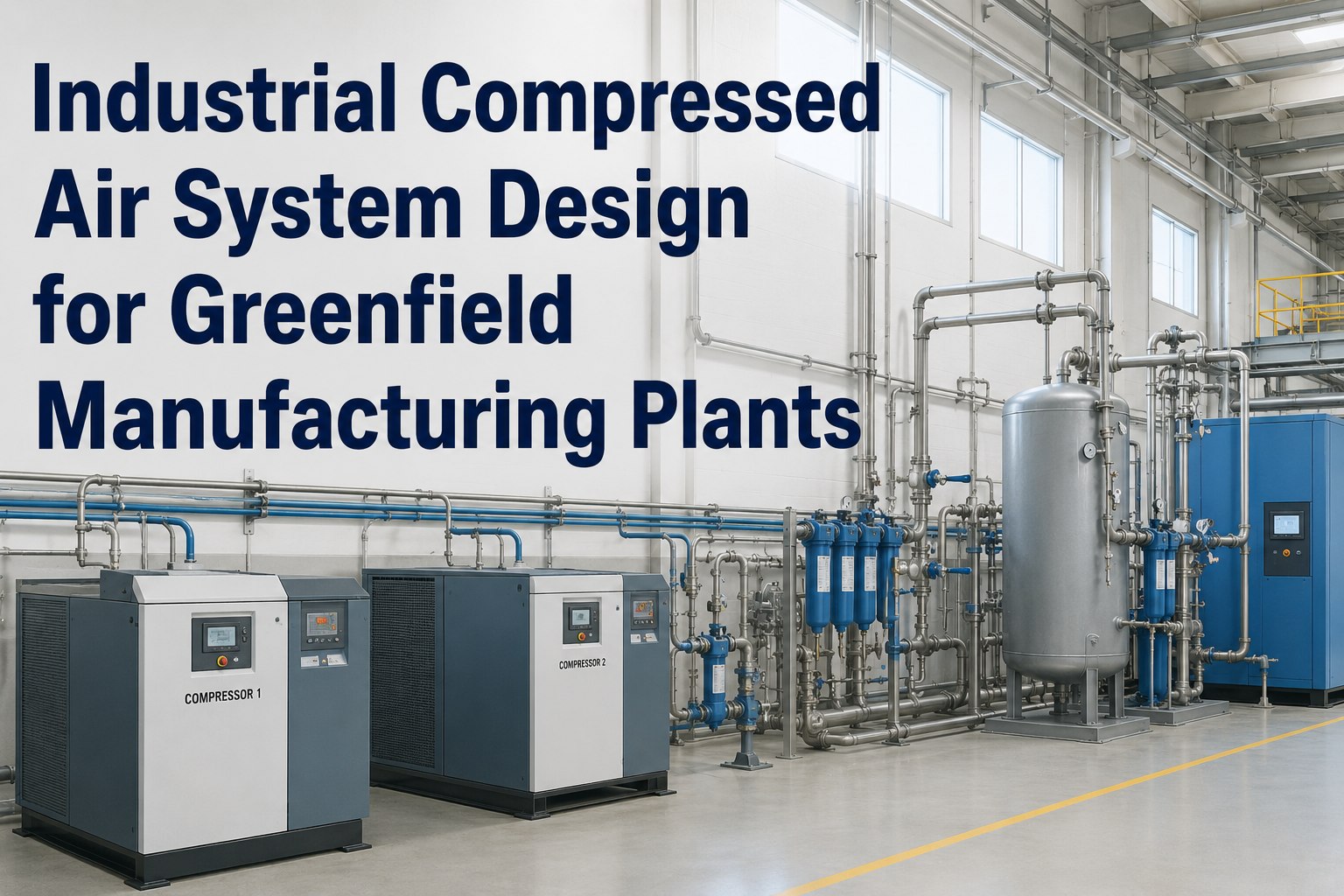
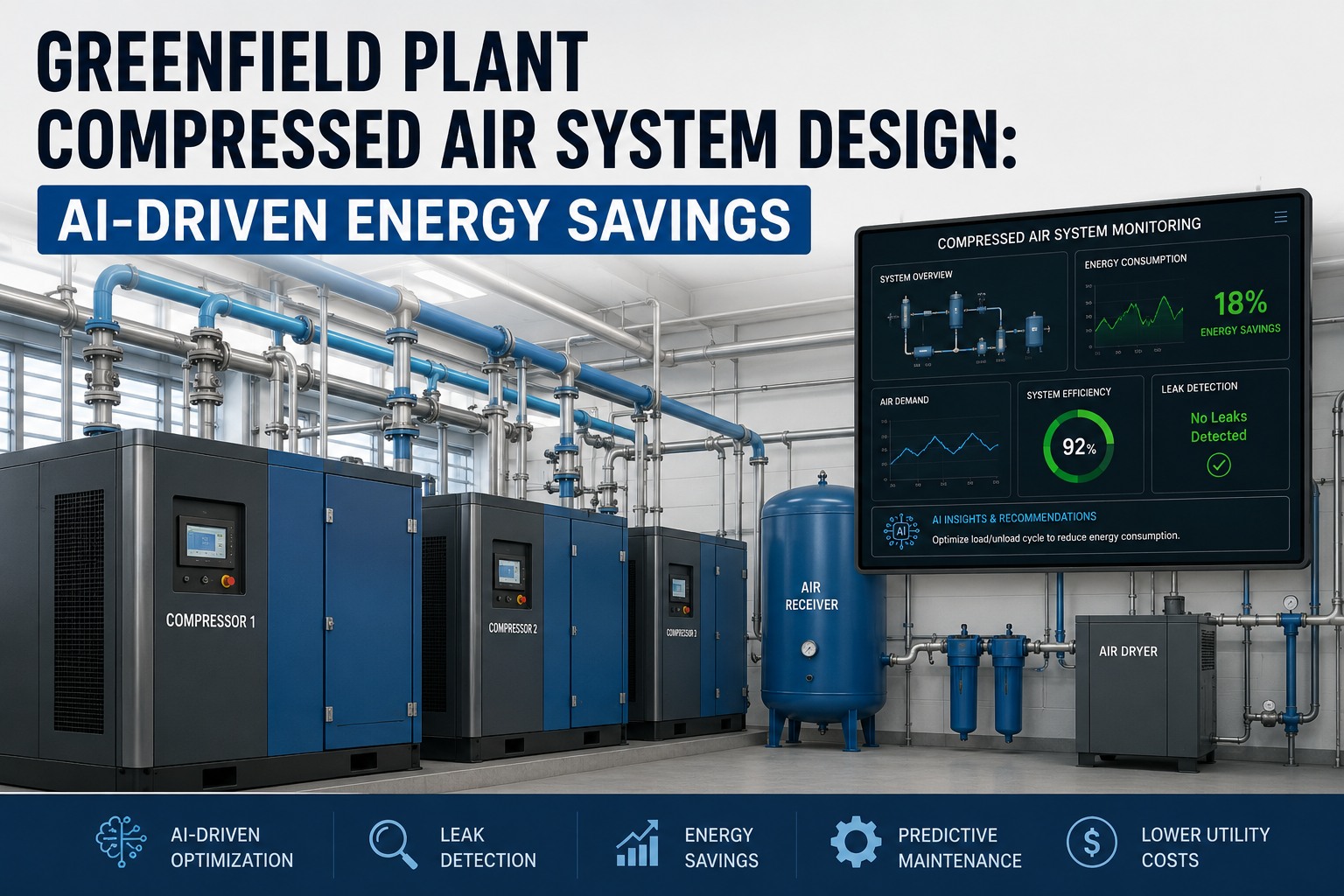
Compressed air is the 4th utility — and the only one where you pay 7-8x more for the energy you waste than the energy you use. A typical mid-size plant burns $200K/year on compressed air. 25-35% of that walks out through leaks, over-pressurization, and oversizing. On a greenfield project, the design decisions made before commissioning lock in the next 20 years of energy bills. Right-size the compressor, design the distribution properly, and build in VSD + heat recovery, and you cut $50-120K from annual operating costs. Get it wrong and you'll never recover that money. This guide breaks down demand analysis, compressor sizing, piping design, energy efficiency strategies, and the five design mistakes that doom greenfield air systems to waste. Book a compressed air design review to apply this to your project.
01
Compressor
Rotary screw · Centrifugal · VSD-controlled
→
02
Treatment
Dryer · Filter · Oil separator
→
03
Storage
Receiver tank · Buffer capacity
→
04
Distribution
Header piping · Drops · End-use
Why Compressed Air Wastes 30% by Default
Five compounding waste sources turn even new compressed air systems into energy money pits within 5 years. Each is preventable at greenfield design. Together they account for the 30%+ losses the DOE consistently measures in average US manufacturing plants.
01
Distribution Leaks
20-30% of output lost through threaded fittings, quick disconnects, hose connections, and worn seals. Inaudible on a busy floor — detectable only by ultrasonic.
~$60K/year on a $200K spend
02
Over-Pressurization
Running the system at 110 PSI when end uses need 80-90. Every 2 PSI of unnecessary pressure adds ~1% to compressor energy. Adds up to 10-15% waste.
~$25K/year preventable
03
Oversized Compressors
Sized for peak demand that occurs 5% of the time. Compressors cycling on/off or running at low load are wildly inefficient. VSD or multiple compressors solve this.
15-25% efficiency loss
04
No Demand Control
Multiple compressors operating without master controllers means they fight each other. Mismatched loads, redundant runtime, and pressure swings waste 10-15%.
10-15% additional waste
05
Wasted Heat (No Recovery)
~80% of compressor energy becomes heat. Capturing it for space heating, process water, or boiler preheat recovers 50-90% of that thermal energy.
Untapped $15-30K/year
The 4-Stage Design Framework
Greenfield compressed air design follows four sequential stages — and skipping any one of them creates a system that can't be optimized later. Each stage decision constrains the next. Get them right in order and the system delivers efficient air for 20 years.
Stage 1
Demand Analysis
Map every end-use point: CFM, PSI required, quality class, duty cycle. Build the load profile across all production scenarios. Don't size to peak — size to operational reality.
Deliverable
Demand profile (CFM vs time) + quality matrix
Stage 2
Compressor Selection
Match compressor type, size, and control strategy to the demand profile. Single large vs multiple smaller. Fixed-speed + VSD trim. Oil-free vs lubricated. Redundancy strategy.
Deliverable
Compressor specs + control sequencer design
Stage 3
Distribution Design
Header piping size, layout (loop vs branch), material (steel/aluminum/composite), drop locations, isolation valves, drain strategy. Right-sized = ≤2 PSI total system pressure drop.
Deliverable
Piping isometric + drop schedule + pressure drop calc
Stage 4
Optimization Layer
VSD compressors, master controller, heat recovery, leak detection sensors, real-time monitoring, demand-side pressure control. Optimization built in — not retrofitted.
Deliverable
Energy mgmt system + sensors + KPI dashboards
Design Compressed Air for 20-Year Efficiency, Not Day-1 Capacity
iFactory's greenfield utility team designs compressed air systems with full demand mapping, right-sized compressor selection, optimized distribution, and built-in VSD + heat recovery — cutting 40-60% from baseline operating costs for the life of the plant.
Compressor Sizing & Selection
Compressor choice determines 60-70% of your system's lifetime energy cost. The wrong compressor type for your load profile means decades of inefficiency. The matrix below summarizes the four main compressor categories — when each wins and when each loses.
Compressor Type
CFM Range
Best For
Watch Out
Rotary Screw (Fixed Speed)
50-3,000 CFM
Stable continuous demand · base-load duty
Wasteful at part-load · cycling kills efficiency
Rotary Screw (VSD)
50-2,000 CFM
Variable demand · trim duty · 30-50% energy savings vs fixed
Higher CAPEX · electronics cooling requirements
Centrifugal
1,000+ CFM
Large continuous loads · process industries · oil-free
Surge limits · narrow efficient operating range
Reciprocating
<100 CFM
Small loads · high pressure · backup duty
Pulsation · maintenance intensity · noise
Need help sizing the right compressor mix for your plant? Book a compressor sizing workshop with our utility team.
Distribution & Piping Design
Piping is where greenfield projects quietly lose 5-10% of system pressure — and once buried in walls or overhead, it's nearly impossible to fix. Four design decisions that separate efficient distribution from energy-leaking infrastructure.
01
Loop vs Branch Layout
Loop (ring main) gives every drop two air paths — pressure drop falls by 50%, single-point failures don't take down the system. Worth the 15-20% extra pipe cost.
02
Pipe Material Selection
Steel is cheap but corrodes (more leaks, contamination). Aluminum and composite are 2-3x more expensive but smoother (lower pressure drop), corrosion-resistant, and modular.
03
Right-Size Header Diameter
Undersized pipes mean excessive pressure drop, oversized waste capital. Target ≤2 PSI total drop from compressor to farthest drop. Use velocity ≤30 ft/sec for main headers.
04
Drop & Drain Strategy
Drops come off the TOP of headers (water falls to bottom). Drain points at low spots with zero-loss drain valves. Filter/regulator/lubricator (FRL) at each use point.
Designing distribution for a complex plant layout? Connect with our piping design team for header sizing and routing review.
Energy Efficiency · 40-60% Savings Available
Five efficiency strategies that, deployed together at greenfield, deliver 40-60% energy savings vs a code-minimum system. Each one is far cheaper to design in than to retrofit. Five strategies that pay back in 1-3 years.
Strategy 1
VSD on Trim Compressor
Variable Speed Drive matches output to actual demand instead of cycling on/off. 30-50% energy savings on variable loads. Payback typically <2 years.
↓ 30-50%
Strategy 2
Master Sequencer Controller
Multi-compressor coordination — base load + trim. One compressor doesn't fight another. Pressure setpoint optimization. 10-15% savings on its own.
↓ 10-15%
Strategy 3
Pressure Optimization
Drop system pressure from 110 to 90 PSI where applications allow. Every 2 PSI = ~1% energy. Demand-side pressure controllers at high-pressure points.
↓ 5-10%
Strategy 4
Heat Recovery
80% of compressor input becomes heat. Recover for space heating, process water preheat, boiler feedwater. 50-90% thermal recovery practical with proper ducting.
↓ 15-20%
Strategy 5
Continuous Leak Monitoring
Ultrasonic sensors + IoT monitoring catch leaks as they develop. Industry baseline is 20-30% leakage; structured programs cut to 5-10%. Annual savings recurring.
↓ 15-25%
Want a quantified efficiency model for your project? Book an efficiency design session with our utility team.
5 Greenfield Design Mistakes
The same five mistakes appear in nearly every compressed air system that underperforms within 3 years of commissioning. Each is preventable at concept design — and each costs the plant tens of thousands annually for the life of the facility.
01
Sizing to Peak Demand
Specifying compressors at the 100th percentile of demand creates oversized capacity that cycles inefficiently 95% of the time. Use a base + VSD trim strategy.
02
Single-Compressor Plant
No redundancy means a compressor failure stops production. Multi-compressor with sequencer gives redundancy AND efficiency through load matching.
03
No Heat Recovery Plan
80% of energy becomes heat — and most plants vent it to atmosphere. Plan recovery ducting and use case (space heat, process water) during compressor room layout.
04
Undersized Storage
Receiver tanks too small cause short-cycling and pressure swings. Size to 4-5 gallons per CFM for fixed-speed compressors. Forgiving storage = efficient compressors.
05
No Monitoring Infrastructure
No flow meters, no kWh meters, no pressure sensors at end uses. You can't manage what you can't measure. Install metering during construction — pennies vs retrofit dollars.
Expert Perspective
Compressed air is the easiest utility to design poorly and the hardest to fix later. Every plant I've audited had the same story: the original team picked a single big compressor because it was simpler, ran the distribution as straight branches because it was cheaper, skipped the VSD because the payback didn't pencil at concept stage, and ignored heat recovery because the boiler was on the other side of the building. Five years later, that plant is spending $80-120K more per year than it needs to — and most of those decisions are now permanent. The greenfield window for compressed air efficiency is roughly six months. Spend that window doing demand analysis, sizing right, designing the loop, and building in optimization. Or pay for the shortcut every quarter for the next two decades.
— Greenfield Utility Design Best Practice
$3.2B
US industry compressed air waste annually
~10%
US industrial electricity used for compressed air
~80%
Compressor input that becomes recoverable heat
1-3 yr
Typical payback on efficiency upgrades
Bottom Line · Design Efficiency Into the CAPEX
Compressed air systems can't be optimized after construction — only patched. Every retrofit costs 3-5x the equivalent greenfield design choice and recovers maybe half the benefit. The systems delivering 40-60% lower energy costs vs industry baseline aren't the ones with the biggest budgets — they're the ones whose engineering team did the demand analysis correctly, picked base + VSD trim compressors, designed loop distribution, planned heat recovery into the compressor room layout, and installed metering during construction. None of those decisions is expensive at greenfield. All of them are nearly impossible to retrofit. Design for the next 20 years of energy bills — not for the bid sheet.
Build Compressed Air Efficiency Into Your Next Factory
iFactory's utility design team engineers compressed air systems for 20-year efficiency — demand mapping, base+VSD compressor strategy, loop distribution, integrated heat recovery, leak monitoring infrastructure. Built for the next decade of energy costs, not the next quarterly bid.
Frequently Asked Questions
Why is compressed air called the most expensive utility?
$1 of compressed air costs $7-8 of input electricity to produce — because compression is thermodynamically inefficient (~80% of input becomes heat, not air pressure). Compressed air accounts for ~10% of US industrial electricity consumption and a typical mid-size plant spends ~$200K/year on compressed air energy alone.
How much compressed air do new plants typically waste?
DOE studies consistently find 20-35% loss in average industrial facilities. Sources: distribution leaks (20-30%), over-pressurization (5-15%), oversized compressors (15-25% efficiency loss), no demand control (10-15%), and unrecovered compressor heat. Proper greenfield design captures 40-60% savings vs code-minimum systems.
What is the right compressor type for a greenfield factory?
Depends on load profile. Rotary screw fixed-speed for stable base-load (50-3,000 CFM). Rotary screw VSD for variable demand (50-2,000 CFM, 30-50% savings). Centrifugal for large continuous loads (1,000+ CFM). Reciprocating for small or high-pressure backup. Most greenfield plants run base + VSD trim for combined efficiency and redundancy.
Should I use steel or aluminum piping for compressed air distribution?
Aluminum or composite for greenfield. Higher CAPEX (2-3x steel) but: corrosion-free (no rust contamination), smoother bore (lower pressure drop), modular fittings (faster install, easier modification), and longer life. Steel only makes sense for very large headers or harsh environments. Distribution should be loop (ring main) not branch — cuts pressure drop 50%.
What energy efficiency strategies are worth building in at greenfield?
Five strategies stacked:
1) VSD on trim compressor (30-50% savings),
2) Master sequencer controller (10-15%),
3) Pressure optimization (5-10%),
4) Heat recovery (15-20%),
5) Continuous leak monitoring infrastructure (15-25%). Combined: 40-60% reduction vs baseline. Payback typically 1-3 years.
Book an efficiency design session to model yours.