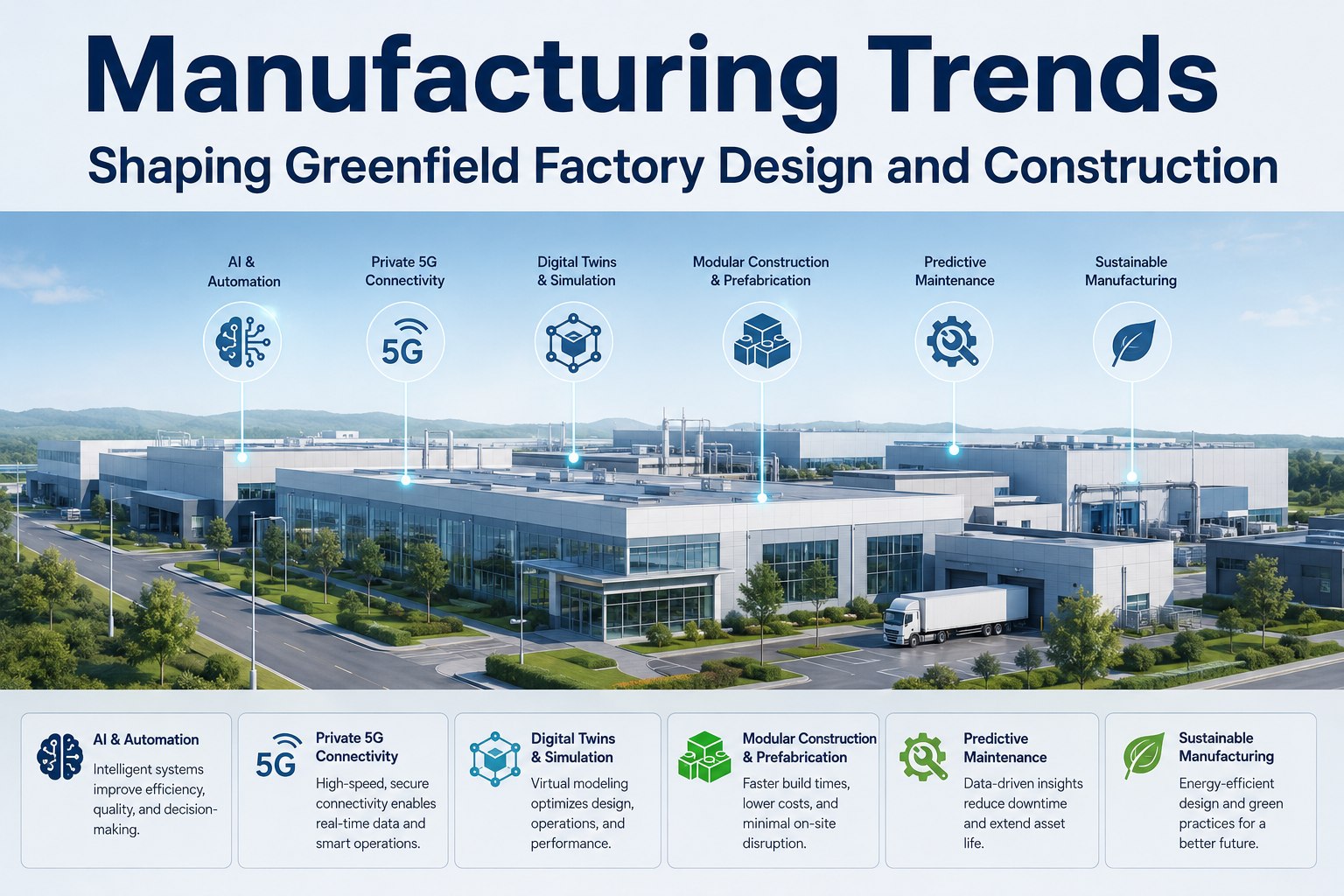
The greenfield factory breaking ground in 2026 doesn't resemble the one built in 2020. AI is now a foundational design layer, not an add-on. Private 5G replaces wired Ethernet for floor-level connectivity. Digital twins simulate the plant before a single column is poured. Modular construction cuts build time 30-40%. ESG commitments turn net-zero design into a board-level decision. Eight compounding trends are rewriting what "modern factory" means — and the teams designing greenfield without accounting for them are building 2020 factories that will need expensive retrofits within 5 years. This guide breaks down each trend, the data behind it, and what it means for your next factory design. Book a trends impact assessment for your greenfield project.
Intelligence
AI-Native Architecture
$34B → $155B
Mfg AI market · 35.3% CAGR to 2030
Connectivity
Private 5G Networks
42%
Companies adopting · +20% productivity
Simulation
Digital Twins
$24.5B → $155B
Market by 2030 · CAGR 39.8%
Maintenance
Predictive Maintenance
↓ 25-40%
Maintenance cost · 30-50% downtime cut
Compute
Edge Computing
$175B
Value · 75% data processed at edge
Construction
Modular Construction
↓ 30-40%
Construction time · predictable schedule
Sustainability
Net-Zero Design
↓ 20-30%
Energy waste · ESG-mandated by buyers
Quality
Computer Vision QC
↑ 25%
QC accuracy · real-time defect detection
Why Greenfield 2026 Is a Different Factory
Five fundamental shifts separate the 2020 greenfield playbook from the 2026 one. Each shift is now expected by buyers, regulators, and capital markets — and each requires architectural decisions at concept design, not retrofit later.
01
AI Is Foundational, Not Optional
In 2020, AI was a pilot project. In 2026, 95% of new IIoT deployments include AI-edge inference and 78% of AI-enabled factories report measurable improvements. AI infrastructure must be designed in — not bolted on.
02
Wireless Replaces Wired on the Floor
Private 5G enables AMRs, AR maintenance, real-time PLC virtualization, and AI vision at scale. Greenfield 2020 ran Ethernet. Greenfield 2026 deploys 5G with Ethernet as backup.
03
Build Virtual Before Physical
Digital twins simulate layout, throughput, energy, and maintenance flows during design. Battery and semi factories now integrate digital twins from concept — every decision validated before construction.
04
Sustainability Moved to Board Level
EU CBAM, US buyer compliance, and SBTi commitments make net-zero design non-negotiable. Renewable integration, ZLD water, and energy resilience are CFO conversations now.
05
Construction Speed Is Competitive Advantage
Modular and off-site construction shave 30-40% off build time. In a reshoring-saturated market, the team breaking ground 6 months earlier wins the customer commitments.
The 8 Trends · Detailed
Each trend below has reached the maturity level where ignoring it costs more than adopting it. The details, data points, and design implications below come from 2026 industry research, market sizing, and documented case studies.
Trend 1
Mainstream
AI-Native Manufacturing Architecture
AI is now the design layer, not the bolt-on. Greenfield factories deploy AI for predictive maintenance, vision quality, autonomous scheduling, energy optimization, and agentic AI agents reasoning on real-time production data. Requires unified namespace, edge compute, and sensor density 5-10x higher than 2020 factories.
Impact: 25-40% maintenance cost reduction · OEE +10-15 pts · $34B → $155B market
Trend 2
Growing
Private 5G & CBRS Networks
Private 5G virtualizes PLCs for wireless real-time machine control. Enables 4K video analytics (50-100 Mbps per camera), AR maintenance overlays, AMR fleets, and worker safety wearables. 5G RedCap modules bridge cost gap to low-power sensors. Replaces Wi-Fi reliability gaps for mission-critical operations.
Impact: 42% of mfrs adopting · +20% productivity · orders of magnitude cheaper than wired
Trend 3
Mainstream
Digital Twins · Design to Operation
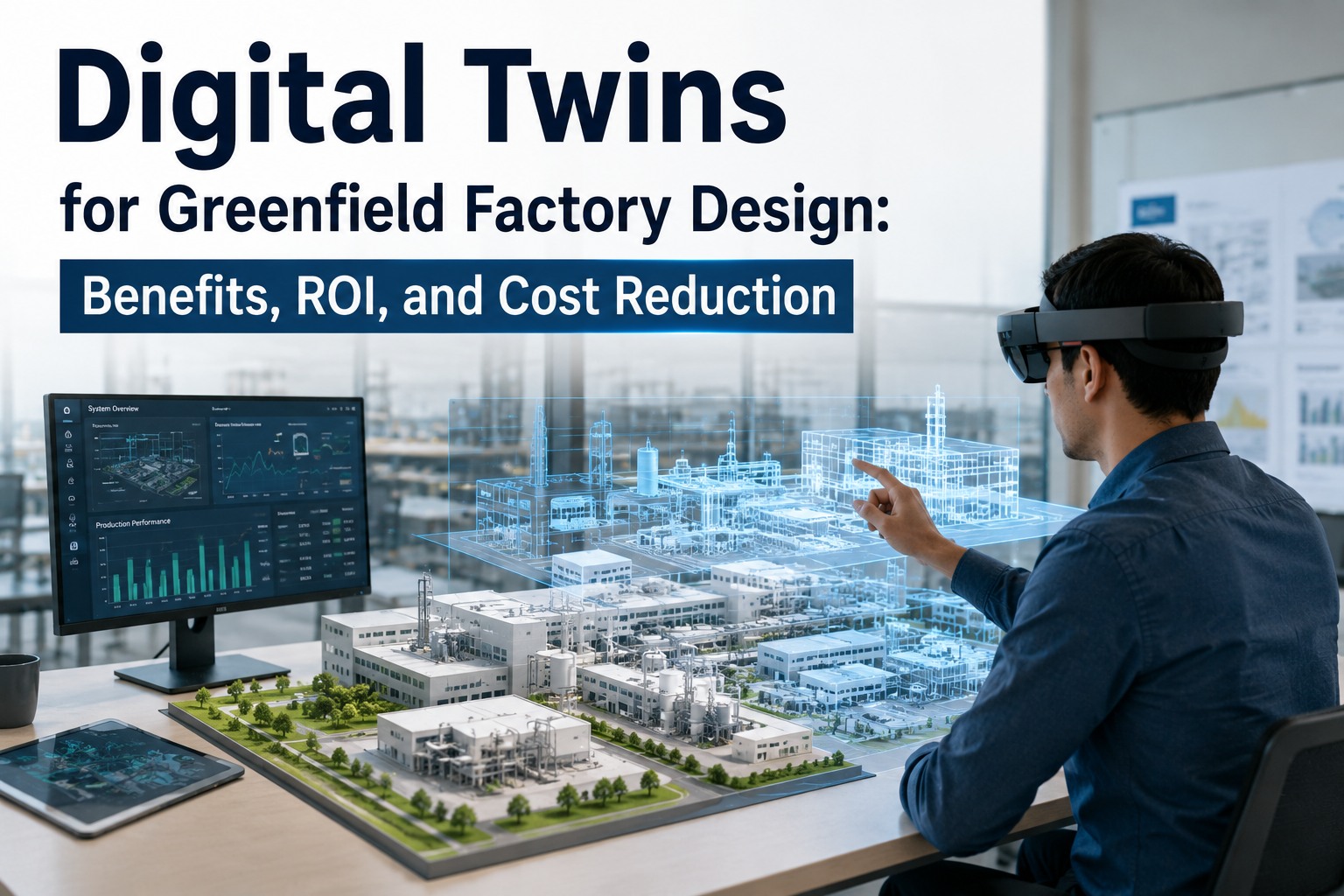
Virtual replicas of the physical plant that update in real-time from sensor data. Used in 2026 across the full lifecycle — site selection, layout optimization, throughput simulation, energy modeling, predictive maintenance, and autonomous operations. New battery factories integrate digital twins during DESIGN phase.
Impact: $24.5B → $155B market by 2030 · 39.8% CAGR · simulate before build
Trend 4
Mainstream
Predictive Maintenance & Condition Monitoring
ML models analyzing real-time sensor data predict failures before they occur. Vibration, temperature, oil analysis, and acoustic signatures fed into anomaly detection. Auto work orders triggered from MES/CMMS integration. Shift from reactive to proactive maintenance is now the new baseline.
Impact: 30-50% unplanned downtime cut · 25-43% maintenance cost reduction · 60-80% failure prevention
Trend 5
Growing
Edge Computing · Sub-Millisecond Inference
GPU-accelerated edge servers (NVIDIA Jetson, industrial GPUs) run AI inference locally for real-time decisions without cloud round-trip. 200-500 sq ft of climate-controlled space per factory, 15-30 kW per rack. By 2026, 75% of enterprise data is processed outside traditional data centers.
Impact: $175B value · sub-ms latency · cloud-independent operation
Trend 6
Growing
Modular & Off-Site Construction
Pre-fabricated building components, modular MEP systems, and standardized utility drops shrink construction timelines and disruption. Skilled labor scarcity makes off-site fabrication a competitive advantage — factories built faster, with predictable schedules, in workforce-constrained markets.
Impact: 30-40% construction time reduction · predictable schedule · lower on-site risk
Trend 7
Mainstream
Net-Zero & Sustainable Design
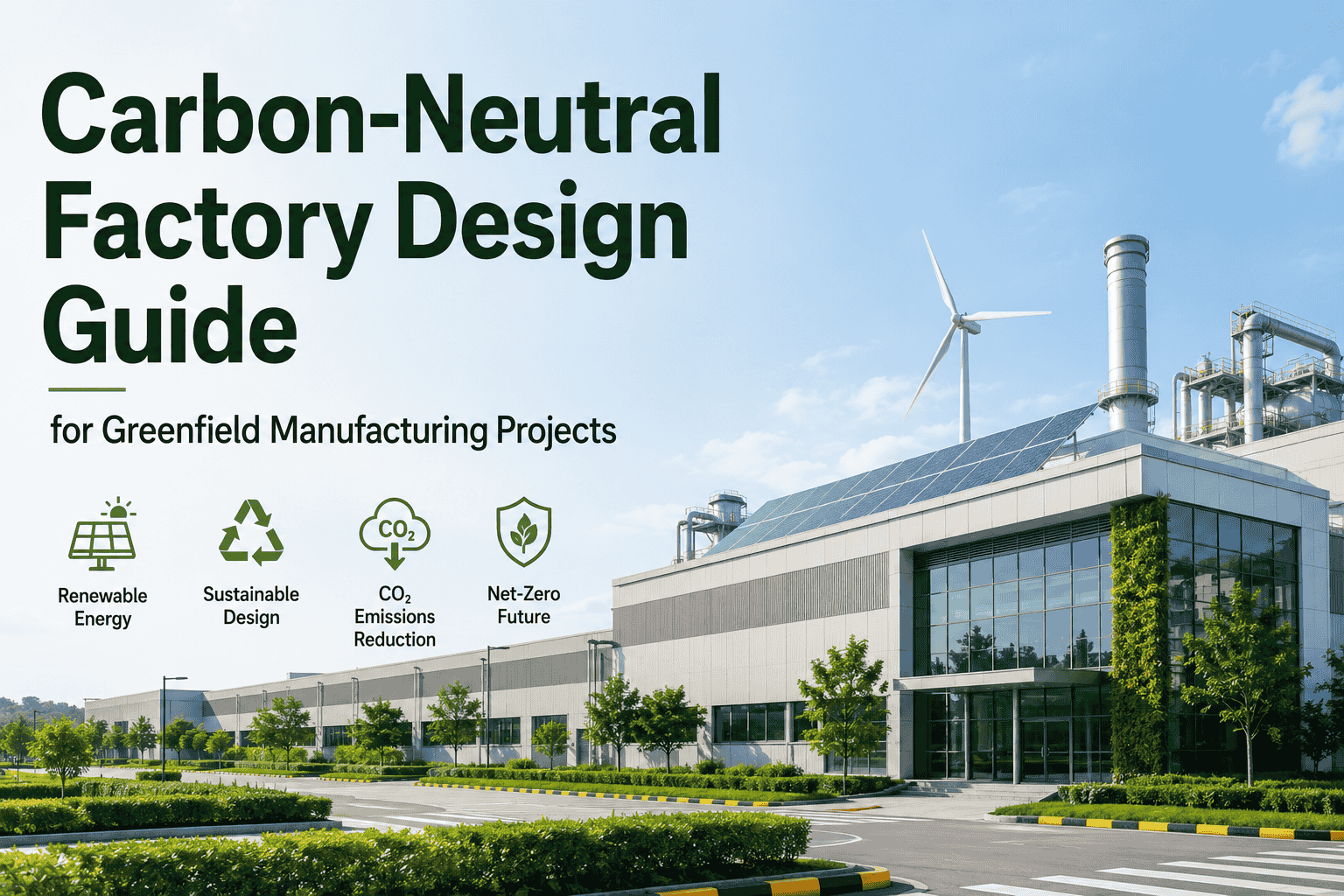
Renewable integration, ZLD water recycling, energy resilience, on-site solar + storage. EU CBAM and US buyer compliance make ESG metrics commercial requirements. Real-time energy monitoring with IIoT reduces waste 20-30%. Net-zero designed at greenfield costs far less than retrofitting later.
Impact: 20-30% energy waste cut · ESG-mandated by buyers · CBAM exposure managed
Trend 8
Growing
Computer Vision Quality & Safety
AI vision cameras inspect every part, every operation, every safety zone. 25% improvement in QC accuracy. Real-time defect detection, PPE compliance, unauthorized zone alerts. Requires camera infrastructure, edge GPU compute, and labeled training data — all designed in at greenfield concept stage.
Impact: ↑ 25% QC accuracy · ↓ 30-40% safety incidents · scrap reduction
Design Your Next Factory Around the Trends That Will Define 2030
iFactory's greenfield team designs AI-native, 5G-connected, digital-twin-enabled factories — with sustainability and modular construction built into concept design. Every decision validated by data, every system designed for the next decade of evolution.
How the Trends Reinforce Each Other
None of these trends works in isolation. AI needs sensor density. Digital twins need unified data. Predictive maintenance needs MES/CMMS integration. The trends are a stack — and the value compounds when they reinforce each other. Four critical dependencies that determine whether your trend adoption delivers or disappoints.
01
Sensors → Edge → AI
AI can't reason without sensor density. Sensor data is useless without edge compute. Edge compute is wasted without AI models. All three or none — partial deployment delivers fractional value.
02
Digital Twin → Predictive Maintenance
Digital twins simulate failures before they happen. Predictive maintenance acts on that simulation. Without the twin, prediction is statistical guessing. Without prediction, the twin is just visualization.
03
Private 5G → Computer Vision & AMRs
4K video analytics, AR overlays, and autonomous mobile robots demand high-bandwidth low-latency wireless. Wi-Fi can't deliver. Private 5G is the prerequisite — vision and AMRs are the apps.
04
Modular Construction → Faster ROI
Modular shaves 30-40% off construction. Faster build means earlier revenue. Earlier revenue funds the AI, 5G, and digital twin investments. Construction speed enables everything downstream.
Need help mapping trend dependencies for your project? Book a convergence planning session with our greenfield team.
Industry Adoption Snapshot
Different industries are adopting trends at different rates — driven by competitive pressure, regulatory mandates, and ROI clarity. The matrix below summarizes where each sector stands in 2026.
Trend
Automotive
Semi / Electronics
Pharma
F&B
AI-Native Architecture
High
High
Medium
Medium
Private 5G
High
High
Low
Medium
Digital Twins
High
High
High
Medium
Predictive Maintenance
High
High
High
High
Modular Construction
Medium
Medium
High
High
Net-Zero Design
High
Medium
High
High
Computer Vision QC
High
High
High
High
Need an industry-specific trend prioritization? Connect with our greenfield advisors for a custom adoption roadmap.
5 Trend Adoption Mistakes
The same five mistakes appear in nearly every greenfield project that tries to adopt 2026 trends and ends up with disconnected technology silos instead of a coherent factory. Each is preventable at concept design.
01
Adopting Trends Without a Data Backbone
AI, digital twins, and predictive maintenance all need a unified data layer. Without UNS/MQTT/Sparkplug B from day one, each trend becomes an island that can't share context.
02
Treating Trends as Pilot Projects
Pilots prove technology works in isolation. Greenfield 2026 needs trends as foundational design layers — not bolted-on demos. Design at scale or accept retrofit costs later.
03
Buying Tech Before Defining the Workflow
Companies buy AI platforms, 5G networks, and digital twin software — then struggle to make them work because the production-maintenance-quality workflows weren't redesigned to use them.
04
Underinvesting in Cybersecurity
AI + 5G + edge + cloud = exponentially larger attack surface. IEC 62443 isn't optional. Zero-trust architecture must be designed in, not bolted on after the breach.
05
Ignoring Human-AI Collaboration
Trends shift technicians into supervisory and strategic roles. Without training programs and workflow redesign, the workforce can't operate the new technology — and trend ROI never materializes.
Avoid these mistakes by aligning trend adoption with workflow and infrastructure design. Book a trends adoption review with our greenfield team.
Expert Perspective
The trend lists everyone publishes look like a shopping list — pick what you want. The reality is the opposite. These trends are a stack. AI is wasted without sensor density. Sensor density is wasted without edge compute. Edge compute is wasted without 5G or wired backhaul. Wired backhaul is wasted without a unified namespace tying everything together. Digital twins are wasted without all of the above to feed them. The teams that get 2026 right design the stack — bottom to top — at concept stage. They don't shop. They architect. And the teams that win in 2030 are the ones whose 2026 factories had this stack designed in from day one.
— Greenfield Manufacturing Future-Proofing Best Practice
95%
New IIoT deployments include AI-edge inference
78%
AI-enabled factories report measurable gains
75%
Enterprise data processed outside data centers
40%
Time-to-market cut by software-defined products
Bottom Line · Architect the Stack, Don't Shop the Trends
Greenfield 2026 is fundamentally different from greenfield 2020 — and the difference compounds for the next decade. The eight trends are not optional features to evaluate; they are a layered stack where each enables the next. AI without edge compute fails. Digital twins without unified data fail. Predictive maintenance without MES integration fails. Private 5G without the apps to use it fails. The teams that win in 2030 are the ones who designed all eight layers into their 2026 concept — sensors, edge, network, data backbone, AI, twin, integration, security, and workflow. Treat trends as a checklist and you'll build a 2020 factory. Architect them as a stack and you'll build the factory your competitors are still trying to retrofit five years from now.
Build Your 2026 Greenfield for the 2030 Factory
iFactory's greenfield team designs AI-native, 5G-connected, digital-twin-enabled factories from concept — with all eight trends architected into a coherent stack. Future-proof infrastructure, modular construction, and integrated workflow design for the next decade of evolution.
Frequently Asked Questions
What are the most important manufacturing trends for greenfield 2026?
Eight trends define greenfield 2026: AI-native architecture ($34B → $155B market), private 5G networks (42% adoption), digital twins ($24.5B → $155B by 2030), predictive maintenance (25-40% cost cut), edge computing ($175B value), modular construction (30-40% faster), net-zero design (CBAM compliance), and computer vision quality (25% accuracy gain).
How is greenfield manufacturing different in 2026 vs 2020?
Five shifts: AI is foundational (was a pilot), wireless replaces wired on the factory floor (private 5G), digital twins simulate before building, sustainability is board-level (CBAM + buyer compliance), and construction speed is competitive (modular shaves 30-40% off build time). 95% of new IIoT deployments now include AI-edge inference vs ~10% in 2020.
Do all manufacturing industries adopt these trends at the same pace?
No. Automotive and semi lead on AI, 5G, digital twins. Pharma leads on digital twins, modular construction, sustainability. F&B leads on modular construction, sustainability, predictive maintenance. All industries are mainstream on predictive maintenance and computer vision QC. Sector regulatory environment and ROI clarity drive adoption pace.
Why do these trends reinforce each other?
They form a technology stack: Sensors → Edge → AI (each enables the next). Digital twins need unified data from sensors + AI to be useful. Private 5G is the prerequisite for computer vision and AMR fleets at scale. Modular construction shortens timeline and funds downstream technology investment. Partial adoption delivers fractional value — architect the full stack.
What's the biggest mistake when adopting these trends?
Adopting trends without a unified data backbone. Companies buy AI platforms, 5G networks, and digital twin software as separate purchases — then discover none of them can share context because there's no
UNS (Unified Namespace). Without MQTT/Sparkplug B or equivalent data layer from day one, every trend becomes a technology island.
Book a data architecture review to design yours.