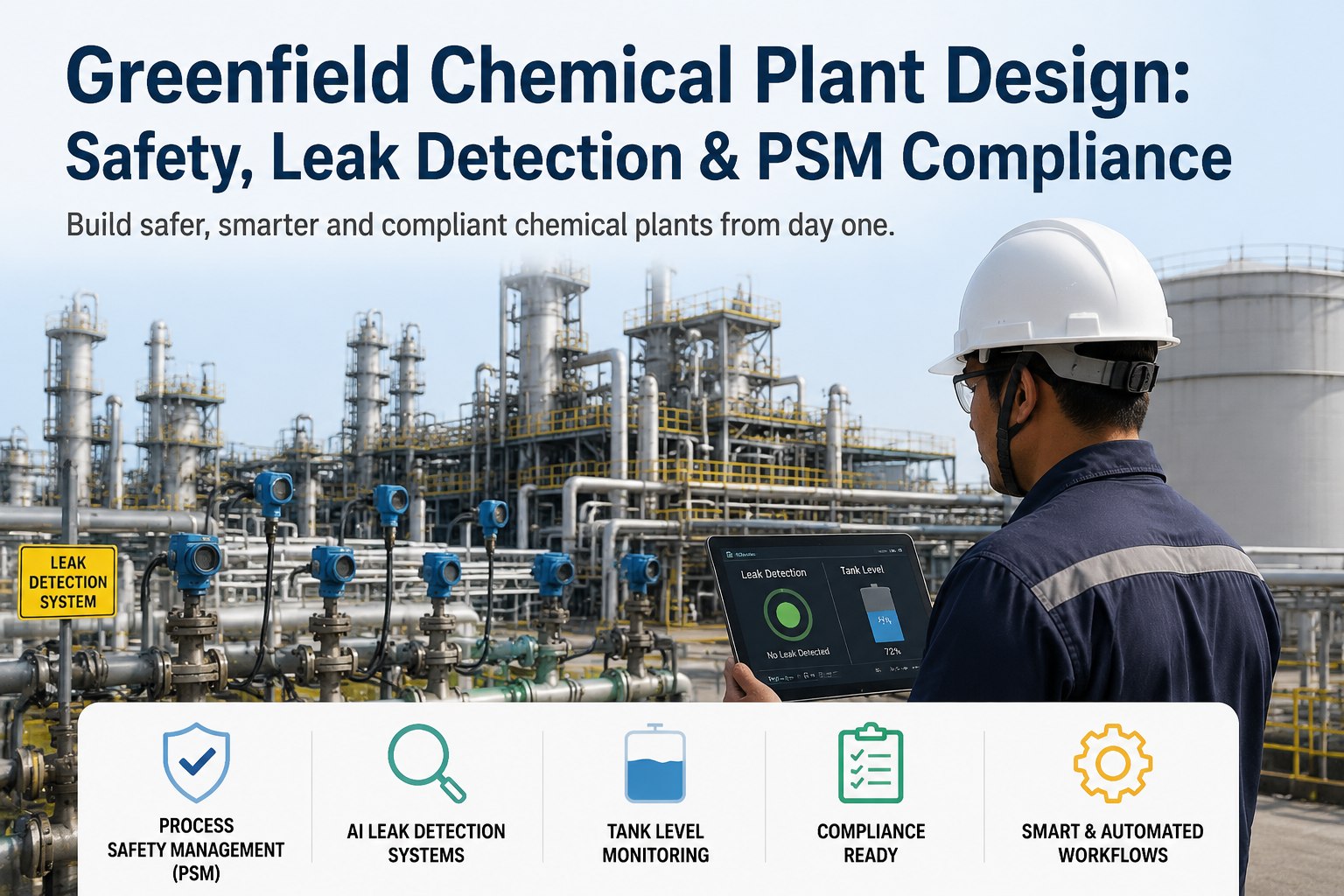
Greenfield chemical plants face a design challenge no other manufacturing sector matches: every safety system, sensor, leak detector, and PSM compliance workflow must be specified, installed, and validated before a single gram of hazardous chemical flows through the process. With 825+ chemical incidents in the U.S. since 2021, OSHA PSM penalties reaching $156,259 per willful violation, and EPA's 2026 RMP rule realignment tightening reporting obligations, the cost of launching without embedded safety automation is measured in incidents, shutdowns, and criminal liability — not just lost production.
Design your chemical plant safety architecture with iFactory — we integrate AI leak detection, PSM workflows, and tank monitoring into your facility design before panel engineering begins.
Safety Architecture
The Three-Layer Chemical Plant Safety Stack
Every greenfield chemical plant must embed all three protection layers before first startup — each layer addressing a different failure mode
Process Design & Hazard Elimination
Stop the hazard from occurring
- Process Hazard Analysis (HAZOP / FMEA)
- Inherently safer design choices
- Process Safety Information (PSI) documentation
- Pre-Startup Safety Review (PSSR)
- Management of Change (MOC) procedures
OSHA 29 CFR 1910.119 — PSM Standard
Real-Time Monitoring & AI Leak Detection
Catch releases the moment they occur
- AI-powered gas & vapor detection networks
- Tank-level & pressure anomaly monitoring
- Pipeline acoustic leak detection
- Thermal imaging for heat & flare anomalies
- AI anomaly detection — 72h advance warning
25% fewer leak incidents with AI anomaly detection
Automated Interlocks & Emergency Response
Contain and control when prevention fails
- Safety instrumented system (SIS) interlocks
- Automated isolation valve triggering
- Emergency response plan (ERP) digital workflows
- Incident investigation & OSHA reporting
- EPA RMP documentation (40 CFR Part 68)
EPA RMP + OSHA PSM dual compliance path
PSM Compliance From Day One: What OSHA 29 CFR 1910.119 Requires in Greenfield Design
OSHA's Process Safety Management standard (29 CFR 1910.119) is not a post-startup audit requirement — it applies from the moment your covered process is designed. A greenfield chemical plant that handles any of the 137 highly hazardous chemicals above threshold quantities (ranging from 100 lbs for acutely toxic substances to 10,000 lbs for ammonia) must have PSM programs established before startup. The key insight for greenfield design teams: PSM compliance built into the facility design phase costs a fraction of retrofitting it after an OSHA inspection or incident.
chemical incidents in the U.S. since 2021 — the case for prevention-first design
maximum OSHA PSM penalty per willful violation — per item, per occurrence
reduction in leak and spill incidents with AI-based pipeline anomaly detection
faster safety audits with AI-automated PSM documentation vs. manual processes
The 14 PSM Elements: Design Phase vs. Operational Requirements
Understanding which PSM elements must be addressed during greenfield design (not just after startup) prevents the most common PSM compliance gap: a plant that completes construction only to discover it cannot receive its operating permit because PSM documentation and systems were not embedded in the design scope.
Need PSM compliance built into your greenfield design scope? Book a PSM design review with iFactory — we map all 14 PSM elements to your process design before your EPC contractor finalizes the P&IDs.
AI Leak Detection Systems: Architecture and Sensor Placement Strategy
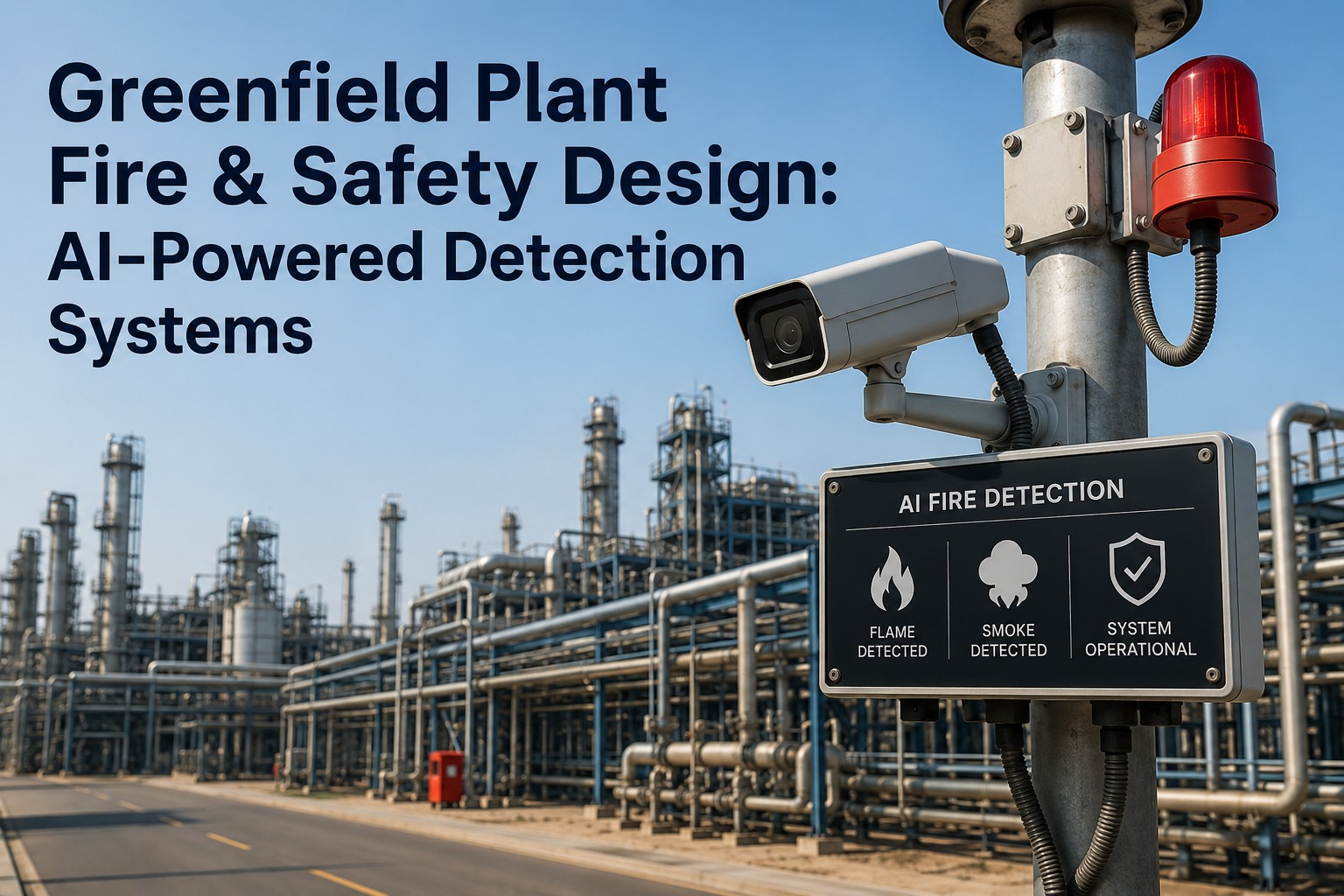
AI leak detection in chemical plants operates across three distinct sensing modalities — gas concentration, acoustic emission, and thermal anomaly — each addressing different release scenarios that the others cannot reliably detect alone. Designing the sensor network requires mapping each modality to the specific hazard profile of each process zone, not applying a uniform sensor grid across the entire facility.
Gas & Vapor Detection
Electrochemical, catalytic bead, open-path IR sensors
Fixed-point gas detectors placed at likely release sources (flanges, valve stems, pump seals) combined with open-path infrared sensors covering large areas. AI correlates multi-sensor readings to distinguish a real release from sensor drift or background interference — reducing false alarms that otherwise desensitize operators.
- Response time: 10–30 seconds to alarm threshold
- AI benefit: Drift compensation, source triangulation
- Placement: 0–30cm from likely release points
Best for: Toxic gas releases, flammable vapor accumulation, LFL monitoring
Acoustic Emission Detection
Ultrasonic leak detection on pipelines and vessels
Ultrasonic sensors clamp directly onto pipelines and pressure vessels, detecting the acoustic signature of turbulent flow caused by a developing leak or crack — before any substance escapes the pipe wall. AI baseline models filter process noise and identify leak signatures 18–72 hours before a physical release occurs.
- Detection range: Insulated pipes, underground lines
- AI benefit: 72h advance warning on developing leaks
- Placement: Critical joints, elbows, corrosion-prone zones
Best for: High-pressure pipelines, insulated or buried lines, early-warning systems
Thermal Imaging & Vision AI
Infrared camera networks with AI anomaly classification
Fixed infrared cameras monitor flare stacks, heat exchangers, and reactor surfaces for temperature anomalies that indicate process deviations, hot spots, or unexpected exothermic reactions. Computer vision AI classifies abnormal thermal patterns and distinguishes process-normal heat signatures from developing hazards without operator interpretation.
- Detection: ±0.1°C sensitivity at 25 meters
- AI benefit: Flare anomaly classification, hot spot trending
- Placement: Flare stacks, reactors, heat exchangers, storage
Best for: High-temperature processes, flare monitoring, exothermic reaction detection
Not sure which sensor modalities are right for each zone? Talk to iFactory's safety systems team — we produce zone-by-zone sensor placement specifications mapped to your P&ID and hazard inventory before construction begins.
PSM-Ready, AI-Monitored Chemical Plant Safety — Built In, Not Bolted On
iFactory integrates AI leak detection, PSM digital workflows, tank-level monitoring, and SIS interlock documentation into your greenfield chemical plant design — so your facility is audit-ready from commissioning day one and every sensor feeds a single compliance-ready platform.
Tank-Level Monitoring: Design Requirements for Hazardous Storage
Tank storage in chemical plants represents one of the highest-consequence failure modes in the facility. An overfill event or structural failure in a tank containing a highly hazardous chemical is not a production disruption — it is an EPA reportable incident, a potential community emergency, and a criminal liability exposure for site management. Tank-level monitoring systems must therefore be designed for fail-safe operation, not just operational convenience.
Primary Level Measurement
Continuous level measurement using radar (guided wave or free-space), servo gauge, or differential pressure transmitters. The primary measurement feeds the DCS and operator displays in real time. Accuracy requirements are tighter for hazardous-inventory tanks than for general storage — typically ±1–2mm for custody transfer tanks.
- Technology: Guided Wave Radar (GWR) or Free-Space Radar
- Accuracy: ±1–5mm depending on fluid properties
- Output: 4–20mA / HART to DCS
Independent High-Level Alarm (SIL-rated)
An independent high-level switch on a separate process connection — completely separate from the primary measurement — provides the first overfill protection signal. This switch must be safety-integrity-rated (SIL 1 minimum for most hazardous tanks, SIL 2 for high-consequence scenarios). It must be tested and maintained independently from the primary measurement device under the Mechanical Integrity program.
- Independence: Separate nozzle from primary measurement
- SIL rating: SIL 1–2 per risk assessment (IEC 61511)
- Testing: Documented proof test, PSM MI record
High-High Level Shutdown (SIS Interlock)
The second independent overfill protection level triggers an automatic safety instrumented function (SIF) — closing the feed valve or stopping the transfer pump without operator action. This SIF is implemented in the Safety Instrumented System (SIS), not the basic process control system (BPCS), to maintain independence. The design must demonstrate the required SIL achievement through a SIL verification calculation.
- Platform: Safety Instrumented System (IEC 61511)
- Action: Automatic feed valve close / pump trip
- Documentation: SIL verification, PSM PSI record
AI Predictive Overfill Analytics
Beyond the three-layer hardware protection, AI analytics layer over the primary measurement data to predict fill rate trends and generate early warnings hours before any alarm level is reached. By analyzing filling rate, ambient temperature effects on liquid density, and upstream flow patterns, the AI system alerts operators to adjust transfer rates before the process approaches the first alarm — reducing alarm activations and extending equipment life.
- Prediction horizon: 2–6 hours ahead of alarm threshold
- Integration: DCS historian, MES transfer scheduling
- Output: Operator advisory, not a safety function
Designing overfill protection for hazardous chemical storage? Book a tank monitoring design session with iFactory — we specify the SIL-rated protection layers and AI analytics for each tank in your facility before construction begins.
Expert Perspective
The facilities we see that pass PSM audits without findings are not the ones with the most sensors — they're the ones that designed their documentation system with the same care they gave to their process design. OSHA doesn't just check whether your leak detector alarmed. They check whether your alarm was logged, whether your operator responded within the documented procedure, whether the incident investigation was completed on time, and whether the corrective action was closed out. A sensor without a digital audit trail is a liability, not a safeguard.
advance leak warning from AI acoustic detection on pipeline networks
faster safety audit completion with AI-automated PSM documentation vs. manual
PHA revalidation cycle — AI platform auto-tracks due dates and generates documentation
Build Your Chemical Plant Safety Architecture Before the First Hazardous Chemical Arrives
iFactory's greenfield chemical plant platform designs AI leak detection, PSM digital workflows, SIS documentation, and tank monitoring into your facility from the FEED stage — so your plant is audit-ready, operationally safe, and OSHA/EPA compliant before commissioning day one.
Frequently Asked Questions
What is OSHA PSM and which greenfield chemical plants must comply?
OSHA's Process Safety Management standard (29 CFR 1910.119) applies to any facility that handles a highly hazardous chemical (HHC) above its threshold quantity. There are 137 listed HHCs, with thresholds ranging from 100 lbs for acutely toxic substances to 10,000 lbs for ammonia. Common covered sectors include petrochemical manufacturing, chemical processing, pharmaceutical manufacturing, and any food processing facility using ammonia refrigeration above threshold quantities. For greenfield plants, PSM is not a post-startup audit framework — it is a design-phase obligation. The Process Hazard Analysis and Pre-Startup Safety Review must be completed before introducing hazardous chemicals to the process, which means they must be planned and budgeted as part of the EPC scope, not as a regulatory afterthought.
How does AI improve leak detection vs. traditional fixed-point gas detectors?
Traditional fixed-point gas detectors generate alarms based on threshold concentration measurements — they detect a release only after a measurable quantity of gas has reached the sensor location. AI-powered leak detection layers three improvements over this baseline: first, acoustic and thermal sensors detect developing leaks 18–72 hours before any gas escapes the pipe wall; second, multi-sensor data fusion correlates readings from gas, acoustic, and thermal sensors to triangulate the leak source and distinguish real releases from sensor drift or process background noise; and third, AI baseline modeling reduces false alarm rates that otherwise cause operators to desensitize to alarms — the leading behavioral cause of delayed response in chemical incident investigations. Documented deployments show 25% reduction in leak and spill incidents with AI anomaly detection versus traditional sensor-only architectures.
What are the tank overfill protection requirements for hazardous chemical storage?
Hazardous chemical storage tanks require at minimum three independent layers of overfill protection under API 2350 (overfill prevention for petroleum storage) and equivalent chemical industry standards: a primary level measurement device for continuous DCS monitoring; an independent high-level alarm on a separate nozzle providing the first operator warning; and an independent high-high level switch triggering an automatic safety instrumented function (SIF) that closes the feed valve or stops the transfer pump without operator action. The SIF must be implemented in a safety instrumented system (SIS) separate from the basic process control system, with a SIL verification calculation demonstrating the required safety integrity level. All three layers must be documented under the PSM Mechanical Integrity program, with proof testing records maintained for the life of the facility.
What is a Process Hazard Analysis (PHA) and when must it be completed for a greenfield plant?
A Process Hazard Analysis (PHA) is OSHA's designated "key provision" of the PSM standard — a structured, documented review of a chemical process that identifies hazards capable of causing a major release and evaluates the adequacy of existing safeguards. OSHA accepts several PHA methodologies: HAZOP (Hazard and Operability Study), What-If analysis, FMEA (Failure Mode and Effects Analysis), and checklist analysis. For greenfield plants, the PHA must be completed before the facility introduces hazardous chemicals to the process — in practice, this means the PHA should begin during detailed engineering using finalized P&IDs, because the PHA findings directly drive sensor placement, SIS interlock design, operating procedure content, and training program scope. PHAs must be revalidated every five years and retained for the life of the process. An AI-integrated PSM platform auto-tracks revalidation due dates and generates documentation for each PHA cycle.
How does the EPA Risk Management Program (RMP) relate to OSHA PSM for greenfield chemical plants?
OSHA PSM and EPA RMP are parallel but distinct regulatory frameworks — both triggered by hazardous chemical quantities, both requiring hazard analysis and emergency response planning, but with different thresholds and reporting obligations. If a facility is subject to OSHA PSM, it is frequently also subject to EPA RMP registration (40 CFR Part 68), because the chemical lists overlap significantly. In 2026, EPA published proposed RMP rule revisions to realign with OSHA PSM, tightening third-party audit requirements and expanding emergency coordination obligations. For greenfield plants, the most efficient compliance path is designing a single integrated safety management system that satisfies both frameworks simultaneously — using one document control system, one incident tracking platform, and one audit trail that meets both OSHA and EPA documentation requirements. This integrated approach reduces compliance cost by 40–60% versus maintaining separate PSM and RMP programs.