PPE Compliance AI for Greenfield Plants: Camera-Based Safety Monitoring

By Riley Quinn on June 23, 2026

ppe-compliance-ai-camera-based-safety-monitoring

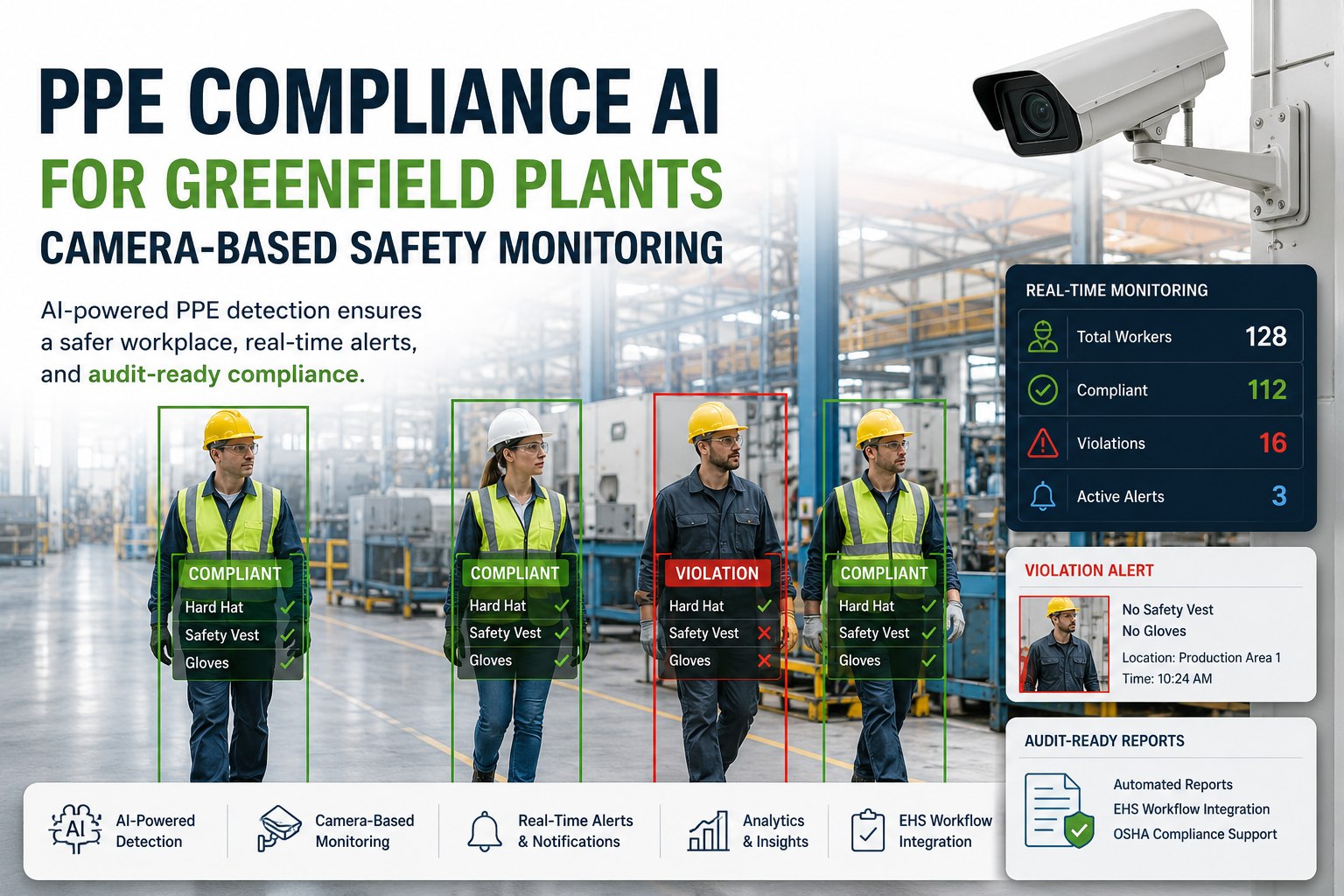
PPE compliance monitoring failed at OSHA's most-cited level in 2025: 5,914 fall-protection citations, 1,665 eye-and-face violations, 2,470 respiratory failures. Penalties run $16,550 per standard violation and up to $165,514 for willful ones. No safety officer can watch every worker across every shift — and that gap is where injuries happen. AI PPE detection using existing CCTV feeds classifies missing hard hats, vests, gloves, goggles, and harnesses in real time, logging each violation as a tracked work order with visual evidence. Plants deploying AI safety monitoring record 79–86% violation reductions within 3 months. Book a PPE compliance consultation to map your hazard zones to camera coverage.

PPE Compliance AI · Greenfield Plant Safety Monitoring 2026
From Camera Capture to OSHA-Ready Log — The Real-Time Detection Workflow
01

Capture

Existing CCTV or IP cameras stream RTSP feeds to edge inference layer at the facility.

~30 fps per stream
02

Detect

AI vision identifies each worker and classifies presence/absence of every PPE category per person.

92–95% accuracy
03

Alert

Confirmed violations push supervisor notifications via Slack, Teams, or HMI within seconds.

<5 sec latency
04

Log

Each violation logged as tracked work order with timestamped video evidence for OSHA audit trail.

Audit-ready
86%Safety incident reduction at Piston Automotive within 3 months
5,914OSHA fall-protection citations in FY2025 — most cited
$165KMax OSHA penalty per willful violation
40%Of occupational injuries preventable with proper PPE use

The 6 PPE Categories AI Vision Detects in Real Time

Modern computer vision safety monitoring classifies six standard PPE categories per worker per frame. Each category maps to a specific OSHA standard and a distinct hazard profile. Advanced deployments extend to ten categories with respiratory, hearing, full-body, and face shield detection.

Hard Hats

Press lines · Overhead crane zones · Construction
OSHA 1910.135 · 36% of detection market

Hi-Vis Vests

Forklift aisles · Loading docks · Vehicle zones
ANSI/ISEA 107 · Worker-vehicle proximity

Gloves

Chemical handling · Hot work · Assembly
OSHA 1910.138 · Hand injury prevention

Safety Goggles

Welding bays · Grinding stations · Chemicals
OSHA 1910.133 · 1,665 citations FY2025

Fall Harness

Scaffolds · Roof edges · Elevated platforms
OSHA 1926.502 · 5,914 citations FY2025

Steel-Toe Footwear

Industrial floors · Material handling · Heavy work
OSHA 1910.136 · Foot impact protection

The OSHA Violation Cost Ladder — and What AI Vision Prevents

OSHA penalties compound rapidly across categories. A single uncovered hazard zone with one repeat willful violation can cost a plant more than the entire 12-month AI vision safety system deployment. The escalation ladder below shows what's at stake.

Tier 1
Other-than-Serious
$16,550
Per violation · Direct OSHA citation, no immediate physical harm
Tier 2
Serious Violation
$16,550
Per violation · Substantial probability of serious harm or death
Tier 3
Repeat Violation
$165,514
Per violation · Same standard cited within 5 years
Tier 4
Willful Violation
$165,514
Per violation · Intentional disregard of OSHA requirements
Tier 5
Workplace Fatality
$1M+
Civil liability + workers comp + criminal exposure + reputational damage

Want to model your specific OSHA exposure against the AI vision deployment cost? Book a PPE compliance consultation — we will produce the side-by-side ROI before any deployment.

Manual Walk-Throughs vs AI Vision: The Coverage Reality

A safety officer on routine rounds catches what they can see, when they can see it. AI ppe detection watches every checkpoint, every shift, every worker — automatically flagging a missing helmet, harness, or vest the moment it appears on camera.

Zone Coverage Per Shift
Manual
~30%
AI Vision
100%
3.3× coverage
Detection Latency
Manual
Hours to days
AI Vision
<5 sec
~1000× faster
Evidence Quality
Manual
Written log
AI Vision
Timestamped video
Audit-grade
Cost Per Shift
Manual
1–3 dedicated FTE
AI Vision
Pennies/hr
85% lower
Watch Every Checkpoint, Every Shift — Without Adding a Single Safety Officer
iFactory's PPE compliance consultation audits your existing camera coverage against hazard zones, designs the edge inference architecture, maps detection rules to OSHA standards, integrates with EHS workflow, and produces the 6 to 10 week phased deployment plan — all delivered before camera changes.

The 6-Point Greenfield Deployment Readiness Checklist

Before a single camera goes live, six prerequisites must clear. Greenfield plants designing PPE AI from day one have a structural advantage — every camera placement, every edge server, every workflow integration is purpose-built rather than retrofitted.

01

Hazard Zone Mapping

Every PPE-required zone identified with rule matrix — which categories required where, at what worker-machine proximity, during which operations.

02

Camera Coverage Audit

Existing CCTV mapped against hazard zones. Blind spots identified. New cameras specified only where coverage gaps exist — typically 10-20% of total cameras.

03

Edge Inference Server Spec

Jetson Orin NX or AGX sized to camera count and concurrent streams. One Orin NX handles up to 18 streams. AGX Orin handles 4K and 32+ streams.

04

Site-Specific Model Training

10 to 14 days of training on actual plant images. Models adapt to lighting conditions, dust haze, partial occlusion, and your specific PPE brands and colors.

05

EHS Workflow Integration

Violations route to Slack, Teams, or HMI in real time. Work orders auto-create in EHS platform. OSHA 300 log preparation streams in automatically.

06

Privacy & Union Alignment

Face blurring, no individual identification, non-punitive coaching framework. Union acceptance follows when footage is used for recognition, not discipline.

Expert Perspective: Why Greenfield Plants Lock in PPE AI From Day One

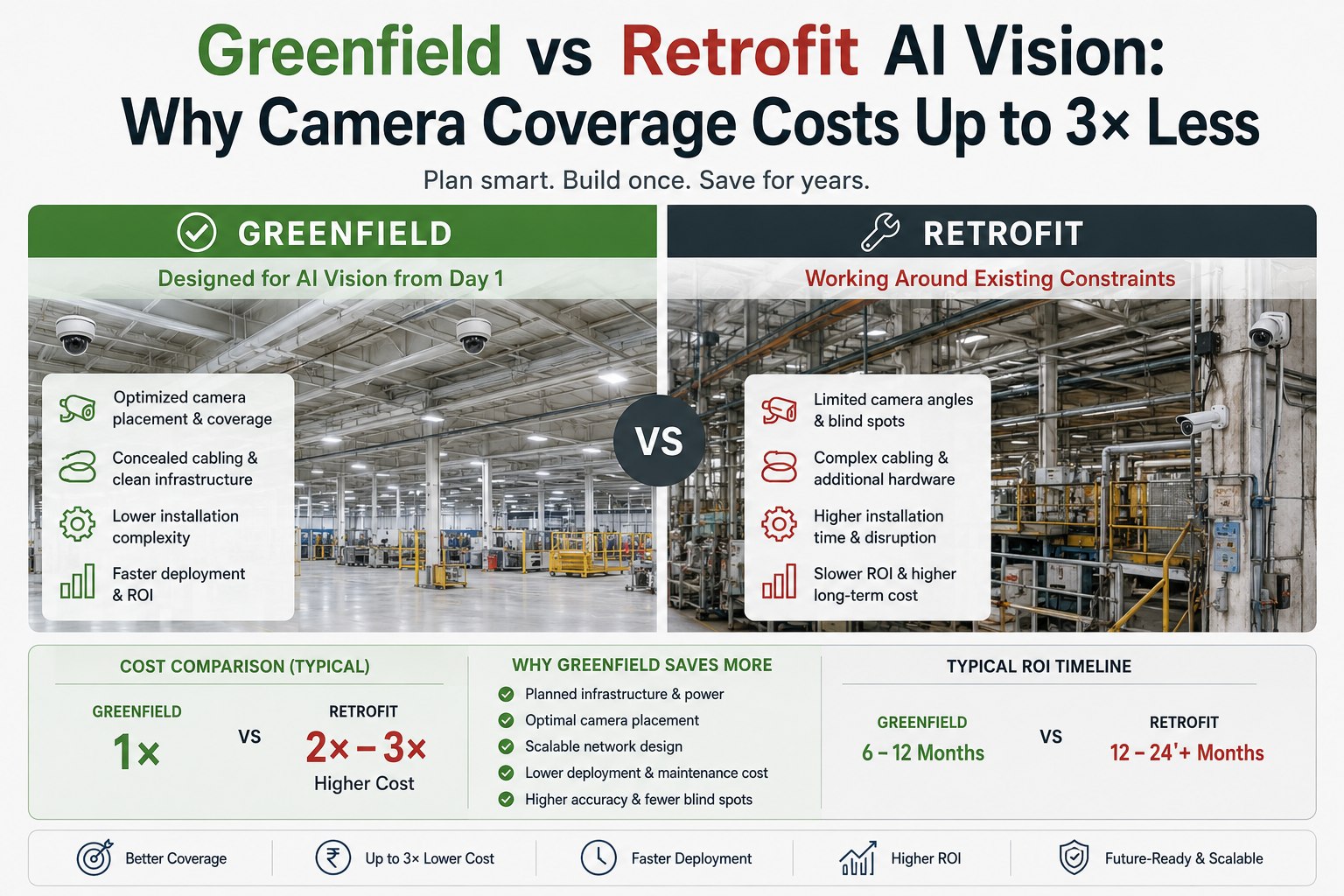
The plants achieving the largest PPE compliance gains are not the ones with the most cameras — they are the ones treating PPE AI as a workflow integration, not a surveillance system. Piston Automotive landed an 86% safety incident reduction in 3 months. NSG Group's Malaysian plant hit 79% reduction in pedestrian zone violations in the same window. The common factor is not camera count. It is that detection routes into supervisor coaching, work orders, and OSHA documentation — not into HR discipline files. Greenfield plants have a structural advantage. Camera placement, edge server location, network architecture, and EHS integration can all be designed in from day one rather than retrofitted onto a CCTV system designed for security. The cost differential is significant — purpose-built PPE AI infrastructure runs 30 to 40% less than retrofit deployments.

— iFactory Greenfield Consulting, Safety AI Practice 2025 to 2026
79–86%
PPE violation reduction within 3 months of deployment
30–40%
Cost advantage of greenfield vs retrofit PPE AI
6–10 wk
Typical greenfield deployment timeline

Ready to design PPE AI into the greenfield plant from day one? Talk to our safety AI team — we will produce the deployment plan before camera infrastructure is finalised.
Cut PPE Violations 79–86% in 3 Months — Without Adding Safety Officers
iFactory's greenfield PPE consultation maps hazard zones to camera coverage, designs the edge inference architecture, trains site-specific detection models, integrates with EHS workflow and OSHA reporting, and produces the 6 to 10 week phased deployment plan — all delivered before camera infrastructure is locked.

Frequently Asked Questions

How accurate is AI PPE detection in real factory conditions?

Production deployments achieve 92 to 95% detection accuracy across all six standard PPE categories after 10 to 14 days of site-specific model training on images from your actual facility. Accuracy holds in dust haze, high-contrast lighting, and partial occlusion scenarios when models are trained on plant-specific conditions. Occlusion avoidance technology further reduces false positives by suppressing alerts when body parts are not visible.

What PPE categories can AI vision detect?

Modern AI PPE detection systems classify six standard categories simultaneously: hard hats, high-visibility vests, gloves, safety goggles, fall protection harnesses, and protective footwear. Advanced deployments add respiratory masks, hearing protection, full-body suits, and face shields for a total of ten categories. Each category routes to its own rule set per hazard zone.

Do we need to install new cameras for PPE compliance AI?

No, most deployments leverage existing CCTV infrastructure. AI vision inference runs on edge servers connected to existing camera feeds via standard RTSP streams. New cameras are typically only needed for uncovered hazard zones or when existing cameras lack sufficient resolution for reliable detection — usually 10 to 20% of total cameras in a typical retrofit, or zero in greenfield designs.

How does AI PPE monitoring integrate with EHS and OSHA reporting?

Each detected violation creates a tracked work order with timestamped video evidence, location, and PPE category. Records integrate with EHS platforms via API and feed directly into OSHA 300 log preparation. Audit-ready reports show compliance trends, violation hotspots, and corrective action closure rates — meaningfully stronger evidence than written walk-through logs during OSHA inspections.

How does iFactory's PPE compliance consultation actually work?

iFactory audits your camera coverage against hazard zones, identifies blind spots, designs the edge inference architecture, maps PPE detection rules to OSHA standards, integrates with EHS workflow, and produces the 6 to 10 week phased deployment plan. All delivered before camera infrastructure changes begin. Book your PPE compliance consultation here.

Share This Story, Choose Your Platform!